
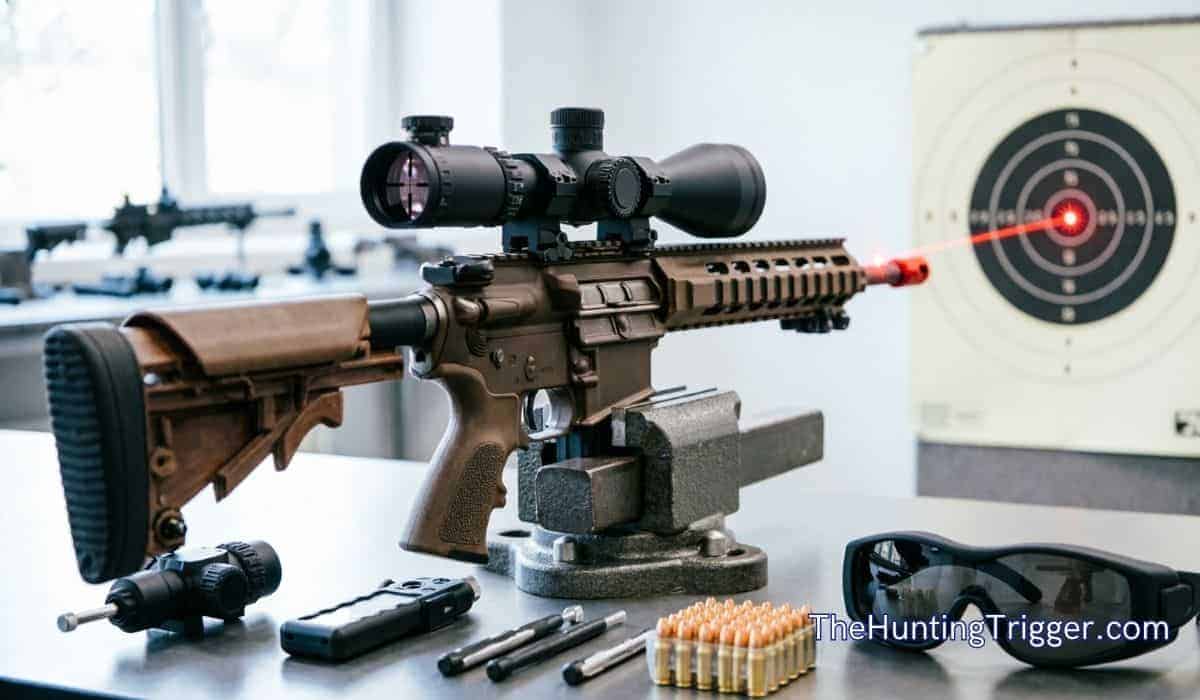
Using a laser boresighter is a practical way to save time and ammunition when zeroing your firearm. Many shooters, from beginners to experienced hunters, want their rifles, shotguns, or handguns to be accurate before heading to the range. But sighting in can be frustrating if your shots are far from the target. A laser boresighter helps you adjust your sights or scope so you’re closer to the bullseye right from your first shot. This article explains how a laser boresighter works, the types available, how to use one correctly, and tips for best results.
Table of Contents
What Is A Laser Boresighter?
A laser boresighter is a device that projects a laser beam from the barrel of your firearm. The laser shows the point where your barrel is aiming. By matching your scope or sights to the laser’s dot, you get a starting point for sighting in.
There are two main types:
- Cartridge laser boresighter: Fits in the chamber like a real cartridge.
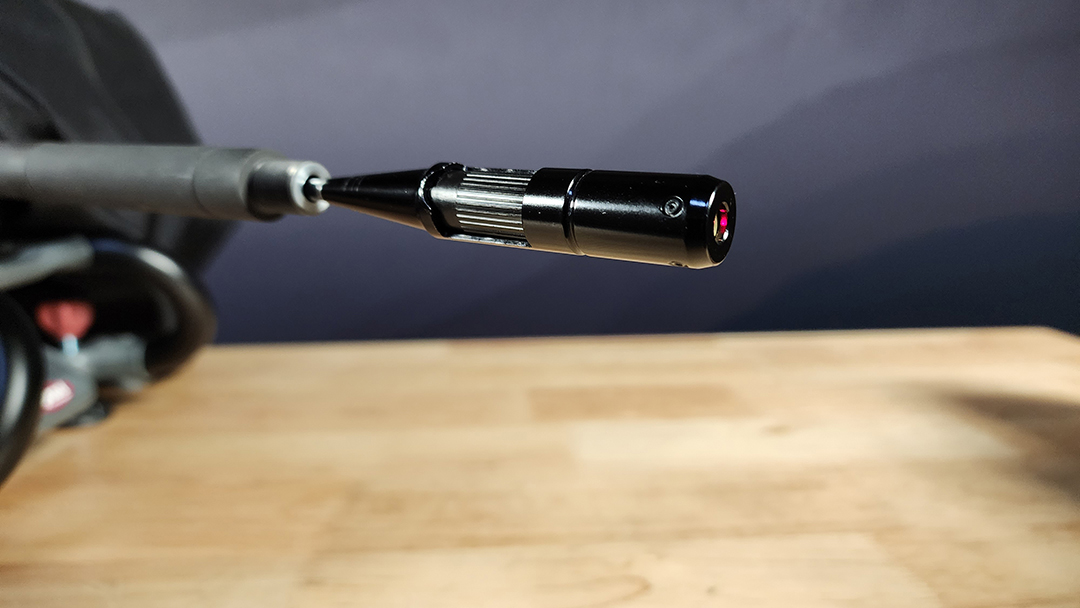
- End-of-barrel boresighter: Inserts into the muzzle.
Both types are popular, but each has advantages for different users.
Types Of Laser Boresighters
Different firearms and personal preferences mean you’ll find several laser boresighter designs. This table compares the main types:
| Type | Fits | Ease of Use | Accuracy | Cost |
|---|---|---|---|---|
| Cartridge | Chamber | Easy | High | Moderate |
| End-of-Barrel | Muzzle | Moderate | Good | Low |
| Universal | Multiple calibers | Moderate | Varies | Varies |
- Cartridge boresighters are precise but limited to one caliber.
- End-of-barrel boresighters work for many calibers but may not fit as tightly.
- Universal boresighters include adapters for different calibers, making them versatile.
Benefits Of Using A Laser Boresighter
Using a laser boresighter offers several clear advantages:
- Saves ammunition: You won’t waste rounds trying to find the target.
- Speeds up sighting in: Faster than traditional bore sighting.
- Reduces frustration: No guessing where your first shot will land.
- Safer: Keeps your firearm pointed in a controlled direction.
- Cost-effective: You avoid the expense of extra ammunition.
Many shooters miss that boresighting doesn’t fully zero your firearm. It gets you close, but you’ll still need to fine-tune at the range.
How A Laser Boresighter Works
A laser boresighter projects a visible red or green laser dot onto a distant target. The device aligns with the barrel, so the dot marks the barrel’s centerline. When you adjust your scope or iron sights to match the dot, you’re aligning your sights with where the barrel is pointing.
Red lasers are more common and cheaper. Green lasers are brighter and easier to see in daylight but cost more.
Most boresighters use batteries. Always check battery life before using it, as weak batteries can cause dim or unstable laser dots.

Setting Up: What You Need
Before you begin, gather the following:
- Laser boresighter (correct type for your firearm)
- Target (preferably with a clear center)
- Stable surface (bench or table)
- Gun cleaning supplies (optional, for safety)
- Scope adjustment tools (if needed)
- Batteries (if not included)
Choose a location with good lighting and enough space to aim safely at your target. Avoid areas where the laser could hit reflective surfaces, as this can cause confusion.
Using A Laser Boresighter: Practical Steps
Follow these main steps to use a laser boresighter effectively:
1. Safety First
- Unload your firearm. Double-check the chamber and magazine.
- Point the muzzle in a safe direction.
- Remove any ammunition from the workspace.
2. Insert The Boresighter
- For cartridge types: Slide the boresighter into the chamber as you would a regular round.
- For end-of-barrel types: Insert into the muzzle and secure it. Some models use o-rings for a snug fit.
3. Turn On The Laser
- Activate the laser. Some models have a button or switch.
- Aim the firearm at the target (usually 25 yards for rifles, 10 yards for handguns).
4. Adjust Your Sights Or Scope
- Look through your scope or sights.
- Move the reticle or sight alignment so it matches the laser dot on the target. Use windage and elevation knobs for scopes.
5. Remove The Boresighter
- Turn off the laser.
- Remove the boresighter from the firearm.
- Double-check that no parts are left inside the barrel or chamber.
6. Test At The Range
- Take a few shots to check your initial zero.
- Make small adjustments as needed.
Many shooters skip the final fine-tuning step, but it’s essential for accuracy. The laser boresighter gives you a solid start, but real-world factors like bullet drop and wind can affect your shots.

Common Mistakes And How To Avoid Them
Even with a laser boresighter, some errors can affect your results:
- Not securing the boresighter tightly: A loose fit can cause the laser to wobble.
- Using the wrong caliber adapter: Universal boresighters need the correct adapter for each caliber.
- Skipping the safety check: Always make sure the firearm is unloaded.
- Adjusting sights before confirming laser position: Check the laser dot’s stability and brightness first.
- Ignoring parallax: If your scope has parallax adjustment, set it for the distance you’re boresighting.
- Not removing the boresighter before firing: Firing with the boresighter in place can damage your firearm and the device.
One extra insight: If your scope has an illuminated reticle, turn it off or use a low brightness setting. High brightness can make it harder to see the laser dot.
Tips For Accurate Boresighting
For the best results, consider these tips:
- Use a solid rest: A gun vise or sandbags help keep the firearm steady.
- Aim at a simple target: Grid targets make it easier to match the laser dot and reticle.
- Check ambient light: Dim lighting makes the laser dot easier to see.
- Set your scope at the lowest magnification: This can help with initial alignment.
- Clean the barrel: Residue can affect the boresighter’s fit and the laser’s path.
Some shooters use a 25-yard target for rifles and a 10-yard target for handguns. This gives a practical starting point, but always finish zeroing at your preferred shooting distance.
Comparing Laser Boresighters To Other Methods
Laser boresighters are not the only way to align your sights. Here’s how they compare to traditional methods:
| Method | Speed | Accuracy | Cost | Skill Needed |
|---|---|---|---|---|
| Laser Boresighter | Fast | Good (preliminary) | Moderate | Low |
| Manual Bore Sighting | Slow | Good (preliminary) | Low | Moderate |
| Range Zeroing Only | Slowest | Best (final) | High (ammo cost) | Moderate |
Laser boresighters offer the best balance for most shooters. Manual bore sighting means looking down the barrel and aligning sights by eye. Range zeroing is always needed for final accuracy, but it’s slower and uses more ammunition.
Choosing The Right Laser Boresighter
When buying a laser boresighter, focus on these factors:
- Caliber compatibility: Cartridge types fit only one caliber, while universal types cover more.
- Laser visibility: Green lasers are easier to see in daylight.
- Build quality: Metal bodies are more durable than plastic.
- Battery life: Check if replacement batteries are easy to find.
- Ease of use: Consider how simple it is to insert and activate.
Many new buyers overlook battery type. Some boresighters use uncommon batteries, which can be hard to replace. Choose a model with standard batteries if possible.
Maintenance And Storage
Proper care extends the life of your laser boresighter:
- Clean after use: Wipe the device and any adapters.
- Remove batteries: Prevent leakage by removing batteries during storage.
- Store in a dry place: Moisture can damage electronics.
- Check for damage: Inspect for cracks or loose parts before each use.
If you plan to use your boresighter often, keep batteries and adapters together in a small case.
Real-world Example: Sighting In A Hunting Rifle
A hunter has a new .308 Winchester rifle and a scope. He uses a cartridge laser boresighter for .308. After inserting the boresighter and aiming at a 25-yard target, he adjusts his scope so the crosshairs match the laser dot. At the range, his first shot lands within 3 inches of the bullseye. He makes minor scope adjustments to finish zeroing. The process saves him about 10 rounds of ammunition and reduces setup time by half.
Data: Ammunition Savings
Here’s an estimate comparing the number of rounds used with and without a laser boresighter:
| Method | Average Rounds Used |
|---|---|
| Laser Boresighter + Range | 5-10 |
| Range Zeroing Only | 15-25 |
Using a laser boresighter can cut ammo costs by 50% or more, especially with expensive hunting cartridges.
When Not To Use A Laser Boresighter?
Laser boresighters are helpful, but there are times to avoid them:
- Damaged barrels: If your barrel is bent or damaged, the laser won’t show true alignment.
- Loose adapters: Poor fitting adapters can mislead your adjustments.
- After major scope changes: If you switch mounts or scope height, re-boresight before shooting.
Some shooters rely only on the laser and skip range zeroing. This is a mistake, as real-world conditions affect accuracy.
Frequently Asked Questions
How Accurate Is A Laser Boresighter?
A laser boresighter gets you within a few inches of the bullseye at short distances. It’s not perfect, but it saves time and ammunition. Always finish zeroing at the range.
Can I Use A Laser Boresighter For Both Rifles And Handguns?
Yes, but you need the correct model or adapters. Some universal boresighters cover multiple calibers, while cartridge types fit only one.
Is It Safe To Use A Laser Boresighter Indoors?
Yes, as long as you follow basic firearm safety. Always unload the firearm, point it in a safe direction, and avoid aiming the laser at people or reflective surfaces.
How Long Does A Laser Boresighter Last?
With proper care, a quality boresighter can last many years. Battery life depends on use, but most models will run for several hours on one set.
Last Word
Using a laser boresighter is a smart move for anyone who values efficiency and accuracy. Whether you’re sighting in a hunting rifle, a tactical carbine, or a target pistol, this device helps you get on target faster. Remember that it’s only a starting point—final adjustments at the range are always necessary.
With the right approach, you’ll save time, money, and frustration, making your shooting experience more enjoyable and productive.

Leave a Reply