Setting a scope with boresight is a crucial skill for shooters who want accuracy and confidence in their equipment. Whether you use rifles for hunting, target shooting, or tactical purposes, aligning your scope properly makes a noticeable difference. Many people skip boresighting because they think it is unnecessary, but this simple process saves time, money, and ammunition at the range.
This guide will help you get your scope set with boresight, covering practical steps, common mistakes, and useful tips that even many experienced shooters miss. The advice here is designed for those new to the process, as well as anyone who wants to improve their technique.
Table of Contents
What Is Boresighting?
Boresighting is the process of aligning your rifle’s scope with the barrel before you fire live rounds. It helps you get your shots closer to the target so you spend less time and ammunition making final adjustments. There are two main ways to boresight: using a manual method (by looking down the barrel) or using a boresight tool (laser or optical device).
Types Of Boresight Tools
| Boresight Tool | How It Works | Best For |
|---|---|---|
| Laser Boresighter | Projects a laser beam from the barrel | Quick alignment, modern rifles |
| Optical Boresighter | Uses a lens and grid to match scope to barrel | Traditional rifles, bolt-action |
| Manual (Eyeball) | Removes bolt, looks down barrel | Budget, basic rifles |
Laser boresighters are more popular today because they are fast and easy to use. However, manual boresighting is still effective, especially for bolt-action rifles.
Why Boresighting Matters
Many shooters think they can skip boresighting and just sight in at the range. This is possible, but it leads to wasted ammunition and frustration. Boresighting puts your scope’s reticle near the point where the barrel is aimed, so your first shots are much closer to the bullseye.
This saves money and makes the zeroing process faster.
A study published by the National Shooting Sports Foundation found that boresighting reduces the average number of rounds needed to zero a scope by 40%. This means less time spent adjusting and more time shooting accurately.
Preparing Your Rifle And Scope
Before you start boresighting, proper preparation is key. Missing these steps is one reason beginners struggle.
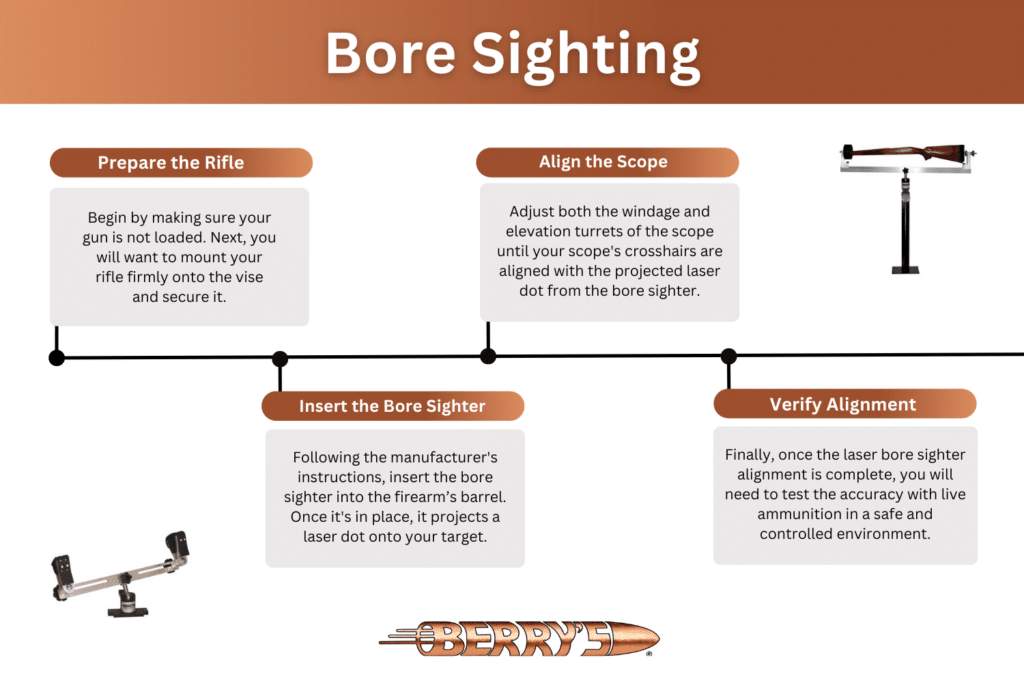
- Secure the rifle: Use a sturdy rest or gun vise to keep the rifle stable. Movement during boresighting leads to errors.
- Check the scope mounts: Tighten all screws and confirm the scope is properly installed. Loose mounts cause shifting and poor alignment.
- Clean the barrel: Dirt and debris can affect the boresighter’s accuracy.
- Set the scope to zero: Adjust windage and elevation turrets to their middle positions. This gives you maximum range for final adjustments.
Many people forget to set their scope to zero before boresighting. This mistake can limit your ability to adjust after boresighting.
Boresighting With A Laser Tool
Laser boresighters are simple and precise. Here’s how you can use one:
- Insert the laser boresighter: Place it into the chamber or muzzle, depending on the model.
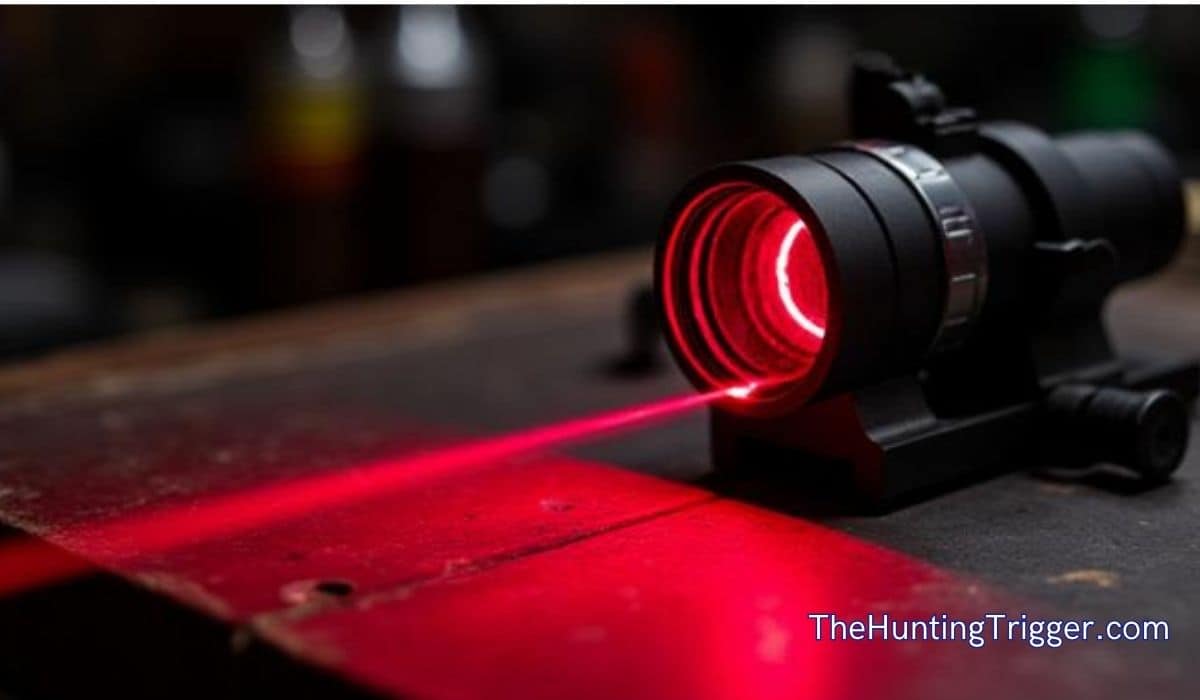
- Turn on the laser: The laser projects a dot onto your target.
- Place a target: Set a target 25 yards away. A plain sheet of paper works well.
- Adjust the scope: Look through the scope and use the windage and elevation turrets to move the reticle to the laser dot.
- Double-check alignment: Small movements can shift the alignment. Confirm everything is still tight and stable.
Laser boresighters work well in low-light conditions. However, strong sunlight can make the laser hard to see. If you struggle, try boresighting indoors or shade your target.
Boresighting Manually (eyeball Method)
Manual boresighting is a good option for bolt-action rifles. It requires patience and attention to detail.
- Remove the bolt: This lets you see straight down the barrel.
- Set up the rifle: Place the rifle in a stable rest.
- Look through the barrel: Aim the barrel at the center of your target (25 yards away).
- Adjust the scope: Without moving the rifle, look through the scope and adjust the reticle until it matches the barrel’s aim.
- Repeat as needed: Check alignment often to ensure nothing shifts.
This method takes longer, but it costs nothing and works with almost any rifle. Many shooters rush this process. Take your time for best results.
Using An Optical Boresighter
Optical boresighters use a lens and grid to help you match the scope’s aim to the barrel. Here’s how to use one:
- Attach the device: Fit the optical boresighter to the barrel.
- Look at the grid: The grid shows where the barrel points.
- Adjust the scope: Move the reticle to match the grid’s center.
- Remove the device: Once aligned, take the boresighter off.
Optical boresighters are less common now, but they offer clear visual feedback. They are great for older rifles or those with traditional scopes.

Common Mistakes And How To Avoid Them
Many shooters make errors during boresighting that affect accuracy. Here are the most frequent mistakes:
- Not securing the rifle: Even slight movement throws off alignment.
- Skipping scope zeroing: Failing to set turrets to the middle limits adjustments later.
- Ignoring barrel cleanliness: Dirt affects both manual and laser boresighting.
- Using incorrect distance: Boresighting at too short or long a range reduces accuracy. 25 yards is standard.
- Rushing adjustments: Fast, rough movements can misalign the scope.
Avoid these problems by following each step carefully and checking your work.
Final Zeroing After Boresighting
Boresighting gets you close, but you still need to finish sighting in with live ammunition. Here’s a basic process to finalize your zero:
- Fire a test shot: Shoot at the target from 25 yards.
- Check the point of impact: Compare where the bullet hits versus your aim.
- Adjust as needed: Use the scope turrets to move the reticle toward the bullet hole.
- Repeat at longer distances: Once you are on target at 25 yards, move to 50 or 100 yards and repeat.
It’s common for your first shot to be a few inches off after boresighting. This is normal. Boresighting brings you close, but real-world factors (barrel harmonics, ammunition, wind) require final adjustments.
Boresighting Different Rifles
Boresighting is not the same for every rifle. Here is a quick comparison of common rifle types:
| Rifle Type | Boresighting Method | Challenges |
|---|---|---|
| Bolt-action | Manual or Laser | Easy bolt removal, stable rest |
| Semi-auto | Laser | Cannot remove bolt, must use chamber laser |
| Lever-action | Laser | Limited access to barrel, need muzzle model |
| AR-15/Modern Sporting | Laser | Quick setup, some lasers fit directly in chamber |
Manual boresighting is best for bolt-action rifles. Laser boresighters are more practical for semi-autos and lever-actions.
Practical Tips For Better Boresighting
Some practical advice helps you get the most from boresighting.
- Use a consistent rest. A sandbag or gun vise is better than improvised supports.
- Mark your scope turrets. If you lose track of adjustments, marking helps you reset.
- Double-check mounting screws. Loose screws lead to poor accuracy.
- Start at 25 yards. This range is ideal for boresighting and initial zeroing.
- If your shots are not landing near the target after boresighting, check for barrel obstructions or mounting issues.
Many shooters overlook turret markings and mounting screws. These small details often cause big problems.
Boresighting For Different Optics
Scopes are not all the same. Boresighting methods may vary for different optics:
- Red dot sights: Laser boresighters work well, but you may need to adjust for parallax.
- Variable scopes: Always boresight at the lowest magnification setting.
- Fixed scopes: Use standard boresighting methods, but check for reticle shift.
If you use high-end optics, consult your scope’s manual for special instructions.
Safety Considerations
Safety is always important when working with firearms.
- Unload the rifle: Double-check that no ammunition is present.
- Point the barrel in a safe direction: Even during boresighting, keep safety first.
- Wear eye protection: Laser boresighters can reflect light unexpectedly.
- Check for barrel obstructions: After boresighting, ensure nothing is left in the barrel before shooting.
Neglecting safety is a common mistake, even among experienced shooters.
Data: Boresighting Efficiency
The benefits of boresighting are clear. Here is a comparison of ammunition usage:
| Method | Average Rounds Needed | Time to Zero |
|---|---|---|
| Boresighted | 5-8 | 10-15 minutes |
| No Boresighting | 12-18 | 25-40 minutes |
Boresighting saves time and ammunition. Over many rifles, this adds up to significant savings.

Frequently Asked Questions
How Accurate Is Boresighting?
Boresighting gets your shots close to the center, but it does not guarantee perfect accuracy. You will still need to fire live rounds and adjust your scope. Most shooters find their shots land within a few inches of the bullseye after boresighting.
Can I Boresight At Longer Distances?
25 yards is the standard distance for boresighting. Boresighting at longer ranges is possible, but small errors are harder to spot. It’s best to start at 25 yards and move to longer distances for final zeroing.
Do I Need A Laser Boresighter?
A laser boresighter makes the process faster and easier, but it is not required. Manual boresighting works well for bolt-action rifles. If you plan to boresight often, investing in a laser tool is a good idea.
Is Boresighting Safe?
Boresighting is safe if you follow basic firearm safety rules. Always unload the rifle, keep the barrel pointed in a safe direction, and wear eye protection when using lasers.
Why Are My Shots Still Far From The Bullseye After Boresighting?
Common causes include loose scope mounts, barrel obstructions, incorrect turret settings, or dirty barrels. Double-check each step and ensure your rifle is stable. If problems continue, check your scope for defects or seek help from a professional.
Last Word
Setting your scope with boresight is one of the best ways to start shooting accurately. It reduces frustration, saves money, and helps you get the most from your equipment. With careful preparation and attention to detail, you will quickly see the benefits.
Remember, boresighting is only the first step—final zeroing with live ammunition completes the process. By avoiding common mistakes and using the right tools, you build confidence in your gear and your shooting skills.

Leave a Reply