
For hunters and wildlife enthusiasts, the term ‘150 inch 150 class whitetail deer’ represents the pinnacle of trophy bucks. This coveted designation refers to a whitetail buck whose antlers have been officially scored at 150 points or higher using recognized systems like Boone and Crockett.


It signifies an animal of exceptional maturity and genetic potential, possessing a truly impressive and rare rack. Achieving or even encountering such a magnificent deer is a goal for many, driven by a deep understanding of whitetail biology, antler development, and effective habitat management.
This article explores the significance of this benchmark, how it’s measured, and the crucial factors contributing to its development.
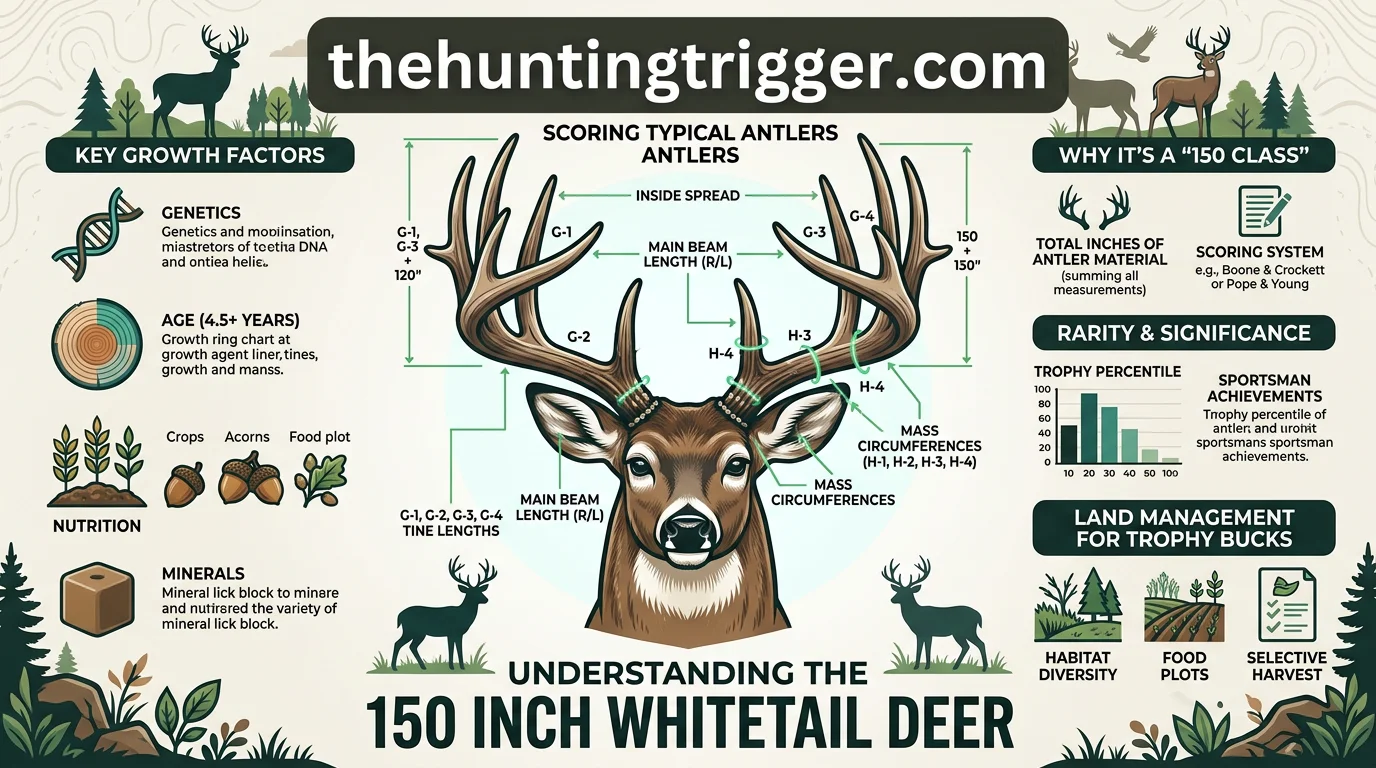
What is a 150-Inch Whitetail Deer? Understanding the Trophy Class
Defining the ‘150 Class’ in Whitetail Hunting
When hunters refer to a ‘150-inch whitetail deer,’ they are specifically talking about the animal’s antler score, calculated using a standardized measurement system. This figure quantifies the size and symmetry of the rack, not the deer’s body weight or height.

The term ‘150 class’ is a widely recognized colloquialism in hunting circles, signifying a whitetail buck whose antlers achieve this notable score. For most hunters, a buck reaching this benchmark represents a truly exceptional trophy, embodying years of growth and development.

Achieving a 150-inch score indicates a mature animal with superior genetics and access to quality nutrition and habitat. It showcases a buck that has survived for multiple years, allowing its antlers to reach their full potential and impressive dimensions.
The Role of Official Scoring Organizations
The standardization of antler measurement is primarily managed by key organizations, most notably Boone and Crockett (B&C) for firearms-taken trophies and Pope and Young (P&Y) for archery-taken trophies. These groups provide the official scoring methodologies that hunters rely on.
These organizations provide the recognized scoring methodologies and certify scores based on precise measurements of various antler characteristics. Therefore, achieving a 150-inch score means the buck’s antlers have met stringent criteria within these respected official systems, confirming its trophy status.
Decoding the 150-Inch Whitetail Deer Antler Scoring System
The Boone and Crockett (B&C) and Pope and Young (P&Y) scoring systems are the standard for classifying trophy whitetail deer, providing a comprehensive framework to measure antler growth and symmetry.
Key Antler Measurements for a High Score
A 150-inch score sums several key measurements: Main Beam Lengths (outside curve), Tine Lengths (G-points like G1, G2, from main beam to tip), and Inside Spread Credit (widest distance between beams, added once). Circumference Measurements (H-points, four per beam) also contribute.
For example, a 150-inch gross score might comprise 44″ from two main beams (22″ each), 64″ from eight tines (8″ avg), an 18″ inside spread, and 24″ from eight circumference measurements (3″ avg). These elements sum to 150 inches.
Gross vs. Net Score: Understanding the Deductions
The Gross Score is the raw total of all antler measurements, reflecting total antler material. The Net Score subtracts points for asymmetry between corresponding measurements on each beam.
If a G2 tine is 9 inches on one side and 7 inches on the other, 2 inches are deducted. A 150-inch net score signifies both substantial antler growth and impressive symmetry.
The Role of Abnormal Points
Abnormal points are antler projections deviating from the typical rack structure, such as drop tines. Their treatment differs based on typical or non-typical scoring.
For typical scoring, abnormal points are measured and deducted from the gross score. In non-typical scoring, these same points are measured and added to the gross score, celebrating unique and irregular antler formations.
Key Factors for a 150-Inch Whitetail Deer: Age, Genetics, and Habitat
The Critical Role of Age in Antler Development
Age is arguably the most significant determinant of a whitetail buck’s antler size. Bucks must reach physical maturity to allocate sufficient resources towards developing large racks. Younger bucks, typically 1.5 to 3.5 years old, are still primarily focused on body growth and may not display their full antler potential.
Peak antler development for most whitetail bucks occurs between 4.5 and 6.5 years of age. During this period, their bodies have fully matured, allowing them to channel maximum energy and nutrients into antler growth, which can lead to the impressive dimensions required for a 150-inch score.
Unlocking Genetic Potential for Trophy Racks
While age provides the opportunity, genetics dictate the inherent potential for antler growth. A buck’s genetic makeup determines traits such as beam circumference, tine length, number of points, and overall antler symmetry. These inherited characteristics establish the blueprint for what a buck’s antlers can ultimately become.
Even with optimal age and nutrition, a buck without superior genetics is unlikely to grow a 150-inch rack. Effective deer management strategies often focus on fostering healthy populations with strong genetic lineages, allowing bucks with desirable antler traits to breed and pass on those genes.
Optimizing Habitat and Nutrition for Growth
A high-quality habitat provides the essential food, water, and cover necessary for deer to thrive and reach their full potential. Nutrition plays a direct and critical role in antler development, as antlers are rapidly growing bone structures that require significant amounts of protein, minerals, and energy.
Diets rich in protein (over 16% is ideal), calcium, and phosphorus are crucial for maximizing antler mass and length. This can be achieved through diverse natural forage, well-managed food plots, or mineral supplements. Without adequate nutrition, even genetically superior, mature bucks cannot express their full antler potential for a 150-inch score. Deer management practices are essential for ensuring these three factors align.
How Rare is a 150-Inch Whitetail Deer? A Significant Trophy
The Rarity Factor of 150-Class Bucks
Harvesting a 150-inch whitetail buck represents a substantial achievement and a truly significant trophy for any hunter. This benchmark signifies a mature animal with impressive antler development, placing it well above the average deer encountered in most hunting territories.
The rarity of a 150-class buck cannot be overstated. In many regions, particularly on public lands, the odds of encountering, let alone harvesting, such an animal are remarkably low, often less than 1-2% for a given season. This scarcity contributes significantly to its coveted status.
Even in well-managed private properties with quality genetics and abundant forage, the pursuit of a 150-inch buck remains a considerable challenge. It demands extensive scouting, precise hunting strategies, and often, years of dedicated effort, reinforcing its value as a personal triumph.
Comparing Trophy Whitetails: 150 vs. Smaller and Larger Bucks
Compared to smaller animals, a 150-inch buck clearly outranks the commonly harvested 100-120 inch deer. While a 100-120 inch rack is respectable, the leap to 150 inches signifies a truly mature buck, demonstrating superior age and genetic potential that few deer achieve.
Conversely, while bucks scoring 170 inches or more are in an even more exclusive category, the 150-class still embodies a profound level of rarity. It serves as an accessible yet highly challenging goal, making it the ultimate aspiration for the vast majority of whitetail hunters.
Typical vs. Non-Typical 150-Inch Whitetail Deer Racks
Understanding Typical Antler Growth and Scoring
The distinction between “typical” and “non-typical” is crucial when discussing 150-inch whitetail deer racks.
A typical antler configuration is characterized by its symmetry and uniform growth pattern.
Points generally grow directly off the main beams in an organized, matching fashion.
Scoring systems for typical racks, like Boone and Crockett, emphasize this symmetry.
They look for exact matches between corresponding points on each antler. Any significant differences in length, circumference,
or placement between opposing points result in deductions from the gross score.
A classic example of a high-scoring typical rack would be a clean 8-point (4 points per side) or 10-point (5 points per side)
with long, symmetrical tines and thick main beams. Its elegance lies in its perfect balance and uniformity.
Characteristics of a Non-Typical 150-Class Whitetail
Conversely, non-typical antlers display characteristics that deviate from this symmetrical ideal.
They often feature abnormal points, also known as “non-typical points,” which grow in unusual directions or locations.
Significant asymmetry between the left and right antlers also defines a non-typical rack.
These unique formations can include drop tines that point downwards, kickers (short points off the base or other tines),
or extra points growing directly from the main beam in irregular spots. A non-typical rack often has a more rugged,
“gnarly” appearance compared to a typical.
It is important to understand that a 150-inch buck can fall into either category. A majestic non-typical with multiple
abnormalities can easily reach or exceed the 150-inch benchmark, just like a perfectly symmetrical typical.
Scoring Differences for Irregular Antler Configurations
The scoring methodology fundamentally changes between typical and non-typical racks.
For non-typical scores, abnormal points are measured and added to the overall gross score, contributing positively
to the final tally. This is a key difference from typical scoring, where asymmetry results in deductions.
Therefore, a non-typical 150-inch buck might have a lower “typical frame” score but gain significant inches
from its unique abnormal points. This direct addition of irregular features allows non-typical racks to achieve high scores.
This distinction highlights a critical pitfall: assuming all 150-inch bucks look alike.
One 150-inch buck might present as a sleek, symmetrical 10-point, while another could be a heavily gnarled
non-typical with impressive mass and drop tines, both equally valued in their respective categories.
Strategies for Managing Land to Grow 150-Inch Whitetail Bucks
Implementing Effective Age Structure Management
Achieving 150-inch class whitetails primarily relies on allowing bucks to reach sufficient age. This often means implementing Quality Deer Management (QDM) principles, where hunters commit to passing on young bucks, typically 1.5 to 3.5 years old, to allow them to mature.
The goal is to shift the herd’s age structure, ensuring a higher proportion of older bucks (4.5 years and older) in the population. These older deer have the biological potential to develop larger antlers. Focus harvesting efforts on does and older, mature bucks that may have already peaked.
Enhancing Habitat for Optimal Antler Growth
A superior habitat provides the necessary nutrition, cover, and water for bucks to express their full antler potential. Food plots are a common tool, but they should supplement, not replace, natural forage. Recommended food plot crops include protein-rich clover and alfalfa, and energy-dense brassicas, oats, or winter wheat for fall and winter.
Beyond food, dense cover is critical for security and thermal regulation. Create or enhance bedding areas through hinge-cutting timber, allowing natural brushy regeneration, or planting evergreen screens. Year-round water sources are also essential, especially during dry periods or in arid regions, supporting overall deer health and antler development.
Considering Genetics in Your Deer Management Plan
While you cannot directly alter the genetics of a wild deer herd as with livestock, you can indirectly influence it through herd management. By consistently allowing bucks with superior antler potential (which is a combination of genetics, age, and nutrition) to mature and breed, you can incrementally improve the herd’s genetic predisposition for larger antlers.
A healthy doe-to-buck ratio is also important, ensuring that breeding is not overly strenuous on younger bucks and that all does are bred efficiently. Focus harvest on older does to maintain population balance and health. Remember, a buck’s antler growth is a complex interplay of age, nutrition, and genetics, and managing all three synergistically offers the best chance for trophy potential.
Avoiding Common Misconceptions About 150-Inch Whitetail Bucks
The pursuit of a 150-inch whitetail buck often comes with several misunderstandings, particularly concerning scoring and what truly defines this trophy class. Correcting these common pitfalls is crucial for hunters, managers, and enthusiasts alike to accurately assess and appreciate these magnificent animals. Understanding the nuances ensures a more informed perspective.
Antler Score vs. Body Size: A Crucial Distinction
One prevalent misconception is that a buck’s antler score directly correlates with its body weight or overall size. This is not the case. The 150-inch measurement refers exclusively to the antlers, quantified through specific scoring methods. A buck can have a massive body but carry a relatively small rack, or conversely, a buck with a slight frame might boast an exceptionally large set of antlers.
For instance, a younger, smaller-bodied buck in a nutrition-rich environment could potentially grow a 150-inch rack, while an older, heavier-bodied deer from a genetically inferior or food-scarce area might never achieve that antler score. The antler score is a measure of bone growth, not biomass.
Gross vs. Net Score: Why It Matters for a 150-Inch Buck
Understanding the difference between gross and net antler scores is vital, especially when discussing a “150-inch class” buck. The gross score is the total sum of all antler measurements—main beam length, tine lengths, and circumferences—without any deductions. The net score, however, subtracts points for asymmetry between corresponding antlers.
A buck might easily gross over 150 inches but drop significantly below that benchmark once deductions for uneven tines or beam lengths are applied, thus failing to meet official record book requirements for a net 150-inch typical score. The term “150 class” is often used generally, sometimes referring to gross score, but official certifications prioritize the net score for typical racks.
Beyond Inside Spread: Recognizing All Scoring Components
Many assume that a wide inside spread is the primary driver for a high antler score, but this is another common misconception. While spread contributes to the total, it’s just one of many components. A buck with a narrow inside spread can still score incredibly high if it possesses exceptional main beam length, long tines (G-points), and impressive circumferences (H-measurements).
All scoring elements work together to create the final number. Focusing solely on spread overlooks the significant contributions of main beam length, the number and length of tines, and the mass of the antlers, which are often more critical in reaching or exceeding the 150-inch mark.
Key Takeaways
-
✓
A 150-inch whitetail refers to the antler score, indicating a trophy-class buck. -
✓
Boone & Crockett (B&C) and Pope & Young (P&Y) are standard scoring systems for antlers. -
✓
Optimal antler growth to 150 inches relies heavily on age, genetics, and nutrition. -
✓
Achieving a 150-inch buck is rare, representing a significant hunting and management accomplishment. -
✓
Effective land management and Quality Deer Management (QDM) are crucial for growing trophy bucks.
❓ Frequently Asked Questions
1
What is a 150-inch whitetail deer?
A 150-inch whitetail deer refers to a buck whose antlers officially score 150 or more points using systems like Boone & Crockett or Pope & Young. This score signifies a trophy-class animal, indicating superior genetics, age, and optimal habitat conditions contributing to exceptional antler development.
2
How are whitetail deer antlers scored to reach 150 inches?
Antler scoring involves measuring various dimensions: main beam length, circumference at specific points, and length of individual tines. Deductions for asymmetry (differences between sides) are applied for net scores. The sum of these measurements provides the total gross score, aiming for 150 inches.
3
What factors contribute to a deer growing 150-inch antlers?
The primary factors are age, genetics, and nutrition. Bucks typically reach their antler potential between 4.5 to 7.5 years old. Good genetics pass on the potential, while abundant, high-quality forage rich in protein and minerals fuels maximum antler growth.
4
Why is a 150-inch whitetail considered a significant trophy?
A 150-inch whitetail is a significant trophy due to its rarity and the combination of biological and environmental factors required for such development. It represents a mature, healthy animal that has thrived, often reflecting successful habitat management or a hunter’s dedicated pursuit and patience.
5
How can land be managed to produce 150-inch bucks?
Managing for 150-inch bucks involves Quality Deer Management. This includes providing year-round high-quality nutrition (food plots, natural forage), maintaining adequate cover, reducing hunting pressure on younger bucks to allow them to age, and balancing the herd’s sex ratio.
6
How is a 150-inch whitetail buck officially scored?
It’s scored by measuring main beam length, tine lengths (G-points), inside spread credit, and circumference measurements (H-points) using standardized systems from organizations like Boone and Crockett or Pope and Young. The sum of these measurements, with deductions for asymmetry in typical racks, determines the final score.


Leave a Reply