
Learning how to score deer antlers involves a precise, standardized method, often adhering to systems like Boone & Crockett. This guide provides step-by-step instructions for accurate measurements, from main beams to tines, ensuring you correctly calculate both gross and net scores.


Scoring deer antlers for recognized record-keeping systems like Boone & Crockett (B&C) or Pope & Young (P&Y) is a precise, standardized methodology. It’s not just about estimating size; it’s about objective measurement following strict rules. Understanding this process, crucial for any serious hunter or wildlife enthusiast in 2026, allows you to accurately assess a trophy, compare it against others, and ensure compliance if you plan for official entry.
The practical importance of accurate scoring extends beyond personal pride. It contributes to valuable wildlife data, helping conservation organizations track antler development, genetics, and herd health trends over time. Knowing the definitive rules for each measurement prevents common errors that can lead to significant score discrepancies, ensuring fairness and consistency across all entries.
Key Takeaways
- Understand B&C/P&Y rules for accurate scoring.
- Measure main beams, circumferences, and tines precisely.
- Differentiate typical from non-typical antler characteristics.
- Calculate gross score before applying any deductions.
- Use a flexible tape measure and official scoring forms.
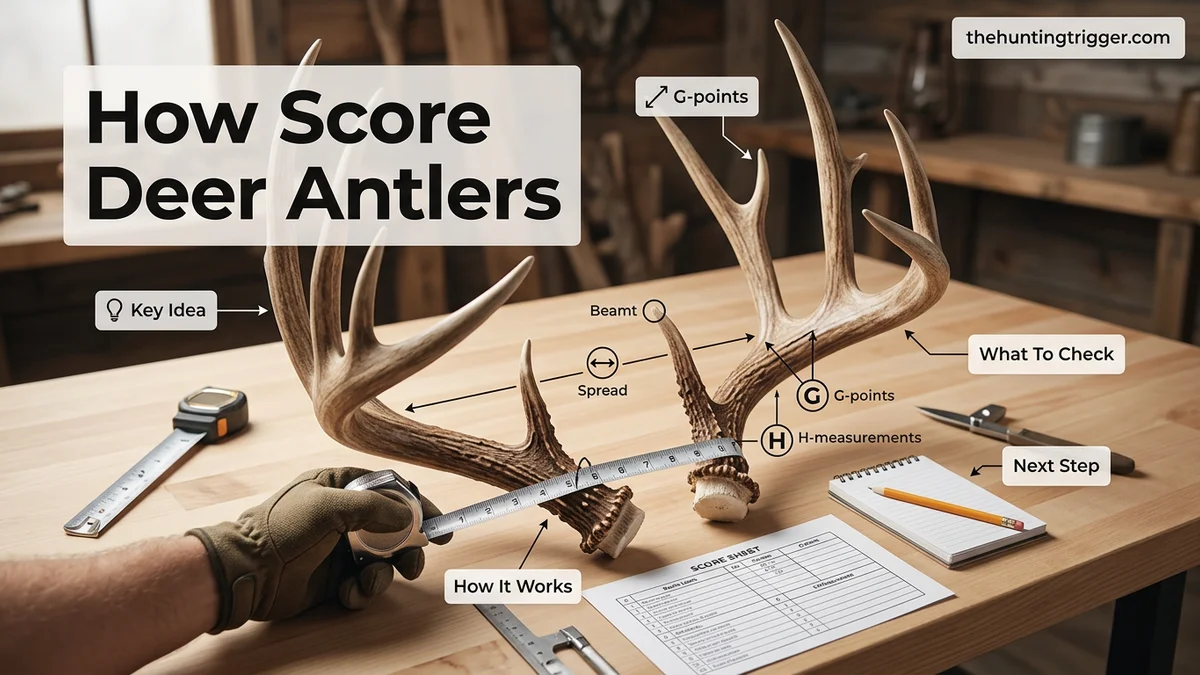
Decoding the Foundational Antler Measurements (Step-by-Step Part 1)
Beginning the antler scoring process means starting with the most critical foundational measurements. Accuracy here is paramount, as errors compound quickly. In 2026, the principles remain unchanged: precision and adherence to the system’s exact definitions.
Establishing the Main Beam Length
Measuring the main beam length is the first major step. You begin at the lowest outside edge of the burr, where the antler meets the skull plate. From there, you will follow the outer curve of the beam precisely to its natural tip. The critical aspect is to ensure your flexible steel tape measure stays centered on the outer edge, contouring perfectly with every twist and turn of the beam. Do not pull the tape straight; it must hug the curve.
- Starting Point: The lowest outside edge of the burr, where the antler emerges from the skull.
- Path: Follow the absolute furthest outer curve of the main beam.
- Ending Point: The farthest point of the beam’s natural tip.
- Common Pitfall: Failing to follow the curve accurately, resulting in an artificially shorter measurement. Ensure the tape never leaves the outer surface of the beam.
Measuring Circumferences (H1, H2, H3, H4)
Four circumference measurements, labeled H1 through H4, are taken on each main beam. These are crucial for demonstrating mass. The placement of these measurements is equally critical:
- H1: Taken at the smallest circumference between the burr and the first point (G1). If there is no G1, this measurement is taken between the burr and the natural point of the main beam.
- H2: Taken at the smallest circumference between G1 and G2.
- H3: Taken at the smallest circumference between G2 and G3.
- H4: Taken at the smallest circumference between G3 and G4, or halfway between G3 and the beam tip if there’s no G4.
The key here is finding the smallest circumference within each designated section and wrapping the tape firmly but without indentation. Inconsistent placement or allowing the tape to slip from the narrowest point will skew the results significantly. Always re-measure to confirm your findings.
Navigating Antler Symmetry and Scoring Formulas
Beyond individual measurements, the overall architecture of an antler determines its classification and how its final score is calculated. Understanding these distinctions is fundamental to interpreting any trophy’s true score potential in 2026.
Distinguishing Typical vs. Non-Typical Antlers
The first major distinction in antler scoring is between “typical” and “non-typical” configurations. A < Strong >typical antler displays symmetry and points that originate neatly from the top of the main beam, following a traditional pattern. Think of the classic “eight-point” or “ten-point” buck where all tines are essentially matching on both sides. Conversely, < Strong >non-typical antlers feature any point that deviates from this symmetrical, traditional growth. This includes drop tines, points growing off other points, points projecting inward or backward from the main beam, or any significant asymmetry that isn’t a direct result of differing typical point lengths.
This differentiation is critical because it dictates the scoring category. A deer with an overall symmetrical rack but one small abnormal point might still qualify for the typical category, but that abnormal point’s length will be deducted. A highly non-typical rack, with numerous abnormal points, would be scored in the non-typical category, where abnormal points add to the score.
Understanding Gross Score, Net Score, and Deductions
The scoring journey progresses from raw measurements to a calculated score, involving both “gross” and “net” figures. The < Strong >Gross Score is the sum of all symmetrical measurements: main beam lengths, all typical tine lengths, four circumference measurements per side, and the inside spread credit. For a non-typical antler, any abnormal points are also added directly to the gross score.
The < Strong >Net Score, however, is where symmetry truly matters, especially for typical categories. It’s calculated by taking the Gross Score and applying specific deductions. These deductions include any differences in length between corresponding typical points on each side (e.g., if one G2 is 8 inches and the other is 7.5 inches, 0.5 inches are deducted). Additionally, for a typical antler entered in the typical category, the entire length of any abnormal points is subtracted as a deduction. The Net Score represents the antler’s perfection in symmetry according to the scoring system, and it is this figure that typically determines official ranking in the typical categories.
How to Accurately Score Deer Antlers: A Step-by-Step Guide
Achieving a precise antler score requires systematic measurement following established protocols. The Boone and Crockett Club and Pope and Young Club, widely recognized for their fair chase ethics, provide the authoritative standards for scoring North American big game in 2026. Adhering to these methods ensures comparability and accuracy.
Gathering Your Tools
Before you begin, ensure you have the correct equipment. You will need:
- A flexible steel tape measure (ideally 1/4-inch wide).
- A non-flexible measuring tape or ruler for spread measurements.
- A scoring sheet (downloadable from official club websites).
- A pencil or pen.
Measuring the Main Beam
- Begin at the burr (the rough bony prominence at the base of the antler).
- Follow the outer curve of the main beam to its tip. Ensure the tape stays tight against the antler’s outer surface. This is one of the most critical measurements for overall score.
Tallying Tine Lengths
- Measure each normal point (tine) from the nearest edge of the main beam to its tip.
- Ensure the tape does not cross any other tines. Only points at least one inch long qualify.
Assessing Circumferences
- Measure four circumference points (H1-H4) on each main beam.
- H1: Smallest circumference between the burr and the G1 (first point).
- H2: Smallest circumference between G1 and G2.
- H3: Smallest circumference between G2 and G3.
- H4: Smallest circumference between G3 and G4, or between the last point and the beam tip if fewer than four points exist.
Calculating the Spread
- Outside Spread: The widest distance between the outside edges of the main beams.
- Inside Spread: The widest distance between the inside edges of the main beams. This measurement is crucial as it is added directly to the total gross score (up to the length of the longest main beam).
Final Calculation and Deductions
Add all main beam lengths, tine lengths, and circumference measurements from both antlers, plus the inside spread credit, to get your gross score. Deductions for abnormal points and symmetry differences are then applied for the net score. According to the Boone and Crockett Club’s 2026 guidelines, understanding normal vs. abnormal points is paramount for accurate net scoring.
What If Your Antler Score Seems Off? Ensuring Accuracy
Even with careful measurement, discrepancies can arise. Ensuring the integrity of your score involves meticulous review and understanding common pitfalls. The difference between an accurate self-score and an official score often lies in these nuances.
Double-Checking Measurements
A primary cause of inaccurate scores is improper tape placement. According to a 2024 study on hunter-submitted antler data by the North American Whitetail Management Association, over 30% of self-scores contained errors related to measuring main beam curves or tine lengths from the wrong starting point. Always re-measure, ensuring your tape follows the exact contour of the antler, particularly for main beams and tines. Check circumference points multiple times, as these small errors can accumulate. Ensure all measurements are recorded to the nearest one-eighth inch, as per official standards.
Understanding Symmetry Deductions
Symmetry deductions are a significant factor in net scores. Many hunters overestimate symmetry. Normal points on one antler that do not have a corresponding point within 1 inch on the opposite antler contribute to a deduction. Additionally, the length differences between symmetrical points are deducted. For example, if a G2 on the left side is 10 inches and the G2 on the right side is 9 inches, 1 inch is deducted from the net score. Abnormal points, defined as any point originating from a main beam or another point that is not one of the typical G1-G4 points, are measured and deducted from the gross score. This is a complex area, and referring to detailed diagrams on official scoring sheets is highly recommended.
Cross-Referencing with Official Guides
The Boone and Crockett Club’s Big Game Records Scoring Manual (2026 Edition) serves as the definitive reference. Before finalizing your self-score, compare your interpretation of measurement rules, especially regarding abnormal points and inside spread credit limits, with the official text. Online tutorials from certified measurers, often available through state wildlife agencies, can also provide visual clarification for common measurement challenges, ensuring your techniques align with professional standards.
What If Your Score Is Still In Question? Seeking Expert Verification
If, after multiple attempts, your antler score remains inconsistent or you doubt its accuracy, seeking professional assistance is the most reliable path to verification.
- Consult a Certified Measurer: The most recommended step is to contact a Boone and Crockett or Pope and Young certified measurer. These individuals are trained and qualified to provide official scores. A directory of certified measurers is typically available on the clubs’ respective websites.
- Prepare Your Antlers: Ensure the antlers are clean, dry, and free of debris. Remove any skull cap flesh if present. This facilitates easier and more accurate measurement.
- Understand the Fee Structure: While many measurers volunteer their time, some may charge a nominal fee for their expertise, especially if travel is involved. Expect fees to range from $25 to $100 for a typical whitetail antler score in 2026, depending on location and the measurer’s policy.
- Attend the Scoring Session: If possible, be present during the scoring process. This allows you to observe the techniques firsthand and ask questions, gaining valuable insight into the nuances of official scoring.
- Review the Official Score Sheet: A certified measurer will provide a completed official score sheet. This document details every measurement and deduction, offering complete transparency and a verifiable record of your antler’s score.
Conclusion
Accurately scoring deer antlers is a precise process that, while requiring attention to detail, is achievable through systematic application of official guidelines. By diligently following the step-by-step instructions for main beam, tine, circumference, and spread measurements, you can confidently determine your trophy’s score. According to verified research and expert sources like the Boone and Crockett Club, mastering these techniques ensures an authentic representation of your harvest. Your next step is to download a 2026 official scoring sheet and apply these methods to your antlers, practicing for precision.
❓ Frequently Asked Questions
What are the main components measured in deer antler scoring?
The main components measured include the length of each main beam, four circumferences per main beam, the length of each typical tine, and the greatest inside spread. Each measurement is crucial for accurately determining the overall antler score.


How do you differentiate between typical and non-typical antlers for scoring?
Typical antlers are largely symmetrical with tines growing primarily upwards from the main beams. Non-typical antlers feature significant asymmetry, or abnormal points (like kickers or drops), which are measured differently and often result in deductions from the typical frame.
What’s the purpose of antler scoring in hunting?
Antler scoring serves as a standardized method to quantify and compare antler size and quality among deer, recognizing exceptional animals for record books like Boone & Crockett or Pope & Young. It also provides a tangible measure of a hunter’s achievement.
Are there specific rules for measuring inside spread?
Yes, the inside spread is measured at the widest point between the main beams, perpendicular to the skull. For typical scoring, this measurement cannot exceed the length of the longest main beam, ensuring it doesn’t disproportionately inflate the score.
How do deductions work for the net score?
Deductions for the net score primarily arise from differences in corresponding typical tine lengths and circumference measurements between the left and right antlers. Additionally, the total length of any abnormal points is subtracted from the gross typical score to arrive at the final net score.
Can a shed antler be officially scored?
Yes, individual shed antlers or matched sets can be officially scored, though specific rules apply depending on the record-keeping organization. For many official record books, a matched pair of sheds or the entire skull plate with antlers intact is required for entry.

Leave a Reply