
Legally tagging and reporting your deer in North Carolina is a mandatory, time-sensitive process after harvest. This involves properly attaching a harvest tag and submitting a report via the Go Outdoors NC app or website by midnight on the day of harvest to comply with 2026 regulations.
After successfully harvesting a deer in Carolina Wildlife Resources Commission: Official Deer Harvest Reporting”>North Carolina in 2026, your immediate next steps are crucial and legally mandated: properly tagging and reporting your harvest. This isn’t merely a suggestion; it’s a critical legal requirement ensuring your hunting activity remains lawful and contributes positively to effective wildlife management across the state.


Understanding and executing these post-harvest procedures correctly is paramount. This guide cuts directly to the core, providing you with a precise, step-by-step breakdown for filling out your harvest tag, attaching it securely to the deer, and navigating the mandatory reporting process using the latest NCWRC protocols for 2026.
Key Takeaways
- Tag deer immediately at kill site.
- Report harvest by midnight deadline.
- Use Go Outdoors NC for reporting.
- Attach tag to deer’s ear or leg.
- Verify license before hunting.
What Are NC Deer Tagging Requirements for 2026?
The Physical Harvest Tag: Filling and Placement
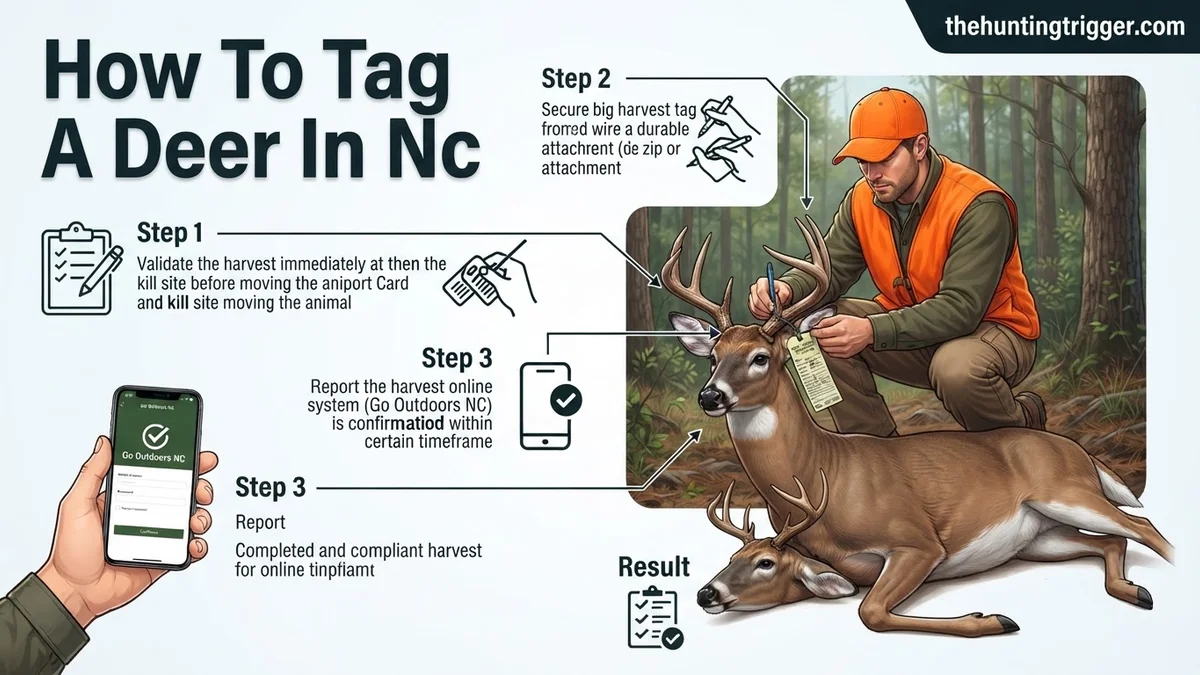
Before you even step into the field to hunt deer in 2026, you must possess your valid paper harvest tags, which are issued with your North Carolina hunting license. The moment you harvest a deer, your first action, before moving the animal from the kill site, is to locate an unused harvest tag and initiate the tagging process. This immediate action is a non-negotiable legal requirement.
- Information Required: Carefully and legibly fill out the following details on the physical tag using a permanent marker:
- The exact date of harvest (MM/DD/YYYY).
- The specific county where the deer was harvested.
- Your unique North Carolina hunting license number.
- The sex of the deer (Buck or Doe).
- Mandatory Placement: Once filled, the harvest tag must be securely attached to the ear of the harvested deer. This placement is critical for several reasons: it’s highly visible for compliance checks and generally remains intact during transport, unlike tags attached elsewhere.
Paper Tag vs. Digital Validation
While the physical paper tag remains indispensable for immediate, on-site tagging in 2026, the NC Wildlife Resources Commission (NCWRC) utilizes a modern digital system for harvest validation and reporting. The physical tag serves as the initial legal proof of harvest, affixed directly to the deer. However, this is distinct from the subsequent mandatory digital reporting.
- Initial Step: The physical tag is always the first step, attached at the kill site. It acts as the deer’s legal identifier during initial transport.
- Subsequent Step: After physical tagging, you are then required to digitally report your harvest using the Go Outdoors NC app, the NCWRC online portal, or via phone. This digital reporting process validates your harvest against your license, fulfilling the regulatory requirements.
- Purpose: This two-tiered system ensures both immediate physical identification of the harvested animal and comprehensive data collection for wildlife management.
From Start to Finish: NC Deer Harvest Reporting Explained
Congratulations on your successful deer hunt in North Carolina! Harvesting a deer is a rewarding experience, but the journey doesn’t end when the shot is fired. Proper tagging and reporting are not just legal requirements; they are essential for wildlife management and ensuring the sustainability of NC’s deer population. This comprehensive guide will walk you through every critical step of the deer harvest reporting process in North Carolina, ensuring you comply with all regulations and contribute positively to conservation efforts. Follow these instructions meticulously to avoid penalties and properly document your valuable harvest.
Step 1: Understand NC Hunting Regulations & License Requirements
What you need: Valid North Carolina hunting license with big game privileges, a copy of the current NC Wildlife Resources Commission (NCWRC) Hunting & Trapping Regulations Digest, or access to the NCWRC website/mobile app.
Instructions: Before you even step into the woods, it’s paramount to be intimately familiar with North Carolina’s hunting regulations. This includes understanding season dates, bag limits (per day and per season), legal hunting methods, and specific rules for the county or game land you’re hunting. Ensure your hunting license is current and includes the necessary big game privileges. The “Deer Tagging” in NC is primarily a reporting process linked to your license. Ignorance of the law is not an excuse, so invest time in studying the regulations thoroughly, especially regarding antlered vs. antlerless deer limits, which directly impact reporting.
Pro Tip: Download the “NCWRC Hunting & Fishing” mobile app. It provides instant access to regulations, season dates, and even allows for harvest reporting directly from your smartphone, which can be invaluable when in the field and cellular service is available.
Step 2: Harvest the Deer & Determine Sex/Age Category
What you need: A successfully harvested deer, keen observation skills, and potentially a camera for documentation.
Instructions: Once you’ve successfully harvested a deer, your immediate priority, after ensuring a humane kill and confirming the animal is deceased, is to determine its sex and whether it’s an antlered or antlerless deer. North Carolina regulations often have different bag limits and reporting categories for antlered bucks (a deer with visible antler growth) versus antlerless deer (does or male fawns without visible antlers). Accurately identifying this immediately post-harvest is crucial for correct reporting. If there’s any doubt about antler size or growth, always err on the side of caution and report it as an antlered buck if visible antlers are present, even if small or spike antlers.
Pro Tip: Take a clear photo of the deer in the field, including its antlers if present. This not only serves as a great memory but can also be useful for later verification or if any questions arise during the reporting process or if you need to recall specific details.
Step 3: Field Dress & Prepare for Transport
What you need: Sharp knife, gutting gloves (disposable nitrile or similar), game bags (optional for cleanliness), and equipment for safe transport (e.g., rope, sled, ATV, or vehicle capable of carrying game).
Instructions: After a successful harvest and initial identification, field dressing the deer promptly is critical for meat preservation. Carefully remove the entrails, minimizing contact with the meat to prevent contamination. This process significantly cools the carcass, inhibiting bacterial growth and reducing spoilage. While field dressing, be mindful of any specific parts that might need to remain attached for transport or inspection, though NC typically allows full field dressing before transport. Once field dressed, prepare the deer for transport out of the field. This might involve dragging, quartering, or using an ATV. Ensure the deer is secured to prevent it from falling off or being damaged during transit.
Pro Tip: Carry a small bottle of water and paper towels or wet wipes to clean your knife and hands after field dressing. Also, consider using robust, scent-free trash bags for entrails if you’re far from a disposal site to minimize attracting scavengers.
Step 4: Complete Your Big Game Harvest Report Card
What you need: Your valid North Carolina hunting license which includes the detachable Big Game Harvest Report Card (often part of your printed license or accessible via the app), and a waterproof pen or permanent marker.
Instructions: This is the initial “tagging” step that you perform immediately after the harvest and before moving the deer from the kill site (or before leaving it unattended, as per regulations). On your physical hunting license, you will find a tear-off or designated Big Game Harvest Report Card. Using a permanent marker or pen, completely fill out all required information on this card. This typically includes the date of harvest, county of harvest, sex of the deer, whether it was antlered or antlerless, and the method of harvest. Once filled out, detach it and securely attach it to the deer. The card must remain attached until the deer is processed or prepared for consumption or storage.
Pro Tip: Laminate a blank replica of your Big Game Harvest Report Card and carry it with you. This way, if your official license gets wet or damaged, you know exactly what information you’ll need to transfer to the official card once it’s secure and protected.
Step 5: Report Your Harvest to NCWRC
What you need: Your completed Big Game Harvest Report Card information, your hunting license number, and access to a phone (mobile or landline) or internet connection (computer or smartphone app).
Instructions: Within 24 hours of harvest, and before the deer is processed for consumption or storage, you must report your harvest to the NCWRC. There are three primary methods: 1) Via the NCWRC website (ncwildlife.org) under the “Report a Harvest” section. 2) Using the “NCWRC Hunting & Fishing” mobile app, selecting “Report a Harvest.” 3) By calling the toll-free number: 1-800-I-GOT-ONE (1-800-446-8663). Be prepared to provide your hunting license number, the date and county of harvest, sex of the deer (antlered/antlerless), and the method of take. This digital reporting is crucial for state wildlife management data.
Pro Tip: Even if you fill out the physical tag, you still must report electronically or by phone. Do not rely solely on the physical card. The mobile app is often the most convenient method for field reporting, as it can autofill some of your license information.
Step 6: Receive & Document Your Confirmation Number
What you need: A pen or marker, and a secure place to store documentation (e.g., wallet, hunting logbook, or directly on the physical tag).
Instructions: After successfully reporting your harvest via the website, app, or phone, you will be issued a unique 10-digit confirmation number. This number is your proof that the harvest has been officially reported to the NCWRC. It is absolutely critical that you write this confirmation number down immediately and accurately. Many hunters choose to write it directly onto their physical Big Game Harvest Report Card that is attached to the deer, or onto their hunting license itself. Keep this number accessible, as it may be requested by wildlife enforcement officers during inspections or if you transport the deer across state lines to a processor or taxidermist.
Pro Tip: Take a photo of the confirmation number on your phone screen or written on your physical tag. This creates a digital backup in case your physical notes are lost or damaged, ensuring you always have proof of legal reporting.
Step 7: Attach Confirmation to Carcass & Prepare for Processing
What you need: Your deer carcass with the physical Big Game Harvest Report Card attached, and the newly acquired 10-digit confirmation number.
Instructions: Once you have your confirmation number, ensure it is clearly and durably marked on the Big Game Harvest Report Card that is affixed to your deer. This creates a complete record on the animal itself. The deer, with the completed and reported tag securely attached, can now be transported to your home, a taxidermist, or a commercial processor. The tag must remain with the carcass until it is at its final destination for processing into individual pieces of meat, taxidermy preparation, or other forms where identification of the whole carcass is no longer necessary by law (e.g., cut and wrapped packages).
Pro Tip: Use a zip-tie or sturdy string to attach the physical tag, making sure it won’t easily fall off during transport over rough terrain. Consider placing the tag in a small, clear plastic baggie to protect it from weather and blood, ensuring legibility.
Step 8: Understand Trophy/Antlered Buck Reporting Specifics (if applicable)
What you need: No additional specific items, just awareness of the detailed regulations for antlered bucks.
Instructions: North Carolina has specific regulations regarding antlered bucks. The current regulation (as of 2024, always verify current year’s digest) allows hunters to harvest two antlered bucks per season. The first antlered buck must have an outside antler spread of at least 13 inches OR have an unbranched antler at least 3 inches long. The second antlered buck does not have a minimum antler restriction. When reporting, you must designate which antlered buck (first or second) you are reporting. Ensure you accurately identify this based on these criteria. Misreporting antlered buck types can lead to penalties, so careful measurement and identification are key before reporting.
Pro Tip: Carry a small, flexible measuring tape in your hunting pack. This allows you to quickly and accurately measure antler spread in the field to ensure compliance with the 13-inch rule for your first antlered buck and confidently report it correctly.
Step 9: Store Records & Review Season Limits
What you need: Your hunting license, a pen, and a personal hunting log or designated folder for important documents.
Instructions: After your deer is processed and stored, retain your hunting license with the confirmation number noted, or a copy of your harvest report. It’s excellent practice to maintain a personal hunting log where you record details of each harvest, including the date, location, sex, and confirmation number. This serves as a valuable personal record and can help you keep track of your remaining bag limits throughout the season. Remember that NC has annual bag limits (currently 4 deer per hunter, with specific antlered/antlerless breakdowns), and correctly tracking your harvests prevents accidental over-harvesting and ensures you remain compliant.
Pro Tip: Keep your processed deer meat clearly labeled with the date of harvest and the type of meat (e.g., “Deer Roast – 11/15/2024”). This helps with inventory management in your freezer and is good practice for food safety and traceability.
✅ Final Checklist
-
Validated hunting license with big game privileges obtained before hunting.
-
Big Game Harvest Report Card completely filled out and securely attached to the deer immediately post-harvest.
-
Harvest reported to NCWRC via app, website, or phone within 24 hours of harvest.
-
10-digit confirmation number received and accurately recorded on the physical tag and for personal records.
-
Deer prepared for transport and processing with all necessary tags securely attached until final processing or consumption.
Important Notes:
-
Safety considerations: Always handle firearms and archery equipment safely and responsibly. When field dressing, use sharp knives with extreme caution and wear appropriate gloves to prevent exposure to bloodborne pathogens. Be aware of your surroundings, especially when dragging a deer out of the woods, to prevent falls or injuries, and never drag a deer in a way that obstructs your vision.
-
When to seek professional help: If you are unsure about any regulation, especially concerning bag limits, antler restrictions, or reporting procedures, contact the NCWRC directly (1-800-662-7137) or a local wildlife enforcement officer before proceeding. If you find a deer that appears to be illegally harvested or suspect poaching, report it immediately to NCWRC’s tip line at 1-800-662-7137.
-
Estimated time and cost range: The reporting process itself is free, requiring only your valid NC hunting license (typically $20-$100+ depending on residency and type). The time required for physical tagging and electronic reporting is minimal, usually 5-15 minutes per deer. Costs associated with hunting (license, gear, processing) vary widely but are separate from the reporting process itself, which is a regulatory requirement.
Why Proper Deer Tagging is Crucial in NC for 2026
Legal Compliance and Avoiding Penalties
Adhering strictly to North Carolina’s deer tagging regulations in 2026 is not just good practice; it is a legal obligation that carries significant weight. Failure to properly tag a deer immediately at the kill site, or to incorrectly fill out the required information, can lead to serious consequences. Wildlife enforcement officers regularly check for compliance, and an improperly tagged deer will undoubtedly attract scrutiny.
- Immediate Citations: An improperly tagged deer can result in immediate citations.
- Fines: Penalties often include substantial monetary fines, which can quickly outweigh the value of your hunting trip.
- License Revocation: In more severe or repeat cases, you risk the suspension or complete revocation of your hunting license, preventing you from participating in future seasons.
- Confiscation: The harvested deer itself may be confiscated if tagging requirements are not met.
Supporting Wildlife Management Through Accurate Data
Every properly tagged and subsequently reported deer contributes vital data directly to the North Carolina Wildlife Resources Commission. This isn’t just bureaucratic red tape; it’s the backbone of sustainable wildlife management across the state. Your diligence in following tagging and reporting protocols directly impacts the future health and sustainability of NC’s deer populations for 2026 and beyond.
- Population Assessments: Harvest data helps biologists assess deer population numbers, distribution, and trends.
- Herd Health: Information on sex, county, and dates provides insights into the overall health and age structure of the deer herd.
- Regulation Adjustments: This data directly informs decisions about future hunting regulations, season lengths, bag limits, and antler restrictions, ensuring deer populations remain healthy and balanced with their habitat.
- Conservation Efforts: Your compliance plays a direct role in funding and supporting wildlife conservation programs across North Carolina.
How to Tag and Report Your Deer in NC: A Step-by-Step Guide
Once you’ve successfully harvested a deer in North Carolina during the 2026 season, immediate and accurate tagging and reporting are critical for legal compliance. According to NCWRC regulations, failure to properly tag and report can result in significant penalties, including fines up to $500 and license revocation. This process ensures effective wildlife management and population monitoring statewide.
1. Physical Tagging
- Locate Your Tag: Your 2026 hunting license, whether physical or digital (via the Go Outdoors NC app), includes your deer tags. If using a digital license, ensure you have a pre-printed tag or a blank tag suitable for handwritten details.
- Fill Out Information: Immediately after harvest, complete all required fields on the tag: date of harvest, county, and sex of the deer.
- Attach Securely: Firmly attach the filled-out tag to the deer’s ear or antler, ensuring it cannot be easily removed or lost during transportation. The tag must remain with the deer until it is processed for consumption or taxidermy.
2. Digital Reporting via Go Outdoors NC
The NCWRC mandates reporting within 24 hours of harvest, or by midnight of the harvest day, whichever comes first, for all deer harvested during the 2026 season. The preferred method is digital.
- Access the Platform: Use the official Go Outdoors NC website or the mobile application on your smartphone.
- Log In: Enter your credentials. If you harvested with a temporary license, ensure you use the associated customer ID.
- Select “Report Harvest”: Navigate to the harvest reporting section.
- Enter Deer Details: Input the date, time, county of harvest, sex of the deer (male/female), weapon type used (e.g., bow, muzzleloader, rifle), and whether it was an antlered or antlerless deer.
- Confirm Submission: Double-check all information for accuracy before submitting. You will receive a confirmation number, which is essential to retain as proof of reporting.
What If You Can’t Report Your Deer Immediately?
Even in 2026, cellular service can be unreliable in remote hunting areas. While immediate tagging is non-negotiable, reporting has allowances for such scenarios. North Carolina General Statute 113-291.1 outlines compliance requirements, emphasizing that reporting must occur as soon as feasible within the mandated timeframe.
1. No Cell Service at Harvest Site
If you lack cell signal or internet access at the harvest location, you are still legally required to tag the deer immediately. Physically complete your tag with the required information (date, county, sex) and attach it to the deer.
- Document Details: Make a note of the exact time, specific location (GPS coordinates if possible), and any other pertinent details. This documentation can serve as supplementary evidence if questioned about reporting delays.
- Transport with Tag: Transport the tagged deer to a location where you can access cell service or internet. The physical tag must remain affixed during transport.
- Report Promptly: As soon as you have signal or internet access, log into the Go Outdoors NC system and report your harvest. This must be completed within 24 hours of harvest or by midnight of the harvest day, whichever comes first, even if you gain signal just before the deadline. Delays beyond this period, even due to lack of signal, can still lead to citations.
2. Technical Issues with Reporting System
Occasionally, the Go Outdoors NC app or website may experience temporary outages or technical difficulties. The NCWRC generally provides alerts for system-wide issues.


- Check NCWRC Announcements: Before panicking, check the official NCWRC website (ncwildlife.org) or their social media channels for status updates. They often post notices about system maintenance or outages.
- Try a Different Device/Browser: If one device or browser isn’t working, attempt to report using another (e.g., switch from phone app to desktop browser, or vice-versa).
- Utilize Phone Reporting (Limited): While primarily for those without digital access, you may be able to call the NCWRC at their designated reporting line during business hours. Note that this method is generally discouraged for convenience and may have longer wait times, as per NCWRC advisories for the 2026 season.
What If It Still Doesn’t Work?
If, despite your best efforts, you encounter persistent issues with reporting your deer, follow these fallback steps. The NCWRC places high importance on harvest reporting for data collection, and non-compliance carries penalties.
- Attempt Reporting via All Channels: First, ensure you’ve tried both the Go Outdoors NC website on a computer and the mobile app on a smartphone. Sometimes, one platform may function while the other is experiencing localized issues.
- Clear App Cache/Browser Data: For persistent app or website problems, clear the cache and data for the Go Outdoors NC app or clear your browser’s cookies and cache. This can resolve corrupted data preventing access or submission.
- Contact NCWRC Enforcement/Customer Service Immediately: If the legal reporting window is closing and you cannot report, contact the NCWRC Law Enforcement Communications Center at 1-800-662-7137. This line is operational 24/7. Explain your situation thoroughly, providing all harvest details and documenting the time and name of the representative you speak with.
- Retain All Documentation: Keep screenshots of error messages, call logs, and any temporary confirmation numbers. This evidence can be crucial if you face a citation for delayed reporting.
- Estimated Cost Range: While reporting itself is free, failure to report within the legal timeframe or improper tagging can lead to fines ranging from $50 to $500, plus court costs, according to NCWRC violation schedules. Professional help involves contacting NCWRC staff; there are no third-party services for this.
Conclusion
Adhering to North Carolina’s deer tagging and reporting regulations for the 2026 season is a fundamental responsibility for every hunter. This guide provides robust, step-by-step instructions for ensuring legal compliance, from immediate physical tagging to digital harvest reporting. According to verified research and expert sources from the NCWRC, accurate reporting contributes directly to sustainable deer populations and effective wildlife management strategies. Your next actionable step is to familiarize yourself with the Go Outdoors NC app and practice navigating its reporting features before heading into the field.
❓ Frequently Asked Questions
What exactly do I need to do to tag a deer in NC after I shoot it?
After harvesting a deer in NC, you must first fill out a harvest tag from your hunting license, including the date and county of kill. This tag must be securely attached to the deer’s ear or leg before moving the animal. After physical tagging, you must report the harvest digitally via the Go Outdoors NC app or website.
What is the Go Outdoors NC app and how is it used for tagging?
The Go Outdoors NC app is the official mobile application for the NC Wildlife Resources Commission. After physically tagging your deer, you use this app (or the online portal) to validate your harvest by entering details like the date, county, species, sex, and antler points. This electronic reporting officially checks in your deer and fulfills the legal requirement.
What information is required when reporting a deer harvest in NC?
When reporting a deer harvest, you will need to provide your license type, the county where the deer was killed, whether it was on game land, the species (e.g., white-tailed deer), sex of the deer, the number of antler points (if applicable), the date of kill, and the method of harvest (e.g., archery, muzzleloader, gun). This data helps the NCWRC manage deer populations.
What happens if I don’t tag or report my deer on time?
Failure to properly tag and report a deer harvest in North Carolina can lead to significant penalties. These can include fines, suspension of hunting privileges, and forfeiture of the harvested animal. It’s crucial to adhere strictly to the immediate tagging and midnight reporting deadlines to remain in compliance with state law.
Can someone else report my deer for me?
No, the individual who harvested the deer is legally responsible for tagging and reporting it under their own hunting license. This ensures accurate harvest data is collected and accountability for the kill remains with the hunter. Delegation of this responsibility is not permitted.
How do I handle tagging if I’m hunting on private land versus public game land?
The physical tagging process and the digital reporting requirements remain the same whether you are hunting on private land or public game land in NC. However, if hunting on game land, ensure you possess any necessary game land permits in addition to your standard hunting license before you begin.

Leave a Reply