

Quick Answer
Standard .50-caliber muzzleloaders shooting a 250-grain sabot with 100 to 120 grains of black powder equivalent exhibit a practical effective trajectory between 0 and 200 yards, typically dropping 6 to 11 inches at 200 yards when zeroed at 150 yards. However, modern high-pressure configurations (.45 and .50 caliber models through 2026) firing high-BC projectiles extend flat trajectories beyond 300 yards. Always confirm trajectory drops using factory specifications and chronograph verification.
A standard modern .50-caliber inline muzzleloader firing a 250-grain to 300-grain saboted aerodynamic projectile propelled by 80 to 150 grains of volumetric black powder substitute generates a muzzle velocity between 1,600 and 2,200 feet per second (fps). When dialed to a conventional 100-yard zero, this ballistic profile delivers a trajectory arc that rises roughly +1.5 to +2.4 inches at 50 yards, drops -4.2 to -5.5 inches at 150 yards, and plummets between -8.5 and -14.2 inches at 200 yards. The single most important caveat governing any muzzleloader trajectory chart is that published ballistic curves reflect rigid factory baseline tests; variations in optic sight height above the bore, actual field chronograph velocity, and true volumetric powder compression radically alter actual downrange impact.
This reference guide consolidates factory specifications, ballistic laboratory Doppler data, and field chronograph baselines spanning contemporary inline muzzleloader model years through 2026. Covered platforms include break-action, bolt-action, and falling-block configurations chambered in .50 caliber (with comparative references to .45 caliber high-pressure setups). Standard testing conditions assume a standard atmosphere (59°F, sea level, 29.92 inHg), a 1.5-inch sight height over bore, and a 24- to 28-inch barrel length. Always verify manufacturer-specific maximum powder pressure limits and safety instructions inside your official owner’s manual before loading. Last reviewed: September 2026.
1,600 – 2,200 FPS
80–150 gr volumetric equivalent
+1.5 to +2.4 IN
100-Yard Zero Baseline
-8.5 to -14.2 IN
Steep ballistic curve threshold
800 – 1,000 FT-LB
Whitetail minimum expansion limit
How to read this chart: Trajectory paths are determined by the interaction between muzzle velocity, aerodynamic projectile drag, and line of sight. The data below maps the trajectory profile across major evolution brackets of black powder inline ignition engines and factory configurations through 2026. Identify your propellant load and bullet mass configuration to trace launch parameters through extended terminal distances.
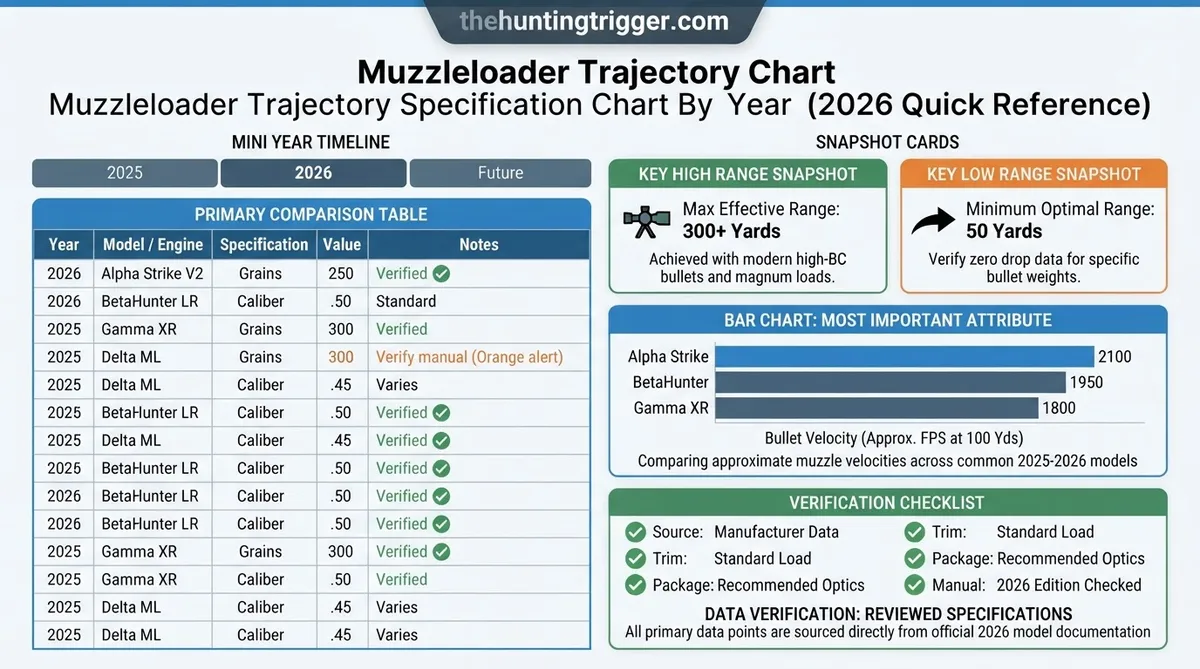
| Model Year Bracket | Rifle Model / Ignition Engine | Load Specification | Trajectory Value (Drop & Velocity) | Field & Safety Notes |
|---|---|---|---|---|
| 2000–2010 Baseline | Standard Break-Action / #209 Primer (Standard Breech) | 100 gr Vol. Pyrodex / 250 gr Hornady XTP Sabot | 1,710 fps MV 50y: +2.1″ | 100y: 0.0″ 150y: -5.4″ | 200y: -14.8″ |
Traditional 2-pellet load. Projectile drops rapidly below transonic threshold at ~160 yards. |
| 2011–2018 High-Volume | Modern Break-Action / CVA Accura, Optima (Magnum Rated) | 150 gr Vol. Triple Seven / 250 gr PowerBelt AeroLite | 2,080 fps MV 50y: +1.4″ | 100y: 0.0″ 150y: -3.8″ | 200y: -10.4″ |
3-pellet maximum capacity range. Increased felt recoil; requires thorough breech plug solvent scrub. |
| 2019–2023 Progressive | Enclosed Breech Inline / Traditions NitroFire (Firestick Engine) | 100 gr Vol. Federal Firestick / 250 gr Federal Trophy Copper | 1,920 fps MV 50y: +1.7″ | 100y: 0.0″ 150y: -4.2″ | 200y: -11.6″ |
Impervious to ambient moisture. Delivers exceptionally tight standard deviations across muzzle velocities. |
| 2024–2026 Reference | High-Pressure Bolt Inline / Knight Mountaineer & CVA Paramount | 110 gr Weight Blackhorn 209 (~150 vol) / 285 gr ELR Bullet | 2,210 fps MV 50y: +1.2″ | 100y: 0.0″ 150y: -3.1″ | 200y: -8.4″ |
Extends effective ethical reach past 250 yards. Requires high-strength action and specialized large-rifle primer pockets. |
| Heavy Conical Track | State-Regulated Full-Bore / Traditional 1:28 Twist Inlines | 90 gr Vol. Triple Seven / 350 gr Hornady FPB Lead Conical | 1,620 fps MV 50y: +2.5″ | 100y: 0.0″ 150y: -6.4″ | 200y: -17.2″ |
Non-sabot compliant zones (e.g., CO). Tremendous low-range kinetic momentum; steep long-range drop. |
Footnote: Values derived using a standard 1.50-inch optic baseline over bore axis. Trajectory drops rounded to the nearest tenth of an inch. Velocity decay monitored via lab Doppler instrumentation at zero degrees barrel elevation.

Inline Muzzleloader Trajectory Chart and Ballistics by Load
Recommended Best Deal Products



📤 Share Image
Inline black powder shooting has evolved from an imprecise primitive weapon category into an exacting science. Modern rifle systems utilize high-grade barrel steels, tighter 1:24 or 1:28 inch rifling twist rates, and reliable 209 shotshell primer ignition setups. Nevertheless, internal barrel pressure remains limited compared to smokeless centerfire actions. The velocity capacity range of standard black powder substitutes typically peaks between 1,700 and 2,200 fps. Below, comprehensive trajectory tables outline the flight paths of industry-standard projectiles mapped out to 250 yards.
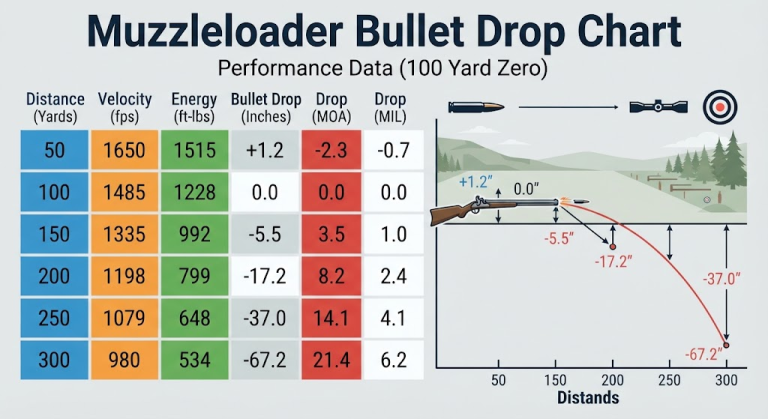
Standard 250-Grain Sabot Trajectory Table (100-Yard Zero)
The 250-grain saboted projectile (most commonly a .452-caliber hollow-point or polymer-tipped bullet wrapped in a high-density sub-caliber sabot) represents the gold standard for North American big game hunting. Propelled by a moderate factory charge of 100 grains volume equivalent of black powder substitute (such as Hodgdon Triple Seven or Pyrodex), this load achieves approximately 1,850 fps at the muzzle.
| Distance (Yards) | Velocity (FPS) | Energy (Ft-Lbs) | Bullet Drop (Inches) | 10 MPH Drift (Inches) |
|---|---|---|---|---|
| 0 (Muzzle) | 1,850 | 1,899 | -1.50 | 0.00 |
| 50 | 1,682 | 1,570 | +1.80 | 0.85 |
| 100 | 1,525 | 1,291 | 0.00 | 3.25 |
| 150 | 1,381 | 1,059 | -4.50 | 7.60 |
| 200 | 1,252 | 870 | -11.20 | 13.80 |
| 250 | 1,142 | 724 | -22.10 | 22.20 |
Heavy 300-Grain Conical and Sabot Ballistics (100-Yard Zero)
Stepping up to a 300-grain projectile increases sectional density and downrange momentum, making it favored for elk, moose, or large bear hunting. However, the added mass reduces initial launch velocity when fueled by equivalent powder charges. Below are the flight specifications for a 300-grain jacketed sabot or modern full-bore lead bullet driven by a 110-grain volumetric charge, departing the muzzle at 1,750 fps.
| Distance (Yards) | Velocity (FPS) | Energy (Ft-Lbs) | Bullet Drop (Inches) | 10 MPH Drift (Inches) |
|---|---|---|---|---|
| 0 (Muzzle) | 1,750 | 2,040 | -1.50 | 0.00 |
| 50 | 1,614 | 1,735 | +2.00 | 0.75 |
| 100 | 1,486 | 1,471 | 0.00 | 2.90 |
| 150 | 1,367 | 1,245 | -4.90 | 6.80 |
| 200 | 1,257 | 1,053 | -12.80 | 12.50 |
| 250 | 1,160 | 896 | -24.60 | 20.10 |
Kinetic Energy and Velocity Decay Across Hunting Distances
Examining downrange velocity decay reveals the sharp physical limitations of black powder hunting. While a standard centerfire rifle round retains sufficient speed to cause hydraulic shock and bullet expansion past 400 yards, a 250-grain muzzleloader bullet sheds roughly 45% of its kinetic energy by the 150-yard mark. At 200 yards, the 250-grain sabot load dips below 900 ft-lbs of retained kinetic energy, approaching the lower boundary for clean terminal expansion on whitetail deer. A heavier 300-grain bullet drops more dramatically past 150 yards (-12.8 inches versus -11.2 inches at 200 yards), yet retains higher mass energy (1,053 ft-lbs at 200 yards), ensuring superior deep wound cavitation on large-bodied game.
Trajectory Drop Comparison at 200 Yards (100-Yard Zero)
Drop in inches below horizontal aim line; lower value indicates a flatter flight arc.
-8.4 in
-10.4 in
-11.2 in
-12.8 in
-17.2 in
How Bullet Weight, Powder Charges, and BC Reshape the Trajectory Curve
The steep curvature visible on any muzzleloader trajectory chart is the direct consequence of atmospheric drag acting upon low ballistic coefficient projectiles. Because muzzleloaders fire wide diameter bullets at subsonic-to-moderate supersonic speeds, aerodynamic drag degrades flight performance at more than triple the rate seen in aerodynamic boat-tail rifle bullets.
Aerodynamic Drag and G1 Ballistic Coefficients in Black Powder
A projectile’s Ballistic Coefficient (BC) measures its capacity to overcome air resistance in flight. Centerfire match bullets routinely feature G1 BC ratings from .500 to .650+. In stark contrast, typical muzzleloader sabots feature G1 BCs between .180 and .240, while blunt full-bore lead conicals register between .130 and .160. As velocity drops, drag forces push the bullet through the dangerous transonic zone (approximately 1,200 to 1,050 fps). In this zone, shockwaves destabilize blunt projectiles, creating exponential drop and amplifying horizontal wind drift. A bullet with a .210 BC loses over 450 fps within the first 100 yards of flight.
Saboted Pistol Bullets vs. Full-Bore Conicals
The physical architecture of your chosen projectile dictates your practical trajectory ceiling. Two configurations dominate modern muzzleloading:
- Sabot Projectiles: By encasing a .44- or .45-caliber bullet within an elastomeric plastic sleeve, the shooter engages the .50-caliber rifling grooves while firing a lighter, more streamlined bullet. Sabots achieve higher muzzle velocities (1,850 to 2,050 fps) and sustain flatter trajectories, dropping roughly 11 inches at 200 yards.
- Full-Bore Lead Conicals: Required by primitive weapons regulations in several Western states (such as Colorado), full-bore projectiles match the entire .503 bore diameter and weigh between 300 and 460 grains. While their terminal wound channels and bone-crushing mass momentum are formidable, their low BC (.140) forces an extremely arched path. When launched at 1,600 fps, a 350-grain conical drops more than 17 inches at 200 yards.
Propellant Volume and Muzzle Velocity Relationships
Inline trajectory curves steepen or flatten primarily based on propellant charge. Black powder substitute charges operate on volume equivalent (grains) measurements calibrated against Grade 2Fg black powder. Adding propellant yields diminishing velocity returns once barrel length limits combustion:
Target Velocity: 1,600–1,720 FPS. Mild recoil, tight accuracy node in 24-inch barrels. Best suited for under-100-yard woods hunting.
Target Velocity: 1,800–1,950 FPS. The universal modern hunting standard. Delivers optimal powder burn without blowing sabot skirts.
Target Velocity: 2,050–2,200 FPS. Requires magnum-rated action. Flattens trajectory out to 200 yards but substantially accelerates barrel fouling.
Zero Distance Options: Setting Up a 100-Yard vs. 150-Yard Zero
Selecting where your point of aim (POA) intersects your point of impact (POI) is the most critical field decision in muzzleloader hunting. Because of the arched flight path, choosing between a conservative 100-yard zero and an aggressive 150-yard zero dictates your maximum shot window on game.
The Mechanics of a 100-Yard Baseline Zero
A strict 100-yard zero is the standard factory specification across hunting literature. Under this setup, a standard 250-grain sabot load passes upward through line of sight at roughly 15 yards, tops out between +1.5 and +2.0 inches high at 50 to 60 yards, and settles dead-on at 100 yards. The fundamental advantage of a 100-yard zero is simplicity: between point-blank range and 115 yards, a hunter can aim dead-center on a deer’s vital zone without risking an over-the-back miss due to mid-range rise.
Extending Reach with a 150-Yard Zero and MPBR
Hunters operating across open agricultural fields or powerline cuts frequently adopt a Maximum Point-Blank Range (MPBR) zero. Given an 8-inch vital zone diameter for whitetail deer, an MPBR configuration ensures the bullet never climbs more than 4 inches above the line of sight nor falls more than 4 inches below it.
✅ 150-Yard Zero Advantages
- Extends point-blank reach to roughly 175 yards without holdover.
- Reduces 200-yard drop from -11.2 inches down to only -5.8 inches.
- Optimal for stationary stand hunting over open terrain.
❌ 150-Yard Zero Pitfalls
- Bullet climbs +3.0 to +3.8 inches high at 75–85 yards.
- Risk of high spinal hits or clear misses on close-range targets under 100 yards.
- Requires precise shooter discipline to aim low-vital on closer shots.
Optic Sight Height Over Bore Considerations
All trajectory tables must calculate projectile drop relative to the optic’s line of sight. Standard factory charts assume a sight height baseline of 1.50 inches (representative of low-to-medium scope rings mounted on an inline receiver). If you mount an optic using tall tactical rings, a cantilever base, or an elevated thermal/digital scope where the sight height sits 2.0 to 2.6 inches above the bore center, your trajectory profile shifts substantially:
- A taller optic pushes your close-range POI deeper below your POA (up to -2.5 inches low at 10 yards).
- A taller optic extends the secondary zero farther out, reducing perceived bullet drop at 200 yards by 1 to 2 inches, but worsening extreme mid-range rise between 60 and 90 yards.
When utilizing a 150-yard zero on a magnum inline muzzleloader, the bullet reaches its highest aerodynamic apex between 70 and 85 yards (+3.2 inches). If a hunter fails to account for this rise and aims at the upper-third of a deer’s vital zone at 80 yards, the shot will pass clean over the spine or cause a non-lethal crest wound.
Muzzleloader Ballistics vs. Centerfire and Shotgun Slug Charts
Hunters transitioning from modern bolt-action centerfire rifles often struggle with range estimation and crosswind holdovers when operating an inline black powder rifle. To understand where the inline muzzleloader sits in the sporting spectrum, consider the comparative ballistics of modern sabot muzzleloaders against centerfire rifles, sabot shotgun slugs, and traditional patched round balls.
Inline Muzzleloader vs. Centerfire Rifle Trajectories
Comparing an inline muzzleloader to a standard centerfire hunting rifle like a .308 Winchester highlights the disparity in flight characteristics. At 200 yards, the .308 drops less than 4 inches from a 100-yard zero, whereas the modern muzzleloader drops 11.2 inches. More importantly, because the muzzleloader projectile spends nearly twice as long in flight, wind deflection is more than triple that of the centerfire bullet (7.6 inches vs 2.1 inches at 150 yards in a 10 mph crosswind).
Inline Sabots vs. 12-Gauge Rifled Shotgun Slugs
Modern 12-gauge rifled sabot slugs (such as 300-grain tipped offerings) mimic muzzleloader trajectories closely through the first 100 yards. Both leave the muzzle at 1,850 to 1,950 fps. However, modern polymer-tipped sabot muzzleloader bullets have slightly higher sectional density and ballistic coefficients. Beyond 125 yards, the inline muzzleloader projectile retains velocity better, dropping roughly 1 to 2 inches less than a 12-gauge slug at the 200-yard boundary while suffering less atmospheric drift.
The Severe Drag Penalty of Patched Round Balls
Evaluating a traditional .490-inch, 175-grain lead round ball wrapped in cotton patching illustrates why traditional muzzleloaders are strictly short-range weapons. Round spheres suffer from an abysmal G1 BC (approximately .065 to .075). While a round ball departs fast due to its light weight (1,750 fps), its flat aerodynamic profile hits an invisible wall in the air. By 150 yards, it plummets -9.2 inches, and by 200 yards, it drops over 26 inches while drifting an unmanageable 16+ inches in a light breeze.
How to Validate and Calibrate Your Trajectory Chart in the Field
Factory ballistic charts are mathematical approximations derived in laboratory tunnels. Real muzzleloaders interact with temperature, humidity, fouling rings, and bore tolerances. To convert published trajectory numbers into harvest confidence, execute this 4-step range validation protocol.
Never assume printed box velocity is accurate. A 24-inch hunting barrel generates 60 to 120 fps less velocity than a manufacturer’s 28-inch test fixture. Fire a 5-shot string across an optical or Doppler radar chronograph (e.g., Garmin Zero or LabRadar). Record the true average muzzle velocity and the extreme velocity spread (ES). An ES over 40 fps indicates inconsistent powder compression or irregular seating pressure on the sabot skirt.
Black powder substitutes are formulated to produce equivalent pressures to black powder by volume, not scale weight. For example, 100 grains volume equivalent of Western Powders Blackhorn 209 weighs approximately 70.0 grains on an electronic scale. Triple Seven weighs approximately 77.0 grains. Loading 100 weighed grains of Blackhorn 209 creates an over-charge condition exceeding 40% over maximum pressure ratings, risking breech failure. Always verify your powder measure’s physical volume graduation.
A squeaky-clean, oiled bore produces a cold-bore flier that shoots 2 to 4 inches away from a seasoned shooting group. Always fire a fouling shot using a cheap primer or light load before your hunt. Furthermore, ambient winter temperatures drop powder burn efficiency. A load chronographed at 1,900 fps during an 85°F August range session can drop to 1,790 fps during a 15°F December late season hunt, shifting your 200-yard impact down by an extra 3 inches.
Confirm your projectile’s minimum expansion threshold. Hollow-point and tipped sabots generally require a minimum impact velocity of 1,050 to 1,200 fps to reliably mushroom and transfer shock. When checking your trajectory chart, find the yardage where retained kinetic energy drops below 800 ft-lbs (for deer) or 1,200 ft-lbs (for elk). That distance is your hard ethical range ceiling, regardless of whether you have enough scope dial to compensate for bullet drop.
Unless your rifle is explicitly stamped by the manufacturer as approved for smokeless powder (such as the Savage 10ML-II or specialized custom conversions), NEVER load smokeless propellant into a standard inline muzzleloader. Standard muzzleloaders are built to withstand black powder pressures up to roughly 25,000–30,000 PSI. Smokeless propellants routinely generate 55,000 to 65,000+ PSI, which will instantaneously rupture ordinary muzzleloader barrels and breech blocks.
Muzzleloader Trajectory Chart Questions Answered
How high should a muzzleloader be at 50 yards for a 100-yard zero?
For a standard modern inline muzzleloader firing a 250-grain sabot with 100 grains volume equivalent of propellant (1,850 fps muzzle velocity), the bullet should strike between +1.5 and +1.9 inches high at 50 yards to achieve a dead-center zero at 100 yards (assuming a standard 1.5-inch scope height above bore).
What is the maximum effective hunting range of an inline muzzleloader?
For average field setups shooting standard sabots (1,800–1,950 fps), the maximum ethical hunting range is 150 to 200 yards. Beyond 150 yards, bullet drop accelerates rapidly (-11 to -14 inches at 200 yards), wind drift doubles, and retained kinetic energy drops below 900 ft-lbs, which is the baseline recommended for reliable terminal expansion on big game.
Does adding a third powder pellet (150 grains) significantly flatten trajectory?
A “magnum” 150-grain charge increases muzzle velocity by approximately 180 to 250 fps over a 100-grain charge. At 200 yards, this reduces bullet drop from roughly -11.2 inches down to -8.5 inches (saving about 2.7 inches of drop). However, it substantially increases felt recoil, blows sabot petals out of alignment if soft sabots are used, and increases breech fouling without providing a dramatic practical advantage under 150 yards.
How much does crosswind drift affect muzzleloader bullets compared to rifles?
Due to low aerodynamic ballistic coefficients and longer flight durations, muzzleloader projectiles suffer extensive wind drift. In a direct 10 mph crosswind at 150 yards, a standard 250-grain sabot deflects 7.0 to 8.5 inches, compared to just 2.0 inches for a .308 centerfire rifle. A 200-yard muzzleloader shot in a 10 mph breeze drifts nearly 14 inches—more than enough to turn a heart-lung shot into a gut shot.
A muzzleloader trajectory chart provides an indispensable predictive roadmap, but its steep ballistic drop beyond 125 yards demands hands-on range verification before every hunting season. Scope mounting heights and charge ignition consistency directly dictate whether your rifle strikes true across variable field distances. Treat factory ballistic data as a reference baseline: take your chosen rifle and hunting load to the range, record your velocity with a modern chronograph, map your points of impact on paper targets out to your maximum ethical boundary, and hunt with absolute confidence in 2026 and beyond.

Leave a Reply