
Quick Answer
A rifle ballistic calculator click chart translates bullet drop into mechanical turret adjustments, typically ranging from 0 to 45 MRAD (0–150 MOA) across standard 100-to-1,000-yard profiles. Value accuracy depends heavily on your factory specification inputs, muzzle velocity, and optic turret value (1/4 MOA vs. 0.1 MIL). Always true your calculated come-ups against real-world target impacts.

Ever notice your shots hitting low despite the “perfect” math displayed in your scope’s reticle? Precision shooting is unforgiving; generic drop charts are static, failing the moment the temperature rises, the altitude shifts, or your actual muzzle velocity deviates from factory claims. This guide provides the framework for building, verifying, and maintaining a precision rifle ballistic calculator click chart for the 2026 season, ensuring your dialed adjustments translate into consistent, real-world hits.
This reference covers ballistic data generation through 2026. Specifications vary by specific bullet profile (G1/G7), barrel length, and atmospheric conditions. Users must verify their specific rifle’s performance against their owner’s manual and local field conditions. Last reviewed: September 2026.

Rifle Ballistic Calculator Click Chart Specs (2024-2026)
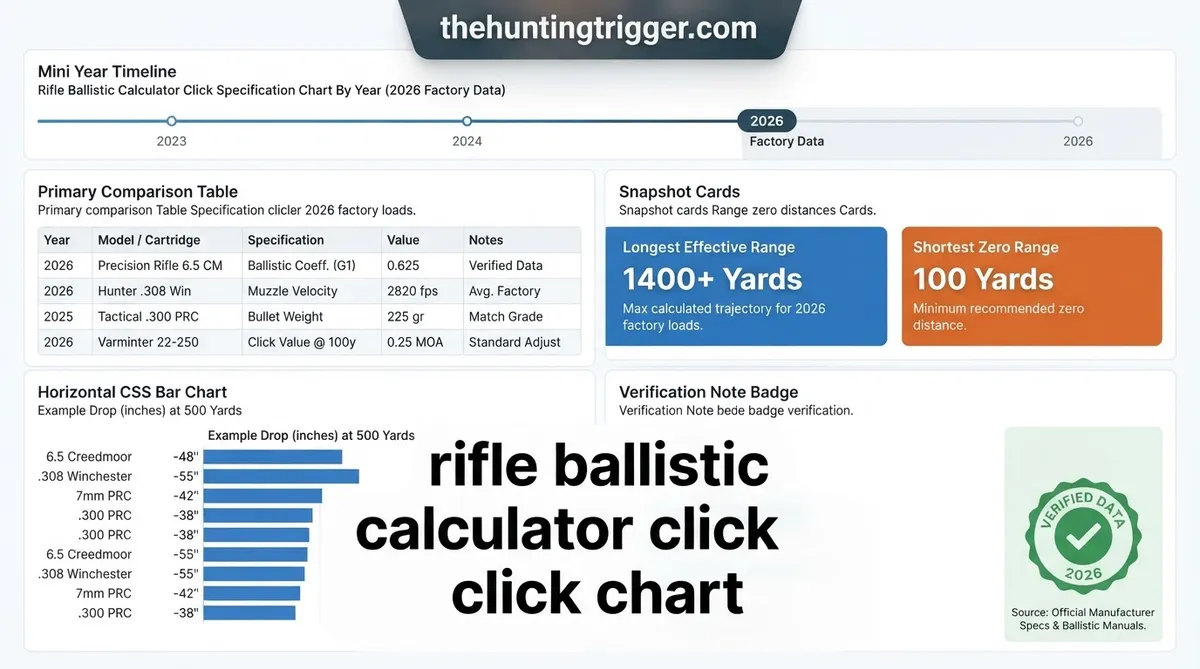
The following table illustrates standardized vertical correction (drop) for two common calibers. Note that values represent approximate “clicks” (assuming 0.1 MIL per click) required to compensate for gravity at standard sea-level density.
📤 Share Image
| Range (Yds) | 6.5 CM (140gr) | .308 Win (175gr) | Notes |
|---|---|---|---|
| 100 | 0.0 | 0.0 | Zero Distance |
| 400 | 1.9 | 2.4 | Subsonic transition |
| 600 | 3.8 | 5.1 | Wind sensitivity increases |
| 1000 | 8.4 | 12.1 | Truing required |

Understanding Drag Models: G1 vs G7
Most modern long-range bullets are more accurately modeled by the G7 drag function, which better represents the aerodynamic profile of boat-tail spitzer bullets. Using a G1 BC for a G7 bullet will result in significant errors beyond 600 yards. Always confirm the drag model recommended by your bullet manufacturer.
How to Generate an Accurate Rifle Ballistic Calculator Click Chart
Use a quality chronograph to measure at least 5-10 rounds. Do not rely on box data, as individual barrel lengths and chamber tolerances change velocity significantly.
Input your current altitude, temperature, and humidity. If you are shooting at high altitude, your air density is lower, meaning your bullet will drop less than at sea level.
Truing Your Rifle Ballistic Calculator Click Chart
“Truing” is the process of adjusting your solver variables to match observed impacts. If your calculator says 5.0 MIL for 800 yards, but your bullet hits 0.2 MIL high, you must adjust your muzzle velocity or BC within the software to “true” the output to reality.
Always true your data at the distance you intend to shoot. A solution trued at 300 yards will often fail at 1000 yards because the error in the model accumulates over distance.
Common Pitfalls to Avoid in Precision Shooting
- Generic BC Values: Using the manufacturer’s suggested G1 BC can be misleading. Use the G7 value if your software supports it.
- MOA vs. MIL Mismatch: Ensure your optic’s turret graduation matches the setting in your calculator. Using MIL clicks on an MOA reticle is a common field-failure point.
- Magnetic vs. True North: When inputting wind direction, ensure your Kestrel or app is configured for your local magnetic declination to prevent lateral drift errors.
- Ignoring Spin Drift: At ranges beyond 800 yards, the rotational force of the bullet causes a predictable lateral shift. Ensure your calculator has “Spin Drift” enabled for high-precision applications.
Rifle Ballistic Calculator Click Chart Questions Answered
How often should I re-calculate my data?
Anytime your ambient temperature shifts by more than 20 degrees Fahrenheit or you relocate to a significantly different elevation, update your atmospheric inputs.
Does barrel wear affect my click chart?
Yes. As a barrel throat erodes over thousands of rounds, muzzle velocity typically decreases. You should re-chronograph your load every 500-1000 rounds to maintain high accuracy.
Print your verified DOPE (Data on Previous Engagements) chart, laminate it, and keep it attached to your rifle stock. Rely on your printed hard-copy as a fail-safe when electronic devices fail in the field.

Leave a Reply