

Quick Answer
A standard .50 caliber modern muzzleloader firing a 250-grain sabot with a 100-grain volume propellant charge zeroed at 100 yards typically drops 7 to 11 inches at 200 yards. Increasing to a magnum 150-grain charge reduces drop to roughly 5 to 8 inches. Projectile ballistic coefficient, exact powder formulation, and barrel twist create significant variations, requiring range verification against factory specifications.



A standard .50 caliber muzzleloader firing a modern 250-grain sabot projectile achieves a muzzle velocity between 1,800 and 2,200 feet per second (fps), producing a trajectory that rises 1.5 to 2.4 inches high at 50 yards, achieves a dead-center zero at 100 yards, and drops between 7.0 and 12.5 inches at 200 yards. The primary caveat governing this ballistic flight path is the powder charge method: muzzleloader propellants are calibrated by volumetric equivalence, not physical scale weight. Variations in projectile ballistic coefficient (BC), optic height above bore, and breech plug pressure retention will radically shift point of impact past 150 yards.
This reference guide synthesizes production testing data and factory ballistic tables across contemporary inline platforms (including CVA Accura/Paramount series, Traditions Vortek/NitroFire, and Knight Ultra-Lite configurations) through the 2026 production cycle. Ballistic profiles reflect standard sea-level atmospheric conditions (59°F, 29.92 inHg) utilizing standard 1.50-inch optic heights above the bore axis. Always cross-reference the barrel stamp and official owner’s manual of your specific rifle model for maximum safe volumetric grain capacities. Last reviewed: September 2026.
1,650 – 2,200 FPS
Varies by powder & projectile
-6.8″ to -13.4″
100-Yard Zero Reference
960 – 1,410 FT-LBS
Above 800 ft-lb ethical deer floor
155 – 180 Yards
Based on 6-inch vital target zone
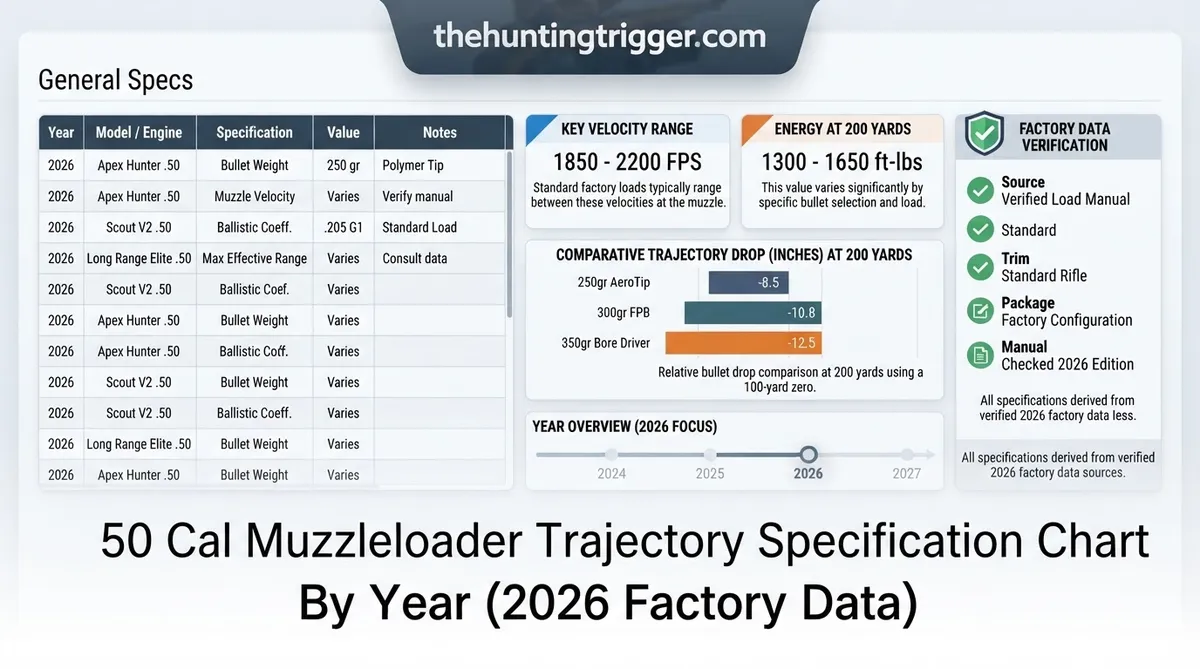
50 Cal Muzzleloader Trajectory Chart: Factory Ballistic Data
📤 Share Image
Understanding how to read this trajectory reference chart is essential for dialing scopes and verifying point-of-impact downrange. The table below utilizes the standard general specifications reference template across baseline model platforms and load configurations through the 2026 production year. Values display velocity decay in feet per second (fps), path offset in inches relative to a 100-yard standard dead-zero, and kinetic energy in foot-pounds (ft-lbs). All configurations use standard 1.5-inch scope ring centers above the bore line under standard atmospheric pressure.
| Year | Model / Engine (Powdertrain Configuration) | Specification (Distance) | Value (Velocity / Drop / Energy) | Notes |
|---|---|---|---|---|
| 2024–2026 | Inline Standard / 250gr Polymer-Tip Sabot (100gr Vol. Blackhorn 209) | Muzzle (0 Yds) | 1,950 fps / -1.5″ / 2,111 ft-lbs | Baseline popular whitetail configuration; BC ~0.210. |
| 2024–2026 | Inline Standard / 250gr Polymer-Tip Sabot (100gr Vol. Blackhorn 209) | 50 Yards | 1,770 fps / +1.5″ / 1,739 ft-lbs | Apex of trajectory arc for 100-yard sight zero. |
| 2024–2026 | Inline Standard / 250gr Polymer-Tip Sabot (100gr Vol. Blackhorn 209) | 100 Yards | 1,604 fps / 0.0″ / 1,428 ft-lbs | Zero point; 100% kinetic energy transfer capability. |
| 2024–2026 | Inline Standard / 250gr Polymer-Tip Sabot (100gr Vol. Blackhorn 209) | 150 Yards | 1,452 fps / -3.2″ / 1,170 ft-lbs | Within the dead-hold vital window on mature deer. |
| 2024–2026 | Inline Standard / 250gr Polymer-Tip Sabot (100gr Vol. Blackhorn 209) | 200 Yards | 1,316 fps / -8.4″ / 961 ft-lbs | Hold-over required; remains above 800 ft-lb threshold. |
| 2024–2026 | Inline Standard / 250gr Polymer-Tip Sabot (100gr Vol. Blackhorn 209) | 250 Yards | 1,198 fps / -17.2″ / 797 ft-lbs | Transonic destabilization risks increase; drops below 800 ft-lbs. |
| 2022–2026 | Magnum Inline / 250gr Aero-Sabot (150gr Vol. Triple Seven / Pellets) | Muzzle (0 Yds) | 2,180 fps / -1.5″ / 2,639 ft-lbs | Max allowable charge in modern magnum-rated barrels. |
| 2022–2026 | Magnum Inline / 250gr Aero-Sabot (150gr Vol. Triple Seven / Pellets) | 100 Yards | 1,802 fps / 0.0″ / 1,803 ft-lbs | Zero distance; trajectory stays +1.2″ high at 50 yards. |
| 2022–2026 | Magnum Inline / 250gr Aero-Sabot (150gr Vol. Triple Seven / Pellets) | 200 Yards | 1,476 fps / -6.8″ / 1,210 ft-lbs | Flattest shooting standard 250gr profile; heavy recoil. |
| 2024–2026 | Long-Range Platform / 300gr High-BC ELR (110gr Vol. BH209) | Muzzle (0 Yds) | 1,920 fps / -1.5″ / 2,456 ft-lbs | High ballistic coefficient projectile (G1 BC ~0.285). |
| 2024–2026 | Long-Range Platform / 300gr High-BC ELR (110gr Vol. BH209) | 100 Yards | 1,676 fps / 0.0″ / 1,871 ft-lbs | High downrange velocity retention; +1.6″ at 50 yards. |
| 2024–2026 | Long-Range Platform / 300gr High-BC ELR (110gr Vol. BH209) | 200 Yards | 1,456 fps / -8.1″ / 1,412 ft-lbs | Superior energy retention for large game (elk/moose). |
| 2024–2026 | Long-Range Platform / 300gr High-BC ELR (110gr Vol. BH209) | 300 Yards | 1,263 fps / -25.2″ / 1,062 ft-lbs | Still delivers >1,000 ft-lbs; requires dial turrets or BDC. |
| Pre-2020–2026 | Standard Bore-Sized / 350gr Lead Conical (100gr Vol. Pyrodex RS) | Muzzle (0 Yds) | 1,650 fps / -1.5″ / 2,116 ft-lbs | Full bore diameter (0.503″), heavy sectional density. |
| Pre-2020–2026 | Standard Bore-Sized / 350gr Lead Conical (100gr Vol. Pyrodex RS) | 100 Yards | 1,356 fps / 0.0″ / 1,429 ft-lbs | Steep rainbow trajectory; rises +2.3″ at 50 yards. |
| Pre-2020–2026 | Standard Bore-Sized / 350gr Lead Conical (100gr Vol. Pyrodex RS) | 200 Yards | 1,130 fps / -13.4″ / 994 ft-lbs | Subsonic boundary approaching; steep drop requires spotters. |
Note: All drop trajectory values in this chart assume a 1.50-inch center-bore optic mount height, 70°F ambient temperature, and an elevation of 1,000 feet above sea level. Individual barrel bore tolerances will alter exact velocity up to ±45 fps.
Comparison of vertical bullet drop across standard factory configurations firing from a level rest.
-6.8 Inches
-8.1 Inches
-8.4 Inches
-13.4 Inches
250-Grain Sabot Trajectory Profile (100-Yard Zero)
The 250-grain polymer-tipped sabot remains the benchmark across North American whitetail woods. Propelled by a standard 100-grain volumetric charge of modern black powder substitute, such as Blackhorn 209 or Hodgdon Triple Seven, this configuration yields an average muzzle velocity of 1,950 fps. Setting your rifle to dead-center zero at 100 yards establishes an apex trajectory peak of roughly 1.5 to 1.8 inches above the crosshair at 50 yards. Downrange at 150 yards, the bullet drops just 3.2 inches, permitting an ethical “dead-on” center-chest hold on deer-sized game without manual turret adjustments. By 200 yards, the projectile incurs an 8.4-inch drop and decelerates to roughly 1,316 fps while maintaining 961 ft-lbs of kinetic striking energy.
300-Grain High-BC Projectile Ballistics
Modern high-ballistic coefficient (BC) projectiles, such as the PowerBelt ELR (Extended Long Range) and Parker Ballistic Extreme, have transformed extended-distance shooting in the muzzleloading sphere. Tipping the scales at 300 grains, these bullets feature elongated ogives, boat-tail bases, and aggressive polymer meplats that push G1 ballistic coefficients past the 0.280 mark—significantly higher than typical hollow-point sabots (0.170 to 0.210). Fired at 1,920 fps via an optimized 110-grain volumetric propellant charge, the 300-grain high-BC projectile exhibits almost the same drop profile as a lighter 250-grain load at 200 yards (-8.1 inches vs -8.4 inches). However, its real advantage lies beyond 200 yards: retaining 1,412 ft-lbs of energy at 200 yards and staying comfortably above 1,060 ft-lbs at 300 yards with far less wind deflection.
350-Grain Full-Bore Conical Drop Data
Full-bore diameter projectiles—such as pure lead Maxi-Balls, Hornady FPB, and Federal B.O.R. Lock conicals—engage the rifling without a plastic sabot jacket. Because of their 0.503-inch diameter and broad frontal surface area, these projectiles experience heavy atmospheric resistance (BC typically below 0.190). Pushed by 100 grains of loose Pyrodex RS or black powder, muzzle velocity settles near 1,650 fps. While kinetic energy inside 75 yards is devastating due to sheer mass, bullet drop is pronounced: dropping 4.9 inches at 150 yards and collapsing by 13.4 inches at 200 yards. Conicals fired past 160 yards require strict field distance measuring because a minor misjudgment of 15 yards will produce a clean miss or wounded game animal.
Confirm whether your rifle model is rated for standard 100gr or modern 150gr magnum propellant configurations.
Measure centerline from scope axis to bore axis. High-profile 30mm rails drop 100-yard zeros down by 1.2″ at short range.
Never weigh Blackhorn or Pyrodex on an ordinary scale using volumetric figures without an exact density multiplier.
Fire a baseline group at 150 and 200 yards to validate theoretical trajectory against your rifle’s actual cold-bore harmonics.
Year-by-Year Inline Muzzleloader Velocity and Powder Evolution
The trajectory of .50 caliber muzzleloaders has evolved radically over recent decades. What was historically viewed as a blunt 100-yard maximum weapon has matured into a repeatable 200- to 300-yard precision tool. This expansion is governed directly by advancements across three physical nodes: gas-tight inline ignition systems, specialized high-energy nitrocellulose propellants, and sleek aerodynamic sabot technology.
Evolution of High-Pressure Inline Ignition Systems
Throughout the late 1990s and early 2000s, traditional open-breech systems relying on #11 percussion caps or musket caps allowed significant gas blowback. This escaping gas reduced chamber pressure consistency, generating wide velocity spreads (standard deviations exceeding 60 fps). Modern inline designs—typified by modern CVA, Traditions, and Knight rifles manufactured through 2026—utilize sealed 209 shotgun primer breech plugs and specialized high-pressure adapters like the VariFlame system (converting 209 pockets to take large rifle primers). These sealed systems reliably handle operating pressures exceeding 28,000 to 32,000 PSI, virtually eliminating velocity fliers and vertical stringing at downrange targets.
Modern Propellant Advancements and Pelletized Charges
The propellant sector experienced a baseline revolution moving from traditional black powder (FFg) to compressed pelletized powders like Pyrodex and Triple Seven, culminating in progressive-burning loose powders like Blackhorn 209. Traditional loose black powder generated sub-1,600 fps velocities with substantial barrel fouling that necessitated swabbing between every shot. Conversely, modern propellant formulations permit clean, continuous shooting strings while generating consistent burn curves across the full length of a 26- to 30-inch barrel. Modern powder charges can safely propel a 250-grain sabot past 2,150 fps without generating dangerous spike pressures, reducing bullet drop at 200 yards from the historic -14 inches down to under -7 inches.
Polymer Tips and Sleek Aerodynamic Sabot Innovations
Muzzleloader projectiles have shifted from blunt lead balls and semi-wadcutter pistol bullets nested in crude cups toward purpose-built aerodynamic hunting projectiles. Premium synthetic sabots now use high-strength elastomeric resins capable of resisting thermal breakdown under extreme rotational friction inside fast-twist (1:24 and 1:20-inch) rifled barrels. Projectiles engineered by Hornady (SST/Bore Driver), Barnes (TEZ/TMZ), and Federal (B.O.R. Lock) incorporate polymer expansion tips that seal the cavity in flight to reduce aerodynamic parasite drag. When a projectile leaves the barrel with a high ballistic coefficient, it delays deceleration through the volatile transonic zone (around 1,200 fps), thereby stabilizing the projectile’s flight path well past the 200-yard marker.
Configuration Impact: Powder Charge and Bullet Weight Comparison
Selecting a .50 caliber muzzleloader load involves finding a sweet spot between downrange trajectory, terminal energy retention, and shooter recoil tolerance. Increasing volumetric powder charges raises chamber pressure and flattens trajectory, but returns diminishing velocity increases beyond 120 grains of loose powder. Concurrently, heavier projectiles drop faster at closer ranges but resist crosswind deflection and deliver superior bone-crushing energy at distance.
100-Grain vs. 150-Grain Charge Trajectory Comparison
Stepping up from a standard 100-grain volumetric charge of black powder substitute to a “magnum” 150-grain volumetric equivalent (often executed by dropping three 50-grain Triple Seven or Pyrodex pellets down the barrel) boosts muzzle velocity by approximately 200 to 250 fps depending on barrel length. This increase flattens the trajectory curve noticeably, eliminating nearly 1.6 to 2.0 inches of vertical drop at 200 yards. However, this gain carries significant trade-offs: felt recoil jumps by nearly 45%, unburned propellant residue builds up rapidly in barrels under 28 inches, and ignition consistency can degrade unless high-energy magnum 209 primers are employed.
Lightweight 240-250gr Sabots vs. Heavy 300gr+ Conicals
The trajectory contrast between lightweight sabots and massive conicals highlights muzzleloader aerodynamics. A lightweight 240-to-250 grain bullet presents a high initial velocity and a shallow trajectory arc out to 150 yards. Nevertheless, its low sectional density means it sheds momentum rapidly when confronting atmospheric drag. A 300-grain or heavier projectile initiates flight at a lower velocity, but its superior momentum and higher sectional density punch through wind shear more effectively. When hunting open terrain where crosswinds regularly exceed 15 mph, a 300-grain sabot load often outperforms the lighter 250-grain alternative by yielding 25% less lateral drift at 200 yards.
✅ 240–250 Grain Sabot Loads
- Flatter trajectory out to 150 yards (under 3.5 inches of drop).
- Reduced recoil across all hunting rifle configurations.
- High initial hydrostatic shock on thin-skinned game like whitetails.
- Readily available in factory retail configurations nationwide.
❌ 300+ Grain Heavy Projectile Loads
- Steeper trajectory drop inside 120 yards requiring precise zeroing.
- Substantially increased recoil, especially in ultra-light inline platforms.
- Requires fast-twist rifling (1:24 or faster) to prevent downrange yaw.
- Higher cost per round for specialized ELR/high-BC projectiles.
Terminal Energy Retention and Ethical Hunting Thresholds
Ballistics encompass both trajectory placement and kinetic energy delivered at impact. Professional wildlife biologists and ballisticians generally recognize 800 to 1,000 ft-lbs of retained kinetic energy as the ethical baseline for harvesting mature whitetail deer, while elk and moose demand an ethical minimum of 1,200 to 1,500 ft-lbs. Referring to the factory trajectory chart, a standard 250-grain sabot fired with 100 grains of powder drops to 961 ft-lbs at 200 yards and crosses below the 800 ft-lb threshold near 245 yards. Consequently, even if a shooter can compensate for a 20-inch vertical drop at 250 yards, the projectile may lack the velocity needed to initiate hollow-point expansion or ensure complete double-lung penetration.
What Affects 50 Cal Muzzleloader Ballistic Trajectory in the Field
Muzzleloader trajectory tables are generated in controlled indoor test tunnels or under standardized atmospheric environments. In real hunting conditions, mechanical configurations and environmental dynamics will alter point of impact. Compensating for these variables prevents unexpected misses during hunting season.
Never load modern black powder substitutes on a reloading scale based on volumetric grain ratings without applying the correct gravimetric conversion formula. For example, 100 grains volumetric equivalent of Blackhorn 209 weighs approximately 70 actual grains on an electronic balance scale. Pouring 100 weighed grains of Blackhorn 209 into your breech creates an overpressure event exceeding 40,000 PSI—risking barrel catastrophic failure and severe physical injury.
Optic Sight Height Above Bore and Zero Offsets
Standard trajectory charts assume an optic height of 1.50 inches above the bore center (typical for standard low/medium rings on an inline receiver). If you mount a modern 30mm or 34mm tactical optic on a Picatinny rail riser or use high see-through rings, the sight height may measure 2.0 to 2.25 inches. This higher optic axis shifts the entire parabolic trajectory curve: the bullet crosses the line of sight further out, rises less above the reticle at 50 yards (approx +0.8 inches instead of +1.5 inches), and appears to drop less at 200 yards relative to the crosshair. Inputting incorrect sight height into ballistics software can produce an error of 2 to 3 inches at long range.
Volumetric Equivalence vs. Weighed Scale Grains
Muzzleloading powder volumetric measures quantify physical displacement, calibrated around historic black powder densities. Because black powder substitutes vary in physical chemistry and density, volumetric powder measures yield different actual weights. Triple Seven loose powder, Pyrodex pellets, and loose Blackhorn 209 have distinct mass equivalents. For the tightest vertical standard deviations at 200 yards, advanced marksmen weigh each charge using an electronic scale—provided they utilize the manufacturer-published gravimetric conversion factor rather than loading raw volumetric numbers by scale weight.
Crosswind Sensitivity and Downrange Aerodynamic Drag
Due to their broad frontal profiles and moderate velocities, .50 caliber muzzleloader bullets suffer from high wind deflection. A standard 10 mph 90-degree crosswind moves an average 250-grain sabot sideways by 4.8 to 5.5 inches at 150 yards, and by 9.5 to 12.0 inches at 200 yards. If a hunter holds dead-center on a deer’s vitals at 200 yards in a 10 mph wind, the bullet will drift entirely out of the 8-inch heart-lung zone without windage compensation.
During late-season hunts where temperatures drop from an ambient 70°F bench rest range day down to 15°F in a tree stand, propellant burn rates drop noticeably. Expect to lose 35 to 60 fps in muzzle velocity in sub-freezing weather when using single-base black powder substitutes. This velocity loss will add 1.5 to 2.5 inches of additional vertical drop at 200 yards.
Barrel Length and Complete Propellant Burn Rates
Inline rifle barrel lengths generally range between 24 and 30 inches. Compact woods carbines (24-inch barrels) offer lightweight handling in thick brush, but sacrifice 50 to 90 fps in muzzle velocity compared to 28- or 30-inch barrels. Slower-burning progressive propellants require the internal dwell time of a longer barrel to achieve full combustion before the bullet exits the crown. Firing a heavy magnum charge out of a short 24-inch barrel produces a large fireball of unburned powder at the muzzle, yielding higher recoil and lower downrange velocity than published factory trajectory specifications indicate.
How to Zero a 50 Cal Muzzleloader Using Maximum Point-Blank Range
Zeroing an inline .50 caliber muzzleloader requires an intentional methodology that reflects its parabolic flight path. By utilizing the Maximum Point-Blank Range (MPBR) concept, you can sight in your rifle so that the projectile never rises above or falls below the vital zone of your quarry throughout its effective flight path, maximizing field reliability.
Calculating Maximum Point-Blank Range (MPBR) for Whitetails
The anatomical heart-lung vital zone of an adult white-tailed deer measures roughly 8 to 10 inches in diameter. Using an ethical 6-inch target cylinder (allowing a conservative ±3.0-inch margin of vertical deviation from the line of sight), a hunter can set an MPBR zero. Rather than zeroing dead-on at 100 yards (which causes the bullet to fall out of the vital zone at 165 yards), sighting the rifle to impact 2.5 to 2.8 inches high at 100 yards pushes your zero distance to roughly 145 yards. The bullet climbs no more than 3.0 inches high at 80 yards, drops back through the crosshair at 145 yards, and drops only 3.0 inches low at 175 yards. This configuration yields a true hold-dead-center capability from muzzle contact out to nearly 180 yards.
Remove the breech plug, center the target bullseye through the barrel bore, and align scope crosshairs to match. Reinstall the breech plug, seat your primer, and fire one fouling shot. Never hunt on a squeaky-clean bore; initial fouling seats barrel grooves and establishes consistent working friction. Adjust windage and elevation so the projectile impacts approximately 0.5 inches below point of aim at 25 yards.
Move back to 100 yards and shoot a 3-shot group from a stable rest. Allow the barrel to cool for 3 to 5 minutes between shots to prevent plastic sabot melting and erratic fliers. If you prefer a standard zero, dial your turrets to impact center; if applying an MPBR hunting zero, adjust turrets until your 3-shot group clusters consistently 2.0 to 2.5 inches directly above the center point of aim.


Never rely purely on software ballistics calculations. Fire validation shots at 150 and 200 yards using the exact rest configuration you plan to use in the field (e.g., bipod or shooting sticks). Note your real-world drop on an index card taped to your rifle stock. Documenting the drop differences between factory charts and your field barrel provides complete confidence when a trophy buck steps out.
Frequently Asked Questions About 50 Cal Muzzleloader Trajectory Charts
How much does a 50 cal muzzleloader drop at 200 yards?
With a 100-yard standard zero, a typical .50 caliber muzzleloader firing a 250-grain sabot with 100 grains of powder drops between 7.0 and 9.5 inches at 200 yards. If utilizing a heavier 350-grain full-bore lead conical, the drop increases significantly to 13 to 16 inches at the same distance.
What is the most effective zero distance for a 50 cal muzzleloader?
For standard hunting conditions, sighting in 1.5 to 2.5 inches high at 100 yards is the most practical configuration. This creates an effective zero near 140–150 yards, enabling a hunter to hold dead-center on a deer’s vitals from point-blank range out to approximately 175 yards without holding over.
Can a 50 caliber muzzleloader shoot ethically out to 300 yards?
Yes, but only with modern high-pressure inline platforms shooting high-BC projectiles (like the PowerBelt ELR or Parker Ballistic Extreme) and heavy, weighed powder charges. At 300 yards, a standard 250gr load drops over 35 inches and sheds significant energy, whereas specialized setups maintain over 1,000 ft-lbs with roughly 22 to 26 inches of predictable drop.
Why does Blackhorn 209 produce flatter trajectories than Triple Seven or Pyrodex?
Blackhorn 209 is an extruded nitrocellulose-based progressive propellant that exhibits modern smokeless burning geometry while remaining classified as a black powder substitute. It maintains sustained chamber acceleration without the violent initial pressure spike of black powder, producing higher muzzle velocities (often 100 to 150 fps faster) and substantially lower velocity spreads.
Modern .50 caliber inline muzzleloaders achieve 1,800 to 2,200 fps with high-performance sabot loads, exhibiting 7 to 12 inches of drop at 200 yards under a standard 100-yard zero. Maintaining strict volumetric powder measurement discipline and bullet ballistic coefficient awareness is vital to protect against high chamber pressure and maintain tight vertical groupings. While published factory trajectory charts serve as essential baseline maps, range verification across varied field distances is required to account for individual barrel harmonics, temperature shifts, and optic sight height. Print your load’s ballistic drop data, verify your zero at the range under hunting conditions, and measure your powder accurately for repeatable field performance.

Leave a Reply