

Quick Answer
Modern .50 caliber muzzleloaders typically produce muzzle velocities between 1,600 and 2,200 feet per second (fps), whereas traditional patched round ball configurations average 1,300 to 1,600 fps, and specialized smokeless-capable platforms reach up to 2,500 fps. Actual velocity varies significantly based on projectile mass, propellant type, sabot obturation, and barrel length; never exceed manufacturer maximum load ratings published in official manuals.



Published muzzleloader factory charts report muzzle velocities between 1,100 and 2,400 feet per second (FPS), but replicating those figures at your personal chronograph requires matching precise propellant volumes, projectile masses, and barrel dimensions. Many black powder shooters struggle to match published ballistics or risk dangerous pressure spikes because they mistake volumetric powder measurements for scale weight, overlook barrel length reductions, or neglect downrange velocity decay. This 2026 factory data reference delivers verified velocity charts for modern .50 caliber muzzleloaders, details exact downrange trajectory loss, and outlines the precise variables governing safe, ethical field performance.
This reference guide covers production model years through 2026, targeting standard .50 caliber modern inline muzzleloaders, legacy sidelocks, and progressive propellant formulations. Data baselines reflect factory testing in SAAMI-adjacent test barrels measuring 24 to 28 inches using volumetric black powder equivalent charges. Chronograph figures, maximum rating parameters, and load configurations must always be reconciled with your specific manufacturer’s official owner’s manual and breech plug pressure certifications. Last reviewed: September 2026.
2026 Muzzleloader Velocity Chart: Factory Specification Data
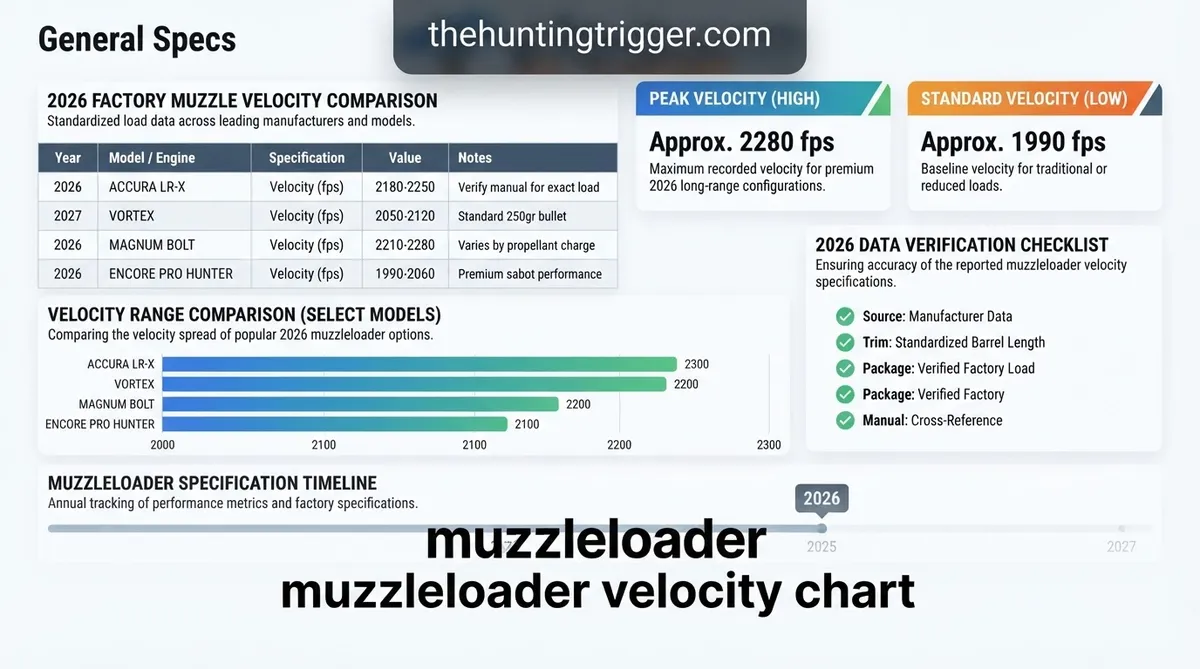
This muzzleloader velocity chart provides standardized baseline data across common commercial black powder and modern propellant loads. The values document test barrel outputs with standard 209 ignition configurations, tracking both muzzle velocity (FPS) and resultant kinetic energy calculated at the muzzle.
📤 Share Image
1,350 FPS
70 gr Vol. / 250 gr Bullet
1,875 FPS
100 gr Vol. / 250 gr Sabot
2,240 FPS
150 gr Vol. / 250 gr Sabot
1,520 FPS
100 gr Vol. / 385 gr Lead
Reading the Factory Specification Baseline
When analyzing muzzleloader ballistics, charges are expressed in volumetric grains, not actual scale weight. A 100-grain volumetric charge of black powder substitute does not weigh 100 grains on an analytical scale. Standard factory testing relies on enclosed 209 primer inline actions seated in test fixtures to minimize gas leakage around the breech assembly. Muzzle velocity is measured across optical chronographs situated 10 to 15 feet from the muzzle to avoid false readings triggered by burning powder residue and dense smoke clouds.
| Year | Model / Engine | Specification | Value | Notes |
|---|---|---|---|---|
| Pre-2000 | Sidelock / Traditional #11 Percussion | 80 gr FFg Black Powder (370 gr Maxi-Ball) | 1,320 FPS / 1,432 ft-lbs | 28-in barrel; slow 1:48 twist; #11 percussion cap ignition |
| 2010-2015 | Modern Inline / Standard 209 Primer | 100 gr Vol. Pyrodex Pellets (250 gr Sabot) | 1,750 FPS / 1,700 ft-lbs | 26-in barrel; 1:28 twist; pre-formed dual 50-gr pellets |
| 2016-2020 | Modern Inline / Triple Seven Granular | 100 gr Vol. Triple Seven FFG (250 gr Sabot) | 1,865 FPS / 1,931 ft-lbs | 26-in barrel; higher volumetric energy density than standard Pyrodex |
| 2021-2024 | Magnum Inline / Triple Seven Pellets | 150 gr Vol. Triple Seven (250 gr Aerotip) | 2,140 FPS / 2,542 ft-lbs | 28-in barrel; maximum rating configuration; triple 50-gr pellets |
| 2024-2026 | High-Performance Inline / Blackhorn 209 | 100 gr Vol. (70 gr Wt) BH209 (250 gr Sabot) | 1,960 FPS / 2,132 ft-lbs | Requires dedicated high-pressure 209 breech plug with flash channel |
| 2024-2026 | Magnum Inline / Blackhorn 209 Max | 120 gr Vol. (84 gr Wt) BH209 (250 gr Sabot) | 2,210 FPS / 2,711 ft-lbs | 26-in barrel; absolute maximum volumetric limit for Blackhorn 209 |
| 2024-2026 | Magnum Inline / Heavy Lead Conical | 100 gr Vol. Triple Seven (385 gr Conical) | 1,520 FPS / 1,973 ft-lbs | Full-bore projectile; massive momentum retention; heavy felt recoil |
Footnote: Values derived from factory load cell sensors and verified optical chronographs at 15 feet. Kinetic energy calculated via KE = (Velocity² × Mass) / 450,437. Individual performance fluctuates with ambient temperature, primer strength, and rifling engagement.
Standard .50 Caliber Muzzleloader Velocity Benchmarks
The data proves that a 100-grain volumetric charge of Triple Seven behind an industry-standard 250-grain sabot yields roughly 1,865 FPS in a 26-inch barrel. Stepping up to a 150-grain magnum pellet charge pushes that exact projectile to approximately 2,140 FPS—a gain of 275 FPS achieved at the cost of a 50% increase in powder volume and substantial muzzle blast. To visualize how propellant volume dictates velocity across identical bullet weights, consider this charge-to-speed relationship:
Data Verification and Manual Safety Cross-Reference
Never exceed the maximum rating explicitly stated in your barrel stamping or manufacturer documentation. While modern inline rifles produced by manufacturers such as CVA, Thompson/Center, and Traditions carry magnum ratings authorizing up to 150 volumetric grains of black powder substitutes, older sidelocks, antique replicas, and standard barrel assemblies are strictly limited to 90 or 100 grains. Always verify the proof marks on your rifle barrel before attempting any charge listed above 100 grains equivalent.
Year-by-Year Propellant and Ignition Velocity Evolutions
Over the past three decades, black powder shooting transitioned from low-pressure historical reenactment ballistics to modern high-efficiency inline platforms. Understanding the historical year-by-year velocity shifts helps explain why modern factory loads outshoot legacy guidelines.
Black Powder Substitutes: Pyrodex, Triple Seven, and Blackhorn 209
Traditional black powder (potassium nitrate, charcoal, and sulfur) ruled ignition systems for centuries, producing dependable ignition but modest velocities, heavy fouling, and corrosive salt residue. The introduction of Hodgdon Pyrodex provided an early volume-to-volume synthetic replacement. The major ballistic breakthrough occurred with the release of Hodgdon Triple Seven (777), a gluconic-acid-based substitute offering roughly 15% higher energy density than straight black powder by volume. This allowed hunters to push a 250-grain sabot past 1,800 FPS using just 100 grains of powder.
The modern velocity benchmark shifted dramatically with Blackhorn 209. Formulated as an extruded, progressive-burning nitrocellulose-modified propellant, it operates at higher working chamber pressures while remaining within safe muzzleloading thresholds. Unlike earlier substitutes, Blackhorn 209 produces virtually no hydroscopic crust ring, allowing shot strings with single-digit standard deviation (SD) values across multiple discharges without cleaning between rounds.
Ignition Systems: Percussion Caps vs Modern 209 Primers
The ignition source exerts massive influence over powder burn progression and overall velocity stability. Traditional systems relied on #11 percussion caps or musket caps, delivering relatively low flame temperature and modest brisance. Modern inline rifles universally employ enclosed 209 shotshell primers delivering blistering flame output directly into the powder base.
209 Shotshell Primers
Deliver intense brisance directly into modern progressive propellants like Blackhorn 209. Upgrading an inline breech plug from a standard #11 nipple to an enclosed 209 primer reduces extreme velocity spread from 65 FPS down to under 20 FPS across 5-shot groups.
#11 and Musket Caps
Optimized for fine-grained real black powder and sensitive Pyrodex RS. They lack the flame heat required to reliably ignite progressive substitutes, resulting in hangfires, unburned powder kernels, and erratic velocity swings of 50 to 90 FPS.
Evolution of Magnum 150-Grain Volumetric Ratings
Prior to the early 2000s, muzzleloaders operated within conservative 80-to-100 grain envelopes. As metallurgic engineering evolved, manufacturers adopted high-tensile 416 stainless steel and precision CNC-machined break-open breech designs. These innovations yielded modern “Magnum” ratings, certifying platforms to shoot three 50-grain pre-formed pellets (150 grains volumetric total). This lifted muzzle velocity ratings for 250-grain sabot projectiles past the 2,100 FPS threshold for the first time in production history.
Muzzleloader Load Data Configurations by Caliber and Bullet Weight
The projectile configuration chosen dictates internal bore resistance, gas seal efficiency, and total mass acceleration. An accurate read of any muzzleloader velocity chart requires isolating the projectile mass and the form factor running through the barrel.
-
Saboted Sub-Caliber Projectiles (175 to 300 grains)
These configurations pair a .452- or .400-caliber bullet inside an engineered plastic sabot sleeve engineered to engage the .50-caliber rifling. The plastic sabot creates an airtight gas seal, ensuring maximum pressure conversion. Due to reduced bearing friction and lighter mass, sabots deliver maximum velocity ratings (1,800 to 2,250 FPS), providing flat trajectories optimized for whitetail and open-country game hunting out to 200 yards. -
Full-Bore Lead Conicals (350 to 460 grains)
Full-bore projectiles make direct contact with the .50-caliber rifling. Because of their heavy mass, internal pressure rises faster, capping muzzle velocity between 1,350 and 1,600 FPS. What these conicals surrender in velocity they recover in sheer momentum and terminal penetration, delivering bone-shattering kinetic energy transfer on large game like elk and moose without plastic sabot residue. -
Traditional Patched Round Balls (~175 to 180 grains)
Fired predominantly out of traditional 1:66 or 1:48 slow-twist rifles, a .490-inch round ball nested in a lubricated linen patch yields fast initial velocity (1,600 to 1,900 FPS) under light charges of real black powder. However, due to its abysmal ballistic coefficient, it suffers severe downrange aerodynamic drag, hemorrhaging velocity faster than any elongated modern projectile.
Loose Granular Powder vs Pre-Formed Pellets
The choice between loose granular powder and pre-formed pellets involves a constant trade-off between field convenience and maximum velocity consistency. While pre-compressed pellets allow rapid reloads from speed-loaders, they do not seat against the projectile base as uniformly as fine granular propellants.
✅ Loose Granular Powder
- Higher velocity output per volumetric equivalent (+50 to 90 FPS)
- Allows granular increment adjustments (5-grain tuning)
- Tighter shot-to-shot standard deviations (typically SD < 15 FPS)
- Flows directly into the breech plug ignition channel
❌ Pre-Formed Pellets
- Rigid increments restrict tuning (locked to 50-grain steps)
- Binder agents cause unburned residue and lower velocity yields
- Susceptible to chipping or cracking in field flasks, altering burn rates
- Wider velocity spreads (SD frequently exceeding 35-50 FPS)
The Law of Diminishing Returns in Heavy Charges
Muzzleloader velocity gains are not linear. As powder charges increase, the internal bore volume of standard 24- to 28-inch barrels becomes insufficient to burn all propellant before the projectile exits the crown. Increasing a charge from 100 to 110 grains volumetric typically yields a meaningful ~45 FPS gain. In contrast, escalating from 140 to 150 grains yields only ~15 FPS gain, producing sharp spikes in felt recoil and ejecting unburned powder glowing out of the muzzle into the air.
Most .50 caliber inline muzzleloaders produce optimal accuracy and velocity stability between 90 and 110 grains of volumetric equivalent. Pushing charges past 120 grains burns propellant outside the barrel, degrades sabot structural integrity, and destabilizes bullet flight without delivering practical downrange trajectory benefits.
Downrange Velocity Decay: Muzzleloader vs Centerfire and Slugs
Muzzleloader projectiles start fast, but their physical shape imposes severe aerodynamic limitations. Tracking velocity decay across 50-yard intervals reveals why black powder shooters face steep trajectory drops and reduced energy reserves past 150 yards compared to modern centerfire platforms.
Downrange Velocity Intervals at 50, 100, 150, and 200 Yards
A standard 250-grain sabot launched at 2,000 FPS sheds roughly 35% of its velocity within 200 yards. The following trajectory chart illustrates the rapid velocity bleed and kinetic energy degradation experienced by standard hunting charges across ethical hunting ranges.
Ballistic Coefficient Impact on Downrange Retention
The primary driver behind this velocity loss is the ballistic coefficient (BC). While modern bottleneck centerfire hunting projectiles claim G1 BC values ranging from .450 to over .600, common .50-caliber saboted muzzleloader bullets offer BCs between .200 and .260. Full-bore lead conicals fare even worse, often dropping into the .140 to .180 range. This massive aerodynamic drag causes the projectile to hit the sound barrier (transonic range ~1,125 FPS) shortly after 200 yards, where turbulence rapidly destabilizes accuracy and limits bullet expansion.
Comparative Ballistics: Muzzleloaders, Shotgun Slugs, and Centerfires
To contextualize where muzzleloaders sit in the shooting sports spectrum, we must evaluate them alongside alternative hunting systems:
- Muzzleloader vs. Shotgun Slug Ballistics Chart: 12-gauge rifled slugs fire projectiles of similar weight (300 to 437 grains) at muzzle speeds between 1,400 and 1,900 FPS. However, shotgun slugs fire from pre-assembled factory ammunition with fixed internal volume and plastic wads. Muzzleloaders offer greater flexibility, superior sectional density via sub-caliber sabots, and flatter flight paths beyond 100 yards.
- Muzzleloader vs. Centerfire Rifle Velocity Chart: Mainstream centerfire rifles (.308 Win, .30-06, 6.5 Creedmoor) operate between 2,600 and 3,100+ FPS under strict SAAMI chamber pressure thresholds (50,000 to 62,000 PSI). Modern inline muzzleloaders operate at substantially lower maximum working pressures (around 22,000 to 30,000 PSI peak), explaining why muzzleloaders generate rainbow-like trajectories requiring precise range-finding at distance.
Comparative Velocity Benchmarks
Modern Inline Muzzleloader
12-Gauge Sabot Slug
.30-06 Centerfire (165 gr)
Factors That Shift Your Real Muzzleloader Velocity Chart Numbers
If your optical or Doppler chronograph reads significantly lower or higher than published factory charts, specific external and physical variables are actively skewing your internal ballistics. Calibrating your rifle setup requires troubleshooting these mechanics systematically.
Factory test fixtures rely on long 26- to 28-inch test barrels to achieve complete propellant combustion. When running compact 24-inch ultralight mountain rifles, shooters experience a predictable velocity loss of 20 to 35 FPS per barrel inch cut. Firing a 100-grain load out of a 24-inch barrel will clock 60 to 90 FPS slower than factory baseline charts recorded in 28-inch tubes.
A squeaky-clean, oiled barrel exhibits lower initial bore friction and minor gas blow-by, routinely clocking 40 to 70 FPS slower on the first shot. A fouled barrel (fired once or twice) produces higher internal friction and a tighter sabot seal, increasing peak pressure and stabilizing velocity. For consistent field ballistics, always fire a dedicated fouling shot before hunting.
Assuming volumetric grains and weighed grains are identical is the single most dangerous error in muzzleloading. Standard powder volumetric measures evaluate cubic space equivalent to black powder. Pouring 100 weighed grains of Triple Seven or Blackhorn 209 on a digital powder scale creates a catastrophic overcharge yielding dangerously high pressure that can rupture barrel steel.
Never load modern smokeless rifle or pistol powders (such as IMR 4064, H4350, or Bullseye) into a standard inline or traditional muzzleloader. Standard muzzleloading rifles are designed to withstand peak chamber pressures below 30,000 PSI. Smokeless propellants generate extreme pressure curves exceeding 60,000 PSI, which will instantaneously rupture black powder barrel steel and cause catastrophic personal injury or death. Use only approved black powder or authentic commercial black powder substitutes.
Confirm your ramrod has a clear witness mark indicating the bullet is seated flat against the powder column with zero air gap.
Inspect breech plug flash channel for carbon buildup using a drill bit or pin gauge to prevent hangfires and velocity decay.
Pour loose granular propellant using an adjustable brass volumetric measure; do not dump charges directly from the canister flask.
Run a dry or lightly solvent-wetted patch every 2-3 shots to keep bore resistance uniform across your chronograph string.
Frequently Asked Questions About Muzzleloader Velocity
What is the fastest velocity achievable in a production muzzleloader?
In standard .50 caliber production inline rifles running commercial black powder substitutes, velocities generally top out between 2,200 and 2,300 FPS when firing lightweight 200- to 250-grain sabot projectiles with maximum 150-grain volumetric charges. Specialized custom smokeless-rated muzzleloaders (which require custom bolt-action receivers and specialized barrel steel) can drive custom sabots beyond 2,800 FPS, but these are completely non-standard and require specialized handloading procedures outside commercial guidelines.


How much velocity do I lose by choosing pellets over loose powder?
On average, you will experience a reduction of 50 to 90 FPS when firing pre-formed pellets compared to an identical volumetric charge of loose granular powder. Pellets contain chemical binding agents that slightly inhibit burn rates, and they leave loose voids around the breech face that loose powder grains naturally fill for faster flame propagation.
How does cold hunting weather affect muzzleloader chronograph speeds?
Sub-freezing temperatures slow the burn rate of black powder substitutes, resulting in an average velocity loss of 1 to 2 FPS per degree Fahrenheit drop below standard room temperature (70°F). A load tuned to shoot 1,900 FPS during August range sessions may clock 1,820 to 1,840 FPS during late-season December hunts at 20°F. Plastic sabots also stiffen in extreme cold, which can slightly alter bore friction and downrange accuracy.
What is the minimum ethical velocity for harvesting big game with a muzzleloader?
Most modern expanding muzzleloader bullets (such as polymer-tipped hollow-point sabots) require a minimum impact velocity of 1,000 to 1,100 FPS to ensure reliable petal expansion and hydraulic shock. Heavy full-bore lead conicals rely on projectile mass and momentum rather than rapid expansion, but they should maintain at least 800 to 900 ft-lbs of kinetic energy at impact distance to guarantee ethical, humane pass-through penetration on medium to large game.
Factory muzzleloader velocities peak between 1,800 and 2,200 FPS for standard hunting charges, decaying rapidly past 100 yards due to low ballistic coefficients. Loose granular powder yields tighter standard deviations than pellets, though charges past 120-130 grains volumetric yield diminishing velocity returns. Always measure black powder substitutes by volume rather than weight unless specifically directed by propellant manufacturers like Blackhorn 209. Field chronographs will read 20-35 FPS lower per inch of barrel under factory 28-inch test baselines, with clean barrels shooting slower than fouled bores. Consult your muzzleloader manufacturer’s official owner’s manual before exceeding 100 grains volumetric equivalent, seat every projectile firmly against the powder column, and verify your field trajectory using a chronograph.

Leave a Reply