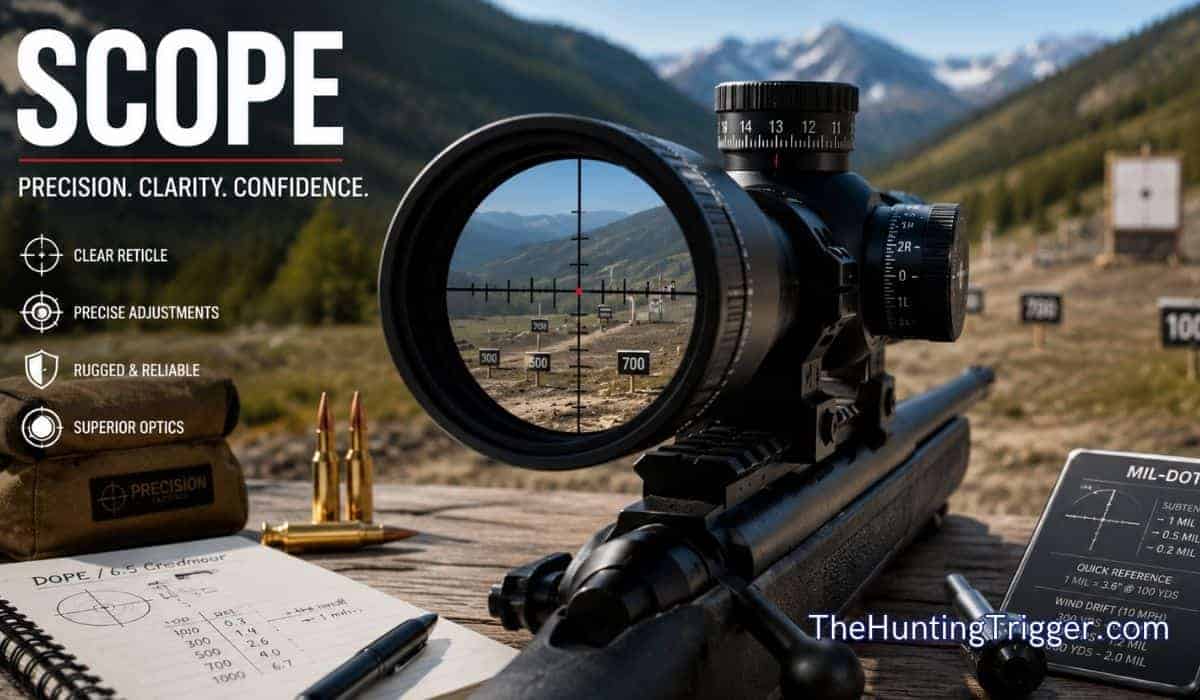
Reading a scope reticle is a skill that transforms your accuracy, whether you’re hunting, target shooting, or using a scope for tactical purposes. Many people own scopes, but not everyone knows how to use the reticle’s features. With modern optics, reticles are not just simple crosshairs—they can provide distance estimation, windage, elevation, and even holdover calculations.
Knowing how to read and use a reticle can save you time, ammunition, and frustration.
Table of Contents
What Is A Scope Reticle?
A scope reticle is the aiming point inside a rifle scope. The most basic reticle is the classic crosshair: two thin lines crossing at the center. However, today’s scopes offer many reticle styles, each serving a unique purpose. Some are simple, while others are packed with reference marks for range and wind adjustments.
Common Types Of Scope Reticles
Scopes come with a wide range of reticle designs. Here are the most common types:
| Reticle Type | Main Feature | Common Use |
|---|---|---|
| Duplex | Thick outer lines, thin in center | Hunting |
| Mil-Dot | Dots spaced along crosshairs | Range estimation, tactical |
| BDC (Bullet Drop Compensator) | Marks below center for holdover | Long-range shooting |
| MOA Reticle | Hash marks in Minutes of Angle | Precision target shooting |
| Christmas Tree | Multiple lines and dots for wind/elevation | Advanced tactical/long-range |
Duplex reticles are favored by hunters for their simplicity. The thicker lines help you center quickly, while the thin center allows precise aiming. Mil-Dot and MOA reticles are popular with those who need range estimation and correction without guessing. BDC reticles are designed to help with bullet drop over long distances, making them useful for open field shooting.
How Scope Reticles Work?
At the center of every reticle is the main aiming point. The rest of the reticle provides reference marks for adjusting your shot. Some reticles have extra marks or dots that let you compensate for bullet drop, wind, or moving targets.
Focal Plane: First Vs. Second
Scopes are usually built with either a first focal plane (FFP) or a second focal plane (SFP) reticle. The difference matters when you adjust magnification.
| Focal Plane | Reticle Size When Zoomed | Best For |
|---|---|---|
| First Focal Plane (FFP) | Reticle grows/shrinks with zoom | Range estimation at any magnification |
| Second Focal Plane (SFP) | Reticle size stays constant | Most hunting, general use |
With FFP, the reticle’s marks always match the scope’s adjustments, so range estimation works at any zoom. With SFP, the marks are only accurate at a specific magnification, usually the highest.
Reading The Reticle For Range Estimation
One of the most important features of advanced reticles is range estimation. If you know the size of your target, you can use the marks or dots on the reticle to estimate distance.
Mil-dot Range Estimation
Mil-Dot reticles use dots spaced one mil apart. “Mil” stands for milliradian, which is an angular measurement. At 100 yards, one mil covers about 3. 6 inches.
Here’s the formula for range estimation with a Mil-Dot reticle:
Distance (yards) = (Target Height in inches × 27.78) ÷ Mil reading
For example, if a deer is 18 inches tall at the shoulder and appears to fit between two mil-dots:
Distance = (18 × 27.78) ÷ 1 = 500 Yards
This method is reliable if you know the target’s size and use the correct magnification.
Moa Reticle Range Estimation
MOA (Minute of Angle) reticles use hash marks instead of dots. One MOA equals 1. 047 inches at 100 yards.
Formula for MOA range estimation:
Distance (yards) = (Target Size in inches × 95.5) ÷ MOA reading
If you measure a 20-inch target across 4 MOA hash marks:
Distance = (20 × 95.5) ÷ 4 = 477.5 Yards
This method is less common but works well for those familiar with MOA-based scopes.
Using Holdover And Windage Marks
Advanced reticles often have holdover and windage marks. Holdover marks help adjust for bullet drop, while windage marks help compensate for wind.
How Holdover Works
Bullets drop as they travel. The farther the target, the more you need to aim above it. Holdover marks below the main crosshair show where to aim for different distances. For example, if your bullet drops 12 inches at 300 yards, you use the holdover mark that matches 12 inches at that range.
Reading Windage Marks
Wind affects bullet flight. Windage marks (lines or dots to the left and right of the center) help you adjust your aim. If the wind is blowing left to right, you may need to aim using a right-side windage mark.
A common mistake is ignoring wind or guessing corrections. Instead, use the scope’s marks for a more precise adjustment.
Practical Tips For Reading Scope Reticles
- Know your reticle style. Each reticle has its own system. Read your scope’s manual to find out which reticle you have and what each mark means.
- Practice measuring targets. Use targets of known sizes to practice range estimation at the range.
- Memorize your bullet’s drop. Ballistics charts show how much your bullet drops at various distances. Match these drops to your reticle marks.
- Use a range card. Many shooters keep a card with common distances and holdover marks for quick reference.
- Don’t rely only on the center crosshair. The extra lines and dots are there to help—use them for faster, more accurate shooting.

Common Beginner Mistakes
- Using the wrong magnification with SFP reticles. If you don’t set your scope to the correct power, your range and holdover marks won’t be accurate.
- Estimating target size incorrectly. If you guess the wrong target size, your range estimation will be off.
- Ignoring environmental factors. Wind, air pressure, and even temperature can change bullet flight. Adjust using your reticle’s windage marks.
- Not confirming your zero. Always make sure your rifle and scope are zeroed at a known distance before relying on your reticle’s marks.
Comparing Reticle Features
Not all reticles are suited for every purpose. Here’s a quick comparison of popular reticle types and their best uses:
| Reticle | Best For | Key Limitation |
|---|---|---|
| Duplex | Quick aiming, hunting | No range estimation |
| Mil-Dot | Range, wind, elevation | Requires math, practice |
| BDC | Long range, quick shots | Pre-set for specific ammo |
| Christmas Tree | Advanced wind/elevation | Can be cluttered |
Advanced Insights Most Beginners Miss
One thing many shooters miss is the importance of matching your reticle’s system to your scope’s adjustment turrets. For example, if your reticle is in mil but your turrets adjust in MOA, calculations get confusing fast. It’s best to have both in the same system.
Another often overlooked detail is parallax error. At certain distances, your eye’s position behind the scope can shift the reticle slightly off the target. Many scopes have a parallax adjustment knob. Take time to adjust it for your shooting distance—this ensures the reticle stays on target even if your head moves a little.
Practice Makes Perfect
Reading a scope reticle is not just theory. Real skill comes from practice. Dry-fire drills (with no ammunition) are safe ways to practice holding the reticle steady, estimating range, and using holdover marks. At the range, shoot at targets at different distances and use your reticle for all corrections instead of adjusting your scope each time.
If possible, shoot in different weather and lighting conditions. Wind and sun can change the way you see the reticle or how the bullet moves. This kind of practice builds confidence and muscle memory.
Essential Gear For Using Reticles
While the scope is your main tool, a few accessories can help:
- Rangefinder: Confirms distance, letting you check your estimates.
- Ballistics app: Calculates bullet drop, wind drift, and more.
- Shooting mat: Keeps you steady and comfortable for longer sessions.
- Lens covers: Protect your scope from dust and scratches.
Many shooters also carry a small notebook to record experiences—what worked, what didn’t, and how the reticle responded at different ranges.
When To Adjust Scope Turrets Vs. Using The Reticle?
Some shooters always adjust their scope’s turrets for every shot. Others use the reticle’s marks to “hold over” or “hold off” instead. Which method is best?
- Adjust turrets: Best for long-range shots where you have time to dial in corrections. The reticle stays centered, reducing error.
- Use reticle holds: Fast and flexible, ideal for moving targets or when you must shoot quickly at different ranges.
For hunting or tactical use, using holdover with the reticle is usually faster. For slow, precise shooting (like long-range target matches), adjusting turrets is more precise.
Real-world Example
Suppose you’re shooting at a target 400 yards away. Your scope is zeroed at 100 yards. The bullet drop at 400 yards is 21 inches. If your reticle has hash marks every 5 inches at that distance, you would aim using the fourth mark below the crosshair.
If a 10 mph wind is blowing left to right, and your reticle shows windage marks for 5 mph each, you’d use the second mark to the right.
This method is faster than adjusting turrets and works well for unexpected targets.
Choosing The Right Scope Reticle
Picking the right reticle depends on your main use:
- For hunting, a duplex or simple BDC reticle is enough.
- For tactical shooting, Mil-Dot or Christmas Tree reticles offer more data.
- For precision target shooting, MOA or Mil-Dot reticles are best.
Avoid buying a scope with a busy reticle if you’re new to shooting. Too many lines or dots can distract instead of help.

Frequently Asked Questions
What Does “subtension” Mean In A Reticle?
Subtension is the amount of space a reticle’s mark covers at a specific distance. For example, a Mil-Dot reticle’s dots cover 3.6 inches at 100 yards. Knowing subtension helps you use the marks correctly for range or wind adjustments.
Is A First Focal Plane Reticle Better Than A Second Focal Plane?
It depends on your needs. First focal plane (FFP) reticles keep their marks accurate at any magnification, which is useful for range estimation. Second focal plane (SFP) reticles stay the same size, which is easier for fast shooting but only accurate for range at one zoom setting.
Can I Use A Bdc Reticle With Any Caliber?
BDC reticles are usually calibrated for a specific caliber and bullet speed. You can use them with other calibers, but the holdover marks won’t match perfectly unless you verify them at the range.
How Do I Use Windage Marks If The Wind Changes?
If the wind changes, estimate the new speed and use the corresponding windage mark. For example, if the wind doubles, move to the next mark. It’s common to split the difference if the wind is between two marks.
Do Illuminated Reticles Help With Reading The Scope?
Illuminated reticles can help in low light by making the marks easier to see. However, they do not change the function of the reticle for range estimation or holdover.
Last Word
A well-read scope reticle adds confidence and accuracy to every shot. With practice and the right knowledge, these marks become your best shooting partner.

Leave a Reply