
Updated September 24, 2026. The correct Traditions
.50 caliber load chart depends on the exact firearm. Traditions lists
separate official PDFs for non-FireStick models, NitroFire, and
NitroBolt. Match the model to its owner’s manual first, then open its
chart below. A shared caliber does not make the chart entries
interchangeable.


How this guide was prepared: The Hunting Trigger
editorial team reviewed Traditions’ online chart directory and
owner-manual library on September 24, 2026. No firearm was fired or
chronographed for this article. Its update date is the date of our
document review, not a claim that Traditions published new 2026 test
data.
Which
Traditions .50 caliber load chart applies to my model?
Start with the model name on the firearm and its matching
owner’s manual. Then open the corresponding chart from Traditions’
example
load chart library. The library separates non-FireStick, NitroFire,
and NitroBolt data.
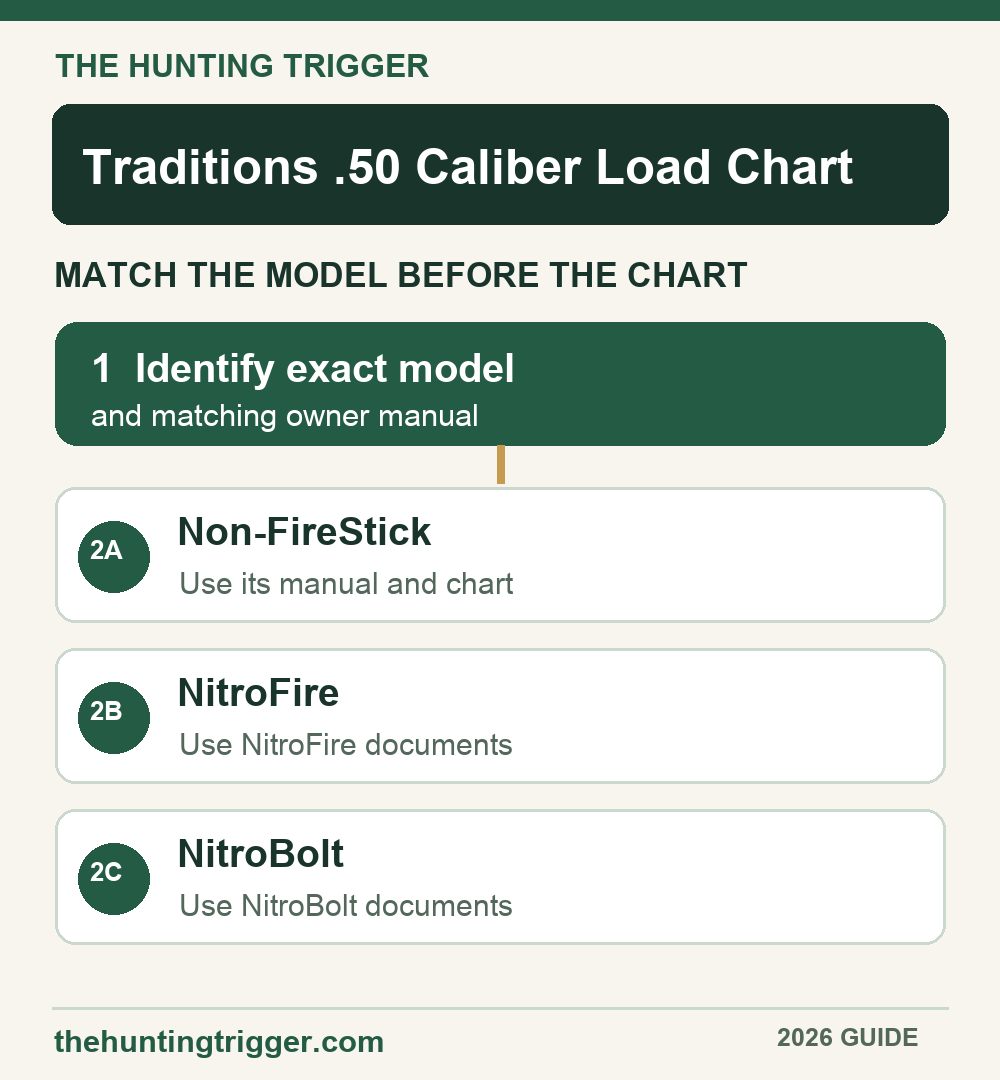
NitroFire, or NitroBolt chart.
| Traditions platform | Official chart | Manual to check |
|---|---|---|
| Non-FireStick .50 models | Traditions .50 caliber non-FireStick chart, revision 4, May 5, 2022 |
The manual for the exact model, plus any listed addendum |
| NitroFire | NitroFire .50 chart |
NitroFire manual |
| NitroBolt | NitroBolt .50 chart |
NitroBolt manual |
Do not transfer chart entries between platforms.
Traditions says the permitted powder amount varies by muzzleloader. Its
FAQ directs
owners to the firearm’s instruction manual for the appropriate
powder and projectile information.
The table is a document finder, not loading data. It
deliberately excludes charge and projectile combinations because a model
name alone may not identify every applicable limitation.
The manufacturer’s
chart directory is the source for these PDF links. Check that page
again before relying on a saved copy, as Traditions can replace its
files.
Where
can I find the official manual for a Traditions .50 muzzleloader?
Traditions keeps its product
owner manuals in a model-by-model library. The page lists
Buckstalker, Pursuit, Vortek, sidelock, NitroFire, NitroBolt, and other
manuals separately. It also lists addenda for certain variants.
The manufacturer specifically notes that some
models need an additional recommended load chart. It names the
Deerhunter rifle as an example. Check the full entry for the exact model
instead of downloading the first PDF with “.50” in its name.
For a used firearm with unclear markings or missing paperwork,
identify the model with Traditions before relying on a chart. The manufacturer’s support
page provides its contact details.
Is a
ballistic chart the same as a safe loading chart?
No. Traditions’ non-FireStick
PDF includes bullet, load, velocity, energy, and trajectory columns.
Those columns describe example combinations and their reported
performance. They do not replace the model’s safety manual.
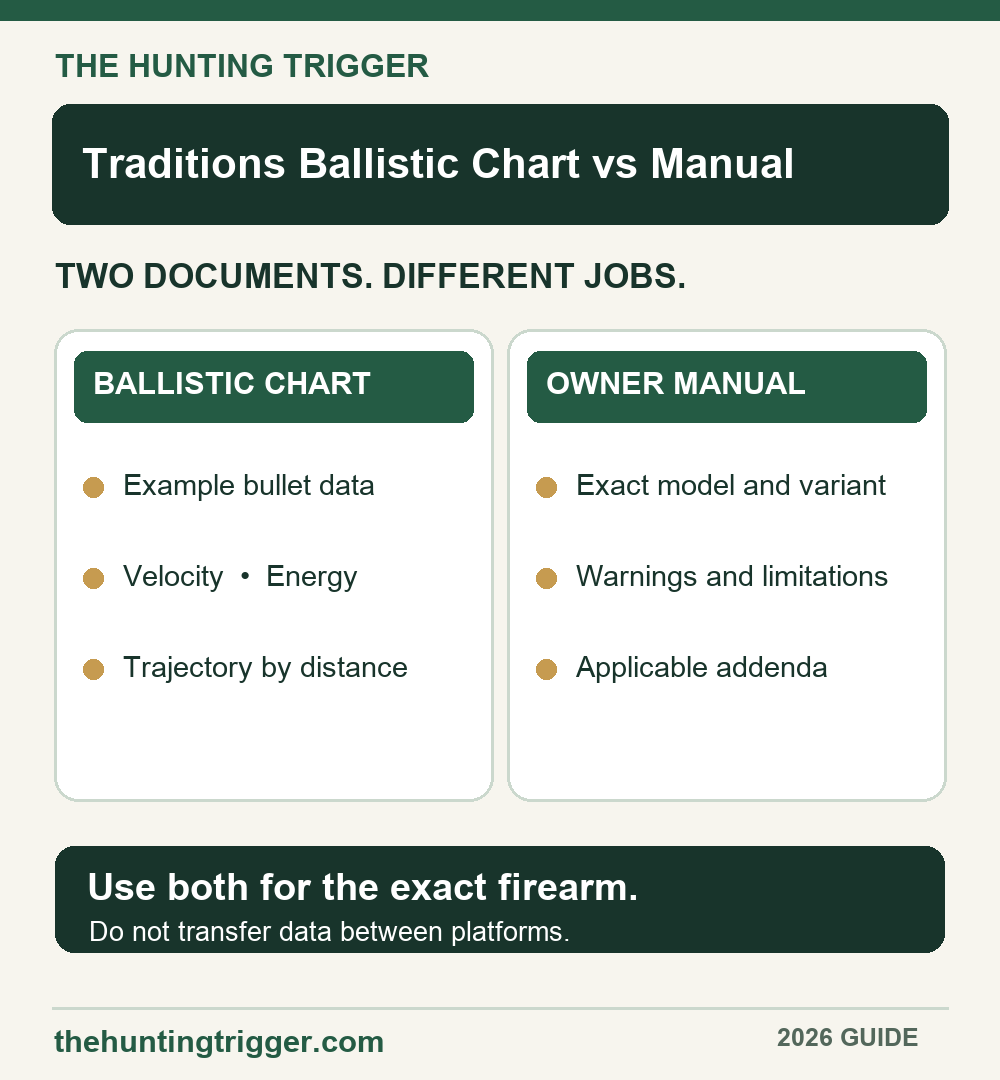
columns. Right: the matching owner’s manual supplies model-specific
warnings.
The PDF itself calls
its examples reference data. The reported trajectory is tied to
those specific examples. A different firearm, projectile, or sight setup
can produce a different result.
Read the manual’s warnings and the powder or projectile maker’s
instructions alongside any performance chart. The Buckstalker
XT manual explicitly points readers to manufacturer load
information.
Can a
NitroFire or NitroBolt use the non-FireStick chart?
No. Traditions publishes separate
charts for NitroFire and NitroBolt. Both are FireStick platforms,
and their manuals must govern any compatibility decision.
The NitroBolt
manual specifies factory-loaded Federal FireSticks. It rules out
loose or pelletized powder for that platform. The NitroFire
manual also describes its FireStick-specific system.
“Traditions .50 caliber” therefore describes bore size, not a shared
loading system. The system and exact model determine which documents
matter.
Why
do older Traditions manuals and charts look different?
Traditions maintains separate
manuals for older and newer models. Its manual page also warns that
some older PDFs contain outdated company contact information. That does
not make a newer model’s instructions interchangeable with an older
firearm.
The non-FireStick
ballistic PDF is marked revision 4, dated May 5, 2022. Check the
revision printed on any downloaded chart. If the model, revision, or
addendum seems uncertain, ask Traditions to identify the correct
documents.
How
do I read the columns in a Traditions ballistic chart?
The non-FireStick
PDF separates bullet data, load data, velocity, energy, and
trajectory. Read these headings together. A velocity or trajectory
figure belongs to its complete, manufacturer-listed row, not to every
.50 caliber model.
Bullet data identifies the projectile series and its
weight. Load data identifies the tested propellant
combination. Velocity is projectile speed,
energy is reported in foot-pounds, and
trajectory describes the path relative to the chart’s
sighting assumptions.


Keep the manual open while reading a chart. A chart row may look
relevant because the caliber matches, while the model or projectile
requirements do not. Treat any mismatch as a reason to stop and consult
the manufacturer.
The table above does not reproduce selected ballistic rows. Copying a
velocity while omitting its exact projectile, propellant, chart
revision, and manual context would turn a specific example into a
misleading general claim.
What if the model
or chart cannot be verified?
Do not infer a load from another .50 caliber Traditions rifle.
Traditions says maximums vary by
muzzleloader. Its manual
library also flags model-specific addenda.
Record the firearm’s model markings and contact Traditions
support. The manufacturer can point to the appropriate manual and
clarify whether an addendum applies. This is more reliable than a copied
chart with its heading or footnotes removed.

Leave a Reply