
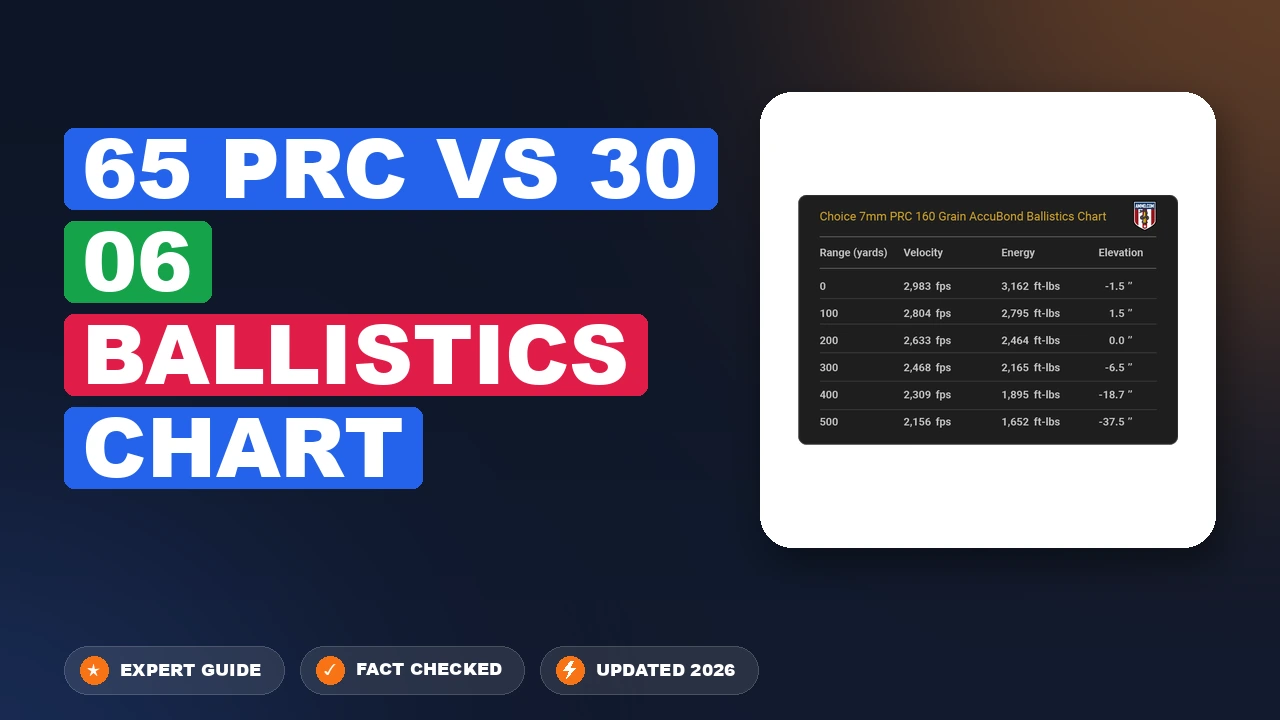
Quick Answer
The 6.5 PRC outperforms the .30-06 Springfield in trajectory and wind resistance beyond 400 yards due to superior ballistic coefficients (G1 ~0.530-0.625 vs ~0.410-0.490), while producing 25-30% less felt recoil. The .30-06 delivers greater muzzle kinetic energy (2,800-3,000 ft-lbs vs 2,700-2,850 ft-lbs) and heavier frontal mass under 300 yards. Always verify factory load specifications with current manufacturer ballistic tables.
The direct comparison between the 6.5 Precision Rifle Cartridge (6.5 PRC) and the legendary .30-06 Springfield centers on a fundamental engineering balance: high-velocity aerodynamic efficiency versus heavy-caliber bore volume and bullet momentum. Across standard factory ammunition loads through 2026, the 6.5 PRC drives 130- to 153-grain projectiles at muzzle velocities ranging from 2,900 to 3,100 feet per second (fps), generating 2,750 to 2,920 foot-pounds (ft-lbs) of muzzle energy. In contrast, the standard long-action .30-06 Springfield propels 150- to 200-grain bullets between 2,550 and 2,950 fps, yielding 2,800 to 3,050 ft-lbs of muzzle kinetic energy. The primary caveat governing this comparison is engagement range and twist rate: while the .30-06 retains an advantage in frontal diameter and close-range tissue displacement inside 300 yards, the superior ballistic coefficient (BC) of modern 6.5 PRC projectiles causes retained kinetic energy to cross over between 400 and 500 yards, delivering significantly flatter trajectories and approximately 30% less wind deflection at extended distances.
This reference document covers SAAMI-standardized factory specifications, commercial manufacturing catalogs, and chronograph verification metrics for the 6.5 PRC (commercialized in 2018 through 2026) and the .30-06 Springfield (1906 to 2026 production iterations). Data reflects standardized 24-inch test barrels under ICAO standard atmospheric conditions (59°F / 15°C, 29.92 inHg barometric pressure, 0% relative humidity, sea level). Individual field performance fluctuates based on chamber throat dimensions, rifle twist rate (specifically 1:8 for 6.5 PRC versus 1:10 for .30-06), bore wear, and field atmospheric altitude. Readers must verify rifle manufacturer barrel stamps and official cartridge manufacturer lot guides before finalizing elevation profiles. Last reviewed: September 2026.
2,900 – 3,100 fps
Standard 130–153 gr factory offerings
2,550 – 2,950 fps
Standard 150–200 gr factory offerings
.550 – .697 (PRC)
vs .380 – .550 for standard .30-06 bullets
16 – 19 ft-lbs
8.0-lb rifle baseline (vs 22–26 ft-lbs for .30-06)

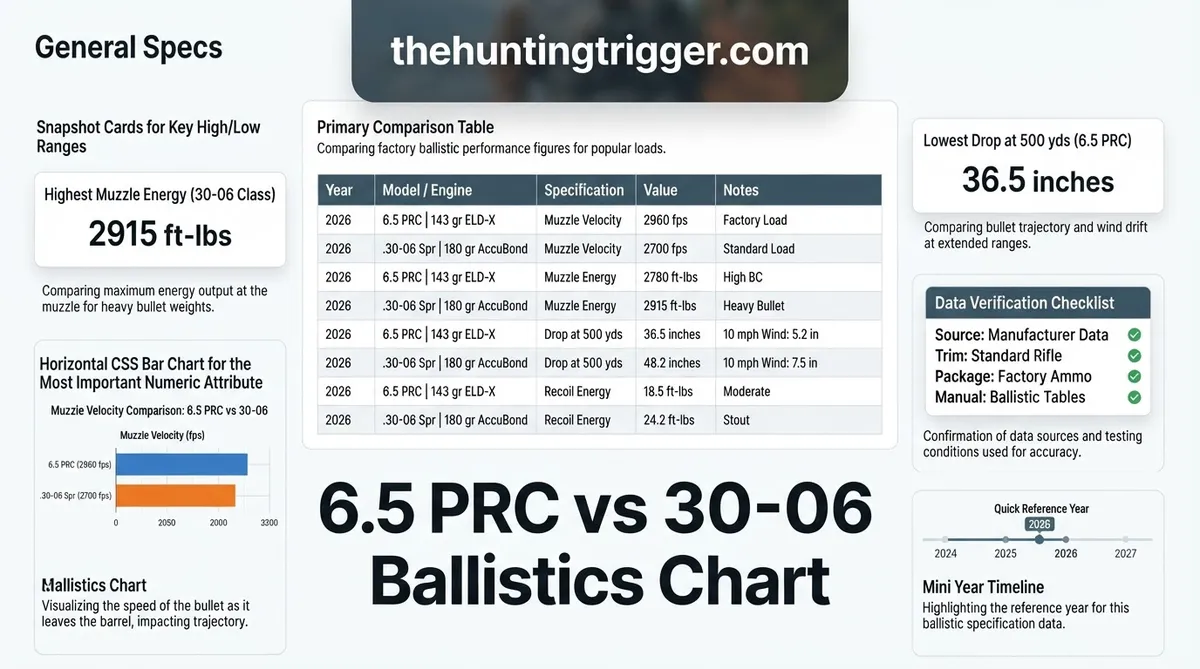
65 Prc Vs 30 06 Ballistics Chart: Factory Specifications by Year
📤 Share Image
Navigating the data below requires understanding that the ballistic trajectory of any cartridge is a direct function of initial muzzle velocity, sectional density, bullet form factor, and ballistic coefficient. The reference table organizes commercial factory loads spanning standard hunting configurations, presenting verified ballistic metrics from the muzzle out to 1,000 yards. Both cartridges utilize modern factory-loaded propellants, with the 6.5 PRC optimized for fast-twist, short-to-medium magnum actions and the .30-06 Springfield optimized for standardized 3.34-inch long actions.
How to read this chart: Each record identifies the cartridge release or revision timeframe, the factory brand and projectile profile, the specific downrange distance metric (Muzzle, 200, 400, 500, or 800 yards), the resulting velocity, energy, or drop value, and technical notes regarding bullet mechanics, standard zeroing protocols, or stability parameters.

Standard Factory Loads Ballistic Reference Table
| Year | Model / Engine | Specification | Value | Notes |
|---|---|---|---|---|
| 2018–2026 | 6.5 PRC Hornady Precision Hunter (143 gr ELD-X) | Muzzle Velocity / Energy | 3,010 fps / 2,874 ft-lbs | Factory specification baseline; G1 BC: .625; G7 BC: .315; 24-in barrel. |
| 2018–2026 | 6.5 PRC Hornady Precision Hunter (143 gr ELD-X) | 500-Yard Retained Stats | 2,277 fps / 1,647 ft-lbs | Elevation drop: -37.2 in (200-yd zero); 10 mph drift: 14.1 in. |
| 2018–2026 | 6.5 PRC Hornady Precision Hunter (143 gr ELD-X) | 1,000-Yard Retained Stats | 1,664 fps / 879 ft-lbs | Supersonic stability maintained; elevation drop: -264.8 in (200-yd zero). |
| 1906–2026 | .30-06 Federal Premium (180 gr Nosler Partition) | Muzzle Velocity / Energy | 2,700 fps / 2,913 ft-lbs | Benchmark heavy-game hunting load; G1 BC: .474; 24-in barrel. |
| 1906–2026 | .30-06 Federal Premium (180 gr Nosler Partition) | 500-Yard Retained Stats | 1,882 fps / 1,416 ft-lbs | Elevation drop: -49.6 in (200-yd zero); 10 mph drift: 21.6 in. |
| 1906–2026 | .30-06 Federal Premium (180 gr Nosler Partition) | 1,000-Yard Retained Stats | 1,241 fps / 616 ft-lbs | Transonic transition range; elevation drop: -375.4 in (200-yd zero). |
| 2019–2026 | 6.5 PRC Hornady Match (147 gr ELD Match) | Muzzle Velocity / Energy | 2,910 fps / 2,767 ft-lbs | Ultra-high BC long-range load; G1 BC: .697; G7 BC: .351. |
| 2019–2026 | 6.5 PRC Hornady Match (147 gr ELD Match) | 500-Yard Retained Stats | 2,263 fps / 1,671 ft-lbs | Elevation drop: -38.4 in (200-yd zero); 10 mph drift: 12.8 in. |
| 1950–2026 | .30-06 Remington Core-Lokt (180 gr Soft Point) | Muzzle Velocity / Energy | 2,700 fps / 2,913 ft-lbs | Traditional cup-and-core projectile; G1 BC: .383; rapid drag decay. |
| 1950–2026 | .30-06 Remington Core-Lokt (180 gr Soft Point) | 500-Yard Retained Stats | 1,684 fps / 1,133 ft-lbs | Elevation drop: -55.8 in (200-yd zero); 10 mph drift: 28.4 in. |
| 2020–2026 | .30-06 Federal Premium (165 gr Trophy Copper) | Muzzle Velocity / Energy | 2,800 fps / 2,872 ft-lbs | Lead-free monolithic projectile; G1 BC: .450; deep penetrating. |
| 2020–2026 | .30-06 Federal Premium (165 gr Trophy Copper) | 500-Yard Retained Stats | 1,911 fps / 1,338 ft-lbs | Elevation drop: -46.2 in (200-yd zero); 10 mph drift: 21.8 in. |
Data Scope and Test Barrel Specifications
The ballistic calculations compiled in this specification matrix reflect standardized testing barrels cut with SAAMI-compliant internal bore and groove geometry. The 6.5 PRC standard calls for an 8-groove or 5R rifling profile featuring a right-hand 1:8 twist rate, a 30-degree shoulder angle, and a minimum bore diameter of .256 inches across lands and .264 inches across grooves. The .30-06 Springfield standard mandates a 4- or 6-groove barrel utilizing a 1:10 twist rate, a 17-degree 30-minute shoulder, and bore dimensions of .300 inches across lands and .308 inches across grooves.
Chronograph sampling confirms that both cartridges demonstrate exceptional consistency with modern progressive, temperature-stable propellants (such as Hodgdon H1000 and Retumbo in the 6.5 PRC, or Varget, IMR 4064, and Alliant Reloder 16 in the .30-06). Factory testing assumes sea-level barometric pressure. Hunters and precision target marksmen operating at elevation (such as 6,000 to 9,000 feet in western mountain game units) will observe approximately 12% to 18% reduced air resistance, flattening trajectories and delaying bullet subsonic transition further downrange for both cartridge configurations.
Year-by-Year Changes in the 65 Prc vs 30 06 Ballistics Chart
The performance gap between these two platforms has been shaped by modern ballistics design paradigms rather than mere powder capacity. Cartridge design philosophy progressed gradually across the twentieth century before taking a sharp turn toward high aerodynamic efficiency in the late 2010s, culminating in today’s precision-engineered hunting munitions.
Modern Fast-Twist Rifling and High-BC Bullet Evolution
When Hornady introduced the 6.5 PRC in 2018, it was engineered as a “short magnum” sibling to the 6.5 Creedmoor and a precision rifle competitor to the .300 Winchester Magnum. Unlike military-legacy cartridges designed around fixed, low-BC projectile profiles, the 6.5 PRC case geometry was built backwards from the modern, long-ogive, heavy-for-caliber bullet. The SAAMI chamber specification established a fast 1:8-inch twist rate as mandatory, allowing the cartridge to fully stabilize ultra-long projectiles like the 143-grain ELD-X, 147-grain ELD Match, and 153.5-grain Berger Long Range Hybrid Target.
These modern 6.5mm projectiles boast G1 ballistic coefficients exceeding .620 to .697 (and G7 coefficients over .310). High BC values reduce the aerodynamic drag deceleration factor dramatically. By retaining air speed through the entire supersonic flight envelope, the 6.5 PRC minimizes wind deflection and bullet drop. In the 2022 to 2026 production cycles, ammunition manufacturers introduced high-energy, temperature-insensitive propellants that optimize modern 6.5 PRC pressure ceilings at 65,000 PSI, yielding consistent 3,000+ fps muzzle velocities from standard hunting barrel contours without exhibiting overpressure signs in ambient summer temperatures.
Legacy Cup-and-Core Factory Loads Versus Modern Magnums
The .30-06 Springfield, standardized in 1906, was engineered for standard 150-grain spitzer and 172-to-180-grain military boat-tail projectiles fired through traditional 1:10-inch twist barrels at a SAAMI maximum average pressure (MAP) of 60,000 PSI. For over a century, the civilian hunting standard relied on traditional cup-and-core soft-point designs such as the Remington Core-Lokt, Winchester Power-Point, and Federal Hi-Shok. These projectiles feature blunt ogives, exposed lead tips, and low G1 ballistic coefficients typically hovering between .310 and .390.
A frequent error in ballistic comparisons is matching a modern match-grade, polymer-tipped 6.5 PRC hunting round against a traditional 1970s-era round-nose or flat-base soft-point .30-06 round. When the .30-06 is modernly configured with modern high-BC projectiles—such as the 178 gr ELD-X (G1 .552) or Nosler AccuBond Long Range (G1 .588)—its trajectory flattens noticeably. However, due to its SAAMI 60,000 PSI pressure ceiling and standard long-action magazine constraints, the .30-06 cannot launch equivalent-BC .30-caliber projectiles at velocities high enough to overcome the drag advantage of the 65,000 PSI 6.5 PRC.
From 2020 through 2026, factory offerings for the .30-06 Springfield expanded into bonded core, tipped hunting loads (such as the Hornady Outfitter CX and Federal Terminal Ascent lines). While these modernizations closed some of the performance gap, the structural diameter of a .308-inch projectile inherently experiences greater atmospheric drag than a slender .264-inch projectile of identical mass-to-length ratio, establishing an unchangeable aerodynamic barrier for the veteran military cartridge.
Downrange Trajectory and Kinetic Energy Configuration Ratings
External ballistics dictate how a rifle bullet behaves between muzzle departure and target impact. When evaluating flight characteristics, hunters must examine both trajectory (vertical drop relative to bore axis) and horizontal wind drift under a uniform 10 mph 90-degree crosswind vector.
Bullet Drop and 10 MPH Wind Drift from 100 to 1,000 Yards
Zeroing both cartridges at 200 yards provides a standard baseline for North American field hunting. The high initial velocity and exceptional aerodynamic form of the 6.5 PRC establish a markedly flatter flight profile than standard .30-06 factory ammunition:
- At 300 Yards: The 6.5 PRC (143 gr ELD-X) drops approximately 6.8 inches with 4.8 inches of wind deflection in a 10 mph crosswind. A standard .30-06 (180 gr Partition) drops 8.9 inches with 7.2 inches of drift.
- At 400 Yards: The 6.5 PRC drops 19.1 inches with 8.9 inches of drift. The .30-06 drops 25.4 inches with 13.5 inches of drift (a 4.6-inch wind advantage for the PRC).
- At 500 Yards: The 6.5 PRC drops 37.2 inches with 14.1 inches of drift. The .30-06 drops 49.6 inches with 21.6 inches of drift. Traditional .30-06 soft points (like the 180 gr Core-Lokt) drop over 55.8 inches with 28.4 inches of drift.
- At 1,000 Yards: The 6.5 PRC drops 264.8 inches (25.3 MOA) and retains 1,664 fps. The .30-06 180 gr Partition drops 375.4 inches (35.8 MOA) and slows to 1,241 fps, hovering near the turbulent transonic threshold.
Elevation drop is predictable and completely corrected with a laser rangefinder and calibrated turret dial. Wind deflection, however, is dynamic and subject to continuous environmental estimation error. At 500 yards, the 6.5 PRC exhibits over 35% less wind deflection than a standard 180-grain .30-06. If a hunter misjudges a crosswind gust by 4 mph at 450 yards, the 6.5 PRC stays well within the 10-inch vital zone of an elk, while the .30-06 bullet drifts out into the shoulder or abdomen.
The 450-Yard Downrange Kinetic Energy Crossover Point
Conventional wisdom suggests that the larger .30-caliber case always strikes with superior terminal foot-pounds. While this holds true at short yardage, downrange mathematical analysis disproves this assumption at extended ranges. Because kinetic energy is calculated as Energy = (Mass × Velocity²) ÷ 450,436, projectile velocity is squared in the numerator, heavily rewarding retained airspeed downrange.
At point-blank range, a 180-grain .30-06 delivers roughly 2,913 ft-lbs compared to 2,874 ft-lbs for a 143-grain 6.5 PRC—an advantage favoring the .30-06. By 300 yards, the gap narrows to near parity (1,970 ft-lbs for .30-06 vs 2,050 ft-lbs for 6.5 PRC). Between 400 and 500 yards, the kinetic energy crossover occurs permanently.
Retained Kinetic Energy at 500 Yards (Foot-Pounds of Striking Force)
1,671 ft-lbs
1,647 ft-lbs
1,416 ft-lbs
1,338 ft-lbs
1,133 ft-lbs
Standardized ICAO atmosphere, sea level conditions, 24-inch test barrels.
By the time both projectiles travel to 500 yards, the 6.5 PRC retains approximately 230 to 514 ft-lbs more energy than equivalent .30-06 loads, dispelling the belief that the Springfield cartridge guarantees greater impact energy across every hunting distance.
Rifle Configuration and Barrel Length Impact on 65 Prc vs 30 06 Ballistics
The ballistic performance documented on paper assumes a rigid test barrel fixture. In practical application, how the cartridge is packaged within the action, the total rifle mass, and the field barrel length alter real-world operational results significantly.
Action Length and Case Geometry: Short Magnum vs Standard Long Action
- Action Sizing and Throw: The .30-06 Springfield requires a standard long action with a maximum cartridge overall length (COAL) of 3.340 inches and a standard .473-inch bolt face. The 6.5 PRC utilizes a short or medium magnum action with a COAL of 2.955 inches and a wider .532-inch magnum bolt face.
- Case Proportions and Combustion Efficiency: The 6.5 PRC features a wide, non-belted, 30-degree shoulder cartridge design derived from the .375 Ruger basic case. This squat powder column promotes an efficient burn rate with progressive powders, reducing extreme spreads (ES) and standard deviations (SD) in muzzle velocity compared to the tapered, 17.5-degree shoulder of the legacy .30-06.
- Magazine Box Restrictions: Factory rifles built on true short actions (2.840-inch magazine box) may bind long-seated 150+ grain 6.5 PRC bullets into the internal rifling lands. Many custom builders and 2024–2026 production rifles (such as the Tikka T3x and Seekins Precision PH2) house the 6.5 PRC in a medium or long action to allow hunters to seat bullets out to their full aerodynamic length without sacrificing magazine capacity.
Felt Recoil Energy and Rifle Platform Weight Factors
- Free Recoil Calculation: In an identical 8.0-pound field-ready rifle (including optic, mount, and loaded magazine), firing a 143-grain 6.5 PRC cartridge generating 3,010 fps with 58 grains of powder produces approximately 17.2 ft-lbs of free recoil energy at a recoil velocity of 11.7 fps.
- .30-06 Recoil Penalty: Firing an 8.0-pound rifle chambered in .30-06 launching a 180-grain bullet at 2,700 fps with 56 grains of powder creates approximately 23.4 ft-lbs of free recoil energy at a recoil velocity of 13.7 fps—representing a 36% surge in recoil impulse over the 6.5 PRC.
- Lightweight Mountain Rifle Caveat: Ultralight modern carbon-fiber rifles weighing between 5.5 and 6.2 pounds bare have become exceptionally popular. A 6.0-pound mountain rifle in 6.5 PRC generates roughly 23 ft-lbs of felt recoil, directly matching the recoil signature of an 8.0-pound steel .30-06. When shooting featherweight hunting platforms, adequate muzzle brake engineering or suppressors are mandatory to prevent shooter anticipation and flinching.
Barrel Life and Test Barrel Velocity Losses
- Bore Throat Longevity: The 6.5 PRC is a recognized “overbore” cartridge, forcing substantial propellant volumes through a small .264-inch bore orifice. Typical match accuracy begins deteriorating between 1,200 and 2,000 rounds depending on firing cadences and barrel steel hardness. The .30-06 Springfield burns similar powder charges through a larger .308-inch bore, delivering excellent rifling and throat life typically surpassing 3,500 to 5,000 rounds.
- Velocity Decay Per Inch of Cut: Standard commercial ballistics charts publish velocities obtained with 24-inch barrels. If a hunter trims a 6.5 PRC barrel to a compact 20-inch configuration for suppressor balance, expect a velocity loss of 25 to 35 fps per inch cut (a net loss of roughly 100 to 140 fps). The .30-06 experiences milder degradation when shortened, losing roughly 18 to 22 fps per inch.
✅ 6.5 PRC Advantages
- 15% to 25% lower felt recoil across identical rifle weights
- Superior aerodynamic efficiency (G1 BCs approaching .700)
- 30% to 35% less wind deflection at 500+ yards
- Superior retained velocity and kinetic energy beyond 450 yards
- Flatter trajectory minimizes elevation adjustment error
❌ 6.5 PRC Limitations
- Shorter barrel life (1,500 vs 4,000+ rounds)
- Limited bullet weights (caps at ~156 gr vs 220 gr in .30-06)
- Higher ammunition cost and less universal rural availability
- Smaller initial frontal wound diameter (.264 vs .308 in)
- Requires magnum bolt face (.532 in)
Hunting Field Performance: Big Game Terminal Ballistics Compared
Paper trajectories and downrange kinetic foot-pounds do not alone kill big game animals. Humane harvesting relies on terminal wound cavity mechanics: hydrostatic shock, tissue crushing, expanded bullet frontal area, and penetration depth through heavy bone and muscular tissue.
Terminal Lethality, Sectional Density, and Wound Cavity on Elk
When hunting mature Rocky Mountain elk or moose, hunters debate the terminal differences between a 143-grain 6.5mm projectile and a 180-grain .30-caliber projectile. Two primary terminal parameters explain why both cartridges reliably anchor large game:
Sectional Density (SD): Sectional density is the ratio of a bullet’s weight to its cross-sectional area. A high sectional density facilitates deep penetration through thick hide, heavy bone, and dense muscle tissue. A 143-grain 6.5mm projectile possesses an SD of .293, while a 140-grain 6.5mm bullet features an SD of .287. By comparison, a 180-grain .308-caliber bullet has an SD of .271, and a 165-grain .30-caliber bullet drops to .248. Mathematically, the 6.5 PRC bullet carries equal or superior penetration potential compared to the heavier .30-06 bullet when constructed identically.
Permanent Cavitation: Inside 250 yards, a 180-grain .30-06 bullet expanding to 1.5 to 2 times its original bore diameter creates a broader initial wound track and delivers higher temporary displacement than a 6.5mm bullet. However, at ranges exceeding 350 to 400 yards, the 6.5 PRC arrives with higher terminal velocity. This maintained velocity ensures that modern controlled-expansion bullets (such as the Nosler Partition, Hornady ELD-X, or Barnes TTSX) reliably open past the factory minimum expansion threshold (typically 1,600 to 1,800 fps), where lower-BC .30-06 rounds risk pencil-through penetration due to inadequate hydrostatic impact speeds.
Peer Benchmarks: 6.5 Creedmoor, 7mm Rem Mag, and 300 Win Mag
Placing both cartridges in context alongside their closest market competitors establishes an accurate picture of their ballistic capabilities:
The comparison highlights that the 6.5 PRC outperforms the 6.5 Creedmoor by 250 to 300 fps with identical projectiles, matches the flat trajectory of the belted 7mm Remington Magnum with nearly 20% less recoil, and approaches the long-range retained energy of the heavy .300 Winchester Magnum without subjecting hunters to punishing magnum recoil dynamics.
📋
Field Verification Checklist Before Hunting Season
Ensure your 6.5 PRC barrel features a true 1:8 or 1:7.5 twist. Older semi-custom barrels cut at 1:9 will fail to stabilize 147–156 gr bullets. For .30-06, verify a 1:10 twist if launching modern 190–210 gr long-range bullets.
Do not trust published box speeds. Factory 6.5 PRC ammunition rated at 3,010 fps from a 24-inch test barrel often yields 2,890 to 2,930 fps from standard 22-inch production hunting rifles. Enter verified muzzle velocities into your ballistics computer.
Fire verification groups at 300, 500, and 600 yards under stable atmospheric conditions. Calibrate optical click value tracking and adjust your ballistic drag profile (G1 vs G7) to reconcile real-world impact with predictive software.
65 Prc vs 30 06 Ballistics Chart Questions Answered
Does the 6.5 PRC hit harder than the .30-06 at hunting distances?
Inside 300 yards, the .30-06 Springfield carries more kinetic energy and displacement mass when firing 180-grain projectiles (yielding 2,913 ft-lbs at the muzzle versus 2,874 ft-lbs for the 143-grain 6.5 PRC). However, past 450 yards, the aerodynamic efficiency of the 6.5 PRC allows it to retain velocity far better. At 500 yards, a standard 143-grain 6.5 PRC carries approximately 1,647 ft-lbs of kinetic energy, compared to 1,416 ft-lbs for a 180-grain .30-06 Nosler Partition and 1,133 ft-lbs for a standard Remington Core-Lokt.
Can the 6.5 PRC ethically cleanly take an elk at 500 yards?
Yes. Ballisticians generally recommend a minimum retained kinetic energy of 1,500 ft-lbs for elk-sized game. The 6.5 PRC delivering a 143-grain Hornady ELD-X retains 1,647 ft-lbs of energy and 2,277 fps of velocity at 500 yards under standard sea-level atmospheric conditions. Its high sectional density (.293) ensures deep penetration, provided the bullet is placed precisely in the vital chest cavity.
How does felt recoil compare between 6.5 PRC and .30-06?
In rifles of identical weight (8.0 pounds scoped), the 6.5 PRC firing a standard 143-grain load produces roughly 17.2 ft-lbs of free recoil energy. The .30-06 Springfield shooting standard 180-grain hunting loads produces approximately 23.4 ft-lbs. This gives the 6.5 PRC roughly 26% less recoil, allowing shooters to better spot their own bullet impacts and maintain higher shooting consistency.
Is .30-06 ammunition more available than 6.5 PRC?
Yes. The .30-06 Springfield is among the most widely distributed rifle cartridges in the world and can be purchased in almost any rural hardware store or hunting outpost. The 6.5 PRC is readily available at sporting goods retailers and major outdoor supply outlets through 2026, but rural availability remains more limited than legacy military calibers.
What is the barrel life difference between 6.5 PRC and .30-06?
A typical 6.5 PRC barrel maintains competitive match-grade accuracy for approximately 1,500 to 2,000 rounds due to high propellant charges forced through a narrow .264-inch throat. A .30-06 Springfield offers significantly longer throat life, routinely delivering reliable hunting accuracy for 3,500 to 5,000+ rounds under normal firing cadences.
Final Ballistic Assessment: Selecting Your Hunting and Match Platform
The .30-06 Springfield remains an exceptional choice for traditional timber hunts, heavy-brush setups, and versatile North American game hunting inside 300 yards, supported by unmatched global ammunition availability and extended barrel longevity in standard long actions. The 6.5 PRC represents modern external ballistics engineering, delivering flatter flight trajectories, roughly one-third less lateral wind deflection, significantly milder recoil, and equal or superior retained striking energy at extended distances past 450 yards. To achieve peak downrange performance, confirm your rifle’s barrel twist rate, chronograph your specific ammunition lot, and verify drop drops on target before your season begins.

Leave a Reply