
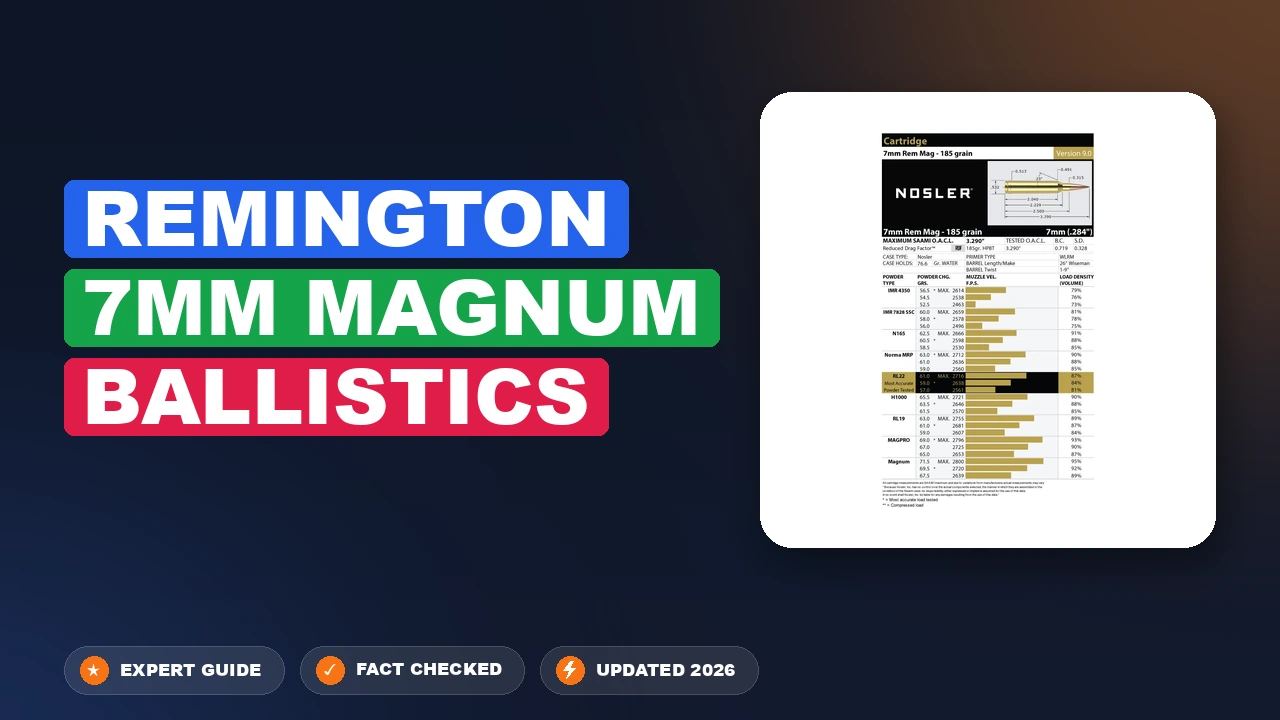
Remington 7Mm Magnum Ballistics: Complete Guide 2026
The 7mm Remington Magnum stands as a legendary cartridge, revered by hunters and long-range shooters for its potent blend of velocity, flat trajectory, and considerable knockdown power. While its reputation precedes it, truly understanding the intricate ballistics of the 7mm Rem Mag—from its initial acceleration to its terminal performance—is key to unlocking its full potential and making informed choices for your next hunt or shooting endeavor. This comprehensive guide dives deep into Remington 7mm Magnum ballistics, providing a trusted, expert analysis of its performance, comparisons to other popular calibers, and practical advice to optimize your shooting experience in 2026.


Understanding Remington 7mm Magnum Ballistics: Core Science for 2026
To truly appreciate the prowess of the 7mm Remington Magnum, it’s essential to grasp the fundamental ballistic principles that dictate its performance. This cartridge, based on the belted .375 H&H Magnum case, shortened and necked down to accept a .284-inch diameter bullet, was designed for speed and power. Our exploration of Remington 7mm Magnum ballistics begins with these core scientific attributes.
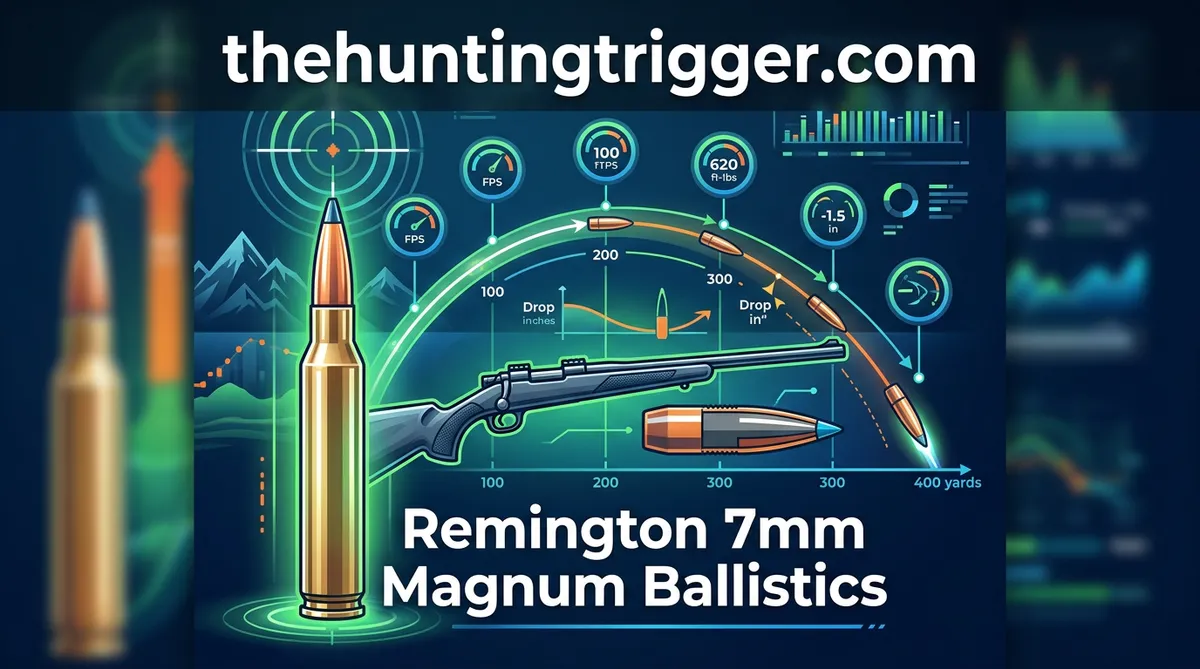
📤 Share Image

Defining Muzzle Velocity and Energy for the 7mm Rem Mag
At the heart of any cartridge’s capability are its Muzzle Velocity (MV) and Muzzle Energy (ME). Muzzle velocity is the speed at which the bullet exits the barrel, measured in feet per second (fps). Muzzle energy, measured in foot-pounds (ft-lbs), represents the bullet’s kinetic energy at the muzzle—a direct indicator of its initial stopping power. For the 7mm Rem Mag, these figures are consistently impressive, contributing to its reputation as a hard-hitting, reliable hunting round. Higher MV generally translates to a flatter trajectory, while greater ME ensures adequate penetration and tissue damage.
Decoding Ballistic Coefficient and Sectional Density (.284-inch Bullet)
Beyond initial speed and power, two critical factors influence a bullet’s flight path and terminal performance: Ballistic Coefficient (BC) and Sectional Density (SD). The BC quantifies a bullet’s aerodynamic efficiency—how well it overcomes air resistance. A higher BC means the bullet sheds velocity more slowly, resulting in less bullet drop and wind drift over distance. Given that the 7mm Rem Mag utilizes .284-inch diameter bullets, many modern projectile designs are highly optimized for excellent BC values. Similarly, Sectional Density (SD) relates to the bullet’s mass relative to its cross-sectional area, impacting its penetration potential. Research indicates that bullets with high SD tend to penetrate deeper, which is crucial for ethical hunting of larger game. For instance, a 160-grain .284-inch bullet often boasts a very favorable SD, allowing for deep penetration on robust game animals.
Trajectory, Bullet Drop, and Wind Drift Explained for Long-Range Shots
The interplay of MV, BC, and gravity defines a bullet’s trajectory—its curved path from muzzle to target. For the 7mm Rem Mag, its high velocities produce a remarkably flat trajectory, reducing the need for significant holdover at common hunting distances. However, bullet drop is an undeniable force, increasing exponentially with distance. Understanding your chosen load’s drop at various ranges is paramount for precise shot placement. Equally important is accounting for wind drift, the horizontal displacement of the bullet caused by crosswinds. This is where a high BC bullet for the 7mm Rem Mag truly shines; its aerodynamic efficiency minimizes wind’s disruptive effect, making it a superior choice for challenging long-range shots. Terminal ballistics, the final stage of bullet performance, then governs how effectively the bullet transfers its energy to the target upon impact, critical for a clean kill.
Always zero your 7mm Rem Mag rifle for a distance relevant to your typical hunting or shooting environment (e.g., 200 yards). This provides a reliable starting point for estimating bullet drop and simplifies holdover calculations for varied ranges, enhancing your overall accuracy and confidence.
Practical Remington 7mm Magnum Ballistics: Performance & Applications
The theoretical understanding of ballistics translates directly into the practical field performance of the 7mm Remington Magnum. Its blend of power and precision has solidified its place as a go-to cartridge for a diverse range of shooting activities, from hunting robust big game animals to engaging targets at extended distances. The quality of this cartridge’s ballistic profile makes it a consistently reliable performer.
Typical Muzzle Velocities and Energies Across Bullet Weights
The 7mm Remington Magnum, with its .284-inch bullets, typically handles weights ranging from 140-175 grains, though lighter and heavier options exist. These bullet weights yield impressive muzzle velocities and energies. Research indicates that a standard factory load for the 7mm Remington Magnum cartridge will generally produce muzzle velocities between 2800 and 3300 feet per second (fps) and muzzle energies from 3000 to 4000 foot-pounds (ft-lbs). These figures underscore its potent capabilities.
Determining the Effective Hunting Range for 7mm Rem Mag
For most hunters, the 7mm Rem Mag offers an effective hunting range generally considered to be 300-600 yards, provided the shooter is proficient and using appropriate ammunition. Within 300 yards, its flat trajectory makes shots relatively straightforward. As distances extend towards 400-500 yards, precise rangefinding, wind estimation, and understanding bullet drop become crucial. Beyond 500 yards, the cartridge still retains significant energy, but the practical challenges of ethical shot placement increase substantially, requiring advanced marksmanship skills and a deeper understanding of external ballistics. Factors like bullet design, barrel length, and atmospheric conditions can subtly influence these ranges, making consistent practice vital.
Choosing the Right Bullet Weight for Big Game Animals
Selecting the optimal bullet weight for your quarry is a hallmark of a professional hunter. For light-bodied big game such as deer and antelope, lighter, faster bullets in the 140-150 grain range are often preferred. Their high velocity results in minimal drop and excellent energy transfer for rapid, humane kills. For medium-to-large game like elk, black bear, and larger deer species, bullets in the 160-175 grain range are ideal. These heavier projectiles offer superior sectional density and retain more energy downrange, ensuring adequate penetration for vital organ disruption even through heavy bone and muscle. For dangerous game, while the 7mm Rem Mag can be used for some species, specialized bullets with bonded cores or monolithic construction in the heaviest weights are paramount to ensure deep, straight-line penetration.
By The Numbers: 7mm Rem Mag Performance
Bullet Diameter (inches)
Common Bullet Weights (grains)
Max Muzzle Velocity (fps)
Max Muzzle Energy (ft-lbs)
Optimizing Your Remington 7mm Magnum Ballistics: Recoil, Accuracy & Reloading
While the 7mm Rem Mag delivers exceptional power, maximizing its potential requires attention to practical considerations such as recoil management, bullet selection, and rifle customization. Our expert guidance will help you fine-tune your setup for superior accuracy and a more enjoyable shooting experience. Achieving optimal Remington 7mm Magnum ballistics is a holistic endeavor.
Managing 7mm Remington Magnum Recoil for Consistent Accuracy
The 7mm Remington Magnum delivers moderate to heavy recoil, which can impact accuracy if not properly managed. While it offers a good balance of power, range, and manageable recoil for a magnum cartridge of its class, various techniques can further mitigate felt recoil:
- Rifle Weight: Heavier rifles absorb more recoil. A rifle weighing 8-9 pounds (without optics) can significantly dampen the kick.
- Recoil Pads: Modern, high-quality recoil pads are highly effective at absorbing and dissipating energy.
- Muzzle Brakes: These devices redirect propellant gases, significantly reducing felt recoil (often by 30-50%). However, they increase muzzle blast and noise, requiring hearing protection.
- Proper Shooting Technique: A firm, consistent stance, good cheek weld, and proper shoulder placement are fundamental to managing recoil and maintaining accuracy.
- Adjustable Stocks: Some modern rifles feature adjustable length of pull and comb height, allowing for a custom fit that enhances comfort and reduces felt recoil.
Effective recoil management leads to greater shooting comfort, reduced flinching, and ultimately, more consistent accuracy, especially on follow-up shots.
Matching Bullet Construction for Reliable Terminal Ballistics
The choice of bullet construction is paramount for achieving reliable terminal ballistics and ensuring ethical hunting. Different bullet designs are optimized for various game sizes and ranges:
- Rapid Expansion: Soft-point or polymer-tipped bullets are excellent for smaller deer and varmints, offering quick, dramatic expansion.
- Controlled Expansion: Bonded-core or partition-style bullets are ideal for medium-to-large game like elk. They expand reliably but retain most of their weight, allowing for deep penetration and a large wound channel.
- Monolithic Solid: For very large or dangerous game (if using the 7mm Rem Mag), solid copper bullets are preferred for their exceptional weight retention and penetration, often without fragmentation.
Always match the bullet’s intended performance with the game you’re pursuing. A bullet designed for rapid expansion on deer will likely fragment too quickly on an elk, failing to reach vital organs.
The Professional Guide to Barrel Twist Rate and Custom Reloading
For the discerning shooter aiming for peak accuracy, understanding barrel twist rate and embracing custom reloading are essential. The barrel twist rate determines how quickly a bullet spins as it travels down the bore. For the 7mm Rem Mag, a common twist rate is 1:9 or 1:9.5 inches, meaning the bullet completes one full rotation in 9 or 9.5 inches of barrel length. This twist rate is generally effective for stabilizing a wide range of .284-inch bullet weights, particularly those from 140 to 175 grains. However, if you plan to shoot exceptionally heavy-for-caliber bullets (e.g., beyond 180 grains for long-range precision), a faster twist rate (e.g., 1:8) may be necessary to ensure optimal stabilization and accuracy. Rifle scopes and optics must also be of sufficient quality and clarity to capitalize on the cartridge’s long-range capabilities.
Custom reloading with specialized reloading equipment offers unparalleled control over your ammunition’s ballistic performance. Reloaders can fine-tune powder charges, bullet seating depth, and primer choices to achieve specific muzzle velocities, reduce standard deviation, and enhance accuracy far beyond factory ammunition. This level of customization allows you to tailor loads precisely to your rifle’s preferences and your specific shooting needs, unlocking the true potential of Remington 7mm Magnum ballistics.
Comparing Remington 7mm Magnum Ballistics to Other Popular Calibers
Understanding the strengths of the 7mm Remington Magnum is often best achieved through comparison with other popular and established cartridges. This provides a clearer perspective on its niche and highlights why it remains a trusted choice for many in 2026. This comparative analysis offers valuable information for any shooter or hunter.
7mm Rem Mag vs. .30-06 Springfield: A Ballistic Showdown
The comparison between the 7mm Rem Mag and the venerable .30-06 Springfield is perennial. The .30-06 is a classic, highly versatile cartridge, often seen as a benchmark. While the .30-06 can handle a broader range of bullet weights (110-220+ grains), the 7mm Rem Mag typically offers a flatter trajectory and higher muzzle velocities, especially with medium-to-heavy bullets. For instance, a 165-grain .30-06 might achieve 2800 fps, while a 160-grain 7mm Rem Mag can exceed 3000 fps. This velocity advantage translates to less bullet drop at extended ranges, making the 7mm Rem Mag a superior choice for shots beyond 300 yards. The .30-06, however, generally produces slightly less recoil and can utilize heavier bullets, offering a marginal advantage for extremely large game at closer ranges where penetration is paramount.


Comparing 7mm Rem Mag to the .270 Winchester for Flat Trajectory
Both the 7mm Rem Mag and the .270 Winchester are renowned for their flat trajectories, making them excellent choices for open country hunting. The .270 Winchester, firing .277-inch bullets typically from 130-150 grains, is often praised for its mild recoil and excellent velocity. However, the 7mm Rem Mag generally surpasses the .270 in both velocity and energy, particularly with heavier bullet weights. A 130-grain .270 Win might achieve 3100 fps, similar to a 140-grain 7mm Rem Mag, but the 7mm Rem Mag can effectively launch 160-175 grain bullets at speeds the .270 cannot match. This allows the 7mm Rem Mag to retain more energy downrange and offer better wind resistance due to higher BC bullet options, making it the more capable cartridge for truly long-range applications and larger game animals.
Remington 7mm Magnum vs. .300 Win Mag and 7mm PRC Ballistics
When stepping up in power, the .300 Winchester Magnum is a frequent comparison. The .300 Win Mag fires heavier .308-inch bullets (150-200+ grains) at high velocities, yielding greater muzzle energy and better performance on extremely large or dangerous game. However, this comes at the cost of significantly increased recoil. For the majority of North American big game, the 7mm Rem Mag offers sufficient power with more manageable recoil, making it a more comfortable and often equally effective choice for most hunters. For a trusted guide, the 7mm Rem Mag balances performance and shootability expertly.
The newer 7mm PRC (Precision Rifle Cartridge) represents a modern advancement designed with long-range precision in mind. The 7mm PRC is non-belted, features a faster twist rate (typically 1:8), and is optimized for modern, high-BC, heavy-for-caliber 7mm bullets (160-190 grains). While the 7mm Rem Mag is a classic magnum performer, the 7mm PRC often surpasses it in certain modern applications, particularly regarding extreme long-range ballistics, thanks to its ability to stabilize longer, more aerodynamic projectiles. The 7mm PRC typically offers a slight edge in velocity and significantly better BC potential with heavier bullets, resulting in less wind drift and bullet drop at distances beyond 800-1000 yards. However, the 7mm Rem Mag remains widely available, more affordable, and perfectly adequate for the vast majority of hunting and long-range shooting scenarios up to 600-800 yards, especially with modern bullet designs. As an expert, I note the 7mm PRC as a strong contender in specialized long-range niches, but the 7mm Rem Mag retains its broad appeal and utility.
The Remington 7mm Magnum delivers an exceptional balance of velocity, energy, and a flat trajectory, making it a versatile choice for medium-to-large game and long-range shooting. Understanding key ballistic factors like BC, SD, MV, and ME is crucial for maximizing the cartridge’s performance. Careful selection of bullet weight and construction, along with recoil management, can significantly enhance your experience. While formidable, comparing its ballistics to other cartridges like the .30-06, .270, .300 Win Mag, and the newer 7mm PRC helps shooters identify its ideal role and confirm its enduring legacy. Armed with this professional insight into Remington 7mm Magnum ballistics, you’re now better equipped to choose the right ammunition, optimize your rifle, and confidently take to the field. What’s your next adventure with the legendary 7mm Rem Mag?

Leave a Reply