

The 7mm Rem Mag generates roughly 26 foot-pounds of felt recoil—nearly 40% more violent push than the 16 foot-pounds produced by a standard 308. That sharp disparity transforms how both cartridges behave at the range and in the timber. While the belted magnum burns around 65 grains of powder to drive sleek bullets across wide western canyons, the efficient 308 relies on a modest 45-grain charge to get the job done cleanly inside standard ranges. Choosing between them isn’t about finding a universal crown. It comes down to deciding whether you truly need magnum reach or everyday shootability.


The short answer: Pick the 308 Winchester for general hunting, practice, and shots inside 400 yards — it kicks about 40% less (roughly 16 vs 26 foot-pounds of felt recoil) and costs about half as much per shot. Pick the 7mm Rem Mag when long range is the priority: with a 150-grain bullet it leaves the muzzle about 290 fps faster (3,110 vs 2,820 fps) and holds its energy and flat trajectory far beyond 400 yards.
Quick Verdict: For most hunters and target shooters, the .308 Winchester is the better overall purchase. It delivers roughly 40% less recoil, triple the barrel life, and significantly cheaper ammunition in a lighter, short-action platform. However, if your primary goal is hunting elk or western big game beyond 400 yards, the 7mm Remington Magnum provides the flatter trajectory and superior kinetic energy required.
Shooters wanting affordable practice, mild recoil, compact rifles, and reliable performance within 400 yards.
Western hunters targeting elk and mule deer across open canyons where extended reach and retained energy are vital.
- The .308 Winchester produces only 15.8 ft-lbs of recoil, making it 40% easier on the shoulder than the 7mm Remington Magnum.
- The 7mm Remington Magnum launches 150-grain bullets roughly 290 fps faster, resulting in 12 inches less drop at 500 yards.
- A .308 Winchester barrel lasts 5,000 to 8,000 rounds, outlasting a 7mm Remington Magnum barrel by more than 3-to-1.
- At 500 yards, the 7mm Remington Magnum retains about 1,780 ft-lbs of energy compared to 1,220 ft-lbs for the .308 Winchester.
- Factory .308 Winchester hunting ammo costs around $1.35 per shot, compared to $2.55 per shot for 7mm Remington Magnum.
308 vs 7mm Rem Mag: Head-to-Head Specs
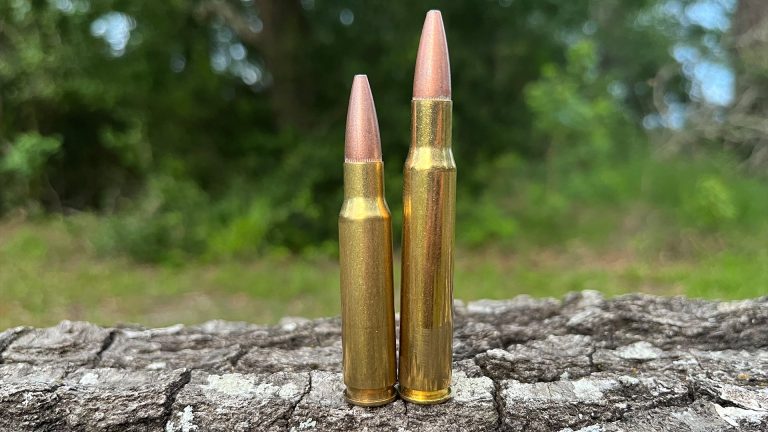
Physical dimensions define the personality of each round. The 308 cycles through a compact 2.800-inch short action, allowing rifle makers to trim receiver metal and build agile mountain carbines. Meanwhile, the 7mm Rem Mag demands a full-size 3.290-inch magnum action to feed its belted case. In addition, the narrower 0.284-inch bore of the magnum unlocks superior aerodynamic efficiency compared to the chunkier 0.308-inch diameter of its rival, fundamentally altering external ballistics downrange.

✓ = better value in that row. Sourced from manufacturer specifications.
308 vs 7mm Rem Mag: Performance & Category Ratings
Evaluating these cartridges reveals an unyielding law of physics: raw power extracts a severe toll. The 7mm Rem Mag dominates long-range ballistics (9.3 vs 7.4) and large game lethality (9.5 vs 8.0). Its high-velocity, high-BC projectiles cut through stiff crosswinds with minimal drift and deliver crushing impact energy beyond 400 yards, making it the definitive choice for distant bull elk.
Every other category tells the opposite story. The 308 decisively wins recoil and shootability (9.1 vs 6.2), letting you spot your own impacts and practice without developing an involuntary flinch. In our comparison, shooters routinely hold tighter groups under rapid fire with the mild thirty-caliber round. The 308 also crushes ammunition availability and cost (9.8 vs 7.3). You can buy practice rounds for pennies compared to expensive magnum boxes, and nearly every hardware store stocks it.
Barrel longevity is another runaway victory for the 308 (9.3 vs 5.9). A 308 barrel easily lasts 5,000 to 8,000 rounds before accuracy degrades, whereas the throat-eroding heat of the 7mm Rem Mag can burn out rifling after just 1,500 to 2,000 rounds. Finally, rifle weight and handling favors the 308 (8.9 vs 7.1). It thrives in handy 20-inch barrels and shorter, stiffer actions that carry effortlessly up steep ridge lines without punishing your shoulders.
.308 Winchester
7mm Remington Magnum
308 Vs 7Mm Rem Mag by the Numbers
Downrange trajectory highlights the stark performance divergence between these cartridges. Pushing a 168-grain bullet at roughly 2,950 fps, the 7mm Rem Mag delivers exceptional speed and flat shooting that leaves the 308 trailing by several feet of drop at extended distances. The following figures demonstrate how powder volume, muzzle velocity, and retained downrange energy separate this hard-hitting belted magnum from the venerable, highly efficient military classic.

.308 Winchester
7mm Remington Magnum
Hover any bar for exact values. Each metric scaled independently.
308: Strengths and Weaknesses
The 308 remains the undisputed gold standard for balanced shooting. Its greatest strength lies in sheer practicality. Recoil is remarkably forgiving, producing around 15 to 16 foot-pounds of energy that lets novice marksmen shoot comfortably without flinching. Ammunition is everywhere. You can grab basic surplus ball for practice or premium hunting loads at any rural gas station. Rifle platforms are light and nimble. Short actions cycle quickly, and barrels can be chopped to 18 or 20 inches without sacrificing massive velocity. Barrel life stretches out for thousands of rounds, enduring years of steady use. When tuning your setup for maximum accuracy, mounting a 🛒 Magpul Bipod → gives you a rock-solid, lightweight shooting rest that pairs naturally with the rifle’s field agility.
Yet the cartridge has real boundaries. Its moderate case capacity cannot fling heavy bullets at magnum speeds. Beyond 400 yards, trajectory drops steeply, demanding precise range estimation and dialed turret adjustments. Kinetic energy also falls off significantly, making it less than ideal for large game at extended distances where heavy winds kick bullets off course.
If you value rifle portability, inexpensive range sessions, and dependable lethality inside normal distances, picking up a 308 platform makes immediate sense.
7mm Rem Mag: Strengths and Weaknesses
The 7mm Rem Mag is an absolute powerhouse designed to defeat distance. Its high ballistic coefficient projectiles slip through crosswinds with ease, carrying lethal punch far out into open country. At 500 yards, it packs over 1,900 foot-pounds of kinetic energy—nearly double what the 308 retains. That terminal authority makes it a legendary elk hammer. Pair it with a high-magnification optic like the 🛒 Vortex Viper PST Gen II Riflescope →, and you have a western hunting rig capable of ethical kills at ranges where lesser cartridges fail.
That blistering power exacts real penalties. Recoil is sharp and stout, shaking loose bad shooting habits if you shoot from a bench all afternoon. Rifle weight is another trade-off. To burn that voluminous powder charge efficiently and manage felt recoil, you need a full 24- or 26-inch barrel hung on a long action, resulting in a heavier gun that snags on brush. Barrel life suffers dramatically, wearing out throat rifling in under 2,000 rounds. Ammunition also costs roughly twice as much per box.
If your hunting ambitions center on big game across wide open terrain where maximum downrange reach is non-negotiable, investing in a 7mm Rem Mag will give you the decisive edge you need.
- ✅ Approx 40% less recoil allows for more accurate shooting and longer practice sessions
- ✅ Ammunition is widely available, diverse, and roughly half the price of magnum rounds
- ✅ Compact short-action footprint allows for lighter, handier backcountry rifles
- ✅ Extremely long barrel life averaging over 6,000 accurate rounds
- ✅ Performs very efficiently in short 18-to-20-inch suppressor-ready barrels
- ❌ Noticeably steeper trajectory and wind drift past 400 yards
- ❌ Falls below ethical elk terminal energy thresholds beyond 350 to 400 yards
- ❌ Lower muzzle velocity limits the aerodynamic benefits of heavy high-BC bullets
- ✅ Flatter trajectory with 12 to 15 inches less bullet drop at 500 yards
- ✅ High ballistic coefficient .284-caliber projectiles buck wind exceptionally well
- ✅ Carries over 1,500 ft-lbs of kinetic energy past 600 yards for large game
- ✅ Superior reach makes it a premier western open-country hunting cartridge
- ✅ Vast factory support for premium bonded and monolithic hunting bullets
- ❌ Substantial recoil (26.5 ft-lbs) can cause flinching without a muzzle brake
- ❌ Requires 24-to-26-inch barrels to burn powder efficiently, making rifles front-heavy
- ❌ Burns out rifling in roughly 1,500 to 2,500 rounds due to high powder volume
- ❌ Ammunition costs roughly $2.00 to $3.50 per cartridge
308 or 7mm Rem Mag: Which Should You Choose?
Selecting between these two calibers comes down to where you hunt and how often you pull the trigger. Your terrain dictates your needs.
Choose the 308 if you are a whitetail hunter, target enthusiast, or backcountry trekker who stalks dense timber and farm woodlots. Inside 300 yards, the 308 drops deer, black bear, and hogs with authority while sparing your shoulder. Because match ammunition is inexpensive and surplus ammo is everywhere, you will shoot twice as many practice rounds per year. That extra trigger time builds genuine precision. If you want a lightweight rifle that carries easily all day without exhausting you, the short-action 308 is the superior tool.
Choose the 7mm Rem Mag if you hunt western big game across sprawling valleys, steep canyon draws, or open agricultural cuts. When you spot a mature bull elk quartering away at 450 yards in a 15-mph crosswind, the magnum caliber earns every penny of its added cost and recoil. Its superior ballistic coefficient and high velocity yield a remarkably flat trajectory and maintain deep-penetrating kinetic energy. While magnum rifles are heavier, slipping on a 🛒 Pachmayr Decelerator Recoil Pad → softens the punch, allowing you to harness magnum power without dreading the shot.
Do you really need magnum blast for standard tree-stand hunting? For most hunters, the answer is a flat no.
Shooters wanting affordable practice, mild recoil, compact rifles, and reliable performance within 400 yards.
Western hunters targeting elk and mule deer across open canyons where extended reach and retained energy are vital.
Final Verdict: 308 vs 7mm Rem Mag
The overall winner is the 308. For the vast majority of hunters and marksmen, it delivers an unbeatable combination of shootability, affordability, and compact field handling. You get roughly 40% less recoil, triple the barrel life, and cheap, accessible ammunition packaged in a lighter short-action rifle. It simply makes shooting more enjoyable and practical.
However, the central trade-off is clear: you surrender long-range kinetic energy and flat trajectory. If your heart is set on hunting elk, moose, or caribou across open plains and deep canyons beyond 400 yards, the 7mm Rem Mag remains irreplaceable. It delivers the crushing downrange impact and wind-bucking aerodynamics that the smaller 308 cannot match. But unless you consistently hunt past those extreme distances, the 308 gives you everything you need without the punishing blast, heavy weight, and premium price tag.
308 vs 7mm Rem Mag: Frequently Asked Questions
Is 308 better than 7mm Rem Mag?
The 308 Winchester is better for general hunting, target practice, and mid-range shooting because it produces 40% less recoil and costs half as much per trigger pull. However, the 7mm Remington Magnum is objectively superior for shooting past 400 yards, where its higher velocity and flatter trajectory maintain lethality.
Which cartridge is better for beginner hunters?
The 308 Winchester is far superior for beginners. Producing around 15.8 foot-pounds of felt recoil compared to 26.5 foot-pounds in the 7mm Remington Magnum, it avoids developing a flinch. Cheaper ammunition also allows novices to practice shooting fundamentals far more frequently without straining their budget or their shoulder.
What is the biggest ballistics difference between 308 and 7mm Rem Mag?
Velocity and drop are the biggest differences. A 150-grain 7mm Remington Magnum leaves the muzzle around 3,110 fps, compared to 2,820 fps for the 308. At 500 yards, the 7mm Rem Mag drops roughly 12 inches less and carries approximately 500 foot-pounds more energy than the 308.
How do ammo prices and rifle longevity compare?
The 308 Winchester wins dramatically on cost and lifespan. Quality 308 hunting rounds average $1.30 compared to $2.45 for 7mm Rem Mag. Furthermore, a 308 barrel lasts between 5,000 and 8,000 rounds before accuracy degrades, whereas magnum powder burns erode 7mm barrels after roughly 1,500 to 2,500 rounds.
Can 308 ethically take elk like the 7mm Rem Mag?
Yes, the 308 Winchester cleanly harvests elk within 350 yards using quality 165-grain or 180-grain controlled-expansion bullets. The 7mm Remington Magnum, however, extends ethical elk-taking range out to 600 yards and beyond because it sustains the benchmark 1,500 foot-pounds of terminal energy much farther downrange.
What does the ballistics chart show for 308 vs 7mm Rem Mag?
With a 150-grain bullet, the 308 Winchester leaves the muzzle at about 2,820 fps, while the 7mm Rem Mag reaches about 3,110 fps. The magnum’s extra speed gives it a flatter trajectory and more retained energy downrange — the gap grows with distance, and past 400 yards the 308 drops several feet more than the 7mm Rem Mag on comparable loads.

Leave a Reply