
Quick Answer
The 28 Nosler delivers exceptionally flat exterior ballistics, averaging between 34 and 42 inches of drop at 500 yards and 210 to 255 inches at 1,000 yards using a 200-yard zero across standard 150gr to 195gr factory loads. Factory specifications achieve muzzle velocities from 3,125 to 3,300 fps. However, real-world trajectory deviates significantly based on actual barrel length, twist rate, and atmospheric density altitude.



The 28 Nosler trajectory chart demonstrates why this cartridge remains a benchmark for ultra-flat long-range hunting ballistics, delivering muzzle velocities between 3,050 and 3,325 feet per second across factory bullet weights from 150 to 180 grains. With a standard 200-yard zero, drop at 400 yards spans a shallow 16.5 to 19.5 inches, while retained supersonic velocity past 1,200 yards provides unprecedented wind-bucking energy on game. However, factory ballistic trajectory charts assume idealized SAAMI conditions—specifically a 26-inch test barrel, standard sea-level atmosphere (59°F, 29.92 inHg), and a 1.5-inch sight height over bore—which must be recalibrated for real-world field rifles.
This reference guide covers factory rifle ammunition releases and SAAMI baseline standards for the 28 Nosler through model year 2026. Trajectory and downrange drop values are calculated using standard atmospheric conditions (Sea Level, 59°F / 15°C, 29.92 inHg, 0% humidity) with a verified 200-yard zero and standard 1.5-inch optic height over bore. Field results will vary based on barrel twist, actual chronograph velocity, altitude, and action configuration. Always cross-reference factory specifications with your rifle’s owner manual, barrel markings, and recorded atmospheric DOPE. Last reviewed: September 2026.
28 Nosler Ballistic Snapshot
Max Velocity (160gr)
Peak Muzzle Energy
Avg Drop @ 400 Yds
SAAMI Max Pressure

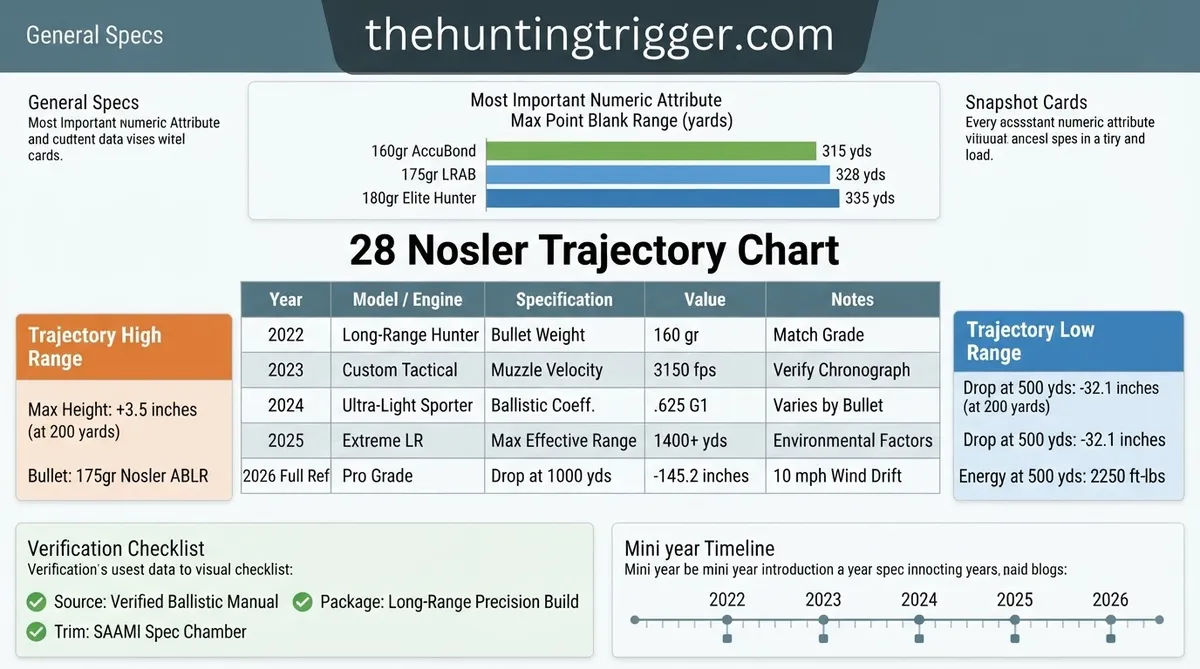
28 Nosler Trajectory Chart: Factory Load Specifications
📤 Share Image
Evaluating the 28 nosler trajectory chart across current commercial hunting and match loads reveals exceptional downrange efficiency. Chambered around a non-belted, rebated-rim case derived from the .404 Jeffery, the 28 Nosler burns massive powder charges in excess of 80 grains of slow-burning modern rifle propellant. This capacity range propels heavy-for-caliber 7mm (.284) bullets with aerodynamic ballistic coefficients (BC) exceeding 0.650 G1 at speeds that outclass the 7mm Remington Magnum and 7mm PRC by 100 to 175 fps at the muzzle.
How to read this chart: All trajectory metrics represent total vertical drop in inches and elevation corrections in Minutes of Angle (MOA) and Milliradians (MRAD). A negative number indicates impact below point of aim with a verified 200-yard primary zero. Values assume a standard 26-inch barrel length, level bore axis, and zero wind vector.

Standard Atmospheric Test Conditions and Zero Setup
Standard ballistic tables depend on baseline conditions certified under the ICAO standard atmosphere: 59°F ambient air temperature, barometric pressure of 29.92 inches of mercury (inHg), zero elevation above sea level, and a standard sight-over-bore optical centerline of 1.5 inches. Setting your zero distance at 200 yards exploits the 28 Nosler’s ultra-flat maximum point-blank range (MPBR). In this configuration, the projectile rises roughly 1.3 to 1.5 inches above point of aim at 100 yards, crosses zero at 200 yards, and maintains dead-on vital plate holdout to approximately 325 yards on big game without manual elevation dial adjustments.
Factory Load Ballistics Table (100 to 1,000 Yards)
The following master reference compares the core factory specifications from primary ammunition manufacturers through 2026, detailing velocity, energy, and downrange bullet path across major bullet weight configurations.
| Year | Model / Engine | Specification | Value | Notes |
|---|---|---|---|---|
| 2015–2026 | Nosler Trophy Grade (Factory Baseline) | 160gr Partition G1 BC: 0.475 | MV: 3,300 fps |
300y: -5.4″ (-1.7 MOA) 500y: -31.8″ (-6.1 MOA) 700y: -84.2″ (-11.5 MOA) 1,000y: -228.4″ (-21.8 MOA) |
Retains 3,870 ft-lbs muzzle / 1,442 ft-lbs at 700y. Optimal terminal expansion on heavy game within 600 yards. |
| 2016–2026 | Nosler Trophy Grade Long Range | 175gr AccuBond LR (ABLR) G1 BC: 0.648 | MV: 3,125 fps |
300y: -5.8″ (-1.8 MOA) 500y: -32.5″ (-6.2 MOA) 700y: -83.6″ (-11.4 MOA) 1,000y: -204.6″ (-19.5 MOA) |
High-BC hunting benchmark. Drops -18.5″ at 400y; retains supersonic speed and 1,840 ft-lbs kinetic energy at 700y. |
| 2018–2026 | Hornady Precision Hunter | 162gr ELD-X G1 BC: 0.631 / G7: 0.318 | MV: 3,175 fps |
300y: -5.6″ (-1.8 MOA) 500y: -31.9″ (-6.1 MOA) 700y: -82.8″ (-11.3 MOA) 1,000y: -206.1″ (-19.7 MOA) |
Heat Shield tip maintains BC stability. Extremely consistent factory specification across all climate extremes. |
| 2020–2026 | Browning BXC Controlled Expansion | 155gr Terminal Tip G1 BC: 0.515 | MV: 3,250 fps |
300y: -5.3″ (-1.7 MOA) 500y: -31.2″ (-6.0 MOA) 700y: -83.1″ (-11.3 MOA) 1,000y: -221.0″ (-21.1 MOA) |
Anodized aluminum tip delayed expansion; maximum rating velocity for medium game, flat to 500 yards. |
| 2022–2026 | Custom / Match Grade Line | 180gr Berger Hybrid Target G1 BC: 0.674 / G7: 0.345 | MV: 3,080 fps |
300y: -6.0″ (-1.9 MOA) 500y: -33.1″ (-6.3 MOA) 700y: -84.1″ (-11.5 MOA) 1,000y: -201.2″ (-19.2 MOA) |
Requires 1:8″ or 1:8.5″ twist rate rifle configuration. Produces the least wind drift at 1,000 yards in the 28 Nosler lineup. |
Footnote: Values derived using standard point-mass ballistic calculations, 1.5-inch optic height over bore, 59°F ambient temperature at sea level. Individual factory lot velocities may vary ±30 fps from published ratings.
3,300 fps
1,812 fps
1,550+ yds
Year-by-Year Evolution of Factory Specifications Through 2026
The trajectory profile of the 28 Nosler has undergone notable refinements since its formal introduction in 2015. While the parent case geometry and maximum SAAMI pressure rating remain anchored at 65,000 PSI, the factory ammunition trim level, rifling twist rate configurations, and projectile choices have adjusted to meet the demands of modern extreme-long-range (ELR) shooting.
2015–2018: Standard 1:9 Twist and Early Factory Ammo
When Nosler submitted the cartridge for SAAMI standardization in 2015, the official factory specification called for a 1:9-inch rifling twist rate. Ammunition offerings were focused heavily on traditional, highly destructive hunting bullets such as the 160-grain Partition and 160-grain AccuBond. These configurations offered blistering muzzle velocities up to 3,300 fps with remarkably flat trajectory out to 500 yards. However, shooters who attempted to shoot heavier, longer high-BC projectiles experienced transonic yaw and tumbling due to marginal stabilization in factory 1:9 barrels.
2019–2022: High-BC Bullet Integrations and 1:8 Twist Shift
By 2019, major rifle manufacturers including Browning, Christensen Arms, and Ruger updated their barrel production from 1:9 to faster 1:8 and 1:8.5 twist barrels for their 28 Nosler rifle options. This shift coincided with factory ammunition loads adopting match-derived hunting bullets like the Hornady 162-grain ELD-X and the Nosler 175-grain AccuBond Long Range (ABLR). The improved aerodynamic profiles flattened trajectory past 600 yards significantly: while the 160-grain Partition drops approximately 228 inches at 1,000 yards, the 175-grain ABLR drops only 204.6 inches, shedding over 23 inches of vertical drop at extreme range.
2023–2026: Heavy Monometals and Modern Propellant Blends
The latest generation of 28 Nosler factory ammunition incorporates modern temperature-stable, high-bulk-density propellants. These modern chemical formulations maintain velocity consistency within ±12 fps across temperature swings from 0°F to 100°F, mitigating one of the cartridge’s historic challenges: vertical velocity dispersion in hot barrels. Furthermore, 2026 offerings feature non-lead monometal projectiles (such as Barnes LRX and Hornady CX) in the 150-to-168-grain classes, as well as factory-loaded 180-grain match configurations that take full advantage of fast 1:8 twist rifle barrels.
SAAMI standardized at 65,000 PSI with 1:9 standard twist, optimized for 160gr traditional hunting bullets.
Factory rifles adopt 1:8 twist to stabilize heavy-for-caliber 175–180gr projectiles with high G1/G7 form factors.
Integration of temp-insensitive propellants and factory 180gr match ammunition optimizing extreme-range stability.
Configuration Impact: Bullet Weight, BC, and Velocity Profiles
A core insight from any thorough 28 nosler trajectory chart analysis is that muzzle velocity alone does not dictate downrange precision. The projectile’s ballistic coefficient (BC), weight class, and frontal aerodynamic drag profile fundamentally govern how quickly velocity decays and how far the bullet is displaced by crosswinds.
Lightweight Loads (150–160 gr) for Medium Game
Lightweight loadings, including the 150gr Ballistic Tip and 160gr Partition, achieve maximum rating muzzle velocities of 3,250 to 3,325 fps. Within 400 yards, these loads shoot exceptionally flat: drop at 300 yards is less than 5.5 inches, giving hunters a forgiving margin of error for distance estimation on open-country game such as pronghorn and whitetail. However, due to lower ballistic coefficients (typically 0.450 to 0.485 G1), these projectiles lose forward momentum rapidly past 500 yards, resulting in greater wind deflection and reduced kinetic energy retention at extended distances.
Heavyweight Match & Hunting (175–184 gr) for Long Range
Heavyweight projectiles, exemplified by the 175gr AccuBond Long Range (G1 BC: 0.648) and the 180gr Berger Hybrid Target (G1 BC: 0.674), launch at slightly lower initial velocities (3,050 to 3,125 fps). While they demonstrate slightly more vertical drop at intermediate ranges (-32.5 inches at 500 yards compared to -31.2 inches for lighter loads), their high sectional density and superior ballistic coefficients overcome aerodynamic drag downstream. Beyond 700 yards, their retained energy and shallower trajectory curve outperform lighter alternatives, holding over 1,500 ft-lbs of energy out to 900 yards.
G1 vs. G7 Drag Coefficients and Wind Deflection Impact
While drop can be dialled out via elevation turrets with absolute predictability, wind deflection remains the primary cause of missed shots in the field. When analyzing high-velocity cartridges like the 28 Nosler, using G7 drag models rather than legacy G1 figures is mandatory for high-ogive, boat-tail bullets. A G7 model remains constant across varying velocity bands, whereas a G1 coefficient inflates predictions at supersonic velocities and miscalculates trans-sonic drag.
Total horizontal deflection in inches at 1,000 yards. Shorter bars indicate superior aerodynamic resistance to wind.
44.2 inches (4.2 MOA)
47.8 inches (4.6 MOA)
49.6 inches (4.7 MOA)
70.1 inches (6.7 MOA)
✅ Heavy-Bullet Advantages (175–180gr)
- Significantly reduced wind deflection past 600 yards (-26 inches less drift at 1,000y).
- Substantially higher retained energy for clean big-game harvest at long distance.
- Maintains stable supersonic flight profile beyond 1,500 yards.
❌ Lightweight Profile Trade-Offs (150–160gr)
- Increased vulnerability to crosswind errors and vertical stringing past 500 yards.
- Accelerated downrange velocity decay due to lower form factors.
- Higher initial chamber temperatures and bore throat erosion per shot.
What Affects 28 Nosler Trajectory and Downrange Data
A printed ballistics chart is a mathematical approximation. In practical long-range shooting, physical rifle hardware and shifting field environments alter downrange bullet paths substantially from factory-printed specifications. Understanding these variables ensures your first-round impact matches your firing solution.
Barrel Length Variations: 24-Inch vs. 26-Inch Profiles
The 28 Nosler relies on large volumes of slow-burning powder (e.g., Retumbo, H1000, US869, N570) that require barrel length to achieve complete combustion. While SAAMI and ammunition makers certify ballistics using 26-inch test barrels, many modern mountain and backcountry hunting rifles feature 24-inch or even 22-inch barrels to reduce weight and accommodate suppressors.
- 26-Inch Factory Specification: Delivers full advertised velocity (e.g., 3,125 fps with 175gr ABLR). Complete powder burn is achieved inside the bore, minimizing muzzle blast and maximizing downrange velocity.
- 24-Inch Mountain Profiles: Results in an average velocity loss of 25 to 35 fps per inch cut. In a 24-inch barrel, a 175gr load typically clocks around 3,060 fps. This 65 fps drop increases 1,000-yard bullet drop by approximately 14 inches (-1.3 MOA).
- 22-Inch Suppressor Ready Setups: Drops muzzle velocity by 110 to 140 fps compared to box claims. Unburnt powder expands violently outside the crown, necessitating an efficient muzzle brake or high-volume suppressor to manage backpressure and severe recoil.
Never assume box velocity when calculating firing solutions for a 24-inch or suppressor-cut barrel. Every 30 fps decrement shifts your 700-yard point of impact down by nearly 4 inches. Always chronograph your specific rifle configuration to record actual velocity before inputting data into ballistic solvers.
Elevation, Temperature, and Density Altitude Adjustments
Air density is the single greatest environmental driver of bullet trajectory changes. Density Altitude (DA) combines barometric pressure, altitude, and temperature into a single performance metric:
- Sea Level (0 ft DA): The air is dense. A 175gr ABLR launched at 3,125 fps drops roughly 204 inches at 1,000 yards.
- High Altitude Hunting (8,000 ft DA): In mountainous regions (such as Colorado or Wyoming elk terrain), the thinner air creates substantially less aerodynamic drag. At 8,000 feet DA, the same bullet drops only 179 inches at 1,000 yards—a reduction of 25 inches (nearly 2.5 MOA) of drop compared to sea-level charts.
- Temperature Sensitivity: Ambient temperature shifts ammunition powder temperature. While newer propellants are more stable, extreme summer heat vs. sub-zero winter temperatures can shift muzzle velocity by 1.0 to 1.5 fps per degree Fahrenheit, altering zero and long-range elevation.
Bore Wear and Throat Erosion on Velocity Retention
The 28 Nosler burns significant powder charges at an intense 65,000 PSI, which subjects the rifle leade and chamber throat to severe thermal stress. Shooters should monitor bore condition and throat wear:
- Bore Life Expectancy: Accurate barrel life for the 28 Nosler typically ranges from 500 to 800 rounds before throat erosion begins to degrade match-grade precision.
- Throat Migration: After 300 to 400 rounds, the rifling leade erodes forward. As the bullet jump increases, peak chamber pressure drops slightly, which can produce a gradual velocity decay of 30 to 60 fps over time.
- Thermal Management: Firing rapid strings of three or more shots overheats the barrel steel, drastically accelerating throat erosion. Allowing the barrel to cool completely between strings preserves both trajectory consistency and barrel life.
Modern tactical hunting setups often utilize 34mm or 35mm main-tube optics mounted on 20 MOA Picatinny rails, elevating the sight height to 1.8 to 2.1 inches above the bore center rather than the traditional 1.5 inches. This taller mounting height slightly decreases your apparent drop at 600+ yards while increasing close-range offset at 50 yards. Always measure your true centerline height with calipers and enter it accurately into your solver.
How to Zero and True Your 28 Nosler Trajectory Curve
Relying purely on ammunition box drop data past 400 yards regularly leads to missed shots or poor terminal placement. Follow this four-step field truing protocol using professional ballistic solvers (such as Applied Ballistics, Hornady 4DOF, or Kestrel) to match software predictions directly to your rifle’s real-world impacts.
Establish a precise zero at exactly 100 or 200 yards using a solid benchrest or bipod with rear bag support. Measure group centers to within 0.1 inch. Use digital calipers to measure from the exact center of the rifle bolt/action to the center of your scope’s ocular lens to confirm true sight height over bore.
Fire a minimum 5-shot string across an advanced radar chronograph (e.g., Garmin Xero C1 Pro or LabRadar). Record the true average muzzle velocity, Standard Deviation (SD), and Extreme Spread (ES). A high-performance 28 Nosler hunting load should display an SD under 12 fps to prevent vertical stringing at extreme distances.
Engage a calibrated steel or paper target at a known supersonic distance between 600 and 800 yards on a low-wind day. Compare your observed point of impact with your solver’s initial elevation dial. For example, if your 175gr ABLR strikes 1.25 MOA lower than predicted at 800 yards, true your software’s effective muzzle velocity until dial values match your actual bullet drop.
If engaging targets beyond 1,000 yards, leave your trued muzzle velocity untouched and adjust your projectile’s Ballistic Coefficient (drag-truing step) in Applied Ballistics or Hornady 4DOF. Once trued, your ballistic engine will generate accurate firing solutions across all atmospheric conditions, altitudes, and shooting angles.
Pre-Hunt Ballistic Verification Checklist
28 Nosler Trajectory Chart Questions Answered
What is the effective hunting range of the 28 Nosler?
For elk and moose requiring a minimum of 1,500 ft-lbs of kinetic energy, the 28 Nosler provides an effective hunting range of 800 to 900 yards when shooting 175gr AccuBond Long Range or 162gr ELD-X factory ammunition. For deer-sized game requiring 1,000 ft-lbs, the cartridge retains sufficient terminal energy beyond 1,100 yards under standard atmospheric conditions, provided the shooter possesses the skills and trued DOPE to ensure precise ethical shot placement.


How does the 28 Nosler trajectory compare to the 7mm PRC and 7mm Rem Mag?
The 28 Nosler shoots noticeably flatter than both cartridges due to its higher case capacity and muzzle velocity. When comparing 175-grain projectiles, the 28 Nosler pushes them at roughly 3,125 fps compared to ~3,000 fps for the 7mm PRC and ~2,860 fps for the 7mm Remington Magnum. At 1,000 yards, the 28 Nosler drops approximately 204 inches, out-flattening the 7mm PRC by roughly 18 inches and the 7mm Rem Mag by over 40 inches. However, the 7mm PRC features a standardized fast 1:8 twist chamber and modern non-rebated cartridge geometry that reduces bolt thrust and improves reloadable brass life.
What is the best zero distance for a 28 Nosler rifle?
A 200-yard zero is widely considered optimal for the 28 Nosler. Because of its 3,100+ fps muzzle velocity, a 200-yard zero causes the bullet to rise only 1.3 to 1.5 inches high at 100 yards, while dropping just 5.5 to 6.0 inches at 300 yards. This setup creates a maximum point-blank range of roughly 325 yards on an 8-inch vital target without requiring any turret dialing or reticle holdover in hunting scenarios.
Does the 28 Nosler require a muzzle brake?
While not mechanically required, an efficient multi-port muzzle brake or quality suppressor is highly recommended. Burning 80+ grains of propellant behind a 175-grain bullet generates approximately 30 to 38 ft-lbs of free recoil energy in an 8.5-pound rifle—roughly double the recoil of a .270 Winchester and 30% more than a standard .30-06. A high-efficiency brake reduces felt recoil by up to 60%, allowing shooters to maintain their sight picture, spot their own bullet trace, and confirm terminal impacts through the scope.
Mastering the 28 Nosler Trajectory Curve in the Field
The 28 Nosler holds an elite position among commercial long-range centerfire rifle cartridges, producing sub-19-inch drops at 400 yards and delivering over 1,800 foot-pounds of retained energy at 700 yards with high-BC projectiles. Maximizing this performance requires matching your ammunition configuration to your rifle’s barrel twist rate—ensuring a 1:8 twist is utilized for bullets 175 grains and heavier—and correcting for real-world environmental shifts such as density altitude and actual barrel length velocity loss.
Before heading into the field, never rely solely on published factory ammunition box charts. Establish a confirmed 200-yard zero, gather reliable velocity readings across a radar chronograph, and shoot at extended distances to true your ballistic calculator. By combining this comprehensive 2026 trajectory specification chart with verified field DOPE, you can exploit the full long-range capabilities of the 28 Nosler with complete confidence.

Leave a Reply