
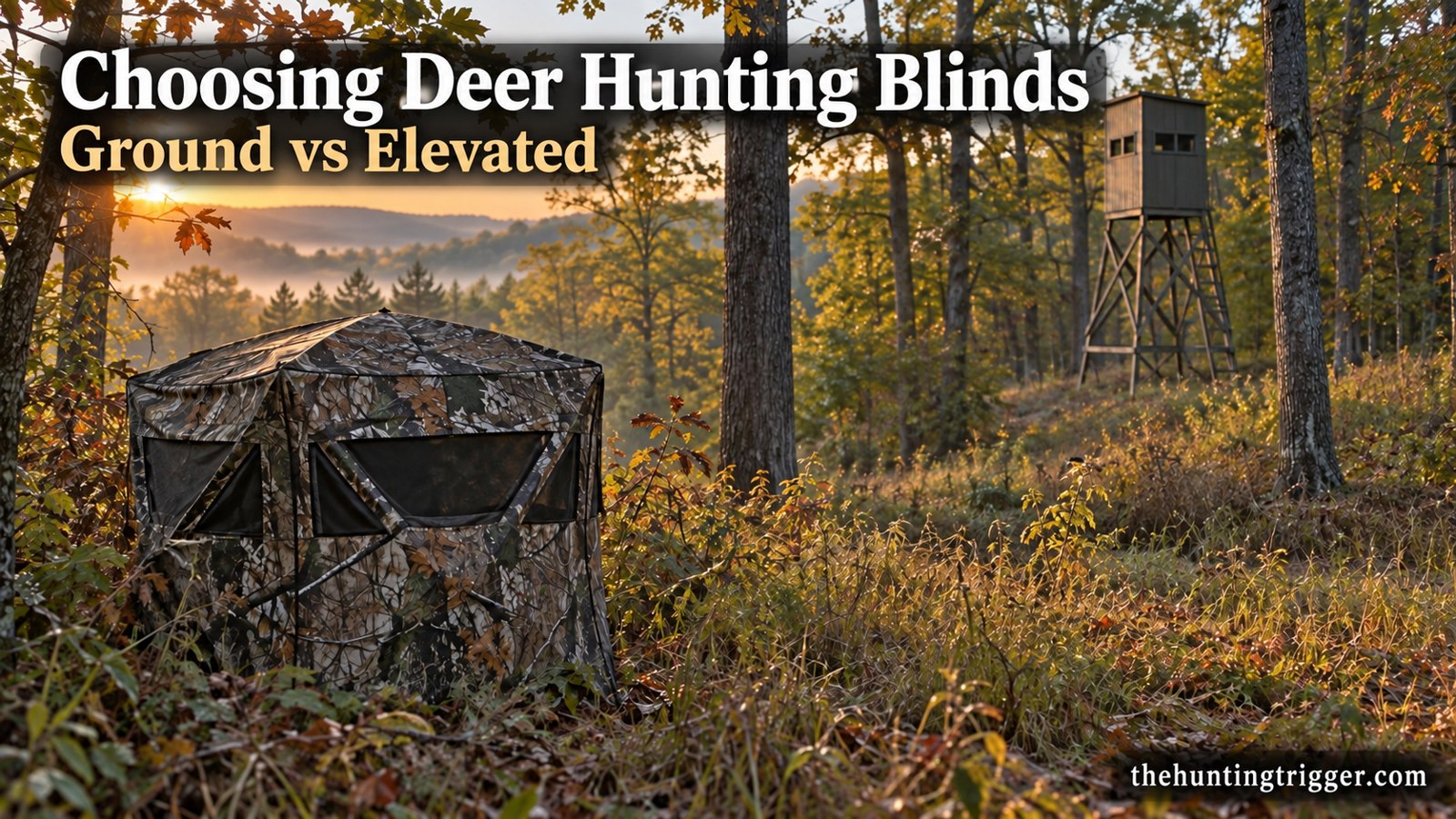
Updated September 24, 2026. Choosing deer hunting blinds starts with the hunt, not the camo pattern. The best blind matches the hunter’s weapon, access route, wind, terrain, safety plan, and local rules.
This guide compares portable ground blinds, elevated box blinds, and open stands. It also gives a practical setup checklist, size examples from published specifications, and a legal review routine for 2026.
What is the best type of deer hunting blind?
There is no single best design for every property. A portable ground blind suits quick moves, field edges, and hunters who want simple access. An elevated box blind improves visibility and weather protection, but it needs a stable platform, careful access, and more planning.
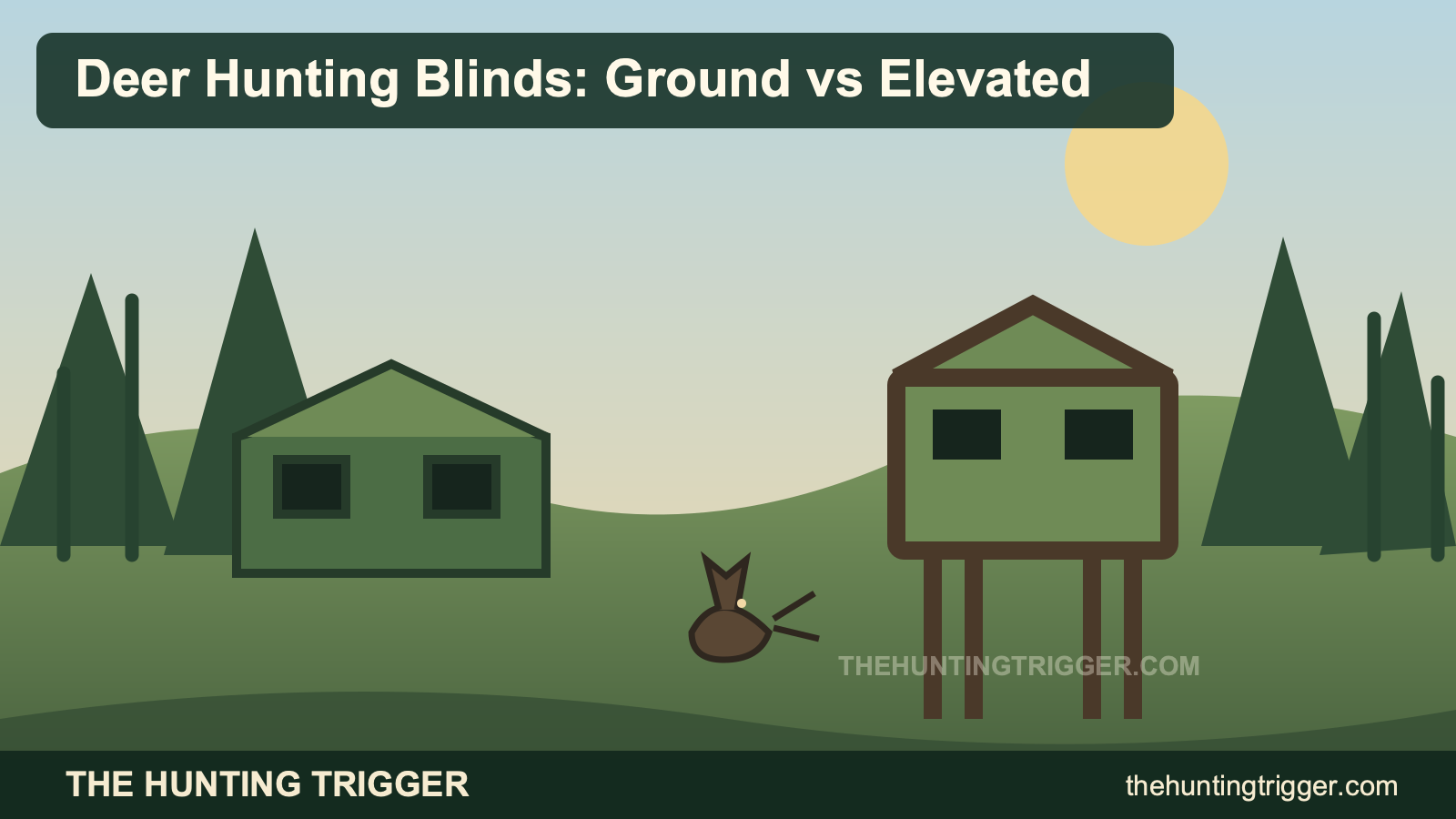
Ground and elevated blinds solve different concealment, visibility, access, and comfort problems.
Texas Parks & Wildlife explains that blinds give hunters more time to watch habitat and animal activity. The same guidance says hunters should inspect a blind before use and keep an elevated blind still for a responsible shot. Read the agency’s blind and stand guidance.
Ground blind
A ground blind sits on the soil or a low base. Pop-up hub blinds pack down for transport, while brush blinds use natural cover and a simple frame.
Choose a ground blind when:
- The hunting location may change during the season.
- A hunter needs level-ground access without a ladder.
- The property has thick cover, crop edges, or small openings.
- A youth, older hunter, or mobility-limited hunter needs easier entry.
- The hunter can place the blind where its outline blends into cover.
Missouri Department of Conservation notes that a ground blind keeps the hunter lower, which can reduce visibility but may let deer approach more closely before detection. See Missouri’s stand-location comparison.
Elevated box blind
An elevated box blind is an enclosed structure on legs or a tower. It offers a stable seat, a higher view, and protection from wind and rain. It also adds fall risk and usually requires a vehicle, trailer, or several people for installation.
Choose an elevated blind when:
- Long sight lines make extra height useful.
- The location is a long-term food plot, field edge, or lane.
- The structure can be anchored on a level, load-rated platform.
- The hunter wants a steady shooting rest and more weather protection.
- The access route can be kept quiet and hidden.
Missouri’s agency guidance lists better visibility, reduced scent exposure, and less noise on entry as potential elevated-stand advantages when placement is correct. Those benefits depend on wind, cover, and disciplined movement.
Open tree or ladder stand
An open stand provides height without enclosing the hunter. It can offer a wide view and a small footprint, but it gives less weather protection and exposes movement.
Use an open stand only when the tree, platform, harness system, and access route meet the manufacturer’s limits. Texas Parks & Wildlife says a full-body safety harness should be used while climbing and worn for the entire time in an elevated stand. Review its elevated-stand safety rules.
How should a hunter match a blind to the weapon?
Weapon choice changes window height, interior movement, and the amount of shooting space required. A rifle hunter usually needs a steady rest and a clear horizontal lane. A bowhunter needs room to draw without touching a wall, window, or partner.
| Hunting method | Blind features to prioritize | Common mistake |
|---|---|---|
| Rifle or muzzleloader | Stable rest, clear lower window, quiet window movement, safe backstop | Choosing a window that forces an awkward rifle cant |
| Crossbow | Vertical opening, enough limb clearance, quiet closures, stable seat | Letting limbs or cams contact the frame |
| Compound bow | Large draw-side space, tall roof, open shooting lanes, quiet fabric | Buying a compact blind sized only for sitting |
| Youth or two hunters | Wider door, two usable seats, clear sight lines, room for coaching | Blocking one hunter’s view with the other hunter |
| Camera or observation | More windows, quiet adjustments, weather cover | Placing the blind where glass reflects toward deer |
Before hunting, practice the full motion with an unloaded firearm or an un-nocked bow. The hunter should be able to raise, aim, and lower the equipment without scraping fabric or striking a frame.
How much room does a deer blind need?
Published dimensions show why capacity labels can mislead. A manufacturer may call a blind “two-person,” but two adults with rifles need less room than two bowhunters with broad draw cycles.
| Published example | Listed size or capacity | What the specification suggests |
|---|---|---|
| Advantage Whitetail blind | 54 in W × 60 in D × 73 in H; 2-person | A compact enclosed footprint for seated firearm use; bow space needs a hands-on test |
| VisionX 4×6 rectangle | 71⅜ in L × 47¾ in W × 79 in H; 2 hunters | A taller box profile with a narrow width; check seat and window spacing |
| HME 2-person hub blind | 62 in × 62 in × 66 in | Portable footprint with limited standing and draw height |
| Texas Hunter 4×8 model | 4 ft × 8 ft; designed for 2 hunters | More length can separate seats and improve movement space |
The figures above come from the Advantage Hunting specification page, VisionX product page, HME listing, and Texas Hunter product page. Product dimensions can change, so verify the current manufacturer sheet before building a platform.
A simple space test
Set the blind on a flat surface before the season. Place every seat, pack, rifle rest, bow case, and shooting accessory inside. Then rehearse the quiet movements used for a real shot.
The blind passes the space test when each hunter can:
- Sit with both feet planted.
- Reach the window without leaning into another hunter.
- Rotate toward every planned shooting lane.
- Close or open windows without a sharp snap.
- Exit without sweeping a loaded muzzle across another person.
Where should a deer hunting blind be placed?
Start with deer movement, then work backward to the blind. Look for trails that connect bedding cover, food, water, and secure travel routes. A blind placed in an empty opening may offer a wide view but no reason for deer to pass.
The best location usually has four elements:
- A legal and safe shooting direction.
- Natural background cover behind the blind.
- An entry route that avoids bedding areas.
- A wind pattern that carries human scent away from expected deer movement.
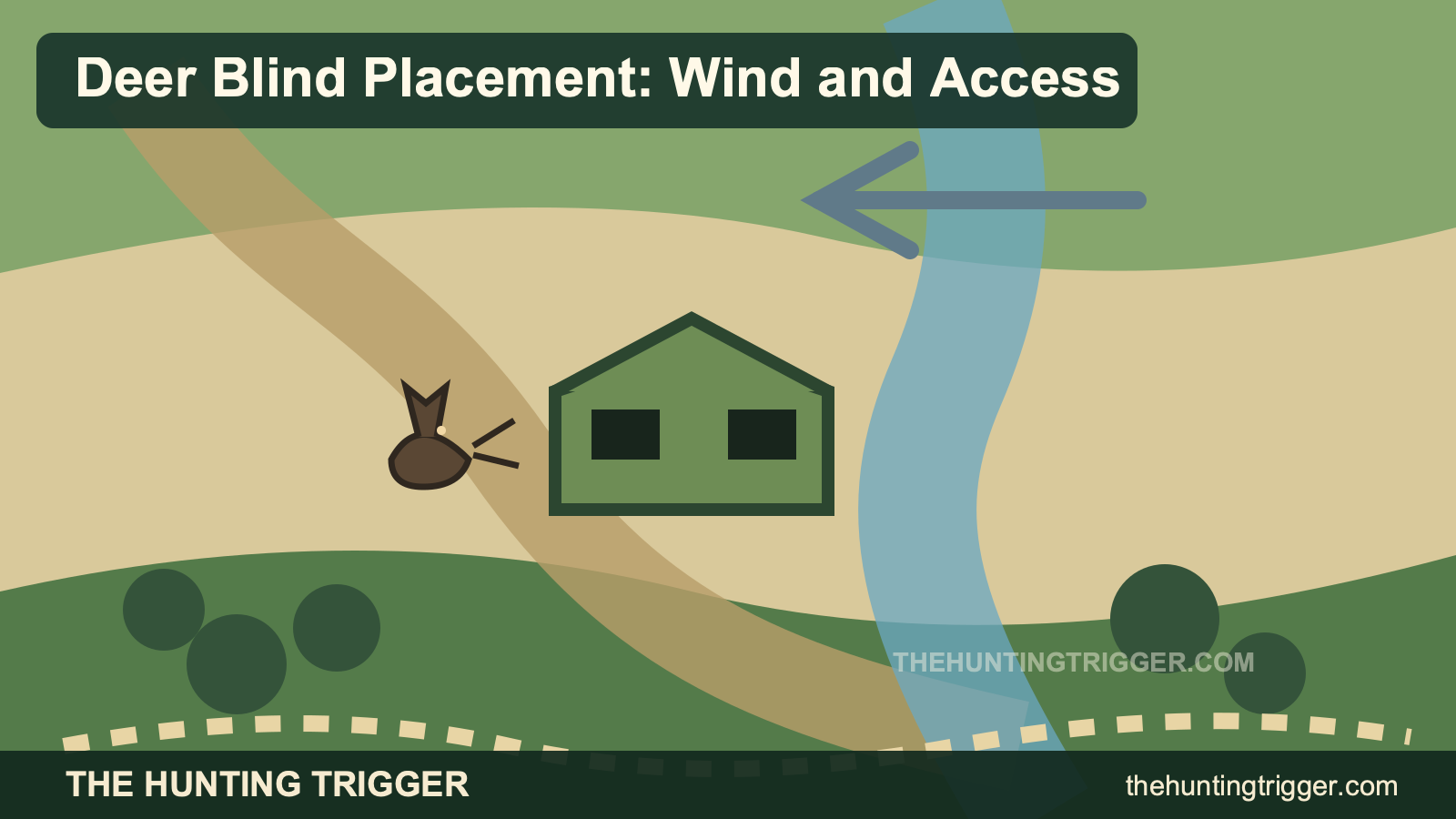
Placement combines travel routes, background cover, access, and a wind plan.
Washington Department of Fish and Wildlife advises placing a blind with the wind in the hunter’s face and using indicators such as dry grass to watch changing air movement. Read the agency’s deer handbook.
Check the wind at the blind and on the route
The wind at the parking area may differ from the wind at the blind. Check it at the entry point, along the trail, and inside the blind. Thermals can shift as shaded ground cools or sun warms a field edge.
If the wind regularly carries scent across a bedding area, move the blind or choose another sit. Scent-control hunting clothing may help manage odor, but cannot repair a poor location.
Use background cover
Deer notice straight edges and dark openings. Place a ground blind beside brush, a tree line, or tall grass. Break up the roof and corners without blocking the planned shooting lanes.
An elevated blind should avoid standing alone on a skyline. A darker tree line behind the structure can reduce the outline from approaching deer.
Plan entry and exit
A perfect blind becomes a poor choice when the walk to it crosses the deer’s likely route. Favor access along a field edge, ditch, creek, or existing trail that keeps noise and scent away from bedding cover.
What safety features matter most?
Safety should be part of the blind selection. Inspect seams, stakes, windows, roof panels, ladders, rails, steps, and anchor points before every season. Replace damaged hardware before carrying a weapon into the blind.
For elevated setups, use a full-body harness and maintain three points of contact on the ladder or climbing device. Texas Parks & Wildlife also says to unload the firearm before climbing into an elevated stand. See the agency’s elevated-stand checklist.
For all blinds, confirm a safe backstop and a clear zone behind the target. Windows should not force the muzzle through a person’s space or point toward a road, home, livestock area, or neighboring property.
What laws apply to deer hunting blinds?
Blind rules vary by state, season, land type, and weapon. Some jurisdictions require hunter orange on or above a blind. Others require identification on a blind left on public land. Natural-material blinds can have different rules from manufactured blinds.
Examples show why a local check matters:
| Location | Example rule or guidance | Official source |
|---|---|---|
| New Jersey | During the open firearm deer season, 200 square inches of hunter orange must be visible from all sides on top of a blind or within 5 feet | New Jersey DEP deer FAQs |
| Indiana | A ground blind must display at least 144 square inches of hunter orange when the season requires orange | Indiana DNR deer hunting |
| Virginia | An enclosed ground blind must display at least 100 square inches of solid blaze material visible 360 degrees | Virginia DWR general regulations |
| Michigan public land | A left-in-place elevated platform or Type 3 ground blind needs required identification attached in legible form | Michigan DNR deer regulations |
These examples are not a substitute for the current rules where the hunt occurs. Check the wildlife agency, public-land manager, season dates, and weapon-specific regulations before setting a blind.
A practical 2026 selection checklist
Use this checklist before buying or building a blind:
- Name the primary hunter. Include height, mobility, and whether a partner or child will join.
- Choose the weapon. Test rifle, muzzleloader, crossbow, or bow movement inside the blind.
- Measure the site. Note trail direction, shooting lanes, cover, and the safest backstop.
- Study access. Walk the entry route in daylight and in the dark with an unloaded firearm case.
- Record wind patterns. Check several mornings and evenings instead of trusting one forecast.
- Inspect construction. Check anchors, seams, windows, roof, ladder, rails, and seat stability.
- Verify local law. Confirm orange, public-land identification, placement dates, and removal rules.
- Rehearse quietly. Practice sitting, aiming, window movement, communication, and exit.
Final answer: which blind should a deer hunter choose?
Choose a portable ground blind for flexibility, level-ground access, and short-term setups. Choose an elevated box blind for stable seating, longer views, and a permanent location with a safe platform. Choose an open stand only when the tree, harness, climbing system, and local rules support it.
The strongest decision combines three checks: the blind fits the hunter, the site fits deer movement, and the setup fits the law. If any one of those checks fails, select a different blind or a different location.

Leave a Reply