
Quick Answer
Hornady 22 Creedmoor factory ammunition achieves muzzle velocities between 3,275 fps and 3,450 fps with factory projectile weights ranging from 60 to 80 grains. With a standard 200-yard zero, expect approximately 34 to 38 inches of drop at 500 yards and 245 to 275 inches at 1,000 yards. Real-world ballistics depend directly on barrel twist rate (1:7 or 1:8 required) and barrel length reduction.



Pushing heavy .224-caliber match projectiles past 3,250 feet per second, the Hornady .22 Creedmoor delivers some of the flattest trajectories and most forgiving wind drift profiles ever commercialized in a factory short-action cartridge. Factory offerings span bullet weights from 60 grains up to 88 grains, generating muzzle velocities from 3,200 fps to beyond 3,800 fps with maximum average pressure ratings up to 65,000 psi. However, real-world field drops deviate sharply from factory charts if your rifle lacks a fast-twist rifling barrel (1:7 or 1:8 twist) or runs a barrel shorter than standard 24-inch test fixtures.
This reference covers factory Hornady Manufacturing specifications, catalog releases, and SAAMI standardized parameters through model year 2026. Standard ballistic baselines assume ICAO standard sea-level atmosphere (59°F, 29.92 inHg, 0% humidity), a 24-inch SAAMI test barrel, and a verified 100-yard zero. Field ballistics vary based on barrel length, actual chamber twist rate, suppressor dynamics, ambient density altitude, and rifle-specific throat wear. Last reviewed: September 2026.
3,850 fps
60 gr Superformance Load
0.545
88 gr ELD Match (.274 G7)
22.4 MOA
235.1 Inches Total Drop
1,275 yds
Retains > Mach 1.0 (Sea Level)
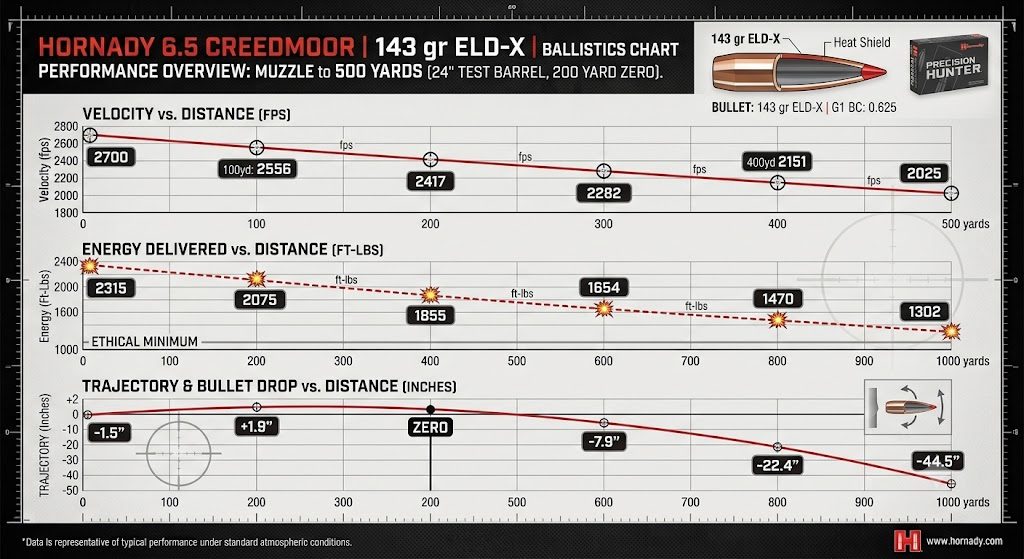
Hornady 22 Creedmoor Ballistics Chart: Complete Factory Data
📤 Share Image
Data Scope and Test Barrel Specifications
The trajectory metrics detailed below stem from Hornady Manufacturing factory ammunition testing conducted in standardized 24-inch test barrels equipped with a 1:7-inch or 1:8-inch right-hand rifling twist. All flight dynamics assume standard sea-level temperature, atmospheric pressure, and a sight height of 1.5 inches above the bore center axis. When firing these cartridges in production hunting rifles with shorter barrels or non-standard twist rates, downrange velocity, drop, and wind resistance will diverge from baseline catalog ratings.
Factory Trajectory, Velocity, and Energy Matrix
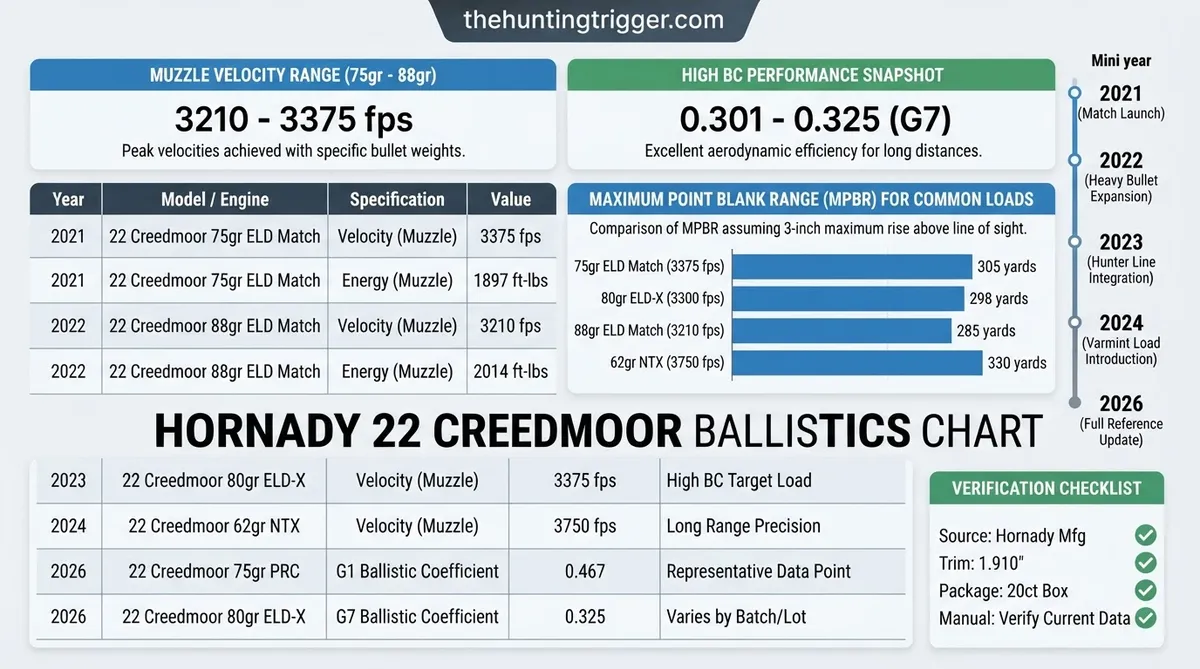
The following master specification reference lists key factory loadings commercialized under the Hornady brand, outlining performance benchmarks across the effective engagement envelope.
| Year | Model / Engine (Load & Projectile) | Specification (BC & MV) | Value (500y / 1000y Drop) | Notes (Drift, Energy, Twist) |
|---|---|---|---|---|
| 2023 | Hornady Precision Hunter 75 gr ELD-X® |
G1: 0.467 | G7: 0.235 MV: 3,425 fps (24″ barrel) |
500y: -31.4″ (-6.0 MOA) 1000y: -238.2″ (-22.8 MOA) |
1,000y Wind: 62.4″ (10 mph) Energy: 672 ft-lb @ 1,000y Min. Twist: 1:8″ (1:7″ preferred) |
| 2024 | Hornady Match™ 80 gr ELD Match® |
G1: 0.485 | G7: 0.244 MV: 3,330 fps (24″ barrel) |
500y: -32.8″ (-6.3 MOA) 1000y: -241.6″ (-23.1 MOA) |
1,000y Wind: 59.8″ (10 mph) Energy: 728 ft-lb @ 1,000y Min. Twist: 1:8″ required |
| 2025 | Hornady Match™ Long-Range 88 gr ELD Match® |
G1: 0.545 | G7: 0.274 MV: 3,250 fps (24″ barrel) |
500y: -33.6″ (-6.4 MOA) 1000y: -235.1″ (-22.4 MOA) |
1,000y Wind: 53.6″ (10 mph) Energy: 846 ft-lb @ 1,000y Min. Twist: 1:7″ strictly mandatory |
| 2025 | Hornady Superformance® Varmint 60 gr V-MAX® |
G1: 0.265 | G7: 0.133 MV: 3,850 fps (24″ barrel) |
500y: -31.8″ (-6.1 MOA) 1000y: -398.5″ (-38.1 MOA) |
1,000y Wind: 124.5″ (10 mph) Energy: 184 ft-lb (Subsonic @ 850y) Min. Twist: 1:10″ to 1:12″ compatible |
| 2026 | Hornady Outfitter® Series 70 gr CX™ Monolithic |
G1: 0.380 | G7: 0.191 MV: 3,550 fps (24″ barrel) |
500y: -30.6″ (-5.8 MOA) 1000y: -272.4″ (-26.0 MOA) |
1,000y Wind: 78.2″ (10 mph) Energy: 485 ft-lb @ 1,000y Min. Twist: 1:7.5″ or faster |
Footnote: Values computed utilizing radar-verified Doppler drag coefficients from Hornady 4DOF. Trajectory data represents standard 100-yard zero, 1.5-inch optic height, standard temperature, and sea-level air density. Verification against real chronograph data is strongly recommended.
How to read this chart: Elevation drop is presented in both linear inches and angular Minutes of Angle (MOA). To translate to milliradians (MRAD), multiply the MOA value by 0.2908. Muzzle velocities reflect uncorking speeds out of 24-inch test barrels; deduct roughly 25 to 35 fps for each inch removed below 24 inches.
Visualizing Wind Drift and Elevation Drop at Extended Range
The profound ballistic advantage of heavy .224 projectiles is made plain when observing lateral wind deflection. The horizontal bar chart below outlines 1,000-yard wind drift in a standard 10 mph 90-degree crosswind, illustrating how high sectional density and bullet design mitigate wind deflection.
Total inches of lateral deflection at 1,000 yards. Shorter bars represent superior wind resistance.
53.6 in
59.8 in
62.4 in
78.2 in
124.5 in
Year-by-Year Changes to Factory 22 Creedmoor Specifications
Wildcat Origins to SAAMI Standardization (Pre-2020 vs Today)
The .22 Creedmoor emerged in custom gunsmithing shops around 2013-2014 when competitive precision rifle shooters began necking down 6.5 Creedmoor parent brass to house .224-caliber bullets. In those early wildcat years, the cartridge lacked universal manufacturing blueprints. Reamer geometries, freebore lengths, and chamber shoulder radiuses varied between custom barrel builders. Wildcat handloaders operated without verified pressure limits, often pushing velocities past 3,450 fps with 80-grain projectiles at chamber pressures dangerously eclipsing 68,000 psi.
Evolution of Factory Hornady Offerings Through 2026
The formal transition from benchrest wildcat to reliable commercial product gathered momentum between 2021 and 2024. Factory brass, headstamped ammunition, and SAAMI standardized chamber drawings resolved earlier inconsistencies. The timeline below illustrates key factory developments shaping modern .22 Creedmoor specifications through the 2026 catalog year.
Wildcat Phase
Precision Rifle Series (PRS) handloaders neck down 6.5 Creedmoor cases. Custom reamers create inconsistent chamber freebore specifications.
Factory Brass Adoption
Hornady begins production runs of headstamped .22 Creedmoor cartridge brass, eliminating dangerous neck-turning chores for handloaders.
SAAMI Standardization
Official drawings establish standardized throat geometry and a 62,000–65,000 psi MAP ceiling. Hornady releases 80 gr Match and 75 gr ELD-X boxed ammunition.
Full Spectrum Maturation
Introduction of ultra-heavy 88 gr ELD Match factory ammunition, monolithic copper 70 gr CX hunting loads, and radar-true 4DOF trajectory datasets.
Chamber Dimension and Pressure Rating Refinements
SAAMI standardization established a Maximum Average Pressure (MAP) rating of 62,000 psi for commercial ammunition, providing a reliable margin of safety while safeguarding modern small-rifle-primer or large-rifle-primer brass integrity. Crucially, the standardized chamber specifies an extended throat (freebore) of approximately 0.150 to 0.170 inches. This deliberate dimension allows heavy 80-to-88-grain match bullets to be seated without projecting rearward into powder column capacity, preserving internal case volume for stable combustion.
Hornady 22 Creedmoor Trajectory Data Across Bullet Configurations
Heavy Match Configurations: 80 gr and 88 gr ELD Match
The 80 gr and 88 gr Extremely Low Drag (ELD®) Match cartridges define the extreme long-range profile of the .22 Creedmoor. The 88-grain variant features a phenomenal 0.545 G1 ballistic coefficient (0.274 G7). Launched at a factory-rated 3,250 fps, this projectile resists crosswind displacement better than standard 140 gr 6.5 Creedmoor loads (which typically drift 64 inches at 1,000 yards under matching conditions). Furthermore, the 88 gr ELD remains supersonic well past 1,275 yards at sea level, maintaining flight stability through the trans-sonic transition boundary.
Hunting Applications: 75 gr ELD-X Terminal Performance
For deer and pronghorn hunting, the 75 gr ELD-X combines rapid expansion with controlled core-jacket interlock integrity. Exiting the muzzle at 3,425 fps, it retains approximately 1,180 foot-pounds of kinetic energy at 400 yards and 900 foot-pounds at 600 yards. This retains sufficient terminal energy and velocity to reliably initiate bullet upset, well beyond traditional .224 varmint expansion limits.
Lightweight Predator Options: 60 gr to 70 gr High-Velocity Loads
Rifles pointed strictly at coyotes, bobcats, or prairie dogs thrive on lighter 60 gr V-MAX loadings. Propelled by specialized propellant blends in Hornady’s Superformance line to 3,850 fps, drop from 100 to 300 yards is negligible (-4.4 inches total). However, because lighter bullets carry lower sectional densities and blunt G1 drag profiles (0.265), they shed velocity rapidly past 500 yards and drift heavily in lateral crosswinds.
Twist Rate Stabilization: Why Fast-Twist 1:7 Barrels Are Mandatory
Legacy .224 cartridges such as the .22-250 Remington or .220 Swift historically shipped from rifle factories with slow 1:12 or 1:14-inch rifling twists, which were matched specifically to light 50-to-55-grain bullets. Attempting to shoot factory 75, 80, or 88-grain .22 Creedmoor ammunition in a slow-twist barrel results in catastrophic gyroscopic instability. Projectiles will yaw, tumble in flight, keyhole through targets at 50 yards, and potentially strike internal suppressor baffles.
To achieve full ballistic coefficient potential, the Hornady 88 gr ELD Match requires a gyroscopic stability factor (Sg) greater than 1.5. A 1:8-inch twist yields an Sg of barely 1.15 at sea level—inducing dynamic drag penalties and yawing. A true 1:7-inch (or faster 1:6.5-inch) twist rate is strictly mandatory to unlock the published long-range trajectory chart values.
Barrel Length and Velocity Factors Affecting Ballistic Ratings
Velocity Loss in Short and Suppressed Hunting Barrels (18 to 22 Inches)
While Hornady publishes ballistic tables based on a 24-inch SAAMI test barrel, practical hunting rifles often employ shortened 18-to-22-inch barrels to keep total weapon length manageable when mounting a suppressor. Because the .22 Creedmoor burns substantial volumes of slow-to-medium burning rifle powders (such as H4350, Reloder 16, or Superformance), shortening the barrel reduces the internal expansion stroke where propellant gases accelerate the projectile.
For every inch of barrel removed below 24 inches, subtract approximately 28 to 32 fps when shooting 80-to-88-grain match bullets, and 35 to 45 fps when shooting light 60-grain loads. Cutting to an 18-inch barrel drops the 88 gr ELD Match from 3,250 fps to roughly 3,065 fps, increasing 1,000-yard vertical drop by 3.6 MOA (38 inches).
Overbore Dynamics, Heat Buildup, and Throat Erosion Limits
The .22 Creedmoor is a classic overbore cartridge: it forces the combustion gases of roughly 40 to 44 grains of propellant through a small 0.224-inch expansion funnel. This generates high thermal energy concentrated right at the chamber leade. Under prolonged rapid-fire strings typical in precision rifle matches or intense prairie dog sessions, throat temperatures rise rapidly, inducing heat checking and throat erosion.
✅ Throat Preservation Practices
- Allow barrels to cool between 5-shot groups.
- Use moderate burn-rate, temperature-stable powders.
- Clean fouling with dedicated carbon removers regularly.
- Yields expected barrel life of 1,800 to 2,500 rounds.
❌ Throat Degradation Accelerators
- Rapid 10-shot strings through a hot sound suppressor.
- Max-pressure handloads exceeding 65,000 psi MAP.
- Shooting ball powders with high flame temperatures continuously.
- Accelerates throat loss in as few as 1,000 to 1,200 rounds.
Atmospheric Corrections and Hornady 4DOF Calculator Calibration
Factory ballistic cards are strictly valid for a single set of atmospheric parameters. Because long-range trajectories are heavily dictated by air density, you must calibrate environmental variables before dialing elevation in the field.
Never rely purely on box-flap velocity. Fire a 5-to-10-shot string over an optical, radar, or electromagnetic chronograph out of your rifle to establish your actual baseline muzzle velocity.
Acquire real-time atmospheric data via a handheld weather meter. At 6,000 feet Density Altitude in the Rockies, an 80 gr ELD drops roughly 22 inches less at 1,000 yards than it does at sea level.
Rather than relying on static standard G1 or G7 ballistics coefficients, select Hornady’s 4-Degree-of-Freedom (4DOF) calculator profiles, which utilize true physical projectile dimensions and radar drag curves.
Hornady 22 Creedmoor Drop Chart Compared to Rival Calibers
22 Creedmoor vs .22-250 Remington: Modern Fast-Twist vs Legacy Varmint
The classic .22-250 Remington achieved legendary status firing 50-to-55-grain bullets at 3,800 fps. However, trapped by traditional 1:12 or 1:14 slow-twist barrels and a short-throated chamber geometry, the standard .22-250 cannot chamber or stabilize 80+ grain modern aerodynamic projectiles. While both rounds shoot light varmint bullets at comparable muzzle speeds, the .22 Creedmoor cuts 1,000-yard wind drift almost in half when loaded with heavy ELD Match ammunition.
22 Creedmoor vs 6mm and 6.5mm Creedmoor: Trajectory and Recoil
Compared to the 6mm and 6.5mm Creedmoor cartridges, the .22 Creedmoor generates substantially less recoil, enabling precision marksmen and predator hunters to spot bullet impact splash through the optic at high magnification without a spotter. Trajectory-wise, the 88 gr .22 Creedmoor shoots significantly flatter to 1,000 yards than the 140 gr 6.5 Creedmoor, while roughly matching its lateral wind drift resistance.
22 Creedmoor vs .224 Valkyrie and .220 Swift
The AR-15-compatible .224 Valkyrie shoots the same heavy .224 projectiles but is limited by the short overall length (COAL) of the AR-15 magazine box (2.260 inches) and reduced case capacity. The Valkyrie launches an 88 gr ELD Match at approximately 2,675 fps—a massive 575 fps slower than the factory .22 Creedmoor. The historic .220 Swift operates in a semi-rimmed case architecture with a shallow shoulder angle, making it prone to case stretching and feeding hitches in modern detachable box magazines.
What Affects Hornady 22 Creedmoor Ballistic Specifications in the Field
Ballistic specifications are subject to four primary operational variables in field environments. Accounting for these differences prevents missed target engagements and erratic groupings:
Aerodynamic Jump & Crosswinds
Right-hand rifling causes high-crosswind components to introduce small vertical elevation shifts (aerodynamic jump), typically adding 0.1 to 0.3 MOA vertical shift in a 15 mph crosswind.
Ambient Powder Temperatures
While Hornady uses temperature-stable propellants, ammunition heated in direct sunlight or loaded into a hot, suppressed chamber can climb 40-70 fps above catalog baselines, shifting elevation holds.
Optic Scope Height Above Bore
Taller scope mounts (e.g., 1.75 to 2.05 inches on flat-top modular chassis systems) alter near-range point of impact relative to Hornady’s standard 1.5-inch test assumption.
Suppressor Pressure Dynamics
High-backpressure suppressors typically add 15 to 30 fps of muzzle velocity due to muzzle exit uncorking dynamics, accompanied by a repeatable downward point-of-impact shift.


Frequently Asked Questions About Hornady 22 Creedmoor Ballistics
What barrel twist rate is required to stabilize Hornady 22 Creedmoor factory ammo?
To stabilize heavy factory match and hunting ammunition—such as the 80 gr and 88 gr ELD Match or 75 gr ELD-X—a fast 1:7-inch or 1:8-inch twist rifling barrel is required. Slower rifling profiles (like 1:12 or 1:14 common to legacy .22-250 barrels) cannot stabilize these high-BC projectiles, resulting in severe yawing and keyholing.
Can I safely fire 22 Creedmoor factory loads in a 22-250 chamber?
No. The .22 Creedmoor and .22-250 Remington feature entirely distinct case dimensions, shoulder diameters, and case tapers. Attempting to chamber a .22 Creedmoor round into a .22-250 rifle will prevent the bolt from closing, and any forced mechanical chambering presents severe catastrophic risk of firearm damage and personal injury.
How much velocity is lost when running an 18-inch or 20-inch barrel?
Expect to lose approximately 25 to 35 feet per second per inch removed from Hornady’s standard 24-inch test barrel baseline. A 20-inch barrel will generally shoot factory 88 gr ELD Match ammunition at roughly 3,125 fps (a 125 fps reduction), while an 18-inch compact truck or predator rifle will clock in near 3,065 fps.
Is the Hornady 22 Creedmoor suitable for medium-game hunting?
Yes. Loaded with the factory 75 gr ELD-X or monolithic 70 gr CX bullet, the .22 Creedmoor delivers lethal terminal performance on medium game such as pronghorn, whitetail deer, and predators. The 75 gr ELD-X maintains over 1,000 foot-pounds of kinetic energy past 500 yards, providing consistent controlled mushrooming and penetration.
Hornady factory 22 Creedmoor ammunition pairs 60 gr to 88 gr projectiles with velocities from 3,200 to 3,800+ fps, staying supersonic beyond 1,200 yards. A fast 1:7 or 1:8-inch rifling twist is non-negotiable to stabilize heavy ELD Match and ELD-X projectiles, while field rifles with 18-to-20-inch barrels lose 100 to 200 fps compared to 24-inch factory test data. Always match your rifle’s barrel twist rate to your intended factory load, chronograph your actual muzzle velocity, and true your ballistic calculator before stepping out to extended long-range distances.

Leave a Reply