
For many hunters and wildlife enthusiasts, the mention of an “8 point 140 class whitetail deer” sparks immediate interest. This specific combination isn’t just a random set of numbers; it defines a highly coveted trophy animal that embodies significant antler maturity and genetic potential.


An 8 point 140 class whitetail deer refers to a buck possessing eight distinct, measurable antler points that achieves a minimum net score of 140 inches under official scoring systems. This benchmark represents a truly impressive animal, indicative of age, health, and prime habitat conditions.
Understanding this classification involves more than just a number. This article will explore what defines these remarkable bucks, how they develop, the standards used to score them, and practical advice for recognizing such a deer in the field.
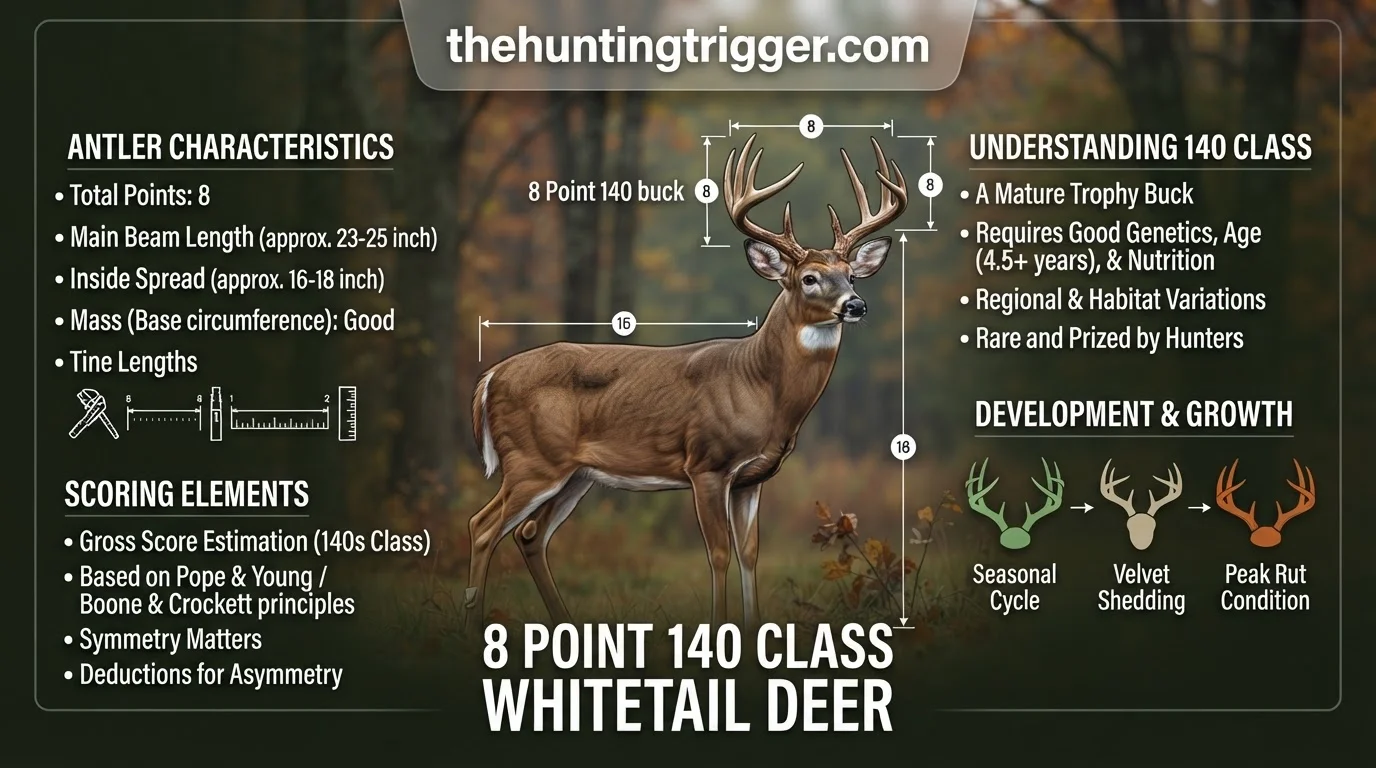
Understanding the 8 Point 140 Class Whitetail Deer Definition
Counting Points vs. Measuring Volume
An “8 point” whitetail deer specifically refers to a buck with eight measurable points on its antlers. This typically means four points on each main beam, excluding the main beam tips themselves, and any abnormal points. These points must be at least one inch long to be considered measurable.
It is a common misconception that the number of points directly correlates to the deer’s age. While older bucks often have more developed antlers, point count is primarily a genetic trait and nutritional indicator, not a precise age marker. A younger buck can sometimes display more points than an older one.
The “140 class” benchmark, however, refers to the antler’s measurable score, often expressed in inches. This score is a composite measurement that assesses the overall size and mass of the antlers, not just the number of points. It signifies a specific level of antler development or “volume.”
Understanding the distinction between gross and net scoring is crucial. Gross score is the total sum of all antler measurements, while net score subtracts deductions for asymmetry between the left and right antlers. For the 140-class, both gross and net scores are considered significant indicators of antler quality.
The Anatomy of a 140-Inch Buck
Achieving a 140-inch antler score requires impressive antler growth across several dimensions. The total antler score is a composite measurement including main beam length, individual tine length, circumference measurements taken at various points along the beams, and the inside spread between the main beams.
For instance, a buck with 24-inch main beams and 10-inch tines (G2 and G3 typically), combined with healthy mass measurements and a decent inside spread, is often closer to the 140-class threshold. It’s the cumulative contribution of these individual measurements that builds the final score.
The goal of antler scoring is to quantify the antler’s size and overall mass, providing a standardized way to compare trophies. A 140-inch buck, especially an 8-point with symmetrical antlers, represents a substantial and mature whitetail trophy that has achieved significant antler development.
The Biological Blueprint: How 8 Point 140 Class Bucks Develop
Genetics: The Foundation of Antler Growth
Antler growth in whitetail deer is a complex biological process, primarily determined by a combination of age, genetics, and nutrition. Among these, genetics lay the fundamental blueprint, establishing the ultimate potential for a buck’s antler development.
Think of genetics as the maximum ceiling for antler size and symmetry. A buck inherits specific genes from its parents that dictate the potential mass, tine length, beam circumference, and overall configuration of its rack.
Even under optimal environmental conditions, a deer lacking the genetic predisposition for large antlers will simply not develop into a 140-class animal. Its genetic code limits its capacity, regardless of how much high-quality food it consumes.
The Critical Role of Quality Nutrition
While genetics set the potential, nutrition acts as the crucial fuel that allows a buck to reach that genetic ceiling. A steady supply of protein-rich forage and essential minerals is paramount for robust antler development. Resources are first allocated to body maintenance and growth, then to antler production.
Key minerals such as calcium, phosphorus, and zinc are directly incorporated into the rapidly growing antler tissue. Insufficient intake of these vital nutrients can severely stunt antler growth, preventing a genetically superior buck from expressing its full potential.
Age also plays an indispensable role. Achieving a 140-class score generally indicates a mature deer, typically 3.5 years or older. Younger bucks, like a 1.5-year-old, are still dedicating significant energy to body growth and skeletal development.
Consequently, a 1.5-year-old buck, even in an area rich with high-protein forage, will rarely reach 140 inches due to physical immaturity. Whitetail bucks commonly hit their peak antler potential between 3.5 and 5.5 years old, when their bodies are fully mature, and energy can be maximally directed towards antler development.
Scoring Standards: Boone and Crockett vs. Pope and Young Insights
Accurately assessing the trophy quality of a whitetail buck involves standardized measurement systems. These systems provide a uniform method for comparing antlers, which is crucial for fair recognition among hunters and for scientific data collection on herd dynamics.
The Official Measurement Process
The Boone and Crockett Club (B&C) is widely recognized as the gold standard for measuring North American big game trophies taken by any legal hunting method. The Pope and Young Club (P&Y) applies an identical scoring methodology but is exclusively for animals harvested with archery equipment.
Official scoring involves precise measurements of main beam length, tine length, circumferences, and inside spread. These records provide valuable insight into regional herd health, genetics, and habitat quality over extended periods, contributing to wildlife management efforts.
Common pitfalls in DIY scoring include incorrect measurement placement, overlooking deductions, and misidentifying typical versus non-typical points. It’s important to remember that not all 8-point bucks are 140 class, and conversely, a 140-class buck doesn’t necessarily have only 8 points; it could have more points with smaller dimensions.
Gross vs. Net Scores Explained
A “gross score” is the sum of all individual antler measurements, including all typical and non-typical points, without any deductions for asymmetry. It represents the total amount of antler material.
The “net score,” particularly relevant for typical categories, is derived by subtracting specific deductions from the gross score. These deductions account for differences in symmetry between corresponding points on each antler and for any non-typical points that protrude from the main beams.
For example, a buck with a high gross score might have a significantly lower net score if it possesses many non-typical points or substantial asymmetries. Understanding this distinction is key to accurately evaluating a deer’s official trophy potential under B&C or P&Y rules.
Comparing the 8 Point 140 Class Whitetail Deer to Other Trophies
8-Point vs. 10-Point: The 140-Class Comparison
Achieving a 140-inch score represents a remarkable trophy for any whitetail deer, yet the physical attributes of an 8-point buck reaching this benchmark are distinct from a 10-point buck with the same score. The fundamental difference lies in how each animal accumulates the necessary antler inches.
A 140-class 10-point buck typically distributes its antler length across a greater number of individual tines. While certainly impressive, this often means that its tines might be comparatively smaller or shorter on average to reach the 140-inch total.
In contrast, an 8-point buck hitting 140 usually possesses exceptional ‘mass’ (circumference measurements) and ‘main beam’ length. With fewer points to contribute to the score, the main beams and the existing four tines per side must be significantly longer and thicker to compensate.
This distinction highlights the engineering of the rack. A well-developed 8-point at 140 inches often showcases an incredible balance of length, mass, and symmetry despite its lower point count.
Why Point Count Doesn’t Equal Score
The number of points on a whitetail buck’s rack does not directly correlate with its Boone and Crockett or Pope and Young score. These scoring systems award points for main beam length, tine length, and mass (circumference measurements), and they deduct for lack of symmetry.
A 140-class 8-pointer is often more prized by seasoned hunters and scorers than a 140-class 10-pointer because it represents a buck that grew an immense amount of antler material with fewer growth points. This suggests superior genetics and ideal habitat conditions for its specific antler configuration.
Comparing mass versus total point count is crucial. A buck with fewer, but very long and heavy, tines and main beams can easily outscore a buck with many short, spindly points. It’s about the overall volume and length of bone, not just the sheer number of protrusions.
It’s also important to distinguish whitetail racks from the bifurcated growth of mule deer. Whitetails typically have tines growing off a single main beam, whereas mule deer often show bifurcated or “forked” points. This fundamental difference in antler architecture means scoring rules are specific to each species.
How to Read This Comparison
This table provides a general comparison of common antler characteristics when two bucks, an 8-point and a 10-point, both achieve a 140-inch typical score. The terms “Generally Longer,” “Often Shorter,” “Typically Higher,” and “Can Be Moderate” are qualitative descriptors, not precise measurements. They reflect trends observed when analyzing how whitetails accumulate score.
“Antler Mass” refers to the circumference measurements taken at various points along the main beams, which contribute significantly to the total score. “Symmetry Deductions” relate to the penalization of non-symmetrical growth in typical scoring systems. A 10-point rack, having more points, statistically has more opportunities for asymmetrical growth compared to an 8-point rack.
The “Rarity/Prize Factor (Subjective)” indicates the general esteem held for such animals within the hunting community; a 140-class 8-pointer is often regarded as rarer due to the immense individual antler growth required to reach that score with fewer points. Always verify specific antler configurations against official scoring rules for exact measurements.
Regional Rarity and Habitat for Trophy 140-Class Whitetails
Geographic Factors Influencing Antler Size
The consistent production of 140-class whitetail bucks is not uniform across North America; it is heavily influenced by specific geographic and ecological factors. Regions with rich soil, abundant water, and a favorable climate create optimal conditions for superior deer development.
These prime areas ensure a year-round supply of high-quality forage, critical for both body growth and significant antler development. Bucks require substantial caloric intake and specific nutrients, like calcium and phosphorus, to express their full genetic potential in antler size.
The American Midwest exemplifies this, with states like Iowa, Illinois, Kansas, and Ohio consistently producing many trophy-class bucks. Agriculture-rich landscapes typically offer the caloric density required to sustain a 140-class buck, including vast fields of corn, soybeans, and alfalfa.
Furthermore, lower deer densities in certain areas reduce competition for these abundant food sources. Less competition means individual deer, especially bucks, access more nutrients, allowing them to allocate more energy towards peak antler growth upon reaching maturity.
Land Management for Trophy Potential
Beyond natural endowments, intentional land management strategies are paramount in fostering environments conducive to producing trophy 140-class whitetails. The most critical factor is allowing bucks to reach older age classes, typically 4.5 years old or more, when their antler growth potential peaks.
This often involves selective harvest regulations, such as antler point restrictions or limiting overall buck tags, which protect younger bucks. Such strategies effectively manipulate the herd’s age structure, ensuring more bucks survive long enough to grow significant antlers.
Habitat improvement projects also play a vital role. These include establishing food plots, ensuring reliable water sources, and creating diverse cover for bedding and security. These efforts supplement natural forage, reduce stress, and contribute directly to better health and antler development.
Private land management often implements these intensive strategies, including controlling predator populations and carefully monitoring herd health. The combination of superior genetics, abundant nutrition, and mature age classes ultimately culminates in consistent production of 140-class whitetails.
Practical Tips for Evaluating a Mature 140-Class 8-Pointer
Accurately field-judging a whitetail buck, especially one potentially reaching the 140-class, requires a keen eye for both antler characteristics and physical maturity. It’s about combining visual cues to make an informed decision in often fleeting moments.
Success in identifying these specific bucks relies on understanding what contributes to their score and what physical traits signify a truly mature animal, beyond just the rack’s appearance.
Field Judging Antler Mass
When assessing antlers in the field, mass is a critical component often underestimated. Focusing solely on point count rather than overall antler mass is a common pitfall. Many hunters overlook bucks with impressive circumferences and overall volume because they aren’t “typical” 10-pointers.
Pay close attention to the base circumference, the measurement around the antler just above the burr. A good rule of thumb is to visually compare it to the buck’s eye diameter; a truly mature 8-pointer will often have bases significantly thicker than its eye, contributing heavily to its score.
Observe the length of the tines. A crucial early indicator is how far tines extend beyond the buck’s ears when viewed from various angles. If a buck’s antlers extend well beyond his ears, especially his main beams and G2 tines, it is a primary indicator of a potential 140-class trophy.
Consider the overall bulk and density of the antlers. Do they appear thick and robust throughout, or do they taper quickly? Wider main beams and lengthy tines, combined with substantial mass, are hallmarks of a high-scoring 8-pointer.
To counteract ‘ground shrinkage’ – the common phenomenon where a buck appears smaller once harvested – always field-judge conservatively. It’s often wise to assume a slightly smaller score than your initial estimate to avoid disappointment and ensure you’re making a calculated decision.
Identifying Maturity Beyond the Rack
Antlers are only one piece of the puzzle. Verifying a buck’s age through physical characteristics is equally important for determining maturity, as younger bucks, even with impressive racks, may not have reached their full potential.
Mature bucks often display deep, dark tarsal stains on the inside of their hind legs. These dark, often black, patches indicate consistent rutting activity and are a strong sign of an older, dominant animal that is actively marking its territory.
Observe the buck’s body profile. Younger bucks tend to have a more athletic, trim build with a well-defined neck that transitions smoothly into the shoulders. In contrast, a truly mature 140-class 8-pointer typically exhibits a blockier body, a thicker, often swollen neck, and prominent, heavy shoulders.
Crucially, look for a noticeable sagging belly. As bucks age, their metabolism changes, and they often develop a deeper, more pronounced belly line, especially compared to their chest. This ‘pot-bellied’ appearance is a reliable indicator of an older, fully mature animal.
Combining these body cues with antler characteristics provides the most accurate field assessment. A truly mature 8-pointer will typically showcase both impressive antler mass and the distinct physical traits of an older, experienced animal.
Key Takeaways
-
✓
An 8 point 140 class whitetail defines a specific trophy benchmark based on antler points and score. -
✓
Buck development into a 140-class deer is primarily driven by genetics, age, and nutrition. -
✓
Scoring systems like Boone & Crockett and Pope & Young provide standardized insights for evaluating antler size. -
✓
Comparing a 140 class 8-pointer to other trophies reveals its distinct characteristics and rarity. -
✓
Effective field evaluation requires understanding antler characteristics, body size, and regional habitat factors.
❓ Frequently Asked Questions
1
What defines an 8 point 140 class whitetail deer?
An 8 point 140 class whitetail deer refers to a buck with eight measurable antler points, typically four on each side, whose antlers score approximately 140 gross inches under accepted scoring systems like Boone and Crockett or Pope and Young. This combination signifies a mature, well-developed trophy animal.
2
How do genetics and nutrition contribute to a 140-class buck?
Genetics provide the blueprint for antler growth potential, determining maximum size and shape. Excellent nutrition, including abundant minerals and protein, allows a buck to reach its genetic potential. Combined with sufficient age, these factors are essential for a deer to develop into an impressive 140-class trophy.
3
What’s the difference between Boone & Crockett and Pope & Young scoring for these deer?
Both Boone & Crockett (B&C) and Pope & Young (P&Y) use similar methods to score whitetail antlers, focusing on measurements like beam length, mass, and spread. The primary difference is that B&C scores are for legally harvested animals with a firearm, while P&Y scores are specifically for animals taken with archery equipment. The 140-class threshold applies to both.
4
Why is an 8 point 140 class buck considered a significant trophy?
An 8 point 140 class buck represents a remarkable achievement for hunters and a testament to excellent deer management. It signifies a mature animal that has reached substantial antler development, often requiring ideal habitat, genetics, and several years of age. Such deer are relatively rare and highly sought after.
5
What are crucial steps for evaluating a potential 140-class 8-pointer in the field?
Key evaluation steps include assessing body size to estimate age, judging antler mass, estimating main beam length, and approximating inside spread. Look for symmetry and uniformity in points. Using binoculars or a spotting scope for detailed observation is crucial to gather accurate insights and details for field scoring.
6
What does ‘8 point 140 class’ actually mean?
It describes a buck with exactly 8 main antler points that, when measured according to B&C standards, totals 140 inches in overall antler volume.


Leave a Reply