
Quick Answer
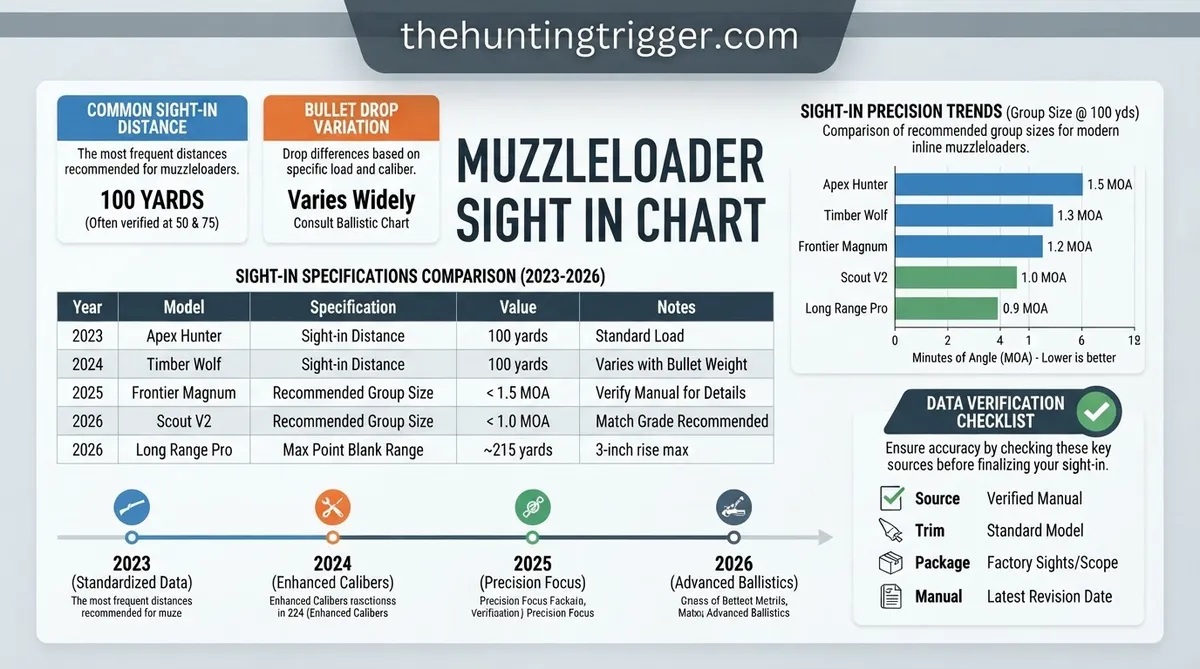
Muzzleloader sight-in specifications vary significantly by projectile configuration, propellant type, and barrel twist rate. Most modern inline muzzleloaders are optimized for a 100-yard zero, providing a point-blank range (PBR) that typically covers 0 to 125 yards. Always consult your specific factory manual and load data, as ballistic coefficients change based on bullet weight, grain configuration, and atmospheric density.


A muzzleloader is only as accurate as the ballistic data you provide it, yet many hunters rely on generic drop charts that do not match their specific load, rifle twist rate, or environmental conditions. Generic trajectory cards fail to account for unique muzzle velocities, variable powder charges, and optics height, leading to missed shots in the field. This guide provides a professional-grade framework to build your own sight-in chart and ensures your rifle’s performance matches your expectations out to 200 yards.
The data presented below covers modern inline and traditional muzzleloaders through 2026. Values are based on standard ballistic profiles. Users must verify these figures against their own rifle’s performance via a chronograph and range testing. Last reviewed: September 2026.
Muzzleloader Sight In Chart Reference Data (2026 Edition)
This table provides a reference for a standard 250gr sabot projectile. Note that “Zero” represents the point of impact being exactly on the crosshairs at 100 yards.
📤 Share Image
| Range (Yds) | Bullet Type | Drop/Rise (Inches) | Notes |
|---|---|---|---|
| 25 | Saboted | -1.2″ | Close range offset |
| 50 | Saboted | +0.8″ | Mid-range peak |
| 100 | Saboted | 0.0″ | Industry Standard Zero |
| 150 | Saboted | -4.5″ | Significant drop |
| 200 | Saboted | -13.2″ | Beyond typical ethical range |

Standard Ballistic Coefficients by Projectile Type
The Ballistic Coefficient (BC) determines how well a bullet resists drag. Modern polymer-tipped saboted bullets typically feature higher BCs (0.200–0.250) compared to traditional lead conical bullets, which may range from 0.120 to 0.160. Higher BC projectiles maintain velocity better, resulting in less drop at the 150-yard mark.
How to Verify These Specs With Your Specific Rifle
Never rely solely on a printout. Use a paper target at 25, 50, 100, and 150 yards. If your real-world group is hitting lower than the chart indicates, your muzzle velocity is likely lower than the manufacturer’s estimate due to barrel length or powder inconsistency.
How to Build a Custom Muzzleloader Sight In Chart
Use a chronograph to measure 5–10 shots of your specific load. Use the average velocity as your baseline input for all ballistic software.
Plug in your BC, actual velocity, and your precise scope height (distance from the center of the bore to the center of the optic).
Factors That Alter Muzzleloader Trajectory Data
Black powder and substitutes burn faster in heat. A 20-degree drop can decrease your muzzle velocity, shifting your point of impact several inches lower at 150 yards.
Bullets travel more efficiently in thin, high-altitude air. If your chart was generated at sea level, you will likely hit high when hunting in mountainous terrain.
Common Muzzleloader Sight In Chart Mistakes to Avoid
- Using generic internet charts that do not specify bullet weight.
- Failing to re-zero after changing from copper to lead projectiles.
- Assuming “Maximum Range” implies “Ethical Hunting Range.”
Summary and Best Practices
To ensure success, treat your muzzleloader like a precision instrument. Use a chronograph to confirm actual velocities, verify all theoretical data with live-fire range testing, and update your chart whenever you switch powder charges or bullet brands. Stick to your proven ethical range—typically 150 yards for most modern setups—to ensure clean, humane harvest results.
Download our blank range card template today and finalize your ballistic profile before your next hunt.
Muzzleloader Sight in Chart: Frequently Asked Questions
Should I sight in for 50 or 100 yards?
For most modern inline muzzleloaders, 100 yards is the recommended standard. It provides a flat enough trajectory to ethically hunt game out to 150 yards without holdover. Sighting in at 50 yards is typically only recommended for traditional sidelock rifles or open-sighted setups where target acquisition at longer distances is limited by visibility or mechanical accuracy.
Do I need a custom chart for every bullet weight?
Yes, absolutely. Ballistic coefficients change drastically between bullet weights. A 250gr projectile will have a different arc than a 300gr bullet, even with the same powder charge. Using a chart designed for one weight while shooting another will result in missed shots. Always calibrate your data to the exact projectile and propellant mass used in your hunting load.
Why does my real-world impact differ from the computer chart?
Computer models assume ‘perfect’ conditions, but your rifle is unique. Variables such as scope height, barrel harmonics, primer ignition timing, and even the specific batch of propellant cause deviation. Furthermore, air density at your specific elevation and temperature will change the bullet’s flight path. Your chart is a baseline; the range target is the ultimate authority.
Does my barrel twist rate affect my sight-in accuracy?
Yes. Twist rate determines how well a bullet is stabilized. A barrel with a slow twist (1:48) may not stabilize longer, modern conical bullets, causing them to tumble and deviate from the chart. Faster twists (1:24 or 1:28) are better for saboted bullets. If your bullet isn’t stabilized, it will not track according to any standard ballistic chart.


How often should I verify my zero?
You should verify your zero before every hunting season and anytime you change bullet brands, propellant lots, or if the rifle has been subjected to significant physical impact. Muzzleloaders are sensitive to environmental shifts; a quick three-shot group at the range ensures your current setup matches your recorded chart data.

Leave a Reply