
Quick Answer
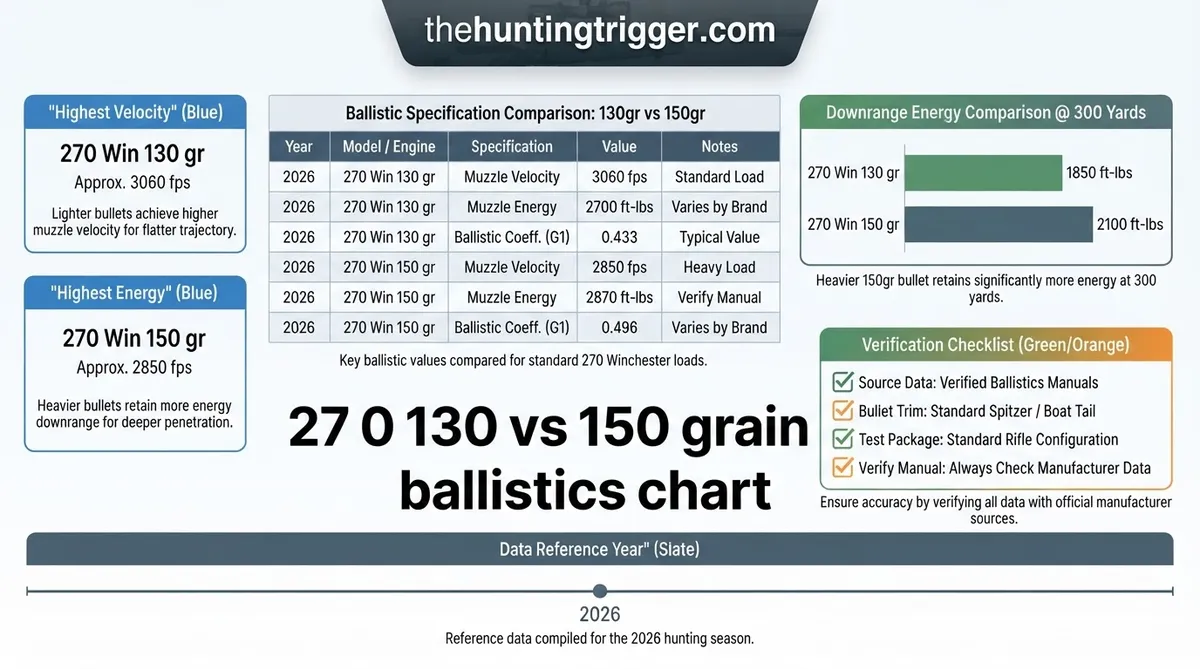
In standard factory specifications, a .270 Winchester 130-grain bullet launches at roughly 3,060 fps with 2,702 ft-lbs of muzzle energy, dropping approximately 6.7 inches at 300 yards (200-yard zero). The heavier 150-grain bullet leaves at 2,850 fps with 2,706 ft-lbs, dropping around 7.8 inches. While 130-grain offers flatter trajectory for open country, 150-grain delivers higher sectional density and retained downrange energy for larger game.


The .270 Winchester in 130-grain and 150-grain factory configurations represents one of the most thoroughly documented hunting debates in modern ballistics. Across standard factory specifications, a standard 130-grain projectile leaves a 24-inch test barrel at roughly 3,060 feet per second (fps) with 2,702 foot-pounds (ft-lbs) of kinetic energy, producing a flat trajectory dropping approximately 19.5 inches at 400 yards (200-yard zero). By contrast, a standard 150-grain projectile clocks in at approximately 2,850 fps and 2,705 ft-lbs at the muzzle, dropping 23.8 inches at 400 yards while retaining superior downrange momentum and sectional density (.279 vs .242). The critical caveat: barrel length variances (22-inch sporting field barrels vs. 24-inch test fixtures), atmospheric density, and modern high-BC bullet designs substantially shift these baseline figures in the field.
This reference covers factory specification standards for the .270 Winchester across sporting rifle platforms through 2026 model year releases. Standard trajectory figures assume SAAMI-spec 24-inch test barrels with a 1:10-inch right-hand twist rate, fired at standard atmospheric conditions (59°F, 29.92 inHg barometric pressure, 50% relative humidity, sea level elevation). Real-world hunting velocities in common 22-inch sporter barrels, compact mountain rifle trim levels, or extreme weather configurations will vary by 50 to 90 fps. Always consult the official load manual, factory ammunition box velocity chart, and verify zero using your specific rifle before entering the field. Last reviewed: September 2026.
3,060 fps
Range: 3,000 – 3,120 fps (Factory Standard)
2,850 fps
Range: 2,800 – 2,900 fps (Factory Standard)
-4.3 in
130 gr: -19.5″ vs 150 gr: -23.8″
.242 vs .279
+15.3% Penetration potential on 150 gr

270 130 Vs 150 Grain Ballistics Chart: Factory Specifications
Understanding the downrange mechanics of the .270 Winchester requires evaluating flight dynamics across 100-yard increments. While both bullet weights share common powder capacities and cartridge overall lengths (COL of 3.340 inches), their trajectories diverge substantially downrange due to differences in initial velocity, bullet profile, and ballistic coefficient (BC).
📤 Share Image

Full Velocity, Drop, and Energy Trajectory Comparison Table
The following master specification chart demonstrates the trajectory, kinetic energy retention, and wind drift behavior for representative modern spitzer boattail bullets (130-grain G1 BC ~.435; 150-grain G1 BC ~.480). All ballistic calculations assume a standard 200-yard primary sight-in zero and a 10 mph 90-degree full-value crosswind.
| Distance (Yards) | Load / Bullet Weight | Velocity (fps) | Kinetic Energy (ft-lbs) | Bullet Drop (200y Zero) | 10 mph Wind Drift |
|---|---|---|---|---|---|
| Muzzle (0 yd) | 130 gr Polymer-Tip BT | 3,060 | 2,702 | -1.5 in (Sight Line) | 0.0 in |
| 150 gr Spire Point BT | 2,850 | 2,705 | -1.5 in (Sight Line) | 0.0 in | |
| 100 Yards | 130 gr Polymer-Tip BT | 2,845 | 2,336 | +1.5 in | 0.7 in |
| 150 gr Spire Point BT | 2,660 | 2,356 | +1.8 in | 0.7 in | |
| 200 Yards (Zero) | 130 gr Polymer-Tip BT | 2,642 | 2,014 | 0.0 in | 2.9 in |
| 150 gr Spire Point BT | 2,478 | 2,045 | 0.0 in | 2.7 in | |
| 300 Yards | 130 gr Polymer-Tip BT | 2,447 | 1,728 | -6.5 in | 7.0 in |
| 150 gr Spire Point BT | 2,302 | 1,765 | -7.8 in | 6.4 in | |
| 400 Yards | 130 gr Polymer-Tip BT | 2,260 | 1,475 | -19.5 in | 13.0 in |
| 150 gr Spire Point BT | 2,133 | 1,515 | -23.8 in | 11.8 in | |
| 500 Yards | 130 gr Polymer-Tip BT | 2,080 | 1,250 | -40.5 in | 21.2 in |
| 150 gr Spire Point BT | 1,970 | 1,293 | -48.6 in | 19.1 in |
Footnote: Table figures calculated based on standard atmospheric parameters (ICAO Standard Atmosphere, sea level). Sight height assumed at 1.5 inches above bore line. Values will vary depending on temperature, barrel twist, and proprietary factory load pressures.
Key Data Scope and Factory Test Barrel Assumptions
The trajectory crossover between these two weights illustrates critical physical trade-offs. The 130-grain load carries an initial velocity advantage of roughly 210 fps. This extra speed keeps its path flatter inside typical sporting ranges, dropping only 6.5 inches at 300 yards compared to 7.8 inches for the 150-grain projectile. At 400 yards, the 130-grain bullet drops 19.5 inches compared to 23.8 inches for the 150-grain bullet—a noticeable difference of over 4 inches.
However, look closely at downrange kinetic energy and wind drift at 500 yards. Due to the 150-grain bullet’s superior ballistic coefficient, it retains 1,293 ft-lbs of kinetic energy versus 1,250 ft-lbs for the 130-grain projectile. Furthermore, the 150-grain bullet experiences 2.1 inches less wind deflection at 500 yards in a 10 mph full-value crosswind (19.1 inches vs. 21.2 inches). The heavier bullet starts slower, but its greater inertia and streamlined shape shed velocity at a lower rate.
270 130 vs 150 Grain Ballistics Chart: Year-by-Year Evolution of .270
The performance specifications for .270 Winchester ammunition have not remained static. Since Winchester introduced the cartridge in 1925 based on the .30-03 parent case necked down to .277 caliber, bullet geometry, jacket metallurgical compositions, and propellant burn rates have evolved substantially across production model years.
| Year | Model / Engine (Load Configuration) | Specification | Value | Notes |
|---|---|---|---|---|
| 1925–1940s | Winchester Model 54 / Early Model 70 | 130 gr Pointed Soft Point | 3,140 fps (Catalog) / 3,050 fps (Actual) | Early corrosive primers; high chamber pressure spikes recorded in testing. |
| 1950s–1970s | Jack O’Connor Standard (Custom M70 / Rem 721) | 130 gr vs 150 gr Cup-and-Core | 3,060 fps (130gr) / 2,860 fps (150gr) | Standardized IMR-4831 powders established benchmark high-velocity loads. |
| 1980s–1990s | Factory Production Sporters (Rem 700 / Ruger M77) | 150 gr Partition / Grand Slam | 2,850 fps (Muzzle Energy: 2,705 ft-lbs) | Introduction of dual-core bullets eliminated core-jacket separation on big game. |
| 2000s–2010s | Modern Polymer Sporters (Savage 110 / Tikka T3) | 130 gr Bonded Plastic Tip (AccuBond / InterBond) | 3,050 fps (G1 BC: .435–.460) | Combines flat 130 gr speed with controlled weight retention (70%+). |
| Through 2026 | High-Precision Field Platforms (Christensen / Bergara) | 130 gr Monolithic / 150 gr Extreme Low-Drag | 3,075 fps (130gr) / 2,840 fps (150gr G1 .525+) | Monolithics provide 99% weight retention; specialized powders reduce temp drift. |
The Classic Cup-and-Core Era: Jack O’Connor Standards
The baseline specifications for the .270 Winchester were immortalized by outdoor writer Jack O’Connor in the mid-20th century. O’Connor favored the 130-grain cup-and-core soft point for practically everything from Coues deer to grizzly bears, relying on muzzle speeds exceeding 3,100 fps powered by slow-burning IMR-4831 surplus powder. During this era, standard factory configurations used simple copper jackets wrapped around lead cores (e.g., Winchester Power-Point or Remington Core-Lokt).
While devastatingly effective on thin-skinned deer, these early 130-grain projectiles occasionally fragmented when impacting heavy bone at close range, where impact velocities exceeded 2,900 fps. This led big-game hunters to adopt the 150-grain loading, which stepped down muzzle velocity to 2,850 fps, preserving projectile structural integrity and ensuring sufficient penetration through elk joints.
The High-BC and Bonded Core Transition (2000s–2010s)
Entering the 2000s, ballistic research shifted away from brute mass toward chemical bonding and aerodynamic efficiency. Ammunition manufacturers introduced designs like the Nosler AccuBond, Swift Scirocco, and Hornady InterBond. By chemically bonding the lead core to a progressively thickening gilded metal jacket, ammunition makers solved high-velocity fragmentation issues.
A bonded 130-grain projectile could now retain 70% to 80% of its initial weight upon impacting heavy tissue at 3,000 fps. Concurrently, sleek polymer tips raised ballistic coefficients from legacy values (~.370) up to modern ranges (.435 to .460), substantially narrowing the aerodynamic wind-drift gap previously held by flat-base 150-grain slugs.
Modern Monolithic and Low-Drag Factory Configurations (Through 2026)
Current production offerings through the 2026 model year fall into two specialized categories: ultra-tough monolithic copper/gilded alloy solids (such as the Barnes TTSX, Hornady CX, and Federal Trophy Copper) and heavy-for-caliber, ultra-high-BC long-range options (such as Federal Terminal Ascent or Hornady ELD-X). Contemporary monolithic 130-grain offerings routinely achieve 98% to 100% weight retention, completely flipping traditional terminal ballistics principles. Meanwhile, advanced temperature-stable propellants maintain exact chamber pressures across temperature extremes ranging from -10°F during late-season mountain hunts to 95°F during early-autumn pronghorn stalks.
Sectional Density and Penetration: 130 Gr Vs 150 Gr Terminal Impact
Terminal ballistics inside vital organs depends heavily on two interacting variables: sectional density (SD) and projectile construction. Sectional density represents the ratio of a bullet’s mass to its cross-sectional area squared. In identical calibers, heavier bullets inherently carry a higher sectional density, which mathematically translates to deeper potential penetration through resisting media, all else being equal.
Sectional Density Comparison (.242 vs .279) and Wound Channels
In .277 caliber, a 130-grain bullet registers a sectional density of .242, while a 150-grain bullet delivers .279. To put this in perspective, an SD of .279 in the .270 caliber mirrors the sectional density of a 165-grain .30-06 bullet (.249) and approaches that of an honest 180-grain .30-caliber slug (.271). This high mass-to-frontal-area ratio explains why the 150-grain .270 Winchester earned a reputation among western guides as a dependable elk cartridge.
The 130-grain projectile creates a wider temporary cavitation pocket during the first 10 to 14 inches of soft tissue due to its violent hydrostatic shock and rapid expansion at 3,000+ fps. However, if the bullet strikes heavy scapular bone or a thick muscle shield at an acute quartering angle, a standard cup-and-core 130-grain bullet may shed 40% of its weight, diminishing its residual straight-line penetration path. The 150-grain bullet, travelling slightly slower and carrying more physical momentum, drives deeper with less disruption to its linear trajectory.
Cup-and-Core vs Monolithic Copper Penetration Realities
Modern bullet technology can upend conventional sectional density rules. Specifically, bullet construction often trumps static weight:
- 130-Grain Monolithic Copper (e.g., Barnes TTSX / Hornady CX): Because these bullets lack a lead core, they do not suffer core-jacket separation. A 130-grain TTSX typically retains 128 to 130 grains of its mass upon retrieving it from ballistics gel. Its terminal penetration frequently exceeds 26 to 28 inches, out-penetrating a standard lead-core 150-grain soft-point.
- 150-Grain Conventional Lead Core (e.g., Core-Lokt / Power-Point): When impacting bone at close range, traditional lead-core bullets can lose their jackets, shedding 30% to 40% of their starting weight. A 150-grain lead bullet that sheds 45 grains leaves an effective penetration mass of only 105 grains.
- 150-Grain Bonded / Partition Configurations: When loaded with Nosler Partitions or Swift A-Frames, the 150-grain load provides deep, reliable punch. The forward core mushrooms into a devastating blunt profile while the enclosed rear core guarantees continuous drive through heavy bone.
When transitioning from lead-core ammunition to monolithic copper bullets, ballistic experts recommend dropping down one step in projectile weight. A 130-grain monolithic copper solid delivers penetration depths that match or exceed a 150-grain conventional lead soft-point, while preserving the flat trajectory and high muzzle speed of the lighter bullet.
✅ 130-Grain Advantages
- Significantly flatter trajectory out to 400 yards (-19.5″ vs -23.8″).
- Higher initial muzzle velocity (~3,060 fps) maximizes close-to-mid range shock.
- Slightly lower free recoil (~16.5 ft-lbs in standard rifles).
- Vast factory availability across every sporting goods retailer worldwide.
🎯 150-Grain Advantages
- Superior Sectional Density (.279) provides reliable penetration on elk and moose.
- Less wind deflection at 400+ yards (11.8″ vs 13.0″ at 400y in 10 mph wind).
- Higher energy retention past 400 yards due to superior ballistic coefficients.
- Less meat damage on medium game when using conventional cup-and-core designs.
What Affects Ballistics: Barrel Length, Twist Rates, and Wind Drift
Catalog ballistics tables published on ammunition packaging represent idealized performance calculated in precision test fixtures. In standard field conditions, mechanical rifle variables and ambient atmospheric density heavily alter real-world muzzle velocity, projectile stability, and wind drift.
Barrel Length Velocity Losses: 24-Inch Test vs 22-Inch Field Rifles
The primary discrepancy between published specifications and real-world chronograph readings comes down to barrel length. SAAMI proof-testing fixtures utilize 24-inch barrels with minimum-dimension chambers to maximize velocity consistency. However, a significant portion of commercial hunting rifles—such as standard-grade bolt actions and compact mountain configurations—are built with 22-inch sporting barrels to reduce weight and improve handling.
Velocity Loss Per Barrel Inch (.270 Winchester)
fps loss per inch (130 Grain)
fps loss per inch (150 Grain)
Total reduction (24″ vs 22″ Barrel)
Because the .270 Winchester operates at a relatively high maximum chamber pressure (65,000 PSI) utilizing slow-burning rifle propellants (such as H4831SC, Reloder 22, and Vihtavuori N165), it needs barrel length to fully combust its powder charge. Cutting barrel length from 24 inches to 22 inches strips approximately 50 to 70 fps of velocity. In a 20-inch carbine, a 130-grain load rated at 3,060 fps often drops to roughly 2,930 fps at the muzzle.
1:10 Twist Rate Rifling and Heavy Bullet Gyroscopic Stability
For almost a century, the universal factory specification for the .270 Winchester has been a 1:10-inch rifling twist rate. This twist rate was optimized specifically around standard-length 130-grain cup-and-core spitzers. Understanding stability requires looking at projectile aerodynamics:
- 130-Grain Projectiles: In a 1:10 twist barrel, conventional 130-grain bullets achieve a gyroscopic stability factor (SG) well over 1.8, ensuring peak aerodynamic performance and tight grouping under all field temperatures.
- 150-Grain Projectiles: Traditional 150-grain flat-base or moderate boattail lead-core spitzers achieve an SG between 1.4 and 1.6, which provides stable flight under SAAMI atmospheric criteria.
- Modern Heavy Monolithic Warnings: Modern monolithic copper bullets are physically longer than lead bullets of identical weight because copper is less dense than lead. A monolithic copper 150-grain bullet is exceptionally long. In colder, high-pressure environments at sea level, standard 1:10 twist barrels can struggle to stabilize high-BC copper solids weighing over 140 grains. For modern ultra-long 150-grain projectiles, a faster 1:8.5 or 1:9 twist barrel is required.
If shooting a standard factory rifle with a 1:10-inch twist rate, verify projectile length before buying 150-grain monolithic copper solid cartridges. If the bullet length exceeds roughly 1.38 inches, standard 1:10 twist rifling may fail to fully stabilize the bullet, causing yawing, erratic group dispersion, and reduced ballistic coefficients downrange.
Downrange Wind Deflection at Extended Distances
Wind drift is often misunderstood. Bullet drop is predictable using modern laser rangefinders and ballistic turrets, but wind speed and angle shift unpredictably across valleys and canyons. In hunting scenarios beyond 300 yards, wind deflection is the primary cause of missed or poor shots.
A common mistake is pairing mismatched bullet shapes when comparing drift—such as contrasting a high-BC boat-tail 130-grain projectile with a flat-base round-nose 150-grain bullet. When comparing bullets of modern, matched boat-tail designs, the higher ballistic coefficient of the 150-grain bullet resists crosswind displacement better over distance:
130 gr: 2.9 in | 150 gr: 2.7 in
Negligible 0.2-inch drift delta at typical big-game engagement distances.
130 gr: 7.0 in | 150 gr: 6.4 in
0.6-inch gap favors the 150 gr, but both remain well inside a deer’s vital zone.
130 gr: 13.0 in | 150 gr: 11.8 in
A 1.2-inch advantage for 150 gr; wind estimation precision becomes critical.
130 gr: 21.2 in | 150 gr: 19.1 in
2.1-inch difference shows how the heavier bullet sheds wind deflection at longer ranges.
Hunting Caliber Comparison: 130 Gr .270 Vs 140 Gr, 6.5 CM, and .30-06
Evaluating the .270 Winchester’s two primary bullet weights is most informative when framed alongside adjacent alternatives: the middleweight 140-grain .270 split load, the modern 6.5 Creedmoor, and the classic .30-06 Springfield.
The .270 Win 140-Grain Middle Ground
Hunters torn between the 130-grain and 150-grain options often settle on the 140-grain loading. Leaving 24-inch barrels at roughly 2,950 fps with an intermediate sectional density of .261, the 140-grain option cleanly bridges the ballistic gap. It drops only 1.7 inches more than the 130-grain bullet at 400 yards (-21.2 inches), while retaining greater downrange kinetic energy (1,520 ft-lbs at 400y) than either of its siblings. Premium 140-grain loads serve as true “do-it-all” cartridges for hunters targeting everything from mountain goats to bull elk with a single rifle setup.
.270 Win 130 Gr vs 6.5 Creedmoor 140 Gr
The comparison between the .270 Winchester 130 gr and the 6.5 Creedmoor 140 gr is one of the most common debates among modern hunters:
- Velocity & Trajectory: The .270 Win 130 gr shoots noticeably flatter inside 450 yards, dropping nearly 6 inches less at 400 yards due to its significant 350 fps muzzle velocity advantage (3,060 fps vs 2,710 fps).
- Kinetic Energy: The .270 delivers roughly 300 to 400 ft-lbs more energy throughout standard hunting distances, offering greater margin for error on medium game.
- Recoil Impulse: The 6.5 Creedmoor’s key advantage is manageable recoil. In identical 8.0 lb rifle setups, the Creedmoor produces roughly 12.8 ft-lbs of free recoil energy compared to 16.5 ft-lbs for the 130-grain .270, making it easier to spot shot impacts through the optic.
.270 Win 150 Gr vs .30-06 Springfield Heavy Loads
When loaded with 150-grain projectiles, the .270 Winchester and .30-06 Springfield present distinct ballistics profiles. The .270 Win 150 gr fires a smaller .277-diameter bullet, whereas the .30-06 fires a wider .308-diameter bullet. Consequently, the .270 bullet has a noticeably higher sectional density (.279 vs .226) and a higher ballistic coefficient than a 150-grain .30-06 bullet. Out past 200 yards, the 150-grain .270 shoots flatter, drifts less in crosswinds, and punches deeper through muscle tissue than a 150-grain .30-06.
The .30-06 reclaims the advantage when loaded with heavy 180-grain or 200-grain bullets. An 180-grain .30-06 Partition delivers 1,680 ft-lbs of kinetic energy at 400 yards—nearly 170 ft-lbs more than the 150-grain .270. However, this extra punch comes at the expense of 27.4 inches of drop at 400 yards and a noticeable jump in felt recoil (22.8 ft-lbs vs 18.0 ft-lbs).
Don’t overemphasize the recoil difference between bullet weights in the same rifle. In an average 8.0-pound field-ready rifle, shooting a 130-grain load generates approximately 16.5 ft-lbs of recoil energy, while a 150-grain load generates roughly 18.0 ft-lbs. This 1.5 ft-lbs difference is imperceptible to most shooters in field hunting conditions.
📋
How to Choose the Right .270 Bullet Weight Step by Step
For open-country whitetail, mule deer, pronghorn, sheep, or mountain caribou under 350 lbs, select the 130-grain loading. For heavy bull elk, moose, or large wild boar exceeding 500 lbs, select the 150-grain loading (or modern 130-grain monolithic copper).
If shots routinely extend past 300 yards in open plains or coulees, the flatter trajectory of the 130-grain load (-19.5″ drop at 400y) gives you a wider margin for error on range estimates compared to the 150-grain projectile (-23.8″ drop).
Ensure your rifle barrel has a standard 1:10 twist before choosing long, monolithic copper bullets. If using a 1:10 barrel with all-copper projectiles, stick with the 130-grain weight for reliable gyroscopic stability and optimal terminal expansion.


270 130 Vs 150 Grain Ballistics Chart Questions Answered
Which drops more at 400 yards: 130 grain or 150 grain .270?
The 150-grain bullet drops noticeably more. Sighted in with a 200-yard zero, a standard 150-grain spitzer drops approximately 23.8 inches at 400 yards, while a standard 130-grain bullet drops approximately 19.5 inches. This gives the 130-grain bullet a 4.3-inch flatter trajectory at 400 yards.
Is a 130-grain .270 Winchester adequate for elk hunting?
Yes, provided you choose modern bullet designs. While early cup-and-core 130-grain bullets sometimes broke apart on heavy elk shoulder bone, modern bonded (Nosler AccuBond, Federal Terminal Ascent) or monolithic copper (Barnes TTSX, Hornady CX) 130-grain bullets retain 80% to 100% of their mass, consistently driving deep into vital organs.
Does the 150-grain .270 buck the wind better than the 130-grain?
Yes, at extended ranges. In a standard 10 mph 90-degree crosswind at 400 yards, a standard boattail 150-grain projectile drifts roughly 11.8 inches compared to 13.0 inches for an equivalent 130-grain bullet. At 500 yards, the 150-grain bullet’s drift advantage widens to 2.1 inches (19.1″ vs 21.2″).
Why do factory ammunition boxes list higher velocities than my chronograph?
Factory ammunition ballistics charts are generated using 24-inch SAAMI specification test barrels. Most commercial sporting hunting rifles feature shorter 22-inch barrels, which generally reduces muzzle velocity by 50 to 70 fps. Differences in ambient temperature, altitude, and internal chamber tolerances also alter recorded speeds.
How Much Flatter Does The 130 Grain Shoot Than The 150 Grain?
With the 200-yard zero used in the chart above, the 130-grain load drops 19.5 inches at 400 yards against 23.8 inches for the 150-grain — about 4.3 inches flatter. At 300 yards the gap is smaller, roughly 1 to 1.5 inches, and it widens the farther you shoot.
What Is The Best Zero Distance For A .270 Winchester?
For most hunting, a 200-yard zero — the zero this chart is built on. It puts the bullet about 1.3 to 1.5 inches high at 100 yards, dead-on at 200, and only around 7 inches low at 300, so you can hold dead-center on deer-sized game across normal hunting ranges.
The 130-grain .270 Winchester remains the benchmark open-country deer load, delivering ~3,060 fps muzzle velocity and dropping under 20 inches at 400 yards with a 200-yard zero. The 150-grain load (.279 sectional density) provides superior penetration momentum for elk and large game, provided shooters account for roughly 4 inches of extra drop at 400 yards. Modern monolithic copper 130-grain projectiles effectively bridge this gap, delivering 150-grain penetration depths alongside 130-grain flat trajectories. Check your rifle’s barrel length against factory specification sheets, chronograph your selected hunting ammunition, and confirm your 200-yard zero at the range before your season opens.

Leave a Reply