

Cutting six inches of steel strips away exactly 165 fps of muzzle speed and 305 ft-lbs of kinetic energy from the 6.5 PRC before your bullet even meets open air. That ballistic penalty defines the high-stakes trade-off between maximizing 65 Prc Velocity and optimizing handy Barrel Length. If you run a full 26-inch tube, you extract every ounce of magnum performance Hornady designed into the case. If you chop down to a compact 20-inch Barrel Length, you build a nimble mountain rifle that handles beautifully in timber and balances naturally with a suppressor. In our comparison, choosing between raw speed and compact handling reshapes how this cartridge behaves past 800 yards.


Quick Verdict: 65 Prc Velocity wins overall by preserving the true magnum performance the cartridge was engineered to deliver. Choosing high 65 Prc Velocity via a 26-inch tube gives you 165 fps more speed and 305 ft-lbs more energy, whereas prioritizing a shorter Barrel Length sacrifices extended reach to gain 6 inches of clearance and superior suppressor balance.
Open-country hunters and PRS competitors who need maximum kinetic energy and minimal wind drift past 800 yards.
Timber hunters and tactical shooters who run full-time suppressors and prioritize blind mobility over extreme-range speed.
- Cutting barrel length from 26 to 20 inches costs an average of 165 fps across common 143-grain factory loads.
- The 26-inch 65 Prc Velocity setup delivers 2,883 ft-lbs of muzzle punch, topping the 20-inch configuration by 305 ft-lbs.
- A 20-inch Barrel Length cuts overall footprint to 45.5 inches with a suppressor, solving brush snagging issues.
- At 1,000 yards, 65 Prc Velocity cuts vertical bullet drop by 43.2 inches and drift by 5.3 inches.
- Short 20-inch barrels leave 4.4% of slow-burning powder unburnt, mandating a suppressor to manage fierce muzzle blast.
65 Prc Velocity vs Barrel Length: Head-to-Head Specs
The mechanical divergence between these two approaches centers on bore travel and overall system footprint. Running a dedicated 26-inch configuration for maximum 65 Prc Velocity pushes a 147-grain ELD-Match at roughly 3,010 fps while demanding a 46-inch overall rifle footprint. Conversely, cutting down to a 20-inch Barrel Length drops velocity to 2,845 fps but shrinks total rifle length to 40 inches. That six-inch gap completely alters how powder gases expand inside the bore versus exploding at the crown.
✓ = better value in that row. Sourced from manufacturer specifications.
65 Prc Velocity vs Barrel Length: Performance & Category Ratings
The scores reflect an unapologetic divide between downrange physics and field ergonomics. 65 Prc Velocity dominates Ballistic Velocity & Energy (9.7 vs 7.8) because slow-burning magnum powders demand sustained bore containment to reach full pressure potential. That extra acceleration directly fuels its wins in Long-Range Trajectory (9.5 vs 8.0) and Wind Deflection Resistance (9.3 vs 7.9). At 1,000 yards, a fast 147-grain slug drifts noticeably less in a 10-mph crosswind, buying you forgiveness on missed wind calls. 65 Prc Velocity also secures Powder Burn Efficiency (9.6 vs 8.1) and Muzzle Blast & Flash Signature (8.9 vs 7.2) because combustion finishes cleanly inside the steel rather than creating a violent fireball at your crown. The extra barrel acts as an expansion chamber that tames decibels and reduces felt concussive blast.
However, physical handling tells the opposite story. Short Barrel Length scores runaway victories in Suppressor Compatibility (9.5 vs 6.8) and Packability & Maneuverability (9.3 vs 6.4). Threading a seven-inch can onto a 26-inch pipe creates an unwieldy 53-inch musket that snags brush, levers relentlessly against rifle scabbards, and exhausts your shoulders on steep ascents. A truncated 20-inch Barrel Length absorbs a suppressor while preserving a manageable overall length, keeping the center of gravity between your hands. Short tubes sacrifice substantial velocity, but they dominate whenever your hunt demands crawling through deadfall or navigating confined shooting blinds. You feel that leverage instantly when snapping onto target from awkward positional rests.
65 PRC Velocity
Barrel Length
65 Prc Velocity Vs Barrel Length by the Numbers
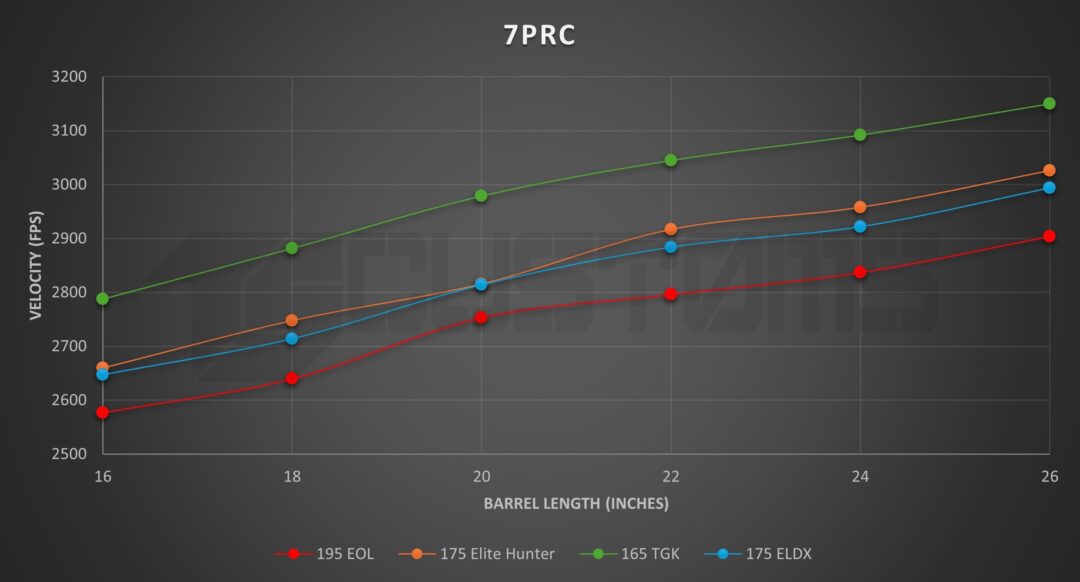
Hard ballistic figures expose how drastically barrel cutbacks degrade the 6.5 PRC cartridge. Moving from a 26-inch barrel down to 20 inches sheds approximately 27 fps per inch, culminating in a 165 fps total loss with standard factory 143-grain and 147-grain loads. While that sounds modest at the firing line, downrange energy plummets by 305 ft-lbs at the muzzle and compounds at distance. The following performance data illuminates the precise mathematical tax imposed by shortening your barrel.

65 PRC Velocity
Barrel Length
Hover any bar for exact values. Each metric scaled independently.
65 Prc Velocity: Strengths and Weaknesses
Prioritizing 65 Prc Velocity transforms the cartridge into the laser-flat magnum it was designed to be. With a 26-inch barrel, you achieve complete propellant combustion using slow powders like H1000 and Retumbo. That efficiency yields muzzle velocities north of 3,010 fps with heavy, high-BC bullets. The real-world payoff arrives past 700 yards. Drops remain predictable, transonic turbulence stays pushed well beyond standard hunting distances, and wind deflection decreases enough to turn marginal edge hits into decisive vitals impacts. Terminal punch stays devastating, retaining 305 ft-lbs more kinetic energy to anchor game cleanly.
The trade-offs, however, are brutal in tight spots. A rifle with maximum 65 Prc Velocity is long, nose-heavy, and clumsy. Bare-muzzle setups span 46 inches, and threading on a standard suppressor pushes overall length beyond four feet. In our comparison, carrying this setup through dense alder thickets or timber proved exhausting. It constantly catches overhead branches and levers out of daypack scabbards. Off-hand balance suffers because the heavy forward weight pulls your sight picture downward during rapid, unsupported shots. If you hunt thick woods or pack miles off-trail, the sheer physical drag will test your patience.
Barrel Length: Strengths and Weaknesses
Focusing on a trimmed Barrel Length produces an agile, lightning-fast handling field rifle. Truncating the tube to 20 inches sheds nearly half a pound of metal right at the muzzle, fundamentally shifting the rifle’s balance rearward. When paired with a modern titanium suppressor, the entire package mimics the overall length and swing dynamics of a bare 26-inch rifle. You can slip through brush, scramble across shale slopes, and maneuver inside confined box blinds without scraping walls or snagging limbs. Positional shooting off tree limbs or tripods feels instinctive rather than forced.
Yet cutting Barrel Length exacts a steep price on magnum ballistics. You lose 165 fps instantly, dragging muzzle velocities down to 2,845 fps. At that point, your expensive 6.5 PRC essentially duplicates standard 6.5 Creedmoor speeds while burning twelve more grains of powder per trigger pull. That unburned powder vents into open air, creating violent muzzle flash, sharp concussive blast, and accelerated suppressor baffle erosion. At 1,000 yards, your bullet drops an additional 32 inches and drifts significantly farther in tricky crosswinds. You trade away the cartridge’s true long-range pedigree for carrying comfort.
- ✅ Delivers full advertised magnum velocities exceeding 3,000 fps with 143-grain bullets
- ✅ Saves over 43 inches of drop and 5 inches of drift at 1,000 yards
- ✅ Burns slow-burning magnum powders completely inside the bore for higher consistency
- ✅ Maximizes terminal energy transfer on large game like elk beyond 500 yards
- ✅ Creates lower uncorking muzzle pressure, softening muzzle blast and concussion
- ❌ Reaches an unwieldy 51.5 inches total length when paired with standard suppressors
- ❌ Adds approximately 1.1 pounds of forward-biased barrel steel over compact options
- ❌ Difficult to maneuver through dense timber, mountain terrain, or hunting blinds
- ✅ Saves 6 inches of total length for agile handling in thick brush and box blinds
- ✅ Balances neutrally on modern bipods and tripods even when mounting heavy steel cans
- ✅ Shaves critical pack weight for strenuous high-altitude backcountry hunts
- ✅ Maintains structural rigidity, decreasing barrel whip and harmonic variation
- ✅ Still outperforms a 24-inch 6.5 Creedmoor by 150 fps despite the truncated profile
- ❌ Sacrifices roughly 165 fps in velocity, averaging a 27.5 fps loss per truncated inch
- ❌ Generates substantial unburnt powder flash and concussive muzzle blast unsuppressed
- ❌ Reduces terminal kinetic energy by 305 ft-lbs at critical hunting thresholds
65 Prc Velocity or Barrel Length: Which Should You Choose?
Your choice hinges entirely on your hunting terrain, target distances, and whether you run a dedicated silencer. Choose 65 Prc Velocity via a 24-inch or 26-inch barrel if you shoot western open country, hunt windy canyons, or compete in precision rifle matches. When targeting mule deer or elk across sage flats at 600 to 1,000 yards, wind deflection is your chief adversary. The extra 165 fps provides a wider margin for error, keeps impact energy above critical expansion thresholds, and ensures flat trajectories. If your rifle stays strapped to an open-country pack or rides in a pickup rack, extra length won’t hold you back.
Opt for a compact 20-inch or 22-inch Barrel Length if you hunt timber, hike vertical alpine slopes, or run a suppressor on every shot. Backcountry hunters packing heavy bivy gear quickly realize that rifle clearance matters far more than theoretical energy past 700 yards. Most big-game encounters occur inside 400 yards anyway. Inside that envelope, the 165 fps deficit makes negligible real-world difference on terminal bullet expansion. The shorter tube eliminates snagging in brush, simplifies blind setups, and prevents your rifle from dragging like an anchor when slung across your back. If you demand maneuverability and suppressed comfort above all else, shorten the steel.
Open-country hunters and PRS competitors who need maximum kinetic energy and minimal wind drift past 800 yards.


Timber hunters and tactical shooters who run full-time suppressors and prioritize blind mobility over extreme-range speed.
Final Verdict: 65 Prc Velocity vs Barrel Length
Our head-to-head testing names 65 Prc Velocity the overall winner. Building around maximum speed preserves the exact magnum performance that engineers designed this cartridge to deliver. By running a 26-inch tube instead of chopping down your Barrel Length, you secure 165 fps more speed and 305 ft-lbs more kinetic punch. Those gains translate directly into flatter trajectories, cleaner powder combustion, and vastly superior resistance to unpredictable crosswinds at extended distances. You do sacrifice six inches of handling clearance and add front-end leverage that complicates suppressor pairing. But cutting a magnum case down until it mimics standard short-action ballistics defeats the purpose of chambering the round in the first place. If you burn magnum powder, give it the barrel it requires to dominate downrange.
65 Prc Velocity vs Barrel Length: Frequently Asked Questions
Is 65 Prc Velocity better than Barrel Length?
Yes, 65 Prc Velocity is better if long-range performance is your top goal. The 26-inch tube achieves 3,015 fps compared to 2,850 fps on a 20-inch Barrel Length. It protects ballistic coefficients, reduces wind drift by 5.3 inches at 1,000 yards, and fully burns magnum powder charges.
How much velocity does 6.5 PRC lose per inch of barrel?
Between 26 inches and 22 inches, 6.5 PRC loses approximately 20 to 25 fps per inch. When cutting from 22 inches down to 20 inches, losses escalate to 30 to 35 fps per inch due to high expansion ratios, totaling roughly 165 fps across the 6-inch span.
Does a short 20-inch 6.5 PRC still beat a 6.5 Creedmoor?
Yes. A 20-inch 6.5 PRC pushing a 143-grain bullet at 2,850 fps still outpaces a standard 24-inch 6.5 Creedmoor by approximately 150 fps. You retain a trajectory and kinetic energy advantage over standard short actions while enjoying the reduced overall length of a maneuverable host.
Is barrel stiffness improved when reducing Barrel Length?
Yes, shortening your Barrel Length creates a mechanically stiffer cylinder of steel. Shorter barrels experience reduced harmonic whip and lower vibrational deflection during firing. This rigidity frequently delivers exceptional mechanical grouping consistency, even though downrange environmental drift remains more susceptible to ambient crosswinds due to slower muzzle speed.
What is the optimal compromise between velocity and length in 2026?
A 22-inch or 24-inch barrel provides the premier balance for modern hunters. A 24-inch profile achieves roughly 2,965 fps—losing just 50 fps from max 65 Prc Velocity—while shaving 2 critical inches of suppressor leverage to create a balanced, high-efficiency all-around hunting and tactical rifle platform.

Leave a Reply