
Updated September 24, 2026. A useful deer shot
placement chart shows the chest organs, shoulder bones, and how the view
changes with angle. Broadside usually offers the clearest view of the
heart and lungs. Quartering away requires careful judgment. Head-on,
rear-facing, obstructed, or unsafe opportunities call for waiting or
passing.


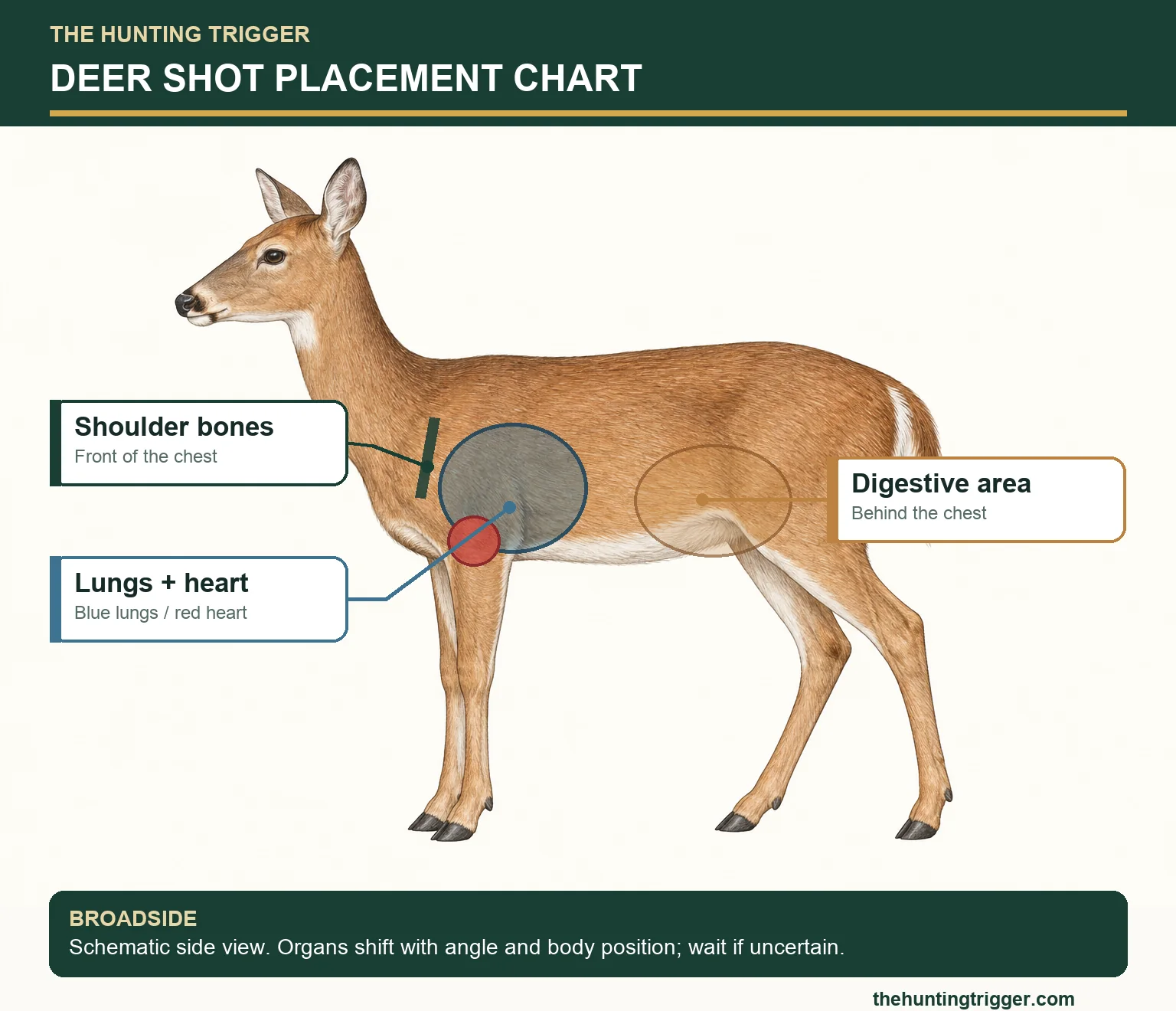
blue lungs and red heart; the digestive area sits behind the chest.
Approximate educational regions, not a scale anatomical map.
Open
the full-size deer anatomy chart for printing or closer inspection.
The decision table below is also selectable text.
| Deer angle | Firearm decision | Bow decision | Main concern |
|---|---|---|---|
| Broadside | Preferred if safety checks pass | Preferred if safety checks pass | Largest heart-and-lung area in view |
| Quartering away | Conditional; evaluate carefully | Conditional; evaluate carefully | A poor path risks the digestive area |
| Quartering toward | Wait for a clearer angle | Pass | Shoulder bones may obstruct the chest |
| Head-on | Wait for a clearer angle | Pass | Narrow chest view |
| Rear-facing | Pass | Pass | No large vital area is presented |
This table follows Texas
Parks & Wildlife’s deer-angle guidance. A favorable angle is
still unsuitable when the path or background is unsafe.
What
anatomy does the deer shot placement chart show?
The heart and lungs sit in the chest behind the
front shoulder. Texas
Parks & Wildlife identifies them as the key vital organs. The
shoulder bones can block access from some angles.
The stomach and intestines are farther back. A
poorly judged quartering-away angle can reach those organs. Our
colored regions teach their general relationship, not exact boundaries
in a living animal.
Editorial method: The Hunting Trigger created this
diagram and checked its claims against linked hunter-education sources.
It is not a veterinary dissection or a substitute for in-person
training.
How do common
deer angles change the decision?
Broadside presents the largest
heart-and-lung area. That makes it the preferred starting point for
a beginner. The animal, foreground, and background still need
assessment.
Quartering away can expose the chest, but the route
through the body changes. Misplacement
can reach the stomach and intestines. Waiting for broadside is
better when that route is unclear.
Quartering toward raises the chance of shoulder-bone
interference. Head-on narrows the useful chest view. A
rear-facing deer presents no
large vital area, so both equipment columns say pass.
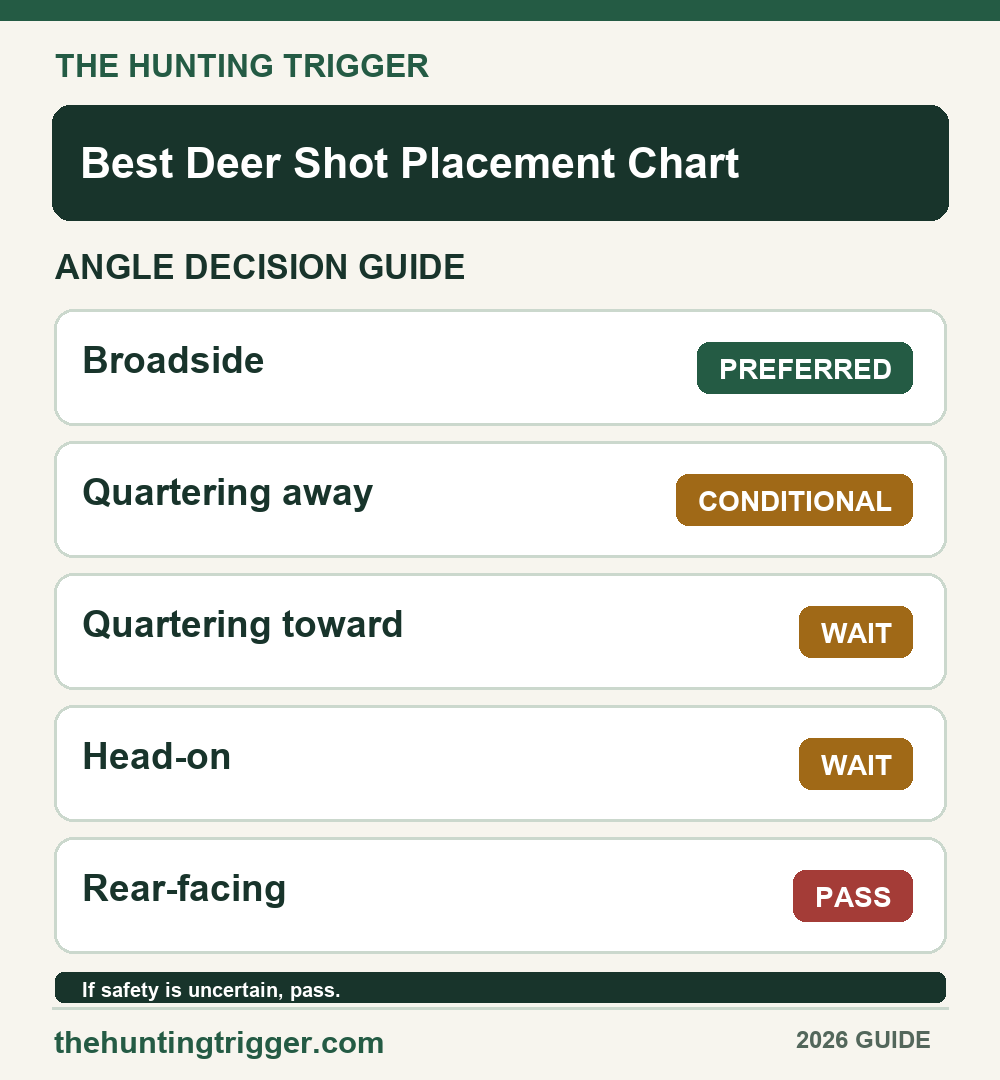
and pass. Every decision remains subject to safe surroundings.
Are bow and firearm
decisions the same?
No. Both depend on chest anatomy, but the practical limits differ. Texas
Parks & Wildlife says bowhunters should avoid quartering-toward and
head-on views. It treats rear-facing opportunities as unacceptable
for both.
A firearm does not make every visible chest angle suitable. The table
recommends waiting on difficult front angles. A flat diagram cannot
supply one universal point for every animal and position.
What changes
from a treestand or elevated blind?
Elevation changes the view through the animal. Nebraska
hunter education warns that the vital area can appear smaller from an
elevated position. The broadside illustration cannot be transferred
unchanged to a steep downward view.
An elevated
position also adds stand-safety duties. If the chest region or safe
background cannot be judged clearly, wait.
When
should a hunter pass even with a favorable angle?
Pass when the animal or legal status is uncertain, the path is
obscured, the background is unsafe, or recovery is doubtful. Hunter
education calls for a clear foreground and safe zone of fire. It
warns against thick vegetation and skylined animals.


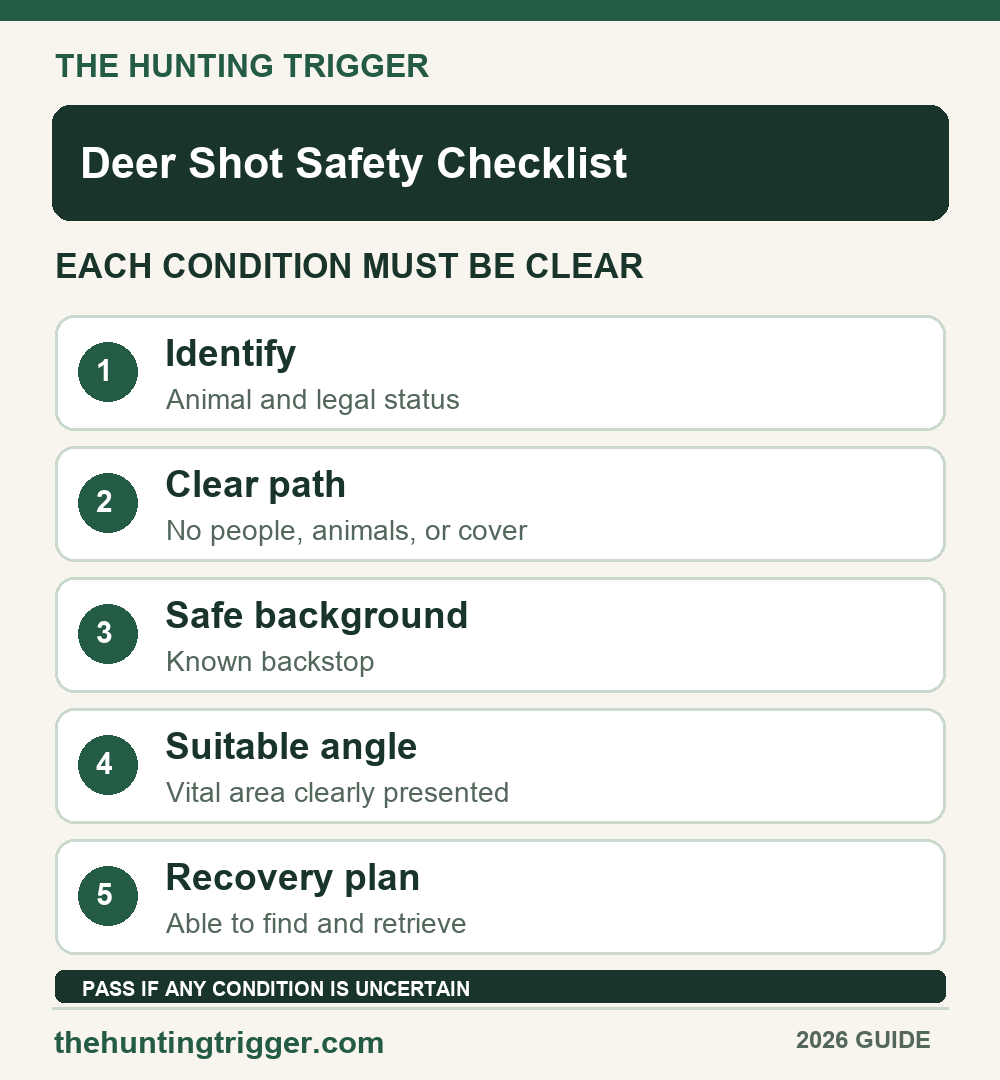
recovery plan. Pass when any condition is uncertain.
- Positively identify the animal and check current local rules.
- Confirm the foreground and background are safe.
- Wait until the animal is still and the chest area is
unobstructed. - Stay within demonstrated ability and have a recovery plan.
The chart is a learning aid, not permission to take a
marginal opportunity. Waiting can be the best outcome.
What happens
after the shot, and which rules apply?
Recovery is part of responsible hunting. Texas
Parks & Wildlife advises marking the animal’s location and watching
its direction. It recommends giving a wounded deer time before
trailing and checking for signs even when a miss seems likely.
Approach a downed animal cautiously. Check the current wildlife
agency rules for the hunting location before the trip. Tagging,
reporting, and retrieval requirements vary by jurisdiction and
season.

Leave a Reply