
Is the .300 Blackout a viable choice for deer hunting? Many hunters are exploring this versatile cartridge, and the short answer is yes, it absolutely can be. With its adaptability across various platforms, the .300 Blackout has gained significant traction for its performance in specific hunting scenarios.


However, maximizing its effectiveness for deer requires more than just loading a magazine. Understanding its ballistic capabilities, selecting the correct ammunition, and mastering ethical shot placement are paramount. This article will equip you with the essential knowledge to confidently and successfully hunt deer with your .300 Blackout.
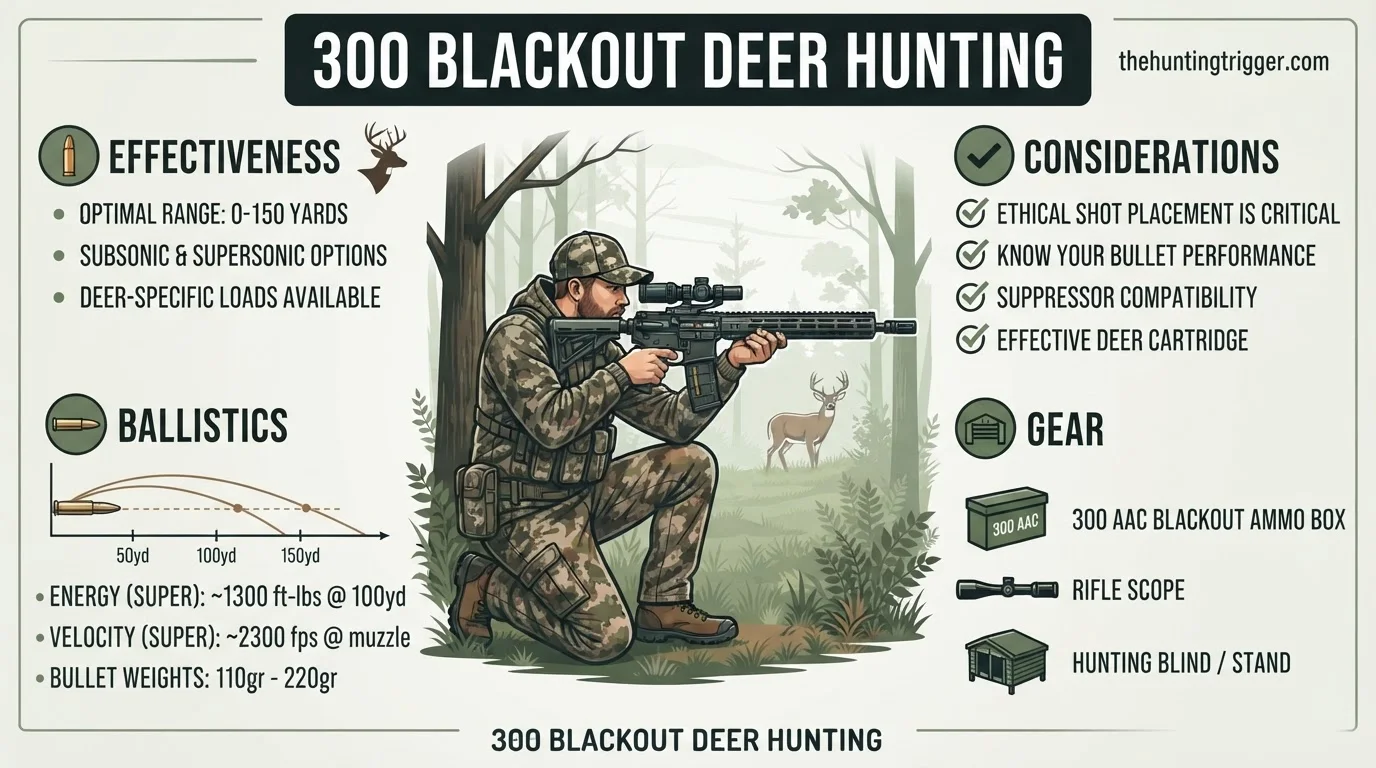
Is .300 Blackout Effective for Deer Hunting? The Quick Answer
In short, yes, the .300 Blackout cartridge is generally considered effective for deer hunting. It provides a practical and capable option for hunters, especially those operating in environments where a more compact and maneuverable firearm is advantageous.
However, its suitability is largely dependent on range. The .300 Blackout is most effective at close-to-moderate distances, typically under 200 yards. Pushing beyond these ethical range limitations significantly reduces the cartridge’s terminal performance and reliability for a humane kill.
Crucially, achieving an ethical and successful harvest with the .300 Blackout demands meticulous attention to proper ammunition selection. Pairing it with projectiles specifically designed for deer-sized game, combined with precise shot placement, is absolutely vital for consistent, humane results.
Key Advantages of Using .300 Blackout for Deer
Reduced Recoil Impulse
The .300 Blackout offers a significantly lower recoil impulse compared to many traditional deer cartridges. This makes it more comfortable to shoot, especially during extended range sessions or for new hunters who might be recoil-sensitive.
Reduced recoil also aids in maintaining target acquisition after the shot, enabling faster and more accurate follow-up shots if needed. This can be crucial in dynamic hunting situations.
Compact & Maneuverable Firearms
One major advantage is the ability to use compact firearm platforms, particularly AR-15 style rifles. These rifles are inherently easy to maneuver in tight spaces, such as dense brush, ground blinds, or elevated stands.
Their shorter overall length and lighter weight contribute to easier carrying and faster target acquisition. This compact design enhances agility and comfort during long hunts in varied terrain.
Excellent Suppressor Integration
The .300 Blackout cartridge is exceptionally well-suited for use with suppressors. Its design, especially with subsonic ammunition, results in significantly reduced noise and virtually eliminates muzzle flash.
This suppressor compatibility protects the hunter’s hearing, minimizes disturbance to surrounding wildlife, and contributes to a more pleasant hunting experience for all involved.
Understanding Ballistics: Max Range & Energy for .300 BLK Deer Hunting
Effective Range Considerations for .300 BLK
Defining an ethical hunting range for any cartridge is paramount for humane kills. For the .300 Blackout, when utilizing supersonic hunting loads, its effective range for deer typically falls within 100-200 yards. This range ensures sufficient kinetic energy delivery and manageable bullet trajectory for most hunters.
Several factors influence this effective distance, including the specific bullet type, the rifle’s barrel length, and the shooter’s proficiency. Beyond 200 yards, the .300 BLK experiences significant bullet drop and reduced energy, making precise shot placement more challenging and increasing the risk of a non-fatal hit.
For instance, a 125-grain bullet zeroed at 100 yards might drop 8-10 inches at 200 yards, requiring hunters to accurately compensate. Pushing past these distances without intimate knowledge of your specific load’s ballistics and your shooting capabilities can compromise ethical hunting practices.
Kinetic Energy and Terminal Performance on Deer
Kinetic energy is a critical metric for assessing a cartridge’s ability to humanely dispatch game. Supersonic hunting loads for the .300 Blackout typically generate muzzle energies ranging from approximately 1000 to 1500 foot-pounds, depending on bullet weight, powder charge, and barrel length.
However, energy retention downrange is just as important as muzzle energy. For effective and humane deer hunting, a bullet needs to retain sufficient energy to both penetrate deeply and expand reliably within the animal, creating a devastating wound channel. A commonly accepted minimum energy threshold for deer is around 800 ft-lbs at impact.
For example, a 125-grain hunting bullet launched from a 16-inch barrel at 2150 fps generates about 1285 ft-lbs at the muzzle. At 150 yards, this same bullet might retain approximately 850-950 ft-lbs of energy, which is ample for a clean kill if paired with an appropriate expanding bullet design.
Impact of Barrel Length on Blackout Velocity
The barrel length of your .300 Blackout rifle significantly influences its ballistic performance, particularly velocity and, consequently, kinetic energy. Shorter barrels, common in many AR-platform .300 BLK firearms, result in lower muzzle velocities compared to longer barrels with the same ammunition.
For every inch reduction in barrel length, there can be a measurable decrease in bullet speed, which directly translates to less energy at the muzzle and downrange. This velocity reduction directly impacts the bullet’s ability to expand properly and retain enough energy for effective terminal performance at distance.
A 16-inch barrel will typically yield 150-250 feet per second (fps) more velocity than an 8-inch barrel with the same ammunition. This velocity difference can mean the distinction between adequate energy retention at 150 yards and falling below ethical minimums for deer hunting.
Choosing the Right Ammunition for .300 Blackout Deer Hunting
Choosing the correct ammunition is paramount for ethical and effective deer hunting with the .300 Blackout cartridge. The unique characteristics of this round, particularly its adaptability for both supersonic and subsonic loads, necessitate careful bullet selection to ensure humane kills and optimize performance in the field.
Why Supersonic Hunting Ammo is Essential
For deer, supersonic ammunition is almost universally recommended. These rounds travel faster than the speed of sound, generating significantly more kinetic energy upon impact. This higher energy is crucial for achieving sufficient penetration and reliable bullet expansion within the deer’s vitals.
Supersonic .300 BLK hunting loads typically feature bullet weights ranging from 110 to 150 grains. This weight range, combined with higher velocities, allows for the necessary energy transfer and tissue damage required for a quick and humane harvest.
Recommended .300 BLK Bullet Types for Deer
Appropriate bullet selection, specifically expanding hunting bullets, is critical for ethical kills. Look for designs engineered to expand reliably upon impact, creating a larger wound channel and maximizing energy transfer.
Excellent examples include controlled expansion designs like the Barnes TSX or Hornady GMX, which mushroom consistently without fragmentation. Soft point or polymer-tipped bullets such as the Hornady SST are also highly effective, initiating rapid expansion for devastating terminal performance.
Conversely, target ammunition or Full Metal Jacket (FMJ) bullets are entirely unsuitable for deer hunting. These bullets are designed for penetration without expansion, leading to insufficient energy transfer and a high risk of wounding an animal without achieving a quick, ethical kill.
The Dangers of Using Subsonic Ammunition for Deer
The severe limitations and ethical concerns of using subsonic ammunition for deer hunting cannot be overstated. Subsonic rounds, often weighing between 180 and 220 grains, travel below the speed of sound, which drastically reduces their kinetic energy.
This insufficient energy transfer, combined with a general lack of reliable expansion from most heavy subsonic bullet designs at lower velocities, makes them highly unethical for deer. They are prone to simply punching through the animal without causing enough damage to ensure a humane kill, leading to prolonged suffering.
Essential Gear & Setup for Successful .300 BLK Deer Hunts
Firearm Platforms: The AR-15 Advantage
The AR-15 platform stands out as a highly popular and effective choice for hunting deer with the .300 Blackout cartridge. Its modular design allows for extensive customization, enabling hunters to tailor the rifle precisely to their needs. This adaptability, combined with its ergonomic handling, makes it a common firearm type in the hunting community.
The inherent design of the AR-15, originally built for a similar cartridge size, optimizes its performance with .300 BLK, providing a reliable and robust base for a hunting rifle.
Optics for Precision and Clarity
Accurate shot placement is paramount for ethical deer hunting, and quality optics are crucial for achieving this. For .300 Blackout, which typically excels at shorter to moderate ranges, optics like a 1-6x Low Power Variable Optic (LPVO) offer versatility, allowing for quick target acquisition at close distances while providing sufficient magnification for precise shots further out.
Alternatively, a red dot sight paired with a magnifier can be effective for fast target engagement in dense cover, offering a broad field of view and quick transition capabilities.
Suppressors: Enhancing the .300 Blackout Experience
The .300 Blackout boasts high suppressor compatibility, making it an excellent cartridge for sound reduction in hunting scenarios. A suppressor significantly reduces muzzle blast, protecting the hunter’s hearing and minimizing disturbance to surrounding wildlife. This reduced noise can also aid in follow-up shots, as recoil impulse is often perceived as smoother.
Most modern .300 BLK barrels come threaded (e.g., 5/8×24) specifically to facilitate easy attachment of a suppressor, enhancing the overall hunting experience while promoting safety and reducing environmental impact.
Mastering Ethical Shot Placement with the .300 Blackout
Mastering ethical shot placement is paramount for humane kills, especially when hunting deer with the .300 Blackout. Given this cartridge’s more limited range and energy compared to larger deer cartridges, precise projectile delivery to vital organs is non-negotiable. Always visualize and target the heart-lung region, an area roughly the size of a dinner plate located just behind the front shoulder.
Consistent accuracy comes only through dedicated practice. Engage in drills that simulate actual hunting scenarios, such as shooting from various field positions or quickly acquiring targets at different distances within your ethical range. This builds the muscle memory and confidence necessary for that crucial moment in the field.
It is crucial to understand that marginal shots are significantly less forgiving with the .300 Blackout. Unlike higher-energy cartridges, there’s less room for error. If the shot isn’t perfectly placed, especially into the primary vital zone, it greatly increases the risk of a non-lethal wound and a lost animal.
Comparing .300 Blackout to Other Popular Deer Cartridges
Understanding how the .300 Blackout stacks up against other common deer hunting cartridges provides crucial context for its capabilities. The .300 BLK was designed as a versatile round for AR-15 platforms, bridging gaps in performance for various applications, including deer hunting.
When compared to the ubiquitous .223 Remington, the .300 Blackout is significantly more powerful for deer hunting. While .223 Remington can be used for very small deer in some jurisdictions, its limited bullet weight and energy often render it marginal for ethical kills on typical whitetail or mule deer. The .300 BLK, with heavier bullet options (110-150 grain supersonic), delivers substantially more kinetic energy suitable for deer.
Conversely, the .300 Blackout offers less power and a shorter effective range than the venerable .308 Winchester. The .308 is a full-powered rifle cartridge known for its long-range capability and greater energy at all distances, making it suitable for larger game and longer shots. The .300 BLK’s ballistic performance thus falls significantly between the .223 Remington and the .308 Winchester.
Comparing it to the traditional .30-30 Winchester, both cartridges share a similar effective range for deer hunting, typically within 150-200 yards. The .30-30 generally delivers more muzzle energy than supersonic .300 BLK loads but often comes in lever-action rifles, which differ greatly from the AR-15 platform versatility of the .300 BLK.
Other AR-15 compatible cartridges also exist, such as the 6.5 Grendel and 6.8 SPC. These rounds typically offer a flatter trajectory and extended effective range compared to the .300 Blackout, often with comparable or slightly higher energy, making them strong contenders for hunters prioritizing longer-range AR-15 performance.
How to Read This Comparison Table
This table provides approximate performance metrics for common deer hunting cartridges to offer a relative comparison. The “Cartridge” column identifies the ammunition type. “Approx. Effective Deer Range (yards)” indicates a generally accepted maximum distance for an ethical deer harvest, assuming proper bullet placement and appropriate hunting ammunition. It is measured in yards.
“Approx. Muzzle Energy (ft-lbs) (Hunting Load)” represents the kinetic energy of the bullet immediately after leaving the barrel, expressed in foot-pounds. These values are for common hunting-specific bullet weights and types; for .300 Blackout, this specifically refers to supersonic loads. Subsonic .300 BLK rounds have significantly lower muzzle energy and are generally not recommended for deer hunting due to insufficient energy for reliable expansion and penetration.
“Relative Recoil” describes the perceived kickback of the firearm when fired, categorized from “Very Low” to “Moderate-High.” This is a subjective measure influenced by rifle weight, stock design, and individual shooter tolerance. All values are approximate and can vary based on specific bullet construction, barrel length, powder charge, and rifle platform. Hunters should always verify specific ballistic data for their chosen ammunition and firearm combination.
Navigating Legalities: .300 Blackout Hunting Regulations Explained
Before hunting deer with a .300 Blackout, hunters must thoroughly verify local regulations. Hunting laws vary significantly by state, county, and even specific management areas, making compliance a critical first step. What is legal in one jurisdiction may be prohibited in another.
Pay close attention to minimum caliber or projectile energy requirements for deer. Some states, for instance, mandate a certain energy threshold, such as a minimum of 800 ft-lbs at 100 yards. Always consult official state game and fish department websites for precise details.
Furthermore, be aware of restrictions on firearm types, such as prohibitions on semi-automatic rifles, or specific projectile types. Several states permit rifles only if they use “straight wall cartridges” for deer hunting, a category into which the .300 Blackout does not typically fall.
Common Pitfalls to Avoid When Deer Hunting with .300 Blackout
While the .300 Blackout is a capable deer cartridge, hunters must be aware of its limitations and common missteps to ensure ethical and successful hunts. Avoiding these pitfalls is crucial for responsible game harvesting.
First, never use subsonic ammunition for deer hunting. Subsonic rounds are designed primarily for sound suppression, not terminal performance on game. They typically lack the velocity and energy needed for reliable expansion and sufficient energy transfer for a quick, humane kill on a deer-sized animal.
Equally important is avoiding shots beyond the cartridge’s ethical range. The .300 Blackout performs optimally at shorter distances, typically under 150-200 yards for deer. Attempting shots at extended ranges significantly increases the risk of a non-lethal hit, leading to a wounded animal.
Furthermore, never use target, Full Metal Jacket (FMJ), or varmint bullets for deer. FMJ rounds usually pass through without adequate expansion, while varmint bullets are too fragile for deer. Always opt for high-quality, expanding hunting bullets specifically designed for medium game.


Hunters must also verify and strictly adhere to all local hunting regulations. Cartridge restrictions, minimum energy requirements, and allowed projectile types vary by state and local jurisdiction. Confirming compliance prevents legal issues and ensures ethical hunting practices.
Finally, do not overestimate the .300 Blackout’s long-range capabilities compared to larger calibers like .308 Winchester. While versatile, it is not designed to be a long-range deer cartridge. Respecting its effective range ensures responsible and ethical hunting.
Key Takeaways
-
✓
.300 Blackout is effective for deer at short to moderate ranges with proper ammunition. -
✓
Understanding ballistic limitations and energy retention is crucial for ethical shots. -
✓
Ammunition choice (bullet weight, type) significantly impacts terminal performance on deer. -
✓
Mastering ethical shot placement is paramount due to the cartridge’s energy profile. -
✓
Always check local and state hunting regulations regarding cartridge minimums and restrictions.
❓ Frequently Asked Questions
1
Is .300 Blackout truly effective for deer hunting?
Yes, .300 Blackout can be highly effective for deer hunting, particularly at ranges up to 150-200 yards, when using appropriate hunting ammunition. Its effectiveness hinges on bullet construction for proper expansion and shot placement, providing sufficient energy transfer for a clean kill with vital insights into its capabilities.
2
What type of ammunition is best for .300 Blackout deer hunting?
For optimal .300 Blackout deer hunting, choose expanding hunting bullets (e.g., controlled expansion, bonded, or monolithic designs) specifically engineered for the cartridge’s velocity range. Look for bullet weights typically between 110-150 grains for supersonic loads, ensuring reliable terminal performance based on solid facts.
3
What is the maximum effective range for .300 Blackout on deer?
The maximum effective range for .300 Blackout on deer generally falls between 150-200 yards, depending heavily on bullet choice, rifle setup, and shooter proficiency. Beyond this, energy drops significantly, increasing the risk of an unethical shot. Details on your specific load’s ballistics are key.
4
How does .300 Blackout compare to other deer cartridges?
.300 Blackout offers less range and energy than traditional deer cartridges like .308 Win or .270 Win, but excels in compact platforms, suppressed shooting, and reduced recoil. Its strengths lie in versatility and closer-range applications, facts important for comparing overall performance.
5
Are there specific legal restrictions for .300 Blackout deer hunting?
Legal restrictions for .300 Blackout deer hunting vary by state and local regulations. Some areas may have minimum bullet energy or caliber requirements that could affect its legality. Always research current wildlife laws for your specific hunting zone to ensure compliance with all information and rules.
6
Is .300 Blackout sufficient for deer hunting?
Yes, for close to moderate ranges (typically under 200 yards) with appropriate supersonic expanding hunting ammunition and precise shot placement.


Leave a Reply