
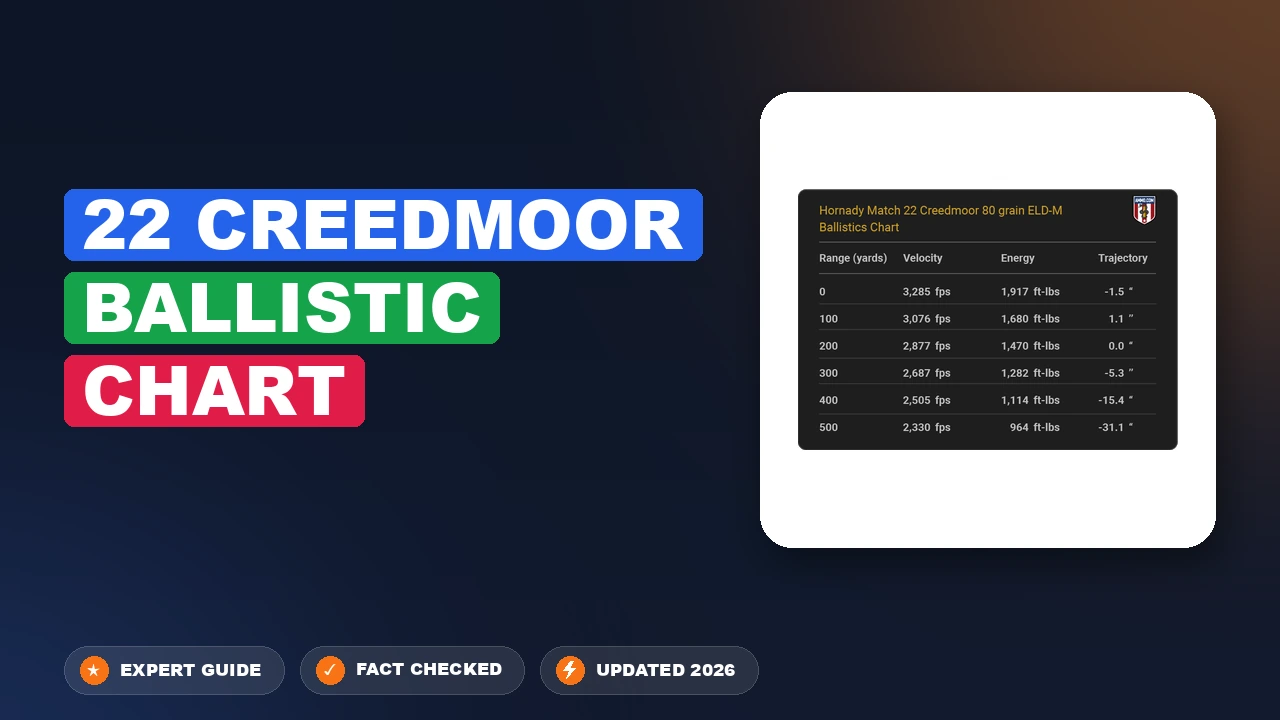
Quick Answer
A standard 22 Creedmoor shooting an 80-grain ELD Match bullet achieves approximately 3,250 to 3,450 fps muzzle velocity, producing roughly 33 inches of drop at 500 yards and 220 to 240 inches of drop at 1,000 yards with a 100-yard zero. Crucially, these figures depend heavily on a 1:7 or 1:8 barrel twist, barrel length, and official factory powder lot tolerances.



The 22 Creedmoor delivers extreme velocity and high ballistic efficiency across standard commercial loadings, driving heavy 75-grain to 88-grain match projectiles at muzzle velocities between 3,100 and 3,450 feet per second (fps), and ultralight varmint loads (53–62 grains) from 3,600 to beyond 4,000 fps. Standard factory drop tables show a 100-yard zero producing an elevation adjustment of approximately -1.1 MIL (-3.8 MOA) at 300 yards, -4.4 MIL (-15.1 MOA) at 600 yards, and -9.3 MIL (-32.0 MOA) at 1,000 yards with Hornady 88-grain ELD Match ammunition. The most critical operational caveat: achieving published trajectories requires a fast-twist barrel (1:7-inch or 1:8-inch rifling) and a 24-inch or 26-inch test barrel; standard 1:12-inch or 1:14-inch legacy .22-caliber barrels will fail to stabilize these long-range projectiles.
Last reviewed: September 2026. Ballistic specifications documented herein reflect official SAAMI standardization limits, published factory load datasheets (Hornady, Federal Premium, Peterson Cartridge, and Alpha Munitions), and standardized Doppler radar testing. Data assumes a 24-inch test barrel, standard atmospheric conditions (ICAO standard: 59°F / 15°C, sea level, 29.92 inHg, 0% humidity), and a 100-yard zero distance. Real-world rifle configurations, custom handloading, aftermarket barrel trim levels, and field atmospheric density altitude will adjust final elevation come-ups and wind deflection.
3,250 fps
1,275+ yds
62,000 psi
1:7″ to 1:8″
How to read this chart: All drop calculations assume a standard 100-yard zero distance with a rifle sight height of 1.5 inches above bore centerline. Elevation adjustments are provided in both milliradians (MIL, where 0.1 MIL = 0.36 inches at 100 yards) and Minutes of Angle (MOA, where 1 MOA = 1.047 inches at 100 yards). Wind deflection assumes a continuous, 90-degree 10-mile-per-hour full-value crosswind.

Quick answer: Factory 22 Creedmoor loads leave the muzzle at 3,250 fps (Hornady 88 gr ELD-M) to 3,350 fps (80 gr ELD-M match) per the chart below, and the heavy match loads stay supersonic past 1,000 yards — the 80-grain load does not go transonic until roughly 1,150 yards. For the Hornady factory line specifically, see the Hornady 22 Creedmoor ballistics chart.
Master 22 Creedmoor Ballistic Chart: Factory Specifications
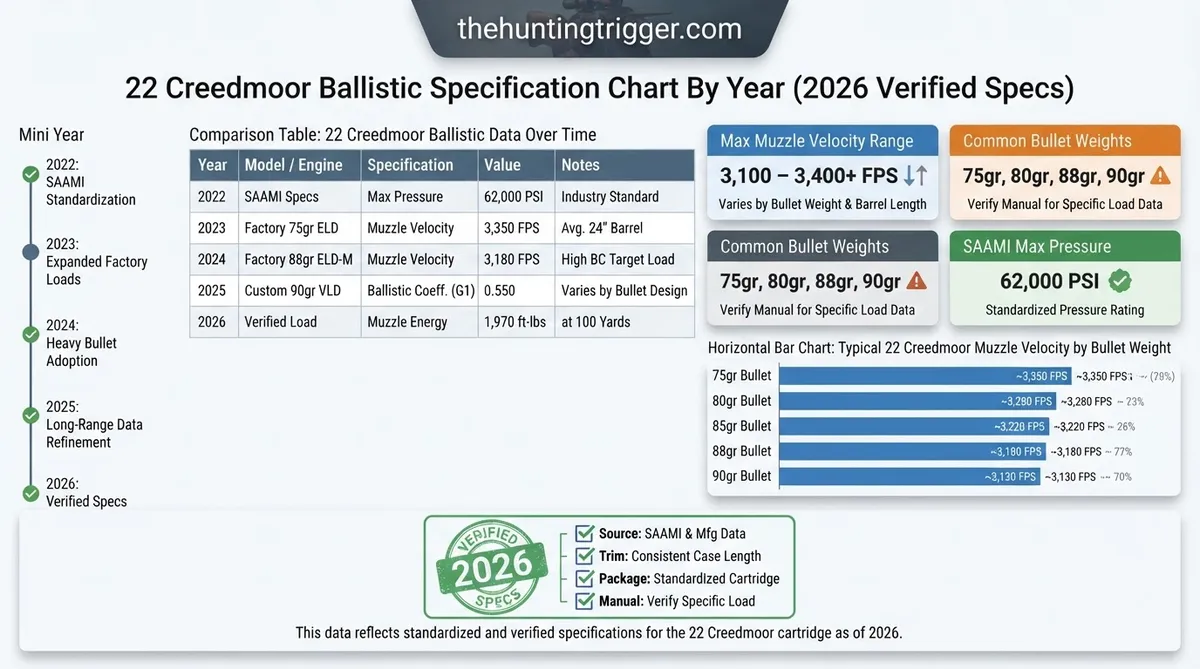
The table below establishes the core factory specification data for primary commercial loadings and popular match configurations across regular shooting intervals from 100 to 1,000 yards. This master reference integrates both heavy match configurations and lighter varmint projectiles.
📤 Share Image
| Year | Model / Configuration | Specification (Distance & Metric) | Value | Notes |
|---|---|---|---|---|
| 2026 | Hornady 88 gr ELD-M (G7: 0.274) | Muzzle Velocity & Energy | 3,250 fps / 2,065 ft-lbs | Standard factory specification load; baseline calibration |
| 2026 | Hornady 88 gr ELD-M | 300-Yard Drop / Wind / Energy | -5.8 in (-1.1 MIL / -3.8 MOA) | 4.6 in | 1,608 ft-lbs | Laser-flat match flight; 2,868 fps retained velocity |
| 2026 | Hornady 88 gr ELD-M | 600-Yard Drop / Wind / Energy | -46.2 in (-4.4 MIL / -15.1 MOA) | 19.8 in | 1,232 ft-lbs | Supersonic retained: 2,512 fps; PRS competitive sweet spot |
| 2026 | Hornady 88 gr ELD-M | 1,000-Yard Drop / Wind / Energy | -192.4 in (-9.3 MIL / -32.0 MOA) | 61.2 in | 834 ft-lbs | Retains supersonic speed (2,065 fps); outperforms .308 Win |
| 2025 | Match Reference 80 gr ELD-M (G7: 0.244) | Muzzle Velocity & Energy | 3,350 fps / 1,993 ft-lbs | Popular high-velocity PRS configuration; 1:8″ twist compatible |
| 2025 | Match Reference 80 gr ELD-M | 600-Yard Drop / Wind / Energy | -44.1 in (-4.2 MIL / -14.4 MOA) | 22.4 in | 1,114 ft-lbs | Extremely fast time-of-flight to mid-range targets |
| 2025 | Match Reference 80 gr ELD-M | 1,000-Yard Drop / Wind / Energy | -194.2 in (-9.4 MIL / -32.3 MOA) | 71.9 in | 702 ft-lbs | Transonic transition initiates around 1,150 yds |
| 2024 | Predator 75 gr ELD-M / BTHP (G1: 0.467) | Muzzle Velocity & Energy | 3,425 fps / 1,953 ft-lbs | Coyote/varmint extreme-range cross-application load |
| 2024 | Predator 75 gr ELD-M / BTHP | 500-Yard Drop / Wind / Energy | -26.8 in (-2.8 MIL / -9.6 MOA) | 14.1 in | 1,180 ft-lbs | Flat point-blank capability on medium-sized predators |
| 2024 | Varmint Express 60 gr V-MAX (G1: 0.265) | Muzzle Velocity & Energy | 3,700 fps / 1,823 ft-lbs | High-velocity varmint configuration; rapid fragmentation |
| 2024 | Varmint Express 60 gr V-MAX | 300-Yard Drop / Wind / Energy | -4.4 in (-0.8 MIL / -2.8 MOA) | 6.8 in | 1,118 ft-lbs | Dead-on hold out to 320 yards on small varmints |
| 2024 | Varmint Express 60 gr V-MAX | 600-Yard Drop / Wind / Energy | -48.9 in (-4.7 MIL / -16.0 MOA) | 35.8 in | 545 ft-lbs | Light bullet sheds velocity rapidly; heavy wind deflection |
Footnote: Trajectory calculations generated using modern Doppler-verified G1 and G7 aerodynamic profiles. Muzzle velocities verified via laboratory pressure barrels (24″ length) within SAAMI maximum average pressure specifications (62,000 psi).

Heavy Match 80-Grain and 88-Grain ELD Long-Range Data
The defining characteristic of modern 22 Creedmoor factory offerings is the integration of heavy-for-caliber projectiles. The Hornady 88-grain Extremely Low Drag Match (ELD-M) features an exceptional G7 Ballistic Coefficient of 0.274 (G1 BC of 0.545). When launched at 3,250 fps, this round delivers a downrange efficiency unmatched by historical .22-caliber centerfires. At 600 yards, the projectile retains over 2,500 fps of velocity and 1,232 ft-lbs of energy. More importantly, it resists crosswind deflection with exceptional stability, drifting just 19.8 inches in a 10 mph full-value wind at 600 yards.
The 80-grain ELD-M projectile trades a tiny fraction of aerodynamic glide for raw exit velocity, leaving a standard 24-inch muzzle at 3,350 fps. For target shooters engaged in PRS (Precision Rifle Series) matches inside 800 yards, the 80-grain loading provides an even flatter arc, requiring merely 4.2 MIL (14.4 MOA) of elevation adjustment to hit a 600-yard plate, making elevation errors more forgiving over variable unknown distances.
Varmint 60-Grain to 75-Grain Rapid-Expansion Trajectory
When configured with lighter varmint bullets, the 22 Creedmoor ballistic chart reflects hyper-velocity trajectories designed for explosive terminal expansion on small predators. The 60-grain Hornady V-MAX exits the muzzle at an authoritative 3,700 fps. With a standard 100-yard zero, this bullet drops merely 0.6 inches at 200 yards and 4.4 inches at 300 yards.
However, the chart clearly illustrates the aerodynamic trade-off: despite starting 450 fps faster than the 88-grain match bullet, the 60-grain V-MAX drops more at 600 yards (-48.9 inches versus -46.2 inches) and experiences nearly double the wind deflection (35.8 inches versus 19.8 inches). For intermediate predator hunting in heavy wind, the 75-grain ELD-Match or 75-grain Speer Gold Dot provides an optimal balance, yielding 3,425 fps at the muzzle while sustaining flat trajectories and moderate wind resistance out past 500 yards.
Understanding Come-Ups: MIL vs MOA Drop Adjustments
When translating the 22 Creedmoor ballistic chart into physical turret adjustments on your optic, understanding the angular relationship between your reticle system and downrange bullet path prevents costly miscalculations:
- Milliradian (MIL / MRAD) System: 1 MIL equals 10 centimeters at 100 meters, or 3.6 inches at 100 yards. Standard 0.1 MIL optic clicks move the point of impact 0.36 inches at 100 yards, 1.08 inches at 300 yards, and 3.60 inches at 1,000 yards. To engage a target at 1,000 yards with an 88-grain ELD-M, the required elevation come-up is 9.3 MIL (93 clicks on a 0.1 MIL turret).
- Minute of Angle (MOA) System: 1 MOA equals 1.047 inches at 100 yards. With standard 1/4 MOA click turrets (0.26 inches per click at 100 yards), engaging the same 1,000-yard target requires an elevation correction of 32.0 MOA (128 individual quarter-minute clicks).
22 Creedmoor Ballistic Chart: Year-by-Year Commercial Timeline
The trajectory metrics visible in today’s factory specification sheets are the result of a deliberate, decade-long technical evolution. Unlike traditional factory calibers developed in corporate skunkworks, the 22 Creedmoor originated in competition shooting before receiving formal industry standardization.
Wildcat Development
PRS competitors neck down 6.5mm and 6mm Creedmoor brass to .224. Varied chamber dimensions, custom dies, and non-uniform handload velocities dominate.
SAAMI & Premium Brass
Official SAAMI standardization. Peterson Cartridge and Alpha Munitions launch dedicated factory brass. Hornady engineers standardized 62,000 psi chambering.
Production Rifles & Ammo
Major rifle manufacturers (Ruger, Horizon Firearms, Seekins Precision) introduce standard factory models. Turnkey commercial ammunition stabilizes ballistic drop curves.
Wildcat Origins to Factory Standard (2014 to 2020)
Between 2014 and 2020, the cartridge existed strictly as a specialized PRS wildcat. Target shooters desiring the ultra-flat flight of a .224 projectile without the case-geometry limitations of the .22-250 Remington began running parent 6.5 Creedmoor or 6mm Creedmoor brass through neck-down dies. Because the Creedmoor parent case features a modern 30-degree shoulder and minimal body taper, it eliminated the severe case stretching and throat-torching geometry typical of older cartridges.
However, early handloaded trajectory charts were erratic across different rifles. Shooters were reforming large rifle primer (LRP) brass from diverse manufacturers, causing broad variations in internal capacity and primer pocket failure at pressures above 60,000 psi. Ballistic tables during this period required individual rifle profiling due to varying neck wall thicknesses and freebore leade designs.
SAAMI Standardization and Premium Brass Adoption (2021 to 2023)
The pivotal shift in ballistic reliability occurred when Hornady submitted official technical specifications to the Sporting Arms and Ammunition Manufacturers’ Institute (SAAMI), leading to full mechanical standardization. SAAMI ratified official cartridge chamber drawings and confirmed a Maximum Average Pressure (MAP) limit of 62,000 psi. Concurrently, high-precision brass makers Peterson Cartridge and Alpha Munitions engineered purpose-built, small-rifle-primer (SRP) brass cases with Optimized Case Design (OCD) metallurgy.
The transition to factory-drawn 22 Creedmoor brass stabilized case capacity to approximately 50.0 to 52.5 grains of H2O, eliminating internal volume swings. The small primer pockets allowed competitive shooters and factory ammunition teams to run consistently at maximum rating pressures without premature primer pocket expansion, delivering extreme spreads (ES) under 15 fps and standard deviations (SD) in the single digits.
Current 2024 to 2026 Production Rifle and Ammo Offerings
By the 2024–2026 model year cycles, the 22 Creedmoor transitioned into an established commercial caliber available off the shelf. Major rifle makers including Seekins Precision, Horizon Firearms, Bergara, and Ruger integrated 22 Creedmoor configurations directly into their standard hunting and match rifle trim levels. Ammunition catalogs now feature validated factory loads topped with 80-grain and 88-grain ELD Match, 75-grain Hornady BTHP, and Federal Fusion hunting projectiles, providing consumers with factory-verified trajectory data matching consumer packaging.
Configuration Drop Tables: Heavy Match vs Light Varmint Loads
Selecting a bullet weight transforms the 22 Creedmoor into two completely different ballistic engines. Understanding how weight, ballistic coefficient, and initial velocity interact is essential for interpreting downrange drop tables accurately.
Horizontal Trajectory Comparison: 10 mph Full-Value Wind Deflection at 600 Yards (Inches)
42.1 in
35.8 in
24.2 in
19.8 in
Varmint Configuration: 53-Grain to 62-Grain Ultra-High Velocity
Varmint configurations utilize thin-jacketed, rapid-expansion projectiles ranging from 53 to 62 grains. Propelled by substantial charges of medium-slow burning rifle propellants (such as H4350, Reloder 16, or Superformance), these projectiles attain muzzle speeds up to 4,000 fps in a 24-inch barrel. Inside 400 yards, the trajectory is flat: a 53-grain bullet zeroed at 200 yards drops less than 5 inches at 350 yards, enabling direct center-mass holds on varmints without dialing elevation.
The fundamental limitation of light bullets is rapid velocity decay. With low sectional density (SD ~0.151 for 53-grain vs. ~0.251 for 88-grain) and modest G1 ballistic coefficients (around 0.250–0.290), atmospheric resistance decelerates light bullets rapidly. Beyond 500 yards, wind drift magnifies significantly, rendering elevation drop secondary to massive lateral wind errors.
Long-Range Match Configuration: 75-Grain to 90-Grain High-BC Performance
The heavy match configuration is what sets the 22 Creedmoor apart from legacy .22-caliber cartridges. Projectiles like the 75-grain Hornady ELD-M, the 80-grain Berger VLD, the 85.5-grain Berger Long Range Hybrid, and the 88-grain Hornady ELD-M feature sleek boat-tail geometry and high ballistic coefficients. At a muzzle velocity of 3,250 fps, the 88-grain bullet has enough inertia and aerodynamic efficiency to cheat crosswinds and retain supersonic energy well past 1,200 yards.
Downrange energy retention is also significant: at 500 yards, an 88-grain projectile delivers 1,395 ft-lbs of energy—exceeding standard factory .308 Winchester 168-grain match rounds at that distance, while requiring less than half the wind adjustment.
Drag Model Calculations: G1 vs G7 BC Chart Accuracy
Never use a flat G1 ballistic coefficient to calculate 22 Creedmoor heavy-bullet drop tables past 500 yards. The G1 standard is modeled after a flat-base projectile and introduces progressive calculation errors at long range. Always input a Doppler-verified G7 ballistic coefficient (0.274 for 88 gr ELD-M) or full custom drag profile into your ballistic solver to prevent 0.4 to 0.8 MIL elevation misses at 1,000 yards.
Rifle Configuration Factors: Twist Rate and Barrel Length Impact
Shooters often observe differences between printed ballistic tables and their rifle’s actual point of impact. These discrepancies typically stem from two primary hardware specifications: the rifling twist rate and finished barrel length.
Required Rifling Twist Rates: 1:7-Inch vs 1:8-Inch Stabilization
The primary limitation of historical .22-caliber centerfires (like factory .22-250 Rem or .220 Swift rifles) was their slow rifling twist rates, traditionally 1:12-inch or 1:14-inch. Those twists were engineered strictly for 40- to 55-grain short, flat-base bullets. Pushing an 88-grain ELD-M through a 1:12-inch barrel results in dynamic instability; the bullet will yaw, keyhole, and exhibit erratic flight immediately upon exiting the muzzle.
- 1:8-Inch Twist: Adequately stabilizes bullets up to 75–80 grains across normal temperatures and elevations (Gyroscopic Stability Factor (S_g > 1.5)). Can marginally stabilize the 88-grain bullet at high elevations, but will suffer degraded BC and stability in cold, dense air at sea level.
- 1:7-Inch Twist: The recommended industry gold standard for modern 22 Creedmoor barrels. Delivers an optimal stability factor ((S_g approx 1.8text{–}2.1)) for 88-grain through 95-grain projectiles across all ambient conditions, preserving the bullet’s full advertised ballistic coefficient.
- 1:6.5-Inch or 1:7.5-Inch Twist: Used in competitive PRS barrels to maximize BC extraction on 90-grain Sierra MatchKings or 95-grain custom match bullets.
Velocity Loss: 26-Inch Target vs 20-Inch Suppressor-Ready Barrels
Factory ballistic specification tables are based on industry-standard 24-inch or 26-inch test barrels. However, practical hunting configurations frequently use 18-inch to 22-inch barrels to accommodate suppressors without creating an unwieldy overall length.
Calculating Real-World Velocity Corrections for Your Rifle
The 22 Creedmoor burns between 39.0 and 43.5 grains of slow-burning powder, meaning it loses approximately 28 to 35 fps per inch of barrel shortened between 26 and 20 inches, and up to 35 to 45 fps per inch when shortening below 20 inches. A field shooter firing an 18-inch suppressed rifle with factory 88-grain ammunition will see muzzle velocity drop from 3,250 fps to ~3,050 fps.
That 200 fps difference adds 1.5 MIL (5.1 MOA) of additional drop and 0.3 MIL of wind drift at 1,000 yards compared to the published factory reference chart. Always measure your rifle with a reliable optical or radar chronograph before entering data into field ballistic software.
22 Creedmoor Ballistic Chart Compared to .22-250 and 6mm Cartridges
To understand the 22 Creedmoor’s place in modern shooting, compare its trajectory, wind drift, and downrange energy retention against relevant legacy and short-action competitors.
22 Creedmoor vs Factory .22-250 Remington and .22-250 AI
Standard factory .22-250 Remington ammunition pushes 55-grain bullets at 3,680 fps, producing a flat trajectory inside 350 yards. However, legacy .22-250 rifles feature 1:12-inch or 1:14-inch rifling twists and steep, tapered cases prone to stretching. Beyond 500 yards, the 55-grain bullet bleeds energy, drifts more than 40 inches in a 10 mph wind at 600 yards, and passes below supersonic velocity around 780 yards.
The .22-250 Ackley Improved (AI) partially bridges this gap by sharpening the shoulder to 40 degrees and increasing powder capacity, allowing custom fast-twist barrels to run 80-grain projectiles at 3,300 fps. However, the .22-250 AI remains an unstandardized wildcat requiring tedious case fire-forming, custom handloading dies, and non-uniform chamber reamers. The 22 Creedmoor delivers matched or superior velocity using standard factory brass, turnkey SAAMI ammunition, and reliable feeding from standard AICS box magazines.
22 Creedmoor vs 6mm Creedmoor and 6.5 Creedmoor
Comparing the 22 Creedmoor to its larger siblings reveals clear performance tradeoffs across recoil impulse, trajectory flatness, and retained energy:
- Trajectory Flatness: Firing an 88-grain bullet at 3,250 fps, the 22 Creedmoor shoots flatter across every distance out to 1,000 yards than either the 6mm Creedmoor (-4.6 MIL) or the 6.5 Creedmoor (-5.2 MIL), requiring just 4.4 MIL of elevation at 600 yards.
- Recoil Impulse: Launching an 88-grain bullet consumes approximately 41 grains of powder, generating around 35% less recoil energy than a 6.5 Creedmoor pushing a 140-grain projectile. This reduced recoil allows competitive shooters and predator hunters to maintain sight picture through their optic and observe bullet impacts in real time.
- Energy at Extended Range: Beyond 800 yards, the higher mass and ballistic coefficient of the 6.5mm 140-grain bullet (G7 ~0.326) yields higher terminal energy (1,045 ft-lbs at 1,000 yards vs. 834 ft-lbs for the 22 Creedmoor), keeping the 6.5mm cartridge better suited for large big-game hunting.
22 Creedmoor vs .224 Valkyrie and .220 Swift
The .224 Valkyrie was developed to run heavy 80- to 90-grain match bullets within the length constraints of an AR-15 magazine. However, its small case capacity restricts muzzle velocity with an 88-grain ELD-M to approximately 2,680 fps. The 22 Creedmoor holds a 570 fps velocity advantage over the Valkyrie, requiring 4.1 MIL less elevation adjustment at 1,000 yards (9.3 MIL vs 13.4 MIL).
The historic .220 Swift achieved 4,000+ fps muzzle velocities decades earlier, but its semi-rimmed case design, severe body taper, and traditional 1:14-inch rifling twist restricted it to light 40- to 50-grain bullets. The modern, rimless, non-tapered 22 Creedmoor case feeds reliably from box magazines while handling modern, high-BC projectiles.
Key Factors Affecting 22 Creedmoor Maximum Rating and Barrel Life
Achieving the trajectories shown on factory specification charts requires understanding the physical wear mechanisms and atmospheric variables that affect the cartridge under field conditions.
✅ Operational Strengths
- Laser-flat mid-range trajectory (-4.4 MIL at 600 yards)
- 30% less wind deflection than legacy .22-250 varmint loads
- Light recoil allows self-spotting of bullet impacts
- Direct compatibility with standard .308 Win bolt faces and AICS magazines
❌ System Limitations
- Accelerated throat erosion (barrel life: 1,200 to 2,000 rounds)
- Requires fast-twist barrels (1:7″ or 1:8″) for heavy-bullet loads
- High powder capacity can generate rapid barrel heating in sustained fire
- Extreme velocity demands robust projectile jackets to prevent fragmentation
Bore Overbore Ratio and Barrel Life Expectations (1,200 to 2,000 Rounds)
The 22 Creedmoor is a heavily overbore cartridge: it funnels 40+ grains of slow-burning propellant through a narrow 0.224-inch diameter bore. The resulting heat, gas volume, and pressure (up to 62,000 psi) create thermal and chemical wear at the chamber leade and throat.
Under regular competition shooting schedules, competitive barrel accuracy spans between 1,200 and 1,800 rounds, while precision hunting rifles fired at lower shot tempos can maintain useful field accuracy out to 2,000 rounds. As the throat erodes, freebore increases, gradually reducing muzzle velocity by 50 to 80 fps over the barrel’s service life. Shooters should verify velocities over a chronograph every 300 to 400 rounds and adjust their ballistic profiles accordingly.
Density Altitude, Temperature Sensitivity, and Transonic Transitions
Standard ballistic charts assume sea-level ICAO conditions. However, temperature and barometric shifts alter air density and bullet drag downrange:
- Density Altitude (DA): Shooting in high-altitude environments (e.g., 6,500 ft DA in the Rocky Mountains) significantly decreases aerodynamic drag. Under these conditions, an 88-grain ELD-M requires only 8.3 MIL of elevation at 1,000 yards (compared to 9.3 MIL at sea level), and the supersonic boundary extends out past 1,450 yards.
- Propellant Temperature Sensitivity: While modern factory ammunition uses temperature-stable propellants like Extreme (Hodgdon) or Reloder 16, firing ammunition stored in hot direct sunlight (100°F) versus cold winter conditions (20°F) can shift muzzle velocities by 40–70 fps, altering points of impact on distant targets.
- Transonic Boundary Stability: High-BC, boat-tail projectiles transitioning through the transonic zone (approximately 1,340 fps down to 1,080 fps) can experience center-of-pressure shifts. Fast 1:7-inch twist barrels provide sufficient gyroscopic stability ((S_g > 2.0)) to keep heavy bullets stable through this transition, enabling predictable sub-MOA impacts at extended ranges.
📋
Field Drop Card Verification Checklist
Use a cleaning rod and tight-fitting jag to manually verify your barrel’s twist rate. Ensure your rifle has a 1:7″ or 1:8″ twist before attempting to shoot heavy 80–88 grain ammunition.
Measure true muzzle velocity with a radar or optical chronograph across a 10-shot string. Document your Average Velocity, Extreme Spread (ES), and Standard Deviation (SD) at your local ambient temperature.
Enter the manufacturer’s verified G7 ballistic coefficient into your ballistics software. Measure your true sight height from the physical center of the rifle bore to the center of the scope tube.
Shoot confirmation groups at 300, 600, and 800 yards under low-wind conditions. True your ballistic solver’s muzzle velocity or drag scale factor (DSF) to match observed impacts before relying on drop charts in the field.
22 Creedmoor Ballistic Chart Questions Answered
What is the effective hunting range of the 22 Creedmoor?
For varmints and predators (coyotes, bobcats), the 22 Creedmoor is effective to 800 yards and beyond when running high-BC bullets that resist wind deflection. For medium game like pronghorn and whitetail deer (where legally permitted for .22-caliber centerfires), the effective ethical limit is approximately 400 to 500 yards using controlled-expansion hunting bullets (such as the 75-grain Swift Scirocco II or Federal Fusion), ensuring retained impact energy stays well above 900 ft-lbs.


Can I shoot 22 Creedmoor ammo in a standard .22-250 rifle?
No, absolutely not. The 22 Creedmoor and .22-250 Remington possess fundamentally different case dimensions, shoulder angles (30 degrees vs. 28 degrees), and body tapers. Attempting to chamber a 22 Creedmoor cartridge into a .22-250 chamber will result in a failure to battery or catastrophic weapon damage and severe personal injury.
What barrel twist rate is required for the 22 Creedmoor ballistic chart?
To replicate the downrange values in standard factory ballistic charts, your rifle must have a 1:7-inch or 1:8-inch twist rate. A 1:8-inch twist comfortably stabilizes bullets up to 80 grains, while a 1:7-inch twist is mandatory for stabilizing 88-grain to 95-grain match bullets across all ambient conditions. Barrels with slower 1:12-inch or 1:14-inch rifling twists cannot stabilize heavy long-range bullets.
How much velocity does a 22 Creedmoor lose with a shorter barrel?
The 22 Creedmoor loses approximately 25 to 35 fps per inch of barrel shortened between 26 and 20 inches, and approximately 35 to 45 fps per inch below 20 inches. A compact 20-inch barrel will launch an 88-grain ELD Match at roughly 3,120 fps, compared to 3,250 fps from a standard 24-inch test barrel.
What is the barrel life of a 22 Creedmoor?
Precision competition barrel life ranges from 1,200 to 1,800 rounds before throat erosion causes velocity loss and group dispersion. For field hunting applications with modest shot strings and careful cleaning habits, barrel service life can reach 2,000 rounds.
Can 22 Creedmoor Stay Supersonic Beyond 1,000 Yards?
Yes, with the heavy match loads. Per the chart above, the 80-grain ELD-M load does not enter the transonic zone until about 1,150 yards, and the 88-grain ELD-M is still travelling 2,512 fps at 600 yards. Lighter varmint loads shed velocity faster and cross over sooner.
Real-World Ballistic Application: Final Takeaways
The modern 22 Creedmoor ballistic chart highlights the cartridge’s unique long-range capability: pushing heavy, aerodynamically efficient .224 projectiles fast enough to remain supersonic well past 1,000 yards while cutting crosswind deflection significantly compared to legacy predator rounds. Unlocking these ballistic advantages requires matching your rifle hardware to the cartridge: specify a 1:7-inch twist rate barrel, account for barrel length velocity differences (25–35 fps per inch), and plan for a competitive barrel service life of 1,200 to 2,000 rounds when running full-pressure factory loads.
Before taking your rifle into competition or the field, measure your true muzzle velocity over a chronograph, input verified G7 aerodynamic drag profiles, and validate your elevation drop adjustments at 300, 600, and 800 yards to true your ballistic calculator to your individual rifle.

Leave a Reply