
Updated September 24, 2026. There is no universal .30-06 trajectory chart for a 100-yard zero. Federal’s 2026 Fusion data gives three comparable examples: 150-, 165-, and 180-grain loads. At 300 yards, their modeled paths are 12.5, 13.4, and 14.3 inches below the sight line, respectively. Actual results can differ.


What does a 100-yard zero mean?
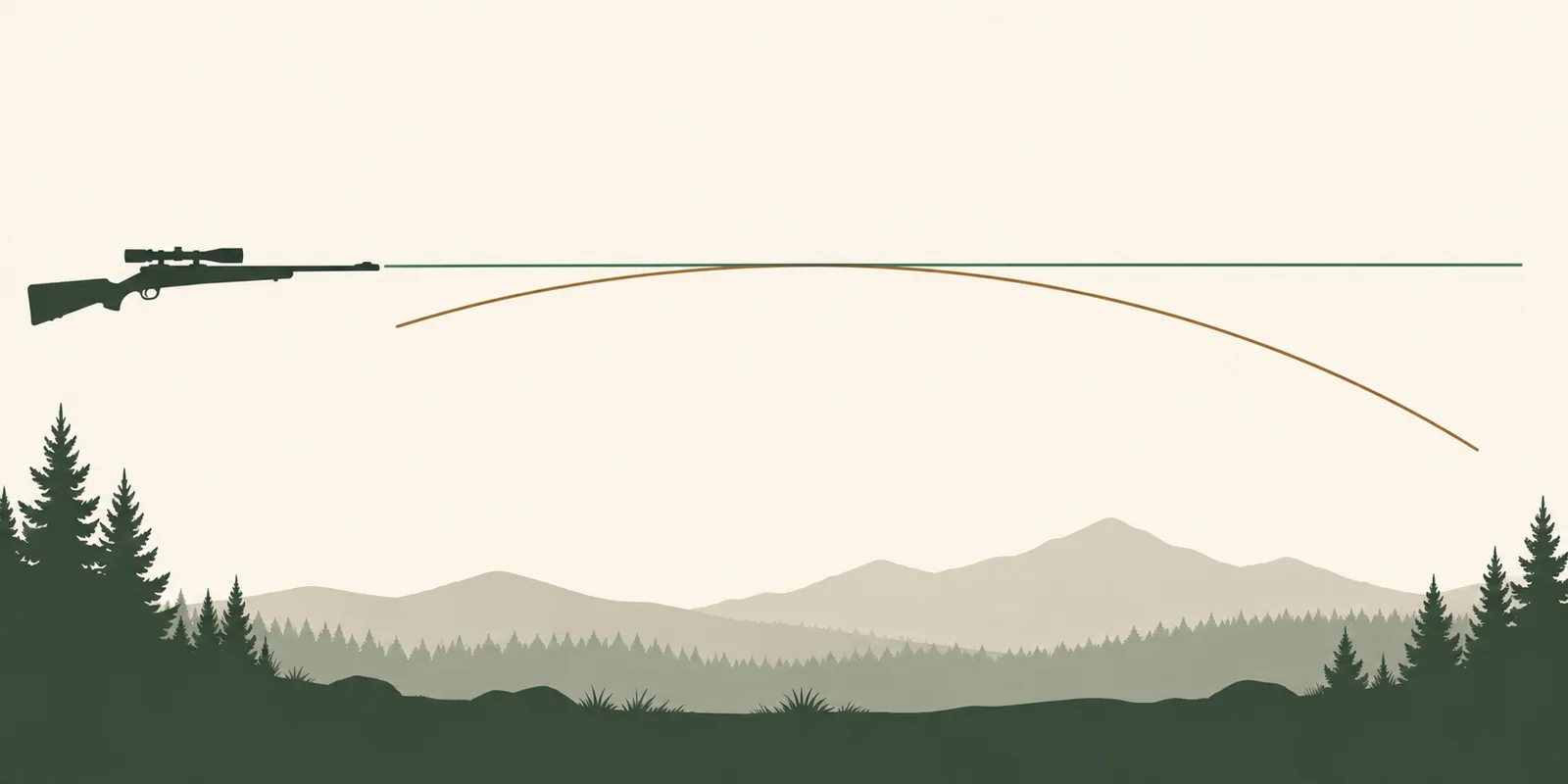
The straight sight line and curved bullet path meet at the chosen zero. This illustration is conceptual and not to scale.
A 100-yard zero means the bullet path intersects the sight line at 100 yards. A chart then reports the path above or below that line. It does not report total gravitational fall measured from the bore.
The sight begins above the barrel. That separation explains why a chart can show a negative value near the muzzle, zero at 100 yards, and negative values farther away. Gravity acts throughout the flight.
What is the .30-06 ballistics chart for a 100-yard zero?
The table below reproduces the 100-yard-zero trajectory values for Federal Fusion .30-06. Values are inches above or below the sight line. A minus sign means below it.
| Fusion load | 100 yd | 200 yd | 300 yd |
|---|---|---|---|
| 150 gr | 0.0 | -3.4 | -12.5 |
| 165 gr | 0.0 | -3.7 | -13.4 |
| 180 gr | 0.0 | -4.0 | -14.3 |
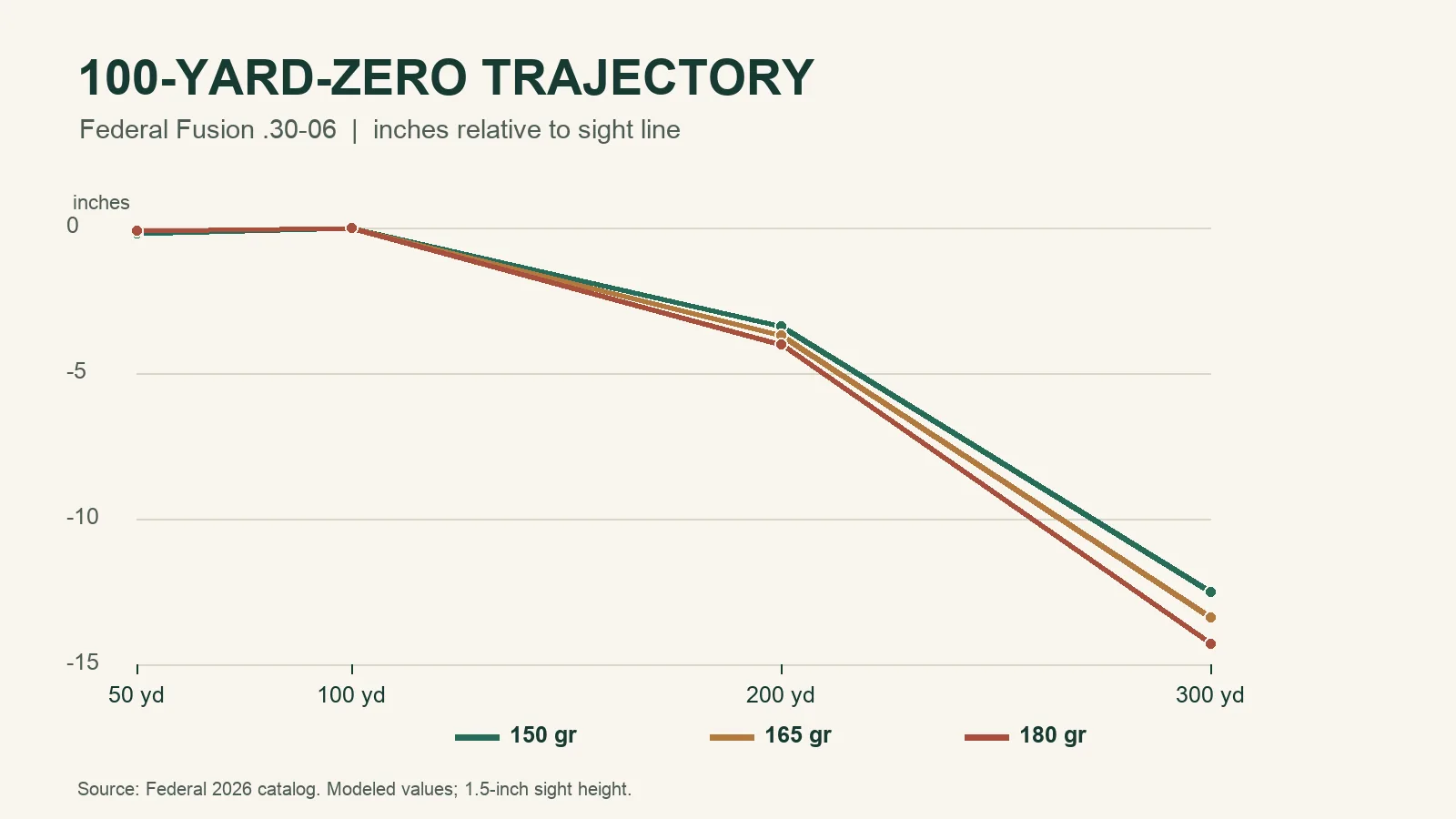
Federal Fusion .30-06 trajectories with a 100-yard zero. This graphic plots the manufacturer modeled values and keeps the table above readable as text.
At 50 yards, the same catalog lists the 150-grain load at -0.2 inch and both heavier loads at -0.1 inch. The manufacturer publishes this short-range trajectory column only through 300 yards. It does not provide 400- or 500-yard figures for a 100-yard zero in this table.
What assumptions sit behind these numbers?
Federal describes its trajectories as computer-calculated nominal behavior. The published assumptions are sea level, 59°F, 29.53 inches of barometric pressure, and sights 1.5 inches above the bore. The three Fusion rows also list a 24-inch test barrel.
These shared assumptions make the three loads comparable. They do not make the table a prediction for every rifle, sight, ammunition lot, or weather condition.
How much velocity do the three loads retain?
The 2026 Federal catalog lists different starting and downrange velocities for these Fusion loads. Velocity is measured in feet per second. Unlike trajectory height, velocity does not depend on which zero distance labels a chart.
| Fusion load | 100 yd | 200 yd | 300 yd |
|---|---|---|---|
| 150 gr | 2,674 fps | 2,459 fps | 2,254 fps |
| 165 gr | 2,590 fps | 2,399 fps | 2,217 fps |
| 180 gr | 2,521 fps | 2,349 fps | 2,185 fps |
At the muzzle, the 150-, 165-, and 180-grain loads list 2,900, 2,790, and 2,700 fps, respectively. Those are catalog figures from Federal’s test setup. A different rifle may produce a different measured velocity.
What do energy and wind-drift statistics add?
At 300 yards, the 180-grain Fusion load has the highest listed energy and lowest listed 10 mph crosswind drift of these three. The 150-grain load has the flattest listed 100-yard-zero path. One metric does not replace the others.
| Fusion load | Path at 300 yd | Energy at 300 yd | Wind drift at 300 yd |
|---|---|---|---|
| 150 gr | -12.5 in | 1,693 ft-lb | 7.4 in |
| 165 gr | -13.4 in | 1,800 ft-lb | 7.0 in |
| 180 gr | -14.3 in | 1,907 ft-lb | 6.6 in |
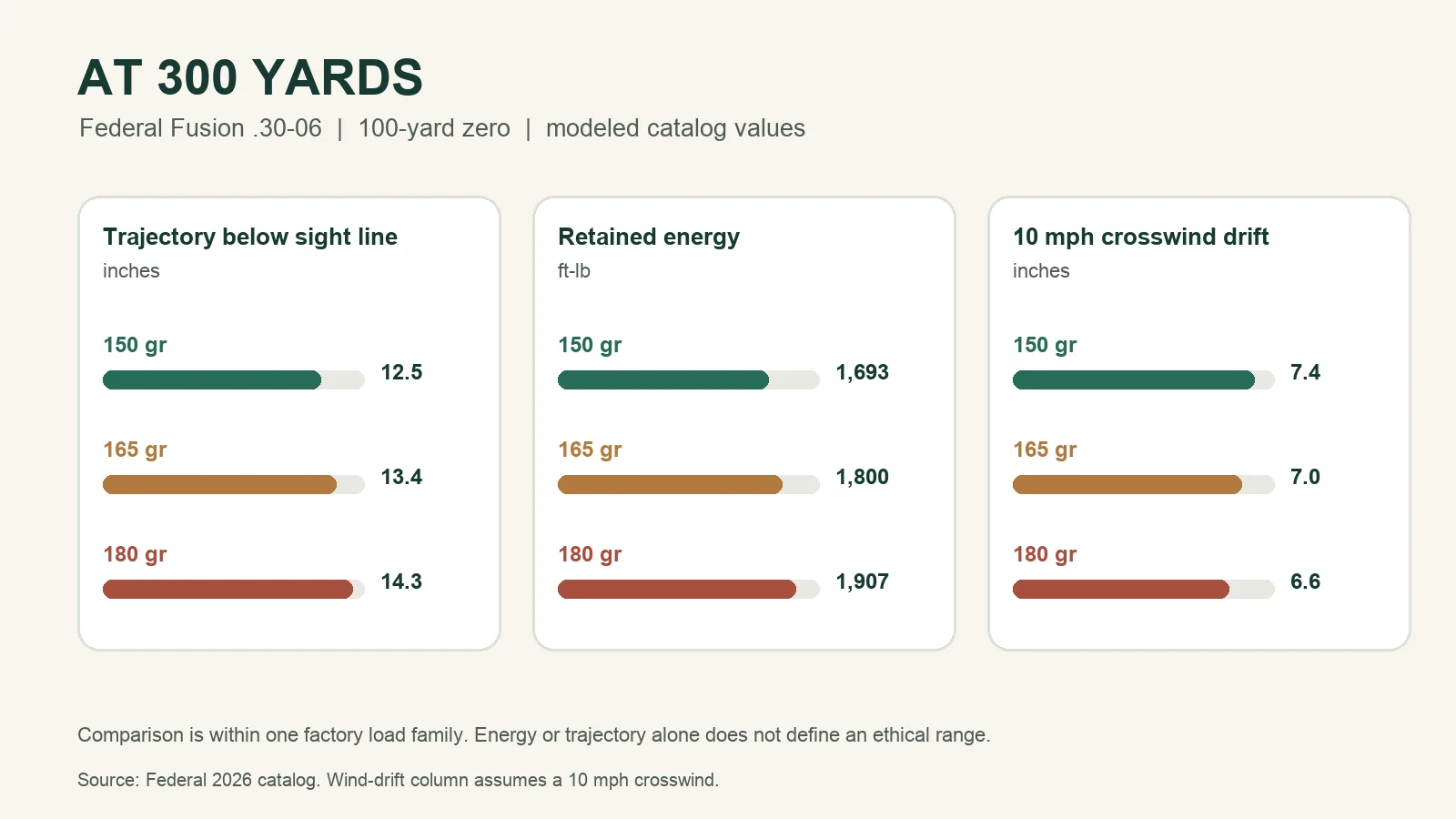
At 300 yards, the 2026 Federal catalog shows less drop for the 150-grain load, but more energy and less modeled wind drift for the 180-grain load.
Federal’s wind-drift column assumes a 10 mph crosswind. Wind direction and speed can differ from that reference. Energy is a useful physical measurement, but hunting performance also depends on bullet design and impact conditions.
How does bullet weight affect this comparison?
Within this one Fusion load family, the 150-grain option starts fastest and has the flattest listed path. The 180-grain option retains the most listed energy at 300 yards. It also has the least modeled drift under Federal’s stated crosswind.
This does not mean every 150-grain .30-06 load is flatter than every 180-grain load. Bullet shape changes drag, and ballistic coefficient can change as velocity changes. Comparing unlike bullets by weight alone hides those differences.
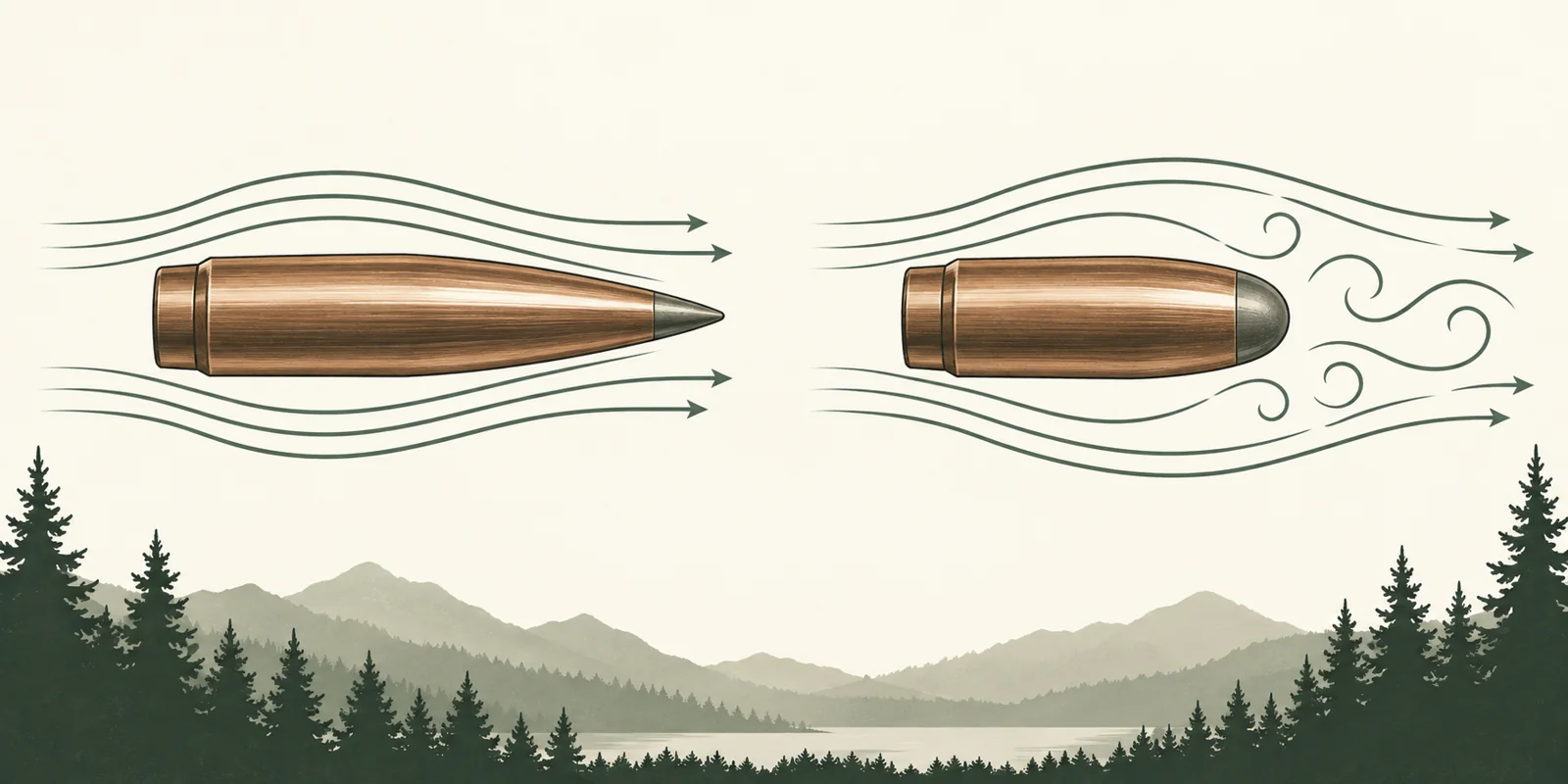
Left: a streamlined pointed profile. Right: a rounded profile. Shape affects drag, while a complete trajectory also depends on the load and conditions.
How is a 200-yard-zero chart different?
A 200-yard-zero table uses a different relationship between bullet path and sight line. The same load therefore has different height values at each distance. Federal publishes separate 100- and 200-yard-zero columns.
For comparison, these are the 200-yard-zero heights in the same Federal Fusion table. They are inches relative to that chart’s sight line, not corrections to apply to the 100-yard-zero table.
| Fusion load | 100 yd | 200 yd | 300 yd |
|---|---|---|---|
| 150 gr | +1.7 | 0.0 | -7.5 |
| 165 gr | +1.8 | 0.0 | -7.9 |
| 180 gr | +2.0 | 0.0 | -8.4 |
The contrast explains why a search result showing a 200-yard zero cannot answer a 100-yard-zero query. First check the table’s stated zero before comparing numbers.


Why can a real trajectory differ from the factory chart?
The Federal calculator treats sight height, zero range, temperature, wind, and altitude as separate inputs. Hornady also explains that temperature, pressure, altitude, and humidity affect drag. A generic chart cannot account for every combination.
Federal explicitly cautions that actual trajectories may differ because of atmosphere, guns, sights, and ammunition. The tables here are manufacturer reference figures. They are not an individual rifle’s verified flight path.
Does this chart establish a responsible hunting range?
No. Modeled drop, velocity, energy, and drift do not establish whether a particular shot is safe, lawful, or humane. They also do not measure the hunter’s accuracy or the animal’s movement.
Check current local regulations and the actual field conditions. If placement or the backdrop is uncertain, pass on the shot. Do not use this chart as a substitute for documented performance from the specific rifle and ammunition.

Leave a Reply