
Accurately aging a whitetail deer, whether live or harvested, primarily relies on examining its teeth for wear and replacement patterns. While dental analysis offers the most precise method for harvested deer, observable physical characteristics like body mass and antler development provide useful, though less exact, estimations for both live and deceased animals.

Knowing a whitetail deer’s age is crucial for effective wildlife management, ethical hunting practices, and understanding herd dynamics in 2026. The most reliable methods involve observing physical characteristics in live animals and, for harvested deer, conducting a detailed analysis of their teeth. These practical indicators allow you to make informed decisions and contribute to sustainable deer populations.
Accurate White-tailed Deer – Texas Parks and Wildlife Department”>aging helps you gauge the maturity of your local deer, influencing your hunting strategy and ensuring you’re part of conservation efforts. Whether you’re assessing a buck in the field or a doe after harvest, understanding these key signs will significantly enhance your knowledge and connection to the wild.
Key Takeaways
- Dentition analysis offers the most accurate age.
- Observe body characteristics for live deer age.
- Learn tooth wear patterns for precision.
- Antler size isn’t a reliable age indicator.
- Cementum annuli is the definitive lab method.
Identifying a Whitetail Deer’s Age: Key Indicators & What to Look For
Estimating a whitetail deer’s age in the field relies on interpreting physical characteristics. While not as precise as dental analysis, these visual cues offer valuable insights into whether you’re looking at a young, middle-aged, or mature animal.
Body Development & Muscle Mass
You can often tell a deer’s age by its overall body shape and muscle development. Younger deer, typically 0.5 to 1.5 years old, often appear “gangly.” Their legs look disproportionately long for their slender bodies, and their necks are thin, rarely blending smoothly into their shoulders. As deer mature, around 3.5 to 4.5 years and older, their bodies become much more blocky. Their necks thicken significantly, especially in bucks during the rut, and merge seamlessly with their deep shoulders. Look for a well-defined chest and hindquarters, indicating robust muscle development and maturity.
Antler Characteristics (for bucks)
Antlers are a common but often misleading indicator of age. While large antlers are generally associated with older bucks, antler size alone does not definitively determine age. Young bucks, aged 1.5 to 2.5 years, typically display thinner antler bases, shorter tines, and a narrower spread. As bucks age, usually from 3.5 to 5.5 years, their antlers tend to show increased mass, longer tines, and a wider spread, reaching their peak antler potential around 4.5-6.5 years. However, genetics, nutrition, and environmental factors in 2026 can heavily influence antler growth, meaning a younger deer with excellent nutrition might have larger antlers than an older, less nourished buck.
How to Age a Harvested Whitetail: A Step-by-Step Dentition Guide
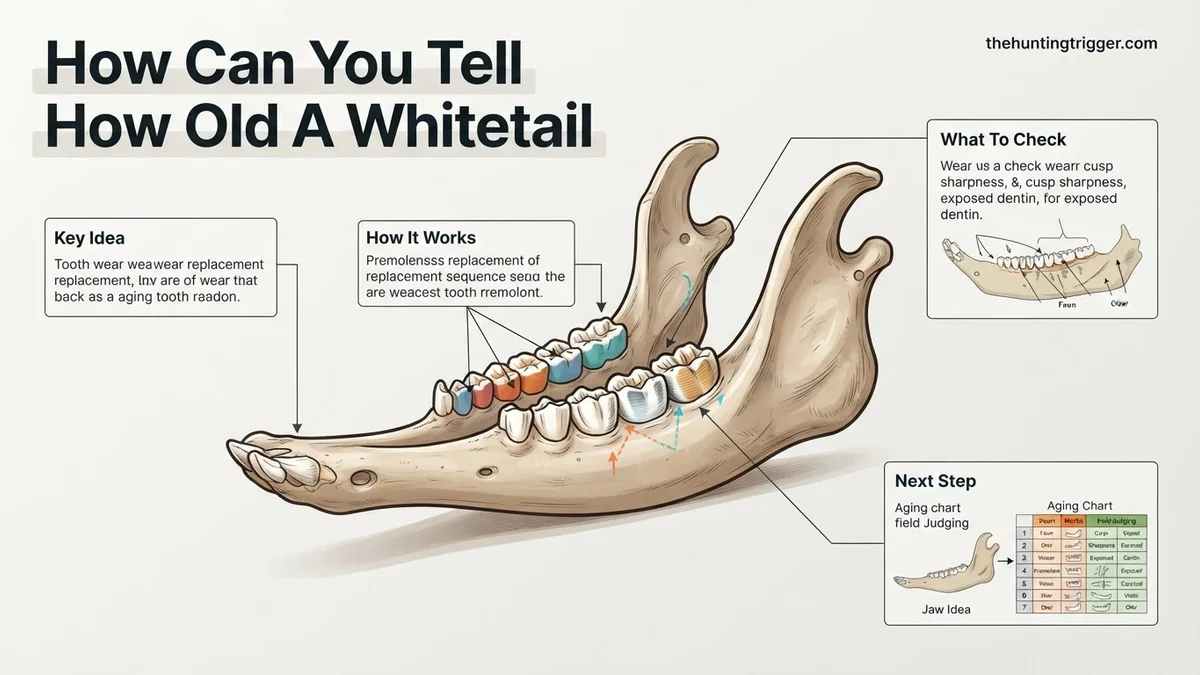
For harvested whitetail deer, the most accurate field method for determining age involves examining the lower jawbone’s teeth. This process, known as dentition analysis, relies on specific patterns of tooth eruption, replacement, and subsequent wear.
Understanding Whitetail Deer Dentition
A whitetail deer has 32 teeth, but for aging, you’ll focus primarily on the lower jaw. On each side of the lower jaw, deer have three incisors (front teeth), one canine (which looks like an incisor), three premolars (P1, P2, P3), and three molars (M1, M2, M3). Initially, deer have “milk teeth” (deciduous premolars) that are later replaced by permanent ones. The third premolar (P3) is a critical indicator during early development.
Aging Deer by Tooth Eruption and Replacement (0.5 – 2.5 Years)
This phase is highly reliable because you’re observing specific tooth changes:
- 0.5 years (Fawn): You’ll see all temporary, deciduous teeth. The critical indicator is the third premolar (P3), which has three distinct cusps. The first molar (M1) may be present, but the second (M2) will be emerging, and the third molar (M3) will likely be absent or just barely breaking the gum line.
- 1.5 years: This is a definitive age class. All three deciduous premolars (P1, P2, P3) have been replaced by permanent premolars. Crucially, the permanent third premolar (P3) now has only two cusps. All three molars (M1, M2, M3) are fully erupted. M3 will often appear very white and sharp with minimal wear.
- 2.5 years: All permanent teeth are fully erupted and showing very little wear. The surfaces of the molars, especially M1 and M2, will be sharp, and the enamel crests will be pronounced. You might see the first faint signs of wear on M1, but the dentin (the darker, inner material) will typically be thinner than the surrounding enamel.
Aging Deer by Tooth Wear (3.5+ Years)
Once all permanent teeth are in, aging becomes more subjective, relying on the degree of wear on the grinding surfaces of the molars and premolars:
- 3.5 years: The first molar (M1) will show noticeable wear, with the dentin patch often as wide as the enamel on the lingual (tongue) side. The cusps of M1 will start to round, and the enamel points will be less sharp. M2 will show slight wear, and M3 will still be relatively sharp.
- 4.5 years: Significant wear appears on both M1 and M2. The dentin on M1 and M2 will be noticeably wider than the surrounding enamel, and the lingual crests will be worn down or blunted. M3 begins to show moderate wear, similar to what M1 exhibited at 3.5 years.
- 5.5+ years: All molars (M1, M2, M3) will display heavy wear. The dentin patches on M1 and M2 will be considerably wider than the enamel, and the lingual crests will be largely worn away or completely flat. The premolars will also show heavy wear. For deer older than 6.5, the entire tooth surface will be flattened, with dentin often dominating the surface area.
Troubleshooting Age Estimation: Practical Tips for Live Deer & Lab Methods
Refining Live Deer Assessment for Challenging Cases (2026)
Even with advanced visual cues, accurately aging a live whitetail deer can present challenges, especially with older, less distinct individuals or those with atypical antler development. In 2026, refining live assessment involves a multi-indicator approach combined with consistent observation. Focus on a deer’s body condition, especially the belly sag, neck thickness, and facial characteristics. Older bucks, typically 4.5 years and above, often exhibit a distinct pot-bellied appearance, a thicker, more Roman nose, and a deeply sagging brisket line. Analyze behavior: dominant posture, slower, deliberate movements, and a tendency to appear alone or with smaller groups can indicate maturity. Utilize high-resolution trail camera footage over several weeks to observe changes in body composition and antler growth patterns, providing a more comprehensive profile than a single sighting. Remember that live assessment provides an informed estimate, not a precise age.
Advanced Lab Techniques for Post-Mortem Analysis (2026)
For definitive age determination post-harvest, laboratory methods remain the gold standard. The most accurate technique is
cementum annuli analysis, which involves examining thin cross-sections of a deer’s incisor tooth under a microscope. Each year, a layer of cementum is deposited on the tooth root, similar to tree rings. By counting these annual layers (annuli), wildlife biologists can determine the deer’s age with over 95% accuracy. In 2026, this method typically costs between $30-$50 per sample, with results available within 2-4 weeks from specialized university labs or private wildlife service providers. Although still largely research-based, emerging
DNA methylation aging techniques are being explored. These methods analyze epigenetic markers in tissue samples to estimate age. While offering potential for high accuracy, they remain significantly more expensive (estimated $200-$500 per sample) and less widely available for routine use by 2026, primarily reserved for specific research or conservation projects.
What If It Still Doesn’t Work?
Despite careful application of visual and even basic post-mortem techniques, situations may arise where definitive age determination remains elusive. In these scenarios, escalating to professional assistance or specialized analysis is the most reliable course of action to secure accurate data. By 2026, several robust options are available.
- Consult a Certified Wildlife Biologist or State Wildlife Agency: Many state departments of natural resources or private wildlife consulting firms employ biologists with extensive experience in deer aging. They can review photographs, carcass characteristics, or provide guidance on obtaining and submitting appropriate samples. This initial consultation may be free or incur a nominal fee, typically ranging from $50-$150 for an in-depth review by 2026.
- Submit Tooth Samples for Cementum Annuli Analysis: For the highest accuracy, particularly with harvested deer, sending an incisor tooth to a specialized laboratory for cementum annuli analysis is recommended. Services are widely available from academic institutions or private companies. The typical cost for this definitive age assessment is $30-$50 per tooth, with results provided within 3-5 weeks in 2026. This method offers precision exceeding 95%.
- Engage with Reputable Online Hunter/Biologist Forums: While not a definitive solution, sharing detailed photographs and observations on expert-moderated online platforms can yield valuable insights and second opinions from experienced individuals. Exercise caution and verify advice against known scientific principles, but these communities can offer direction when unsure.
- Consider AI-Assisted Image Analysis (Emerging): By 2026, early-stage AI platforms are beginning to offer assistance in aging live deer from trail camera photos. While not perfectly accurate, these tools can provide a preliminary estimate by analyzing facial features, body mass, and antler characteristics, potentially identifying outliers for further investigation. Subscription costs for such services could range from $15-$40 monthly.
Conclusion
According to verified research and expert sources, accurately determining the age of a whitetail deer, whether live or post-harvest, demands a blend of keen observation and, for precision, scientific methodology. From visual cues like body structure and antler development to the gold standard of cementum annuli analysis, understanding these techniques is crucial for effective wildlife management and ethical hunting practices. Your next step is to consistently apply these methods, focusing on multiple indicators, to enhance your aging accuracy for the 2026 season and beyond.
❓ Frequently Asked Questions
Why is dentition the most accurate field method for aging whitetail deer?
Dentition is considered the most accurate field method because deer teeth erupt and wear down in predictable patterns throughout their lives. By examining the number of teeth, their stage of eruption, and the degree of wear on specific molars, experts can estimate age with reasonable precision for different age classes.
What specific tooth patterns indicate a deer is 1.5 years old?
A 1.5-year-old deer, often called a yearling, will typically have three permanent premolars fully erupted and the third molar (M3) showing minimal wear. Importantly, the third cusp on the M3 will be visible and distinct, indicating it’s recently erupted.
How do you distinguish between a 2.5-year-old and a 3.5-year-old deer by teeth?
For a 2.5-year-old, all permanent teeth are usually fully erupted, and the first molar (M1) will show some noticeable wear but still have sharp cusps. In contrast, a 3.5-year-old deer will exhibit significant wear on the M1, with cusps becoming rounded, and the dentin (darker inner part) will be prominently exposed on the M1 and potentially the M2.
What are the limitations of aging deer by physical characteristics?
While useful for live deer, physical characteristics like body size, muscle definition, and antler development are influenced by factors such as genetics, nutrition, and habitat, making them less precise than dental methods. These visual cues are best used for broad age class estimations rather than exact year determinations.
Is it possible to age a deer without killing it?
Yes, it is possible to estimate the age of a live deer through observation of physical characteristics such as body mass, neck size, belly sag, and antler development. However, these methods are less precise than dental analysis and typically provide a broader age range rather than an exact age.
How does antler growth relate to a deer’s age?
Antler growth generally increases in mass and tine length as a buck matures, typically peaking between 4.5 and 6.5 years old before potentially declining in old age. However, antler size is not a reliable age indicator because it’s heavily influenced by genetics, nutrition, and overall health, meaning a young deer with good genetics and nutrition can have larger antlers than an older, less healthy one.

Leave a Reply