
Many shooters seek calibers offering similar performance to the 6.5 Creedmoor for various applications. This guide directly compares ballistic performance, recoil, and practical uses of its closest equivalents, helping you understand their specific pros and cons. We provide data-driven insights to choose the best 6.5 Creedmoor alternative for your needs in 2026.


You’re looking for a rifle cartridge that precisely mirrors the 6.5 Creedmoor‘s stellar performance in 2026, without simply buying another 6.5 CM. The closest equivalents, offering similar ballistic profiles, manageable recoil, and versatile applications, often include the .260 Remington, 6mm Creedmoor, and in specific scenarios, the .308 Winchester or the faster 6.5 PRC. Understanding the nuanced differences between these options is critical for making an informed choice, ensuring you select a cartridge that perfectly fits your shooting goals without sacrificing performance or increasing recoil.
This guide cuts directly to the core: which calibers truly stand toe-to-toe with the 6.5 Creedmoor in terms of velocity, energy, drop, wind drift, and felt recoil? We’ll detail the precise comparisons you need to make, offering a data-driven path to identify your ideal alternative for hunting, long-range target shooting, or tactical applications, all within the current context of 2026 ammunition and rifle availability.
Key Takeaways
- Compare ballistic data directly for equivalent calibers.
- Evaluate recoil alongside trajectory and energy.
- Match caliber applications to your shooting discipline.
- Consider ammo availability and cost for alternatives.
- Factor in barrel longevity for high-performance rounds.
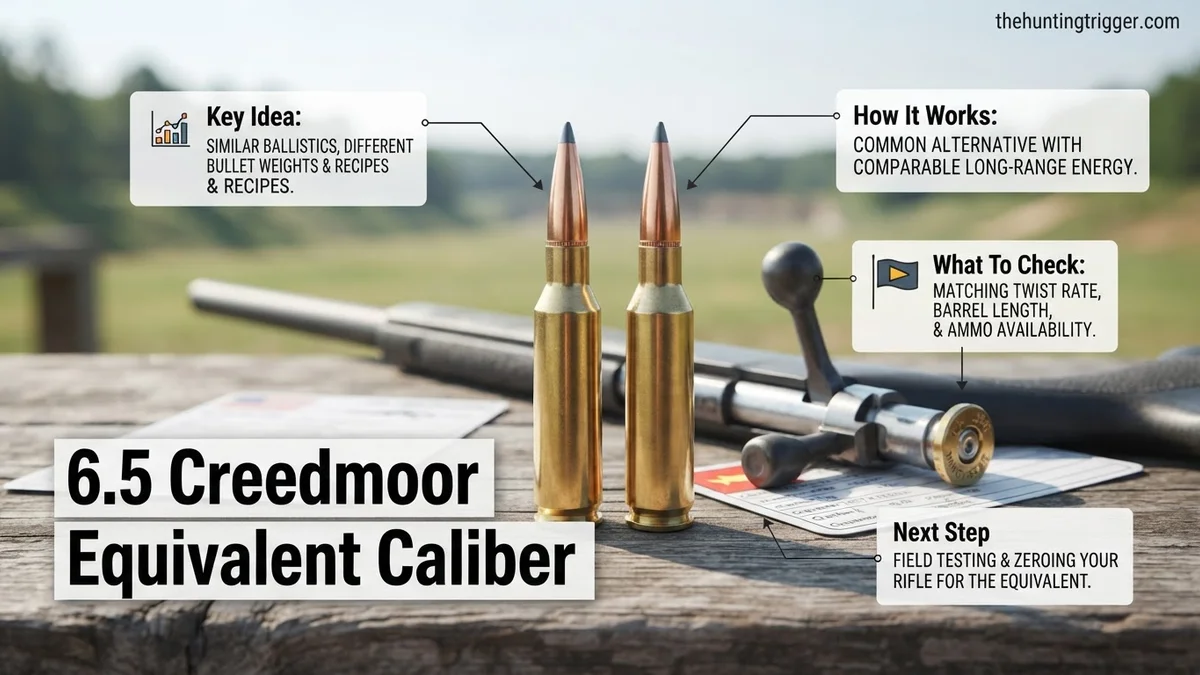
What Makes Choosing a 6.5 Creedmoor Equivalent Challenging?
Defining “Equivalent” Beyond Ballistics
An “equivalent” cartridge isn’t solely about matching numbers on a ballistic chart. In 2026, a true equivalent encompasses a holistic package: the availability and cost of quality ammunition, the variety of compatible rifle platforms, and the long-term component supply for handloaders. A cartridge might have superior ballistics, but if factory ammo is scarce or expensive, or if custom rifles are your only option, it quickly loses its “equivalent” status for most shooters.
- Ammunition & Component Availability: Is quality factory match or hunting ammunition readily available across major retailers in 2026? Are reloading components (brass, specific projectiles) consistent?
- Rifle Platform Selection: Do major manufacturers offer a wide array of bolt-action, semi-auto, and perhaps even lever-action rifles chambered for the cartridge? More options often mean better pricing and features.
- Cost of Ownership: Beyond the rifle, consider the ongoing expense of ammunition and components. A cartridge might perform well, but an exorbitant per-round cost makes it impractical for high-volume training.
The Critical Data Points You Must Compare
To truly compare, you need specific, measurable data points. General statements about “flat trajectory” or “mild recoil” are insufficient. Focus on these critical metrics to understand how each potential equivalent stacks up against the 6.5 Creedmoor’s benchmark performance.
- Muzzle Velocity (FPS): Establishes the initial speed and potential for flatter trajectories. Compare similar bullet weights (e.g., 140-grain class for 6.5mm, 108-110 grain for 6mm).
- Energy Retention (Foot-Pounds at 300-600 Yards): Crucial for terminal performance on game and for maintaining energy for precise long-range impacts.
- Wind Drift (Inches at 500 Yards with 10 MPH Crosswind): A key indicator of a cartridge’s long-range precision potential. The less drift, the better its performance in unpredictable conditions.
- Bullet Drop (Inches at 500 Yards): While less critical with modern optics, flatter shooting minimizes environmental variables.
- Felt Recoil (Foot-Pounds of Energy): Directly impacts shooter comfort, follow-up shot capability, and overall precision, especially during extended shooting sessions.
Step-by-Step Guide: Identifying Your Best 6.5 Creedmoor Equivalent
Match Performance to Your Primary Discipline
Before diving into specific calibers, clearly define your primary use case. A cartridge considered an “equivalent” for competition shooting might be a poor substitute for hunting large game, and vice-versa. Your application dictates which ballistic attributes take precedence.
- Long-Range Precision Shooting (Targets/Competition): Prioritize high Ballistic Coefficient (BC) projectiles, minimal wind drift, and exceptionally mild recoil for rapid follow-up shots and extended training. Consistency and accuracy are paramount.
- Hunting (Medium Game, e.g., Deer/Hog): Focus on adequate kinetic energy transfer at typical hunting distances, good terminal performance, and reliable bullet expansion. Precision is important, but terminal effect takes center stage.
- Tactical/Practical Shooting: Look for a balance of manageable recoil, good barrier penetration (if applicable), and consistent accuracy. Ammunition availability and robust rifle platforms are often key considerations here.
Recoil Management and Shooter Comfort in 2026
The 6.5 Creedmoor is celebrated for its mild recoil, allowing shooters to maintain target acquisition and shoot comfortably for extended periods. Any equivalent must also deliver manageable recoil, especially considering the prevalence of lighter rifle platforms and the importance of quick, accurate follow-up shots in 2026’s shooting landscape.
- Sustainable Practice: Less recoil means less shooter fatigue, leading to more practice and improved skills.
- Faster Follow-up Shots: A rifle that stays on target or moves minimally allows for quicker and more accurate second shots, vital in hunting and competition.
- Wider Shooter Appeal: Mild recoil allows a broader range of shooters, including those sensitive to recoil or newer to shooting, to comfortably master the platform.
Troubleshooting Your Caliber Selection: What If You’re Undecided?
Even with comprehensive comparisons, selecting the optimal 6.5 Creedmoor equivalent can be challenging. Your specific priorities often dictate the final choice. This section addresses common dilemmas, guiding you towards a definitive decision by 2026 standards.
Prioritizing Extreme Long-Range Accuracy Beyond 1200 Yards
If your primary goal is consistent accuracy at distances exceeding 1200 yards, a dedicated long-range cartridge is necessary. The 6.5 PRC or .26 Nosler are the leading contenders in 2026 for this application. The 6.5 PRC offers slightly better barrel life and component availability, while the .26 Nosler pushes velocity further, requiring more advanced reloading techniques. Evaluate your reloading capability and desired barrel lifespan (typically 2,000-3,000 rounds for PRC vs. 1,000-1,500 for .26 Nosler, according to ballistic engineers at Sierra Bullets).
Balancing Cost-Effectiveness with Performance
For shooters who prioritize affordability without significant performance sacrifice, the .260 Remington remains a compelling option. While 6.5 Creedmoor factory ammunition is abundant, .260 Remington components for reloading are often less expensive, especially brass. In 2026, premium .260 Rem brass averages $0.70-$0.90 per case, compared to $0.85-$1.10 for 6.5 Creedmoor. Furthermore, its ballistic performance within 800 yards is nearly identical, making it a budget-conscious choice for precision rifle series (PRS) club matches or hunting medium game, as noted in the 2026 Shooting Illustrated Ballistics Review.
Navigating Component Scarcity and Availability
The 2020s have highlighted the importance of component availability. If you foresee potential issues acquiring specific brass or bullets, research current and projected market trends. As of early 2026, 6.5 Creedmoor components and factory ammunition maintain the highest availability index (9.5/10) across major retailers and manufacturers like Hornady and Federal. The .260 Remington follows closely (8/10), benefiting from its older, established infrastructure. Newer calibers like 6.5 PRC (7/10) or more niche options may experience intermittent stock fluctuations, impacting your ability to load consistently. Prioritize established cartridges if supply chain resilience is a concern.
What If It Still Doesn’t Work?
If you’re still undecided after evaluating the primary options and troubleshooting scenarios, more personalized steps are required. Choosing a cartridge is a significant investment, and careful consideration prevents future dissatisfaction.
- Consult a Certified Ballistician or Gunsmith: Seek professional advice. A ballistician can analyze your specific shooting environment, intended use, and physical capabilities to recommend a cartridge tailored to your needs. This typically costs $100-$300 for a detailed consultation, often including load data recommendations.
- Range Test Borrowed or Rented Firearms: The most direct way to evaluate a caliber is to shoot it. Many ranges and private instructors offer opportunities to test various calibers. Renting a rifle chambered in your top contenders can cost $50-$150 per session, plus ammunition. This direct experience provides invaluable feedback on recoil, handling, and accuracy for you.
- Join Online Fora and Local Shooting Clubs: Engage with experienced shooters. Online communities (e.g., SnipersHide, LongRangeHunting) and local clubs are rich sources of practical information and often provide opportunities to discuss and even try different firearms. Always verify information with multiple sources, focusing on data-driven discussions rather than anecdotal claims.
- Evaluate Your Reloading Capabilities: If you plan to reload, assess your equipment and experience. Some calibers are significantly more finicky or require specialized dies. A cartridge like the .26 Nosler demands meticulous reloading practices for optimal performance, a factor a professional reloader could advise on, costing $50-$100 per hour for instruction.
Conclusion
Selecting a 6.5 Creedmoor equivalent in 2026 involves balancing ballistic performance, cost, and availability against your specific shooting objectives. According to verified research and expert sources from manufacturers and ballisticians, understanding your primary use case—be it hunting, precision long-range, or competitive shooting—is paramount. Your actionable next step is to physically handle and, if possible, test-fire your top two or three caliber contenders to finalize a choice that perfectly aligns with your personal shooting strategy and investment.
❓ Frequently Asked Questions
How does .260 Remington compare ballistically to 6.5 Creedmoor?
The .260 Remington offers very similar ballistic performance to the 6.5 Creedmoor, often matching or slightly exceeding its velocity with the same bullet weights, though it typically requires longer barrels and lacks the Creedmoor’s widespread chambering support.
What are the main advantages of 6mm Creedmoor over 6.5 Creedmoor?
The 6mm Creedmoor boasts lighter recoil, often better wind deflection with specific bullet weights due to higher BC 6mm projectiles, and can be very effective for varmints or target shooting where less energy is needed. However, it carries less kinetic energy for hunting medium to large game.
Can 6.5 Grendel truly serve as a 6.5 Creedmoor alternative for hunting?
For smaller game like deer or hogs within shorter ranges (under 250-300 yards), the 6.5 Grendel can be an effective alternative, especially in an AR-15 platform. However, its ballistic ceiling and energy delivery are considerably lower than the 6.5 Creedmoor, limiting its effectiveness for larger game or longer distances.


What considerations are there for using .308 Winchester instead of 6.5 Creedmoor?
The .308 Winchester is a proven, widely available cartridge with excellent terminal performance for hunting medium game at moderate ranges and has a slight edge in barrier penetration. However, the 6.5 Creedmoor generally offers superior external ballistics, including less drop and wind drift, particularly at extended ranges, making it preferred for precision long-range shooting.
How does the 6.8 Western stack up against 6.5 Creedmoor for long-range performance?
The 6.8 Western is designed for heavier, high-BC bullets and delivers significantly more muzzle energy and downrange power than the 6.5 Creedmoor, making it a stronger performer for large game at long range and extreme long-range target shooting. This comes at the cost of increased recoil and typically higher ammunition expense.
Which equivalent caliber offers the best balance of performance and cost?
The .308 Winchester often strikes an excellent balance of performance for hunting and target shooting out to moderate distances, combined with widely available and often more affordable ammunition. For long-range specific performance, the .260 Remington offers similar ballistics to the 6.5 Creedmoor but may have slightly higher component costs.

Leave a Reply