
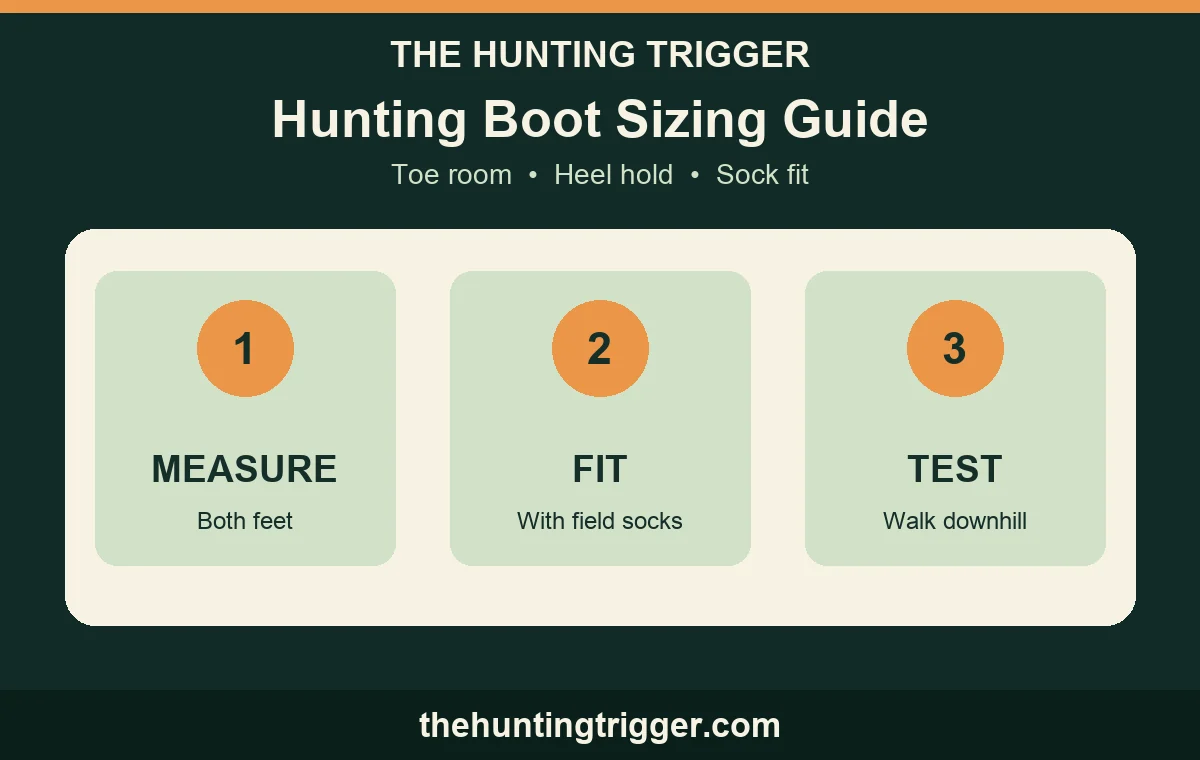
Updated September 25, 2026. A hunting boot should hold the heel securely, leave room for the longest toe, and feel snug around the midfoot without pinching. Fit it with the socks and insoles intended for the hunt. A familiar street-shoe size is only a starting point because boot shapes and manufacturer sizing differ.
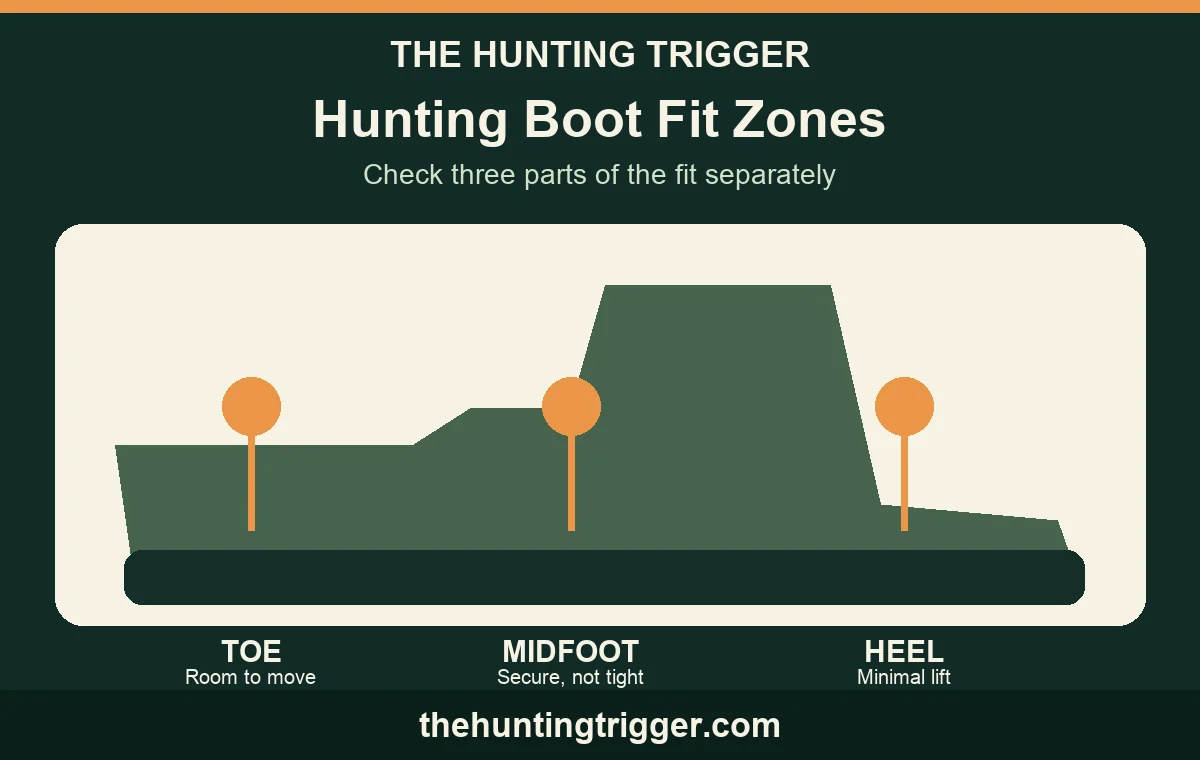
The fastest useful check is to lace both boots, walk indoors, and look for three things: toe contact at the front, noticeable heel sliding, and pressure along the sides. Danner’s fitting guidance says toes should not touch the end, heels should not slide substantially, and pinching is a sign to reconsider size or width.
| Fit area | Good sign | Warning sign | Next check |
|---|---|---|---|
| Toes | Wiggle room while standing and walking | Toes touch the front, especially on a decline | Compare length and the model’s sizing guidance |
| Forefoot | Secure without squeezing | Pressure at the big or little toe | Try a wider last or width |
| Midfoot | Held without painful pressure | Foot slides forward or laces must be overtightened | Recheck volume, sock, and last |
| Heel | Moves with the boot | Repeated rubbing or substantial lift | Re-lace, then compare a different heel shape |
Measure both feet before choosing a size
Meindl recommends measuring both feet for length, width, and arch length while wearing the usual boot socks. One foot can be larger, so fit the larger foot. Trying boots near the end of the day can reveal a fit that feels too tight after activity, as Meindl’s choosing guide notes.
Look up the exact boot’s fit notes, not only the brand’s general chart. A last is the form around which a boot is built; Danner’s last guide shows that even one manufacturer uses different forefoot and heel shapes. A narrow toe box cannot reliably be fixed by adding length.
How much toe room should hunting boots have?
The toes should not press against the front when standing or walking downhill. For a model-specific starting check, Kenetrek advises sliding the foot forward in an unlaced boot until the toes lightly touch, then checking for a finger’s width behind the heel. Meindl describes a similar check.
That finger check is an approximate try-on cue, not a universal sizing standard. Lace the boot afterward and walk on a safe incline if a store provides one. The toes should not repeatedly strike the front on the downhill step.
Should the heel slip?
Some initial stiffness is normal in a structured boot. Substantial heel lift or rubbing while walking is a warning: Danner says the heel should not slide up the back of the boot substantially. Check whether the tongue lies flat and the laces hold the midfoot without painful pressure.
Meindl recommends snug lacing and checking that the heel stays in place. If re-lacing does not solve repeated lift, a different last or size may fit better. Avoid tightening so much that the forefoot is compressed merely to hold the heel.
Does width matter as much as length?
Yes. Pinching at the sides, especially at the big or little toe, can call for more width or a different last rather than more length. Danner’s new-boot guide advises trying a wider width or larger size when pinching persists; the better choice depends on where the pressure occurs.
The same distinction applies to overall boot volume, the space above and around the foot. Kenetrek discusses volume after confirming length. Socks and footbeds can change that space somewhat, but they should not be used to force a fundamentally wrong shape to work.
Fit with the socks used on the hunt
Bring the socks and insoles that will actually go into the boot. Meindl recommends matching the try-on sock thickness to field use. A thicker sock changes the available room and can turn a good fit into a tight one.
Do not assume that adding a heavy sock is always the right way to make an insulated boot warmer. Kenetrek warns that an overly thick sock can compress the boot’s fit and reduce circulation. Choose the boot and sock system together, then test it under the conditions expected for the hunt.
Should hunting boots be a half-size larger?
There is no blanket half-size rule. Kenetrek’s chart gives different advice for its Pac Boots and Mountain Boots, while Meindl says the last and construction can alter fit even among its own models. Start with measured feet and the exact model’s chart, then judge the actual toe, width, midfoot, and heel fit.
If buying online, check the manufacturer’s current fit and return guidance before wearing a new pair outdoors. Danner recommends the first fit test indoors, where a wrong size can be identified without treating break-in as a fix.
Break in the right fit before a hunt
Once the boot passes the indoor check, build walking time gradually. Meindl’s break-in guide starts with indoor wear, then flat ground, then uneven terrain and added load. It explicitly cautions that break-in cannot correct a wrong size.
Pay attention to repeated hot spots. Kenetrek’s break-in guidance recommends addressing them early and adding pack weight gradually. Do not wait for a long hunt to discover that a downhill step drives the toes into the front.
A final five-minute boot fit check
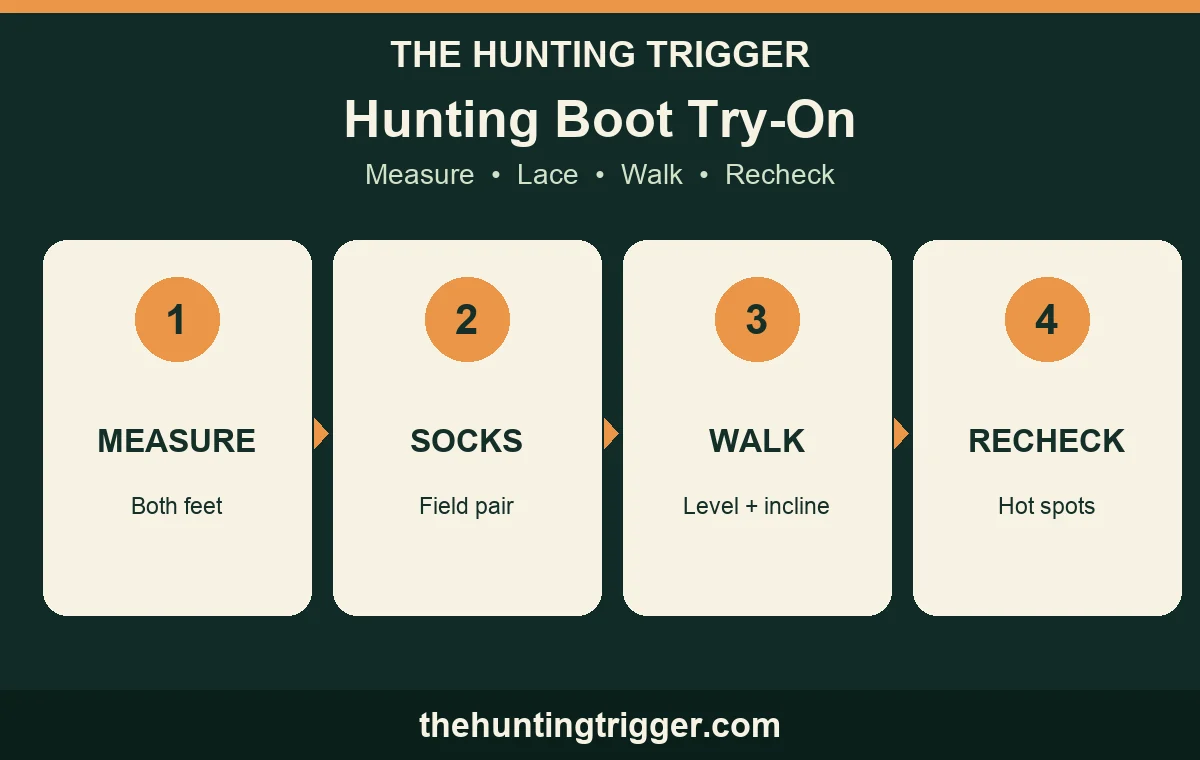
- Wear the actual sock and insole combination.
- Lace both boots snugly, with the tongues flat.
- Stand with full weight on each foot. Check toe clearance and side pressure.
- Walk indoors, then use a safe incline if available. Notice toe contact and heel lift.
- Recheck after a longer indoor wear period. Persistent pinching, rubbing, or numbness means the fit needs another look.
The practical choice: select a boot that fits the larger foot, matches the expected terrain and weather, and passes the walking checks. Meindl recommends choosing the boot type for terrain and conditions first; then fit the specific model to the hunter’s feet.
For the route and weather decisions beyond footwear, use the site’s hunting fieldcraft basics guide.

Leave a Reply