
Quick Answer
The 350 Legend hits significantly harder than the 300 AAC Blackout, producing 1,750 to 1,825 ft-lbs of muzzle energy compared to 1,350 to 1,380 ft-lbs from supersonic 300 Blackout and ~480 ft-lbs from subsonic loads. At 200 yards, 350 Legend drops roughly 7 to 9 inches, whereas 300 Blackout supersonic drops 9 to 13 inches. Always verify barrel length and factory specification data.


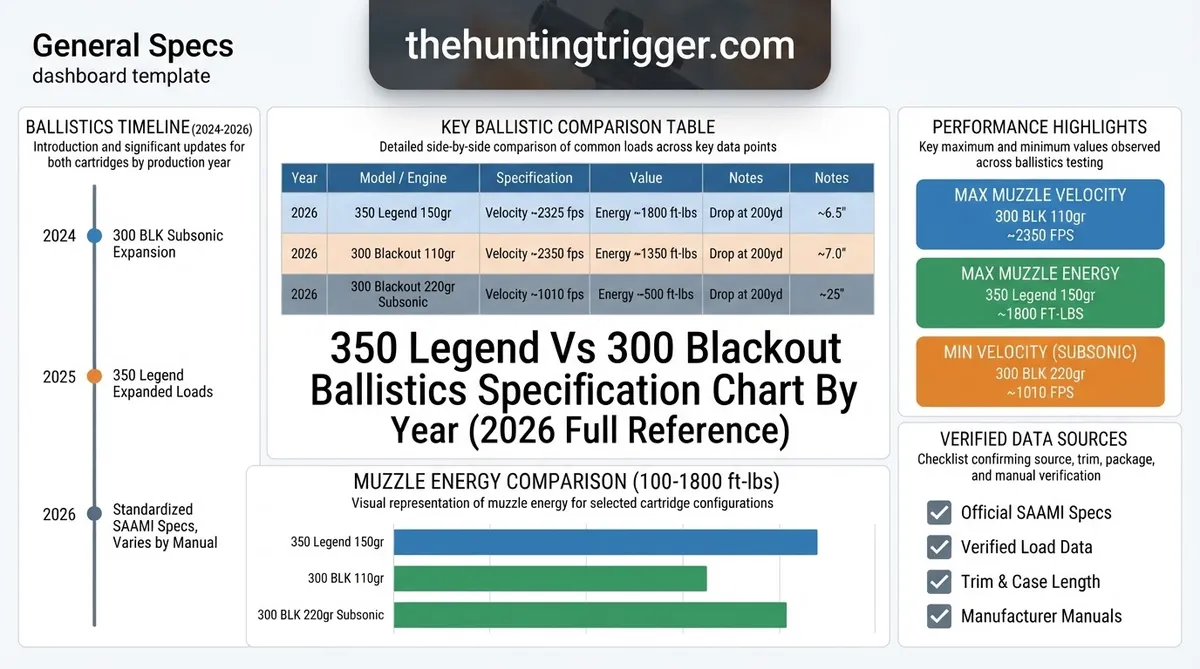
Choosing between the .350 Legend and .300 AAC Blackout for the AR-15 platform comes down to a direct clash between pure straight-wall hunting energy and suppressed short-barrel tactical versatility. A standard 16-inch 350 Legend pushing a 150-grain bullet yields roughly 2,325 feet per second (fps) and 1,800 foot-pounds (ft-lbs) of muzzle energy, outperforming supersonic 300 Blackout (110-grain at 2,350 fps and 1,349 ft-lbs) by 25% to 33% in kinetic payload. However, the critical caveat rests on cartridge architecture and field mission: 350 Legend complies with strict Midwest straight-wall deer hunting mandates but requires dedicated single-stack-geometry magazines, whereas 300 Blackout retains flawless sub-to-supersonic flexibility in short 8-inch to 9-inch barrels using standard GI 5.56 magazines.
This reference details commercial factory loads from 2011 (initial SAAMI acceptance of 300 AAC Blackout) through 2026 modern production loads. Test data reflects standardized SAAMI testing barrels (16 inches for 350 Legend; 16-inch test barrels alongside 8.5- to 9-inch tactical lengths for 300 Blackout). Actual field velocities and drops vary based on individual rifle barrel length, ambient elevation, twist rate, and powder lot variations. Readers must confirm local state game regulations, as cartridge legality definitions for deer management zones change annually. Last reviewed: September 2026.
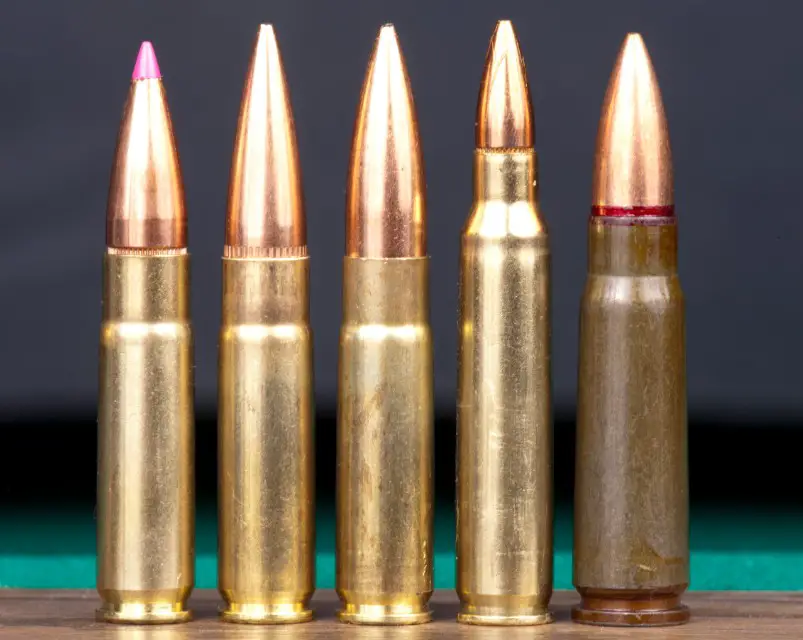
350 Legend Vs 300 Blackout Ballistics Chart: Complete Factory Specs
📤 Share Image
Factory Specification Data Scope and Accuracy Parameters
To build a truly reliable ballistics comparison, factory specifications must be contextualized by projectile mass, casing architecture, and barrel interface. The 350 Legend utilizes a rebated-rim straight-wall casing pushing .355- to .357-inch diameter projectiles, designed strictly to maximize bore expansion volume and powder efficiency inside a 16-inch to 20-inch barrel envelope. In contrast, the 300 AAC Blackout (7.62x35mm) utilizes a necked-down .223 Remington case hosting .308-inch diameter bullets, balanced to run dual operational regimes: lightweight 110-grain to 125-grain supersonic projectiles, or heavyweight 190-grain to 220-grain subsonic munitions engineered to cycle flawlessly through suppressors.
The baseline data below indexes flagship factory offerings from industry leaders including Winchester Ammunition, Federal Premium, Hornady, Barnes, and Remington. Velocity figures (feet per second) and kinetic energy values (foot-pounds) are measured at the muzzle and tracked to 200 yards using standard atmospheric profiles (59°F, sea level, 29.92 inHg barometric pressure).
Core Factory Ballistics Comparison Table
The following master reference compiles factory specifications across key release milestones from 2011 to modern 2026 catalog loads.
| Year | Model / Engine | Specification | Value | Notes |
|---|---|---|---|---|
| 2011 | 300 BLK (Remington Premier Match 125gr OTM) | Muzzle Vel / Energy | 2,215 fps / 1,360 ft-lbs | SAAMI standardization baseline load; 16-in barrel reference |
| 2012 | 300 BLK (Barnes VOR-TX 110gr TAC-TX) | Muzzle Vel / Energy | 2,350 fps / 1,349 ft-lbs | Benchmark hunting load; expands down to 1,300 fps |
| 2014 | 300 BLK (Remington UMC 220gr OTM Subsonic) | Muzzle Vel / Energy | 1,010 fps / 498 ft-lbs | Standard subsonic training baseline; cycles carbine gas systems |
| 2019 | 350 Legend (Winchester Deer Season XP 150gr Extreme Point) | Muzzle Vel / Energy | 2,325 fps / 1,800 ft-lbs | Winchester flagship launch spec; 16-in barrel standard test |
| 2019 | 350 Legend (Winchester Super-X 180gr Power-Point) | Muzzle Vel / Energy | 2,100 fps / 1,762 ft-lbs | Heavy-for-caliber brush load; optimal deep timber penetration |
| 2020 | 350 Legend (Hornady Custom 170gr InterLock) | Muzzle Vel / Energy | 2,200 fps / 1,827 ft-lbs | Balanced medium-game offering; high energy retention past 100y |
| 2021 | 300 BLK (Hornady Sub-X 190gr Subsonic) | Muzzle Vel / Energy | 1,050 fps / 465 ft-lbs | Expanding subsonic hunting bullet; patented Flex Tip design |
| 2022 | 350 Legend (Winchester Copper Impact 150gr Copper Extreme Point) | Muzzle Vel / Energy | 2,270 fps / 1,716 ft-lbs | Monolithic lead-free projectile compliant with non-lead zones |
| 2024 | 350 Legend (Federal Fusion 160gr Bonded Soft Point) | Muzzle Vel / Energy | 2,300 fps / 1,879 ft-lbs | Molecularly fused jacket for controlled expansion and bone punch |
| 2026 | 300 BLK (Federal Premium 110gr Trophy Copper) | Muzzle Vel / Energy | 2,360 fps / 1,360 ft-lbs | Modern hunting loading; deep cavity polymer tip monolithic build |
Footnote: Velocities sourced from 16.0-inch test barrels for all 350 Legend loads and supersonic 300 Blackout loads. Subsonic 300 Blackout loads cycle reliably through both 9-inch and 16-inch barrels, staying below the transonic threshold of ~1,125 fps at standard sea level.
1,879 ft-lbs
Federal 160gr Bonded (16″ bbl)
1,360 ft-lbs
Federal 110gr Copper (16″ bbl)
+38.1%
350 Legend Muzzle Kinetic Gain
465–498 ft-lbs
300 BLK 190–220gr Loads
Muzzle Velocity and Kinetic Energy Baseline Differences
The physical law dictating these ballistic outputs is fundamental mechanics: kinetic energy equals half the mass times velocity squared. Although both cartridges reach similar top-end muzzle velocities between 2,300 and 2,360 fps from 16-inch barrels when firing their lightest popular configurations (150-grain in 350 Legend vs 110-grain in 300 Blackout), the 350 Legend delivers 40 grains more mass at virtually identical speed.
This delta establishes an energy floor of roughly 1,750 to 1,880 ft-lbs for 350 Legend versus 1,300 to 1,360 ft-lbs for supersonic 300 Blackout. The 350 Legend reliably puts 400 to 500 ft-lbs more raw force into the target at close range. For hunters pursuing medium game like whitetail deer or feral hogs inside 150 yards, this additional energy promotes wider permanent wound channels, faster hydrostatic shock transfer, and consistent exit wounds through heavy bone.
Year-by-Year Load Developments and Cartridge Evolution (2010–2026)
2010–2018: 300 Blackout Standardization and Tactical Proliferation
The 300 AAC Blackout was engineered around 2010 by Robert Silvers and Advanced Armament Corporation (AAC) in partnership with Remington Defense. Its operational requirement was direct: replicate Soviet 7.62x39mm ballistics from an AR-15 platform using standard STANAG 5.56 magazines at full 30-round capacity, while maintaining the ability to switch instantly to whisper-quiet 220-grain subsonic munitions using the same barrel and host suppressor. Standardized by SAAMI in January 2011, the round spread rapidly through military special operations teams, law enforcement units, and civilian home-defense setups.
Between 2012 and 2018, ammunition makers focused primarily on bullet expansion mechanics. Early .308-caliber rifle bullets were designed to expand at .308 Winchester velocities (2,700–2,800 fps); when driven at modest 300 Blackout speeds, they failed to open. Development of specialized projectiles like the Barnes 110-grain TAC-TX—which features a wide internal cavity and nose polymer tip capable of initiating expansion at velocities as low as 1,300 fps—cured the cartridge’s terminal hunting performance limitations.
2019: Winchester Introduces 350 Legend to State Game Regulations
At the 2019 SHOT Show, Winchester Ammunition introduced the 350 Legend, solving an entirely different engineering puzzle: state-level game regulations. Several populous whitetail hunting states across the Midwest—notably Ohio, Michigan (Limited Firearm Deer Zone), Indiana, and Iowa—had historically restricted firearms to shotguns firing clumsy lead slugs or muzzleloaders to minimize stray bullet travel in flat agricultural country.
When these state wildlife agencies amended their hunting codes to permit straight-wall centerfire rifle cartridges with minimum case lengths and specific bore diameters (commonly .350 inches or greater), existing options like the .450 Bushmaster and .45-70 Government brought punishing recoil and high ammunition costs. Winchester designed the 350 Legend from scratch as a purpose-built straight-wall cartridge that produces less recoil than a 243 Winchester, cycles cleanly in an AR-15, and shoots flatter than a shotgun slug out to 200 yards. By mid-2019, the cartridge was adopted nationwide as the premier entry-level legal deer cartridge in straight-wall zones.
2020–2026: Commercial Load Expansion and Monolithic Bullet Options
Over the past six seasons through 2026, factory load availability for both calibers has expanded beyond standard jacketed soft points into precision-engineered monolithic copper projectiles and specialized bonded structures. Winchester added the 150-grain Copper Impact, Hornady released the 165-grain FTX Subsonic load for 350 Legend, and Federal launched the 160-grain Fusion bonded bullet.
AAC & Remington standardize 300 BLK. Immediate focus on military suppression and short-barrel 9-inch PDW reliability.
Winchester unleashes 350 Legend. Tailor-made for Midwest legal zones; delivers 1,800 ft-lbs with light AR-15 recoil.
All-copper hunting loads (Barnes TAC-TX, Winchester Copper Impact) guarantee high weight retention and deep penetration.
Bonded hunting projectiles and specialized subsonics (Sub-X, Trophy Copper) bridge terminal energy gaps across both calibers.
Cartridge Configuration and Barrel Length Ballistic Ratings
Straight-Wall Versus Bottleneck Case Geometry
Internal ballistics vary drastically between these two rounds due to case profile. The 300 Blackout’s bottleneck architecture funnels expanding gas from its 35mm case body into a narrow 7.62mm (.308-inch) bore neck. This allows fast-burning pistol-profile propellants (such as Lil’Gun, H110, or Accurate 1680) to complete 98% of their burn within just 8 to 9 inches of barrel length. Gas pressure spikes and resolves in a compact internal volume.
The 350 Legend employs a straight-wall profile with a nominal 0.355-inch to 0.357-inch projectile riding inside a casing with negligible taper (.390-inch base to .378-inch mouth). Because the expansion chamber behind the bullet expands more rapidly as the slug moves forward, the powder charge requires a slightly slower progressive burn curve to maintain working chamber pressures (55,000 psi max SAAMI for 350 Legend vs 55,000 psi max SAAMI for 300 BLK). Consequently, 350 Legend relies heavily on a full 16-inch or longer barrel to achieve its advertised velocity.
Short-Barrel Velocity Retention: 8-Inch to 16-Inch Comparison
When trimming barrel lengths on an AR-15 pistol or short-barreled rifle (SBR), the 300 Blackout retains velocity significantly better than the 350 Legend. The table below illustrates the velocity decay as barrel length scales down from a 16-inch standard rifle tube to an ultra-compact 8.5-inch setup.
| Cartridge & Factory Load | 16-Inch Velocity | 12.5-Inch Velocity | 8.5 / 9-Inch Velocity | Total Loss (16″ to 8.5″) |
|---|---|---|---|---|
| 300 BLK (110gr Barnes TAC-TX) | 2,350 fps | 2,230 fps | 2,140 fps | -210 fps (8.9%) |
| 300 BLK (125gr Hornady SST) | 2,215 fps | 2,090 fps | 1,995 fps | -220 fps (9.9%) |
| 350 Legend (150gr Winchester XP) | 2,325 fps | 2,110 fps | 1,940 fps | -385 fps (16.5%) |
| 350 Legend (170gr Hornady InterLock) | 2,200 fps | 1,990 fps | 1,825 fps | -375 fps (17.0%) |
Dropping a 350 Legend below 12 inches causes rapid unburned powder waste, intense muzzle flash, and a severe drop in velocity (losing roughly 45 to 55 fps per inch removed). The 300 Blackout was engineered specifically around a 9-inch barrel, losing only about 25 to 30 fps per inch removed down to 8 inches. If your build envelope demands an 8- to 10-inch barrel, 300 Blackout is ballistic engineering perfection.
Supersonic Hunting Loads Versus Subsonic Suppressor Loads
Comparing a 300 Blackout subsonic round to a 350 Legend is an apples-to-oranges comparison. A 220-grain subsonic bullet leaves the muzzle at roughly 1,010 fps, generating around 498 ft-lbs of energy. That is ballistic parity with a standard .45 ACP handgun round, albeit with substantially higher sectional density. It relies entirely on bullet placement, heavy momentum, and specialized mechanical expansion to harvest game.
By comparison, supersonic hunting rounds from either caliber utilize true rifle mechanics. The 350 Legend cannot run subsonic cleanly in typical AR platforms due to gas volume constraints, case cycling limits, and bullet weight stability in 1:16 twist barrels (though specialized heavy 250gr+ boutique handloads exist, they remain niche). 300 Blackout excels precisely because a single magazine change allows you to shift from a 2,350 fps deer round to a sub-1,050 fps hearing-safe home defense setup.
350 Legend vs 300 Blackout Ballistics Chart: Drop and Energy at Range
Downrange Trajectory: 100-Yard Zero to 300 Yards
Neither cartridge is built for long-distance marksmanship. Both cartridges drop off significantly past 200 yards due to poor ballistic coefficients (BC). However, understanding the downrange drop and remaining velocity is critical to ensure clean, ethical medium-game harvesting. Below is a comprehensive downrange trajectory table with both calibers zeroed at 100 yards.
| Cartridge & Load Spec | Metric | Muzzle | 100 Yards | 150 Yards | 200 Yards | 300 Yards |
|---|---|---|---|---|---|---|
| 350 Legend Winchester 150gr XP (BC: 0.223 G1) |
Velocity (fps) | 2,325 | 1,970 | 1,805 | 1,650 | 1,375 |
| Energy (ft-lbs) | 1,800 | 1,292 | 1,085 | 907 | 630 | |
| Drop (inches) | -1.5 | 0.0 | -2.9 | -8.4 | -30.8 | |
| 300 BLK Supersonic Barnes 110gr TAC-TX (BC: 0.289 G1) |
Velocity (fps) | 2,350 | 2,055 | 1,915 | 1,780 | 1,530 |
| Energy (ft-lbs) | 1,349 | 1,030 | 895 | 774 | 572 | |
| Drop (inches) | -1.5 | 0.0 | -2.6 | -7.6 | -26.4 | |
| 300 BLK Subsonic Hornady 190gr Sub-X (BC: 0.437 G1) |
Velocity (fps) | 1,050 | 980 | 950 | 925 | 875 |
| Energy (ft-lbs) | 465 | 405 | 381 | 361 | 323 | |
| Drop (inches) | -1.5 | 0.0 | -14.8 | -38.2 | -118.5 |
Retained Energy and Terminal Expansion Thresholds
The benchmark rule of thumb widely held by wildlife biologists and ethical hunters is retaining 1,000 ft-lbs of kinetic energy for humane kills on whitetail deer, and a minimum of 800 ft-lbs on smaller hogs or antelope.
Tracking downrange values reveals the practical boundaries of each caliber:
- 350 Legend crosses beneath the 1,000 ft-lbs ethical threshold around 170 yards with typical factory 150-grain soft points. Out to 150 yards, it hits like a freight train, sustaining over 1,080 ft-lbs.
- 300 Blackout Supersonic drops beneath 1,000 ft-lbs around 110 yards. While Barnes 110gr TAC-TX projectiles continue to expand reliably down to 1,300 fps (extending practical tissue disruption beyond 200 yards), total shock power drops to 774 ft-lbs at 200 yards.
- 300 Blackout Subsonic drops more than 3 feet at 200 yards and never exceeds 500 ft-lbs of energy. Subsonics require archery-style shot placement within 75 yards when hunting medium game.
Wind Deflection and Ballistic Coefficient Limitations
Neither round is aerodynamic. The 350 Legend carries blunt, wide-frontal-area bullets with poor G1 ballistic coefficients typically resting between 0.215 and 0.240. In a steady 10-mph crosswind at 200 yards, the 150-grain 350 Legend deflects approximately 5.8 to 6.2 inches.
The 300 Blackout enjoys a slight aerodynamic edge in its supersonic loadings. The sleeker profile of .308-caliber 110-grain TAC-TX or 125-grain SST projectiles yields G1 BCs around 0.285 to 0.320. At 200 yards in the same 10-mph crosswind, supersonic 300 Blackout drifts roughly 4.2 to 4.8 inches. Beyond 225 yards, both rounds experience steep trajectories where small errors in range estimation or wind calls result in complete misses.
AR-15 Platform Compatibility, Magazine Capacity, and Legal Regulations
AR-15 Conversion: Bolt Face and Barrel Requirements
One of the most appealing features of both calibers is their shared lineage with the venerable AR-15 platform. Both cartridges utilize the standard Mil-Spec 5.56 NATO / .223 Remington bolt face (.378-inch rim diameter). Because of this shared geometry, converting an existing 5.56 AR-15 to shoot either 350 Legend or 300 Blackout requires only changing the barrel assembly.
The bolt carrier group (BCG), charging handle, upper receiver, buffer tube, and lower receiver remain 100% standard across both builds. Standard Mil-Spec buffers (carbine or H2 depending on gas tuning) function reliably with both cartridges.
Magazine Feeding Reliability: Standard GI Versus Dedicated Straight-Wall
Magazine cross-compatibility is where the two rounds divide sharply in operational reliability:
300 Blackout Magazine Native Integration
Runs natively in standard GI metal and Magpul PMAG 5.56 magazines at standard 30-round capacities for most supersonic bullets. Dedicated 300 BLK magazines are only required when cycling heavy, blunt-profile 200- to 220-grain subsonics whose wide ogives drag against interior ribs.
350 Legend Requires Dedicated Magazines
Cannot use standard 5.56 magazines reliably. Due to the lack of case taper, straight-wall cartridges stack into a natural banana curve; regular 5.56 feed lips cause 350 Legend rounds to point downward, inducing severe nose-dive feed jams. Caliber-specific magazines (such as CMMG, Duramag, or Winchester) with single-stack centered ribs are mandatory.
Straight-Wall Legal Compliance Zones Across the Midwest
State hunting regulations are often the deciding factor in caliber choice. In designated limited-firearm deer zones across Ohio, southern Michigan, Indiana, Iowa, and portions of Maryland and Pennsylvania, rifle hunting for white-tailed deer is legally constrained to straight-wall cartridges.
The 300 AAC Blackout is a bottlenecked cartridge and is strictly illegal for deer hunting in designated straight-wall-only zones. Using a 300 Blackout rifle in these areas carries severe poaching penalties, including heavy fines, equipment forfeiture, and suspension of hunting licenses. If you hunt in these zones, the 350 Legend is mandatory between the two.
Alternative Caliber Considerations: 450 Bushmaster and 400 Legend
If your focus is straight-wall deer hunting, the 350 Legend faces internal competition within its category:
- .450 Bushmaster: Launches a massive 250-grain .452-inch bullet at 2,200 fps, producing an immense 2,680 ft-lbs of muzzle energy. However, it requires a specialized large-diameter bolt face, single-stack 4- to 5-round magazines, and generates punishing recoil similar to a 20-gauge shotgun slug. Ammunition is also nearly double the cost of 350 Legend.
- .400 Legend: Introduced by Winchester in 2023, the 400 Legend splits the difference between the 350 Legend and 450 Bushmaster. Pushing a 215-grain .400-inch bullet at 2,250 fps (2,416 ft-lbs), it generates 20% more energy than the 350 Legend with half the recoil of the 450 Bushmaster. However, factory ammo options through 2026 remain far more limited than the established 350 Legend.
✅ 350 Legend: When It Wins
- 100% legal in Midwest straight-wall deer hunting zones
- Generates 400 to 500 ft-lbs more kinetic energy inside 150 yards
- Very mild recoil suitable for youth and recoil-sensitive hunters
- Affordable, widely available factory hunting ammunition
- Superior terminal frontal diameter (.357″ vs .308″)
✅ 300 Blackout: When It Wins
- Exceptional short-barrel performance (optimal burn in 8″-9″ tubes)
- The industry standard for suppressed subsonic whisper-quiet shooting
- Feeds flawlessly from standard Mil-Spec 5.56 AR-15 magazines
- Maintains full 30-round magazine capacity for tactical/defense builds
- Superior aerodynamic bullet options with higher ballistic coefficients
350 Legend Vs 300 Blackout Ballistics Chart Frequently Asked Questions
Yes. Comparing standard 16-inch barrels, the 350 Legend produces between 1,750 and 1,880 ft-lbs of muzzle kinetic energy, whereas supersonic 300 Blackout produces between 1,300 and 1,360 ft-lbs. The 350 Legend carries roughly 25% to 38% more raw muzzle energy, which translates to heavier knock-down power on medium game inside 150 yards.
Yes, provided you use dedicated supersonic expanding hunting projectiles (such as the Barnes 110gr TAC-TX or Hornady 125gr SST) and keep your shots inside 150 yards in states where bottleneck rifle cartridges are legal. You cannot legally use 300 Blackout in designated straight-wall-only zones such as southern Michigan, Ohio, or Indiana.
No. Never attempt this. The 350 Legend uses a .355- to .357-inch diameter bullet, while a 300 Blackout barrel is sized for a .308-inch projectile. Forcing a .357-inch bullet into a .308 bore will cause catastrophic structural failure of the barrel, severe firearm destruction, and life-threatening injury.
The 300 AAC Blackout is distinctly superior for compact home-defense setups. It achieves full powder combustion in barrels as short as 8 to 9 inches, works cleanly with compact sound suppressors using subsonic ammo to protect indoor hearing, and holds a full 30-round capacity in standard, highly reliable 5.56 PMAGs.
Final Decision: Matching Cartridge to Mission
The 350 Legend generates roughly 25% to 35% more kinetic energy than supersonic 300 Blackout, making it the clear ballistic winner for harvesting white-tailed deer and medium game out to 200 yards. Furthermore, its straight-wall architecture makes it legally compliant in strict Midwest game management zones where bottlenecked cartridges are banned. Conversely, the 300 AAC Blackout remains the undisputed champion of suppressor host builds, ultra-short barrel rifles (under 10 inches), and native 30-round 5.56 magazine compatibility.
Select the 350 Legend if your primary objective is 100- to 200-yard deer hunting from a 16-inch to 18-inch AR carbine or bolt-action rifle, especially in straight-wall regulatory states. Choose the 300 Blackout if your firearm build prioritizes home defense, sound suppression, compact 8- to 10-inch barrels, and logistical interchangeability with standard 5.56 rifle gear.

Leave a Reply