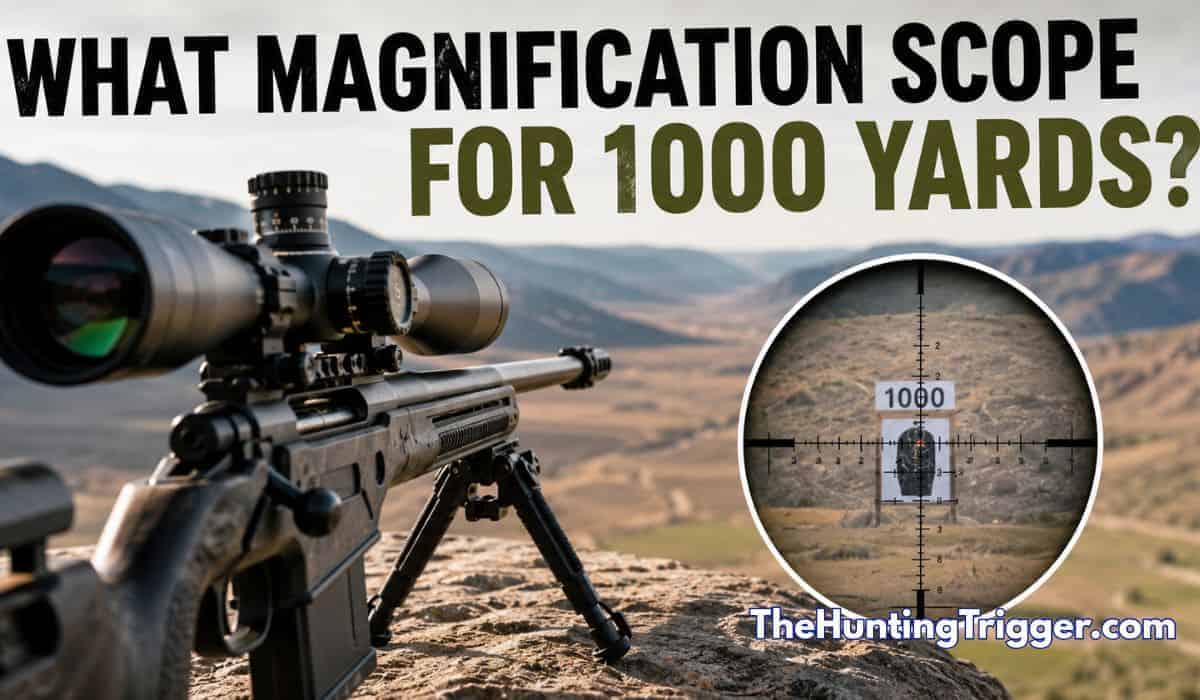
Choosing the right magnification scope for 1000 yards is a big decision for anyone interested in long-range shooting. Whether you are a hunter, competitive shooter, or just enjoy precision target practice, the scope you use can make or break your accuracy at such distances. The options are many, but not all scopes are equal when it comes to the demands of 1000-yard shooting. It’s essential to know what magnification you need, what features matter most, and how to avoid common mistakes. This guide will help you make an informed choice, with practical advice and real-world examples.
Table of Contents
Why Scope Magnification Matters At 1000 Yards?
Magnification means how much closer a scope brings the target to your eye. At 1000 yards, targets appear very small. For example, a standard bullseye on a paper target can look almost like a dot. With the wrong magnification, you may struggle to see your target clearly, let alone aim accurately.
Most shooters agree that 10x to 20x magnification is ideal for 1000 yards. Lower magnification can make it hard to see details, while higher magnification may lead to problems like blurring, reduced field of view, and more visible shaking from small movements.
Factors To Consider When Choosing A Scope
Picking a scope for long-range shooting is not only about magnification. Several other factors play a role:
- Objective lens size: A larger lens gathers more light, making the image brighter. For 1000 yards, a lens of 40mm or larger is recommended.
- Reticle type: Look for reticles designed for long-range, such as mil-dot or MOA reticles. These help you estimate distance and compensate for bullet drop.
- Turrets: Adjustable turrets for windage and elevation are important for fine-tuning your aim.
- Quality of glass: High-quality glass gives you clearer images and better color.
- Parallax adjustment: At 1000 yards, parallax errors can ruin accuracy. A scope with parallax adjustment helps keep your target sharp.
- Durability: Long-range shooting often means harsh environments. Choose a scope built to last.
How Much Magnification Do You Need?
The right magnification depends on your goals, the type of shooting, and even your eyesight. Most experts suggest 10x to 16x as a good starting point for 1000-yard shots. This range allows you to see your target clearly without sacrificing field of view or clarity.
Some shooters prefer higher magnification, such as 20x or even 25x, especially for small targets. However, higher magnification can magnify the effect of wind and shaking, making it harder to keep the reticle steady.
Common Magnification Ranges
- 10x: Good for larger targets and experienced shooters with steady hands.
- 12x–16x: A balanced choice for most 1000-yard situations. Offers clear detail without too much shaking.
- 18x–25x: Useful for small targets or precision competition. May require a sturdy tripod or rest.
Real-world Examples
Let’s consider some practical scenarios:
- Hunting: If you hunt at 1000 yards, you may use a 12x–16x scope. Animals move, so a wider field of view helps you track them.
- Benchrest shooting: For target shooting from a fixed position, 18x–25x can be helpful. You can focus on tiny details and shoot for maximum precision.
- Tactical shooting: Law enforcement or military shooters often stick to 10x–12x for speed and flexibility.
Comparing Popular Scopes For 1000 Yards
Here’s a comparison between three well-known scope models used for long-range shooting:
| Scope Model | Magnification Range | Objective Lens | Reticle Type | Price |
|---|---|---|---|---|
| Vortex Viper PST Gen II | 5–25x | 50mm | EBR-2C (MRAD) | $950 |
| Leupold Mark 5HD | 5–25x | 56mm | PR-1 MOA | $1,800 |
| Nikon Black FX1000 | 6–24x | 50mm | FX-MOA | $700 |
Is the Vortex Strike Eagle as good as the Viper PST
Key Features To Look For
Certain features can make a big difference when shooting at 1000 yards:
- Side parallax adjustment: Helps keep the target sharp and reduces error.
- Zero-stop turrets: Allow you to return to your original settings quickly.
- First focal plane (FFP) reticle: Reticle stays in scale with target as you change magnification. Useful for making quick calculations.
- High-quality coatings: Protect glass and improve light transmission.

Mistakes To Avoid
Choosing the wrong scope can waste money and hurt your results. Watch out for these common mistakes:
- Over-magnification: Going above 25x can make the image blurry and unstable.
- Ignoring lens quality: Cheap scopes may have high magnification but poor clarity.
- Skipping parallax adjustment: Without it, your shots may miss even if your aim looks right.
- Choosing a scope without sturdy turrets: Adjustments must be reliable at long distances.
- Forgetting about weight: Heavy scopes can make your rifle hard to handle.
Magnification Vs. Field Of View
Magnification increases how close the target appears, but it also reduces field of view. At 1000 yards, you want to see enough of the area around your target to spot bullet impacts and wind changes. Here’s how different magnifications affect your field of view:
| Magnification | Field of View (ft at 1000 yds) |
|---|---|
| 10x | 20 ft |
| 16x | 14 ft |
| 24x | 9 ft |
Choosing Between Fixed And Variable Magnification
There are two main types of scope magnification:
- Fixed: Always the same magnification (for example, 10x).
- Variable: Can be adjusted (for example, 5–25x).
Most shooters prefer variable magnification for 1000 yards. It allows flexibility for different conditions. Fixed scopes are simpler and sometimes clearer, but less versatile.
How The Environment Affects Scope Choice?
Environmental factors can change what scope works best:
- Heat waves (mirage): High magnification can make mirage worse.
- Wind: Strong wind may make high magnification shaky.
- Light conditions: Low light needs a large objective lens and good coatings.
For example, on a hot day, you may want to lower magnification to reduce the effect of mirage.
Example Calculations: Bullet Drop And Reticle Use
At 1000 yards, bullet drop is significant. Most scopes with mil-dot or MOA reticles let you estimate bullet drop without adjusting turrets for every shot. For a .308 caliber, bullet drop at 1000 yards can be over 300 inches. Using the reticle’s markings, you can aim higher to compensate.
Top Scope Brands For 1000 Yards
Some brands are known for their quality at long distances:
- Vortex
- Leupold
- Nightforce
- Swarovski
- Nikon
These brands offer scopes with good magnification, clear glass, and reliable adjustments.

Comparing Scope Durability
Durability is important for outdoor shooting. Here’s how three scopes compare on durability features:
| Brand | Waterproof | Shockproof | Warranty |
|---|---|---|---|
| Vortex | Yes | Yes | Lifetime |
| Leupold | Yes | Yes | Lifetime |
| Nikon | Yes | Yes | 5 years |
Two Insights Shooters Often Miss
- Matching scope magnification to your rifle’s accuracy: If your rifle isn’t accurate enough for 1000 yards, high magnification won’t help. Make sure your rifle is capable before investing in a high-end scope.
- Eye relief matters: At high magnification, scopes often have shorter eye relief. This can cause discomfort or safety issues, especially with powerful rifles.
Practical Tips For 1000-yard Shooting
- Use a stable shooting rest to minimize shaking.
- Adjust magnification based on weather and target size.
- Clean your scope regularly for best clarity.
- Practice at shorter ranges before moving to 1000 yards.
Frequently Asked Questions
What Is The Best Magnification For 1000 Yards?
Most shooters prefer 10x to 16x magnification for a balance of detail and stability. For small targets or competition, 18x–25x may help.
Can I Use A Scope With Less Than 10x Magnification For 1000 Yards?
It’s possible, but you may struggle to see the target clearly. For most shooters, 10x is the minimum recommended.
Do I Need A First Focal Plane (FFP) Scope For 1000 Yards?
FFP scopes make reticle markings stay accurate at any magnification, which is useful for quick calculations at long distances.
How Important Is Parallax Adjustment For Long-range Shooting?
It’s very important. Without parallax adjustment, your aim may be off even if the reticle is on the target.
Are Expensive Scopes Always Better For 1000 Yards?
Not always. Quality matters more than price. Some mid-priced scopes offer great performance if they have the right features.
Last Word
Choosing a scope for 1000 yards is about more than just magnification. It’s about matching your scope to your rifle, your needs, and your environment. With the right magnification, clear glass, and proper features, you can improve your accuracy and enjoy long-range shooting. Take your time, try different scopes, and focus on what works best for you.

Leave a Reply