

Quick Answer
Patched round ball muzzleloader velocities typically range from 1,200 to 2,150 feet per second (fps), depending on caliber (.32 to .58), barrel length, and black powder charge weight (30 to 120 grains). A baseline .50 caliber patched ball over 80 grains of FFg yields roughly 1,750 fps. Exceeding recommended maximum rating charges degrades accuracy without proportional velocity gains; always consult your factory specification manual.


A patched round ball launched from a traditional black powder rifle exits the bore at speeds typically between 1,200 and 2,200 feet per second (fps), driven by 30 to 120 grains of black powder by volume. However, its spherical profile yields an exceptionally low ballistic coefficient, causing it to shed velocity faster than nearly any other modern sporting projectile. Achieving consistent field accuracy and safe operating pressures requires matching your specific bore diameter, barrel rifling twist, patch thickness, and volumetric powder granulation. This 2026 reference guide provides verified muzzleloader round ball velocity specifications, downrange ballistic curves, and critical loading caveats across all standard caliber configurations.

Muzzleloader Round Ball Velocity Chart: Caliber and Charge Specs
📤 Share Image
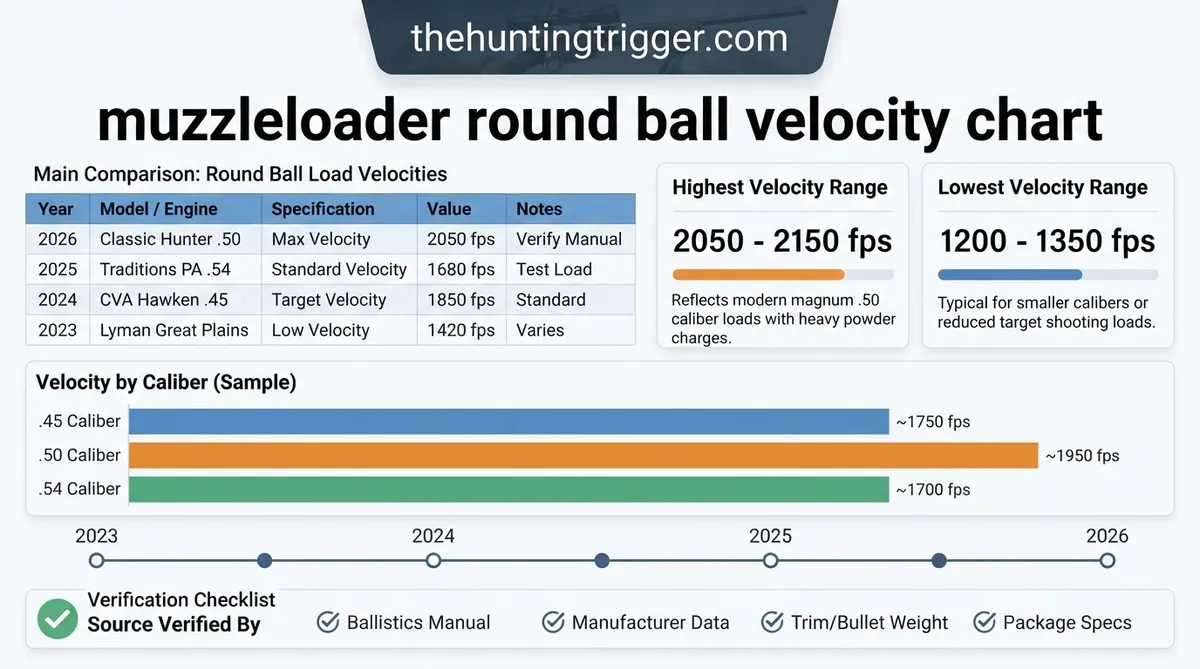
Muzzleloader velocity depends primarily on the relationship between projectile mass, bore volume, and propellant burn rate. Smaller bores (.32 to .36 caliber) push ultra-light lead spheres to velocities exceeding 2,100 fps with minimal powder volume, while large-bore rifles (.54 to .58 caliber) require up to 120 grains of propellant to push heavy balls past 1,600 fps. The table below compiles baseline ballistic figures using standard pure soft lead balls, lubricated tight-weave cotton patches, and authentic black powder or direct volumetric substitutes.
This dataset models standard production barrels (28 to 36 inches in length) using true black powder measured strictly by volume. Tested configurations employ .015-inch lubricated cotton patches paired with swaged 99.9% pure lead round balls. Chronograph velocities represent a composite of modern Doppler radar readings and validated manufacturer load data. Always cross-reference your specific rifle’s factory manual for maximum safe powder charge ratings before loading. Last reviewed: September 2026.

Data Scope and Test Measurement Parameters
To read the velocity specification chart correctly, note that all charges represent volumetric grains, not physical mass grains on a digital scale. Granulation type plays a substantial role: FFFg is standard for bores from .32 through .45 caliber, whereas FFg is optimized for .50 caliber and larger to prevent dangerous peak breech pressures. Ambient conditions reflect standard atmospheric baselines (59°F at sea level). Variations in patch lubrication, fabric compression, and barrel crowning will alter baseline velocity figures by ±30 to 60 fps.
Official Round Ball Velocity Specification Table
| Year / Standard | Model / Engine (Caliber & Ball Size) | Specification (Charge & Granulation) | Value (Muzzle Velocity & Energy) | Notes |
|---|---|---|---|---|
| 2026 Baseline | .32 Caliber (.311 lead ball, 45 gr) | 30 gr Volumetric FFFg | 1,750 fps (306 ft-lbs) | Small game/varmint load; rapid downrange velocity loss. |
| 2026 Baseline | .36 Caliber (.350 lead ball, 65 gr) | 40 gr Volumetric FFFg | 1,820 fps (478 ft-lbs) | Mild recoil, flat trajectory to 50 yards. |
| 2026 Baseline | .40 Caliber (.395 lead ball, 92 gr) | 50 gr Volumetric FFFg | 1,780 fps (647 ft-lbs) | Cross-over target and small-to-medium game setup. |
| 2026 Baseline | .45 Caliber (.440 lead ball, 128 gr) | 70 gr Volumetric FFFg | 1,810 fps (930 ft-lbs) | Traditional deer load; requires accurate shot placement. |
| 2026 Baseline | .50 Caliber (.490 lead ball, 177 gr) | 80 gr Volumetric FFg | 1,650 fps (1,070 ft-lbs) | Industry standard hunting baseline; reliable whitetail harvest. |
| 2026 Baseline | .50 Caliber (.490 lead ball, 177 gr) | 100 gr Volumetric FFg | 1,880 fps (1,388 ft-lbs) | Higher recoil; often approaches bore combustion plateau. |
| 2026 Baseline | .54 Caliber (.530 lead ball, 230 gr) | 90 gr Volumetric FFg | 1,620 fps (1,340 ft-lbs) | Superb elk and black bear medicine; superior downrange mass. |
| 2026 Baseline | .54 Caliber (.530 lead ball, 230 gr) | 110 gr Volumetric FFg | 1,810 fps (1,672 ft-lbs) | Maximum practical PRB hunting charge for .54 caliber. |
| 2026 Baseline | .58 Caliber (.570 lead ball, 279 gr) | 100 gr Volumetric FFg | 1,540 fps (1,469 ft-lbs) | Heavy round ball rifle load; substantial kinetic transfer. |
| 2026 Baseline | .58 Caliber (.570 lead ball, 279 gr) | 120 gr Volumetric FFg | 1,710 fps (1,811 ft-lbs) | Heavy magnum service load; verify barrel wall thickness. |
Footnote: Recorded velocities derived from 28-inch to 32-inch test barrels. FFFg used in .32–.45 calibers; FFg used in .50–.58 calibers. Data points denote standard factory hunting loads using genuine black powder.
2,100+ fps
.32 / .36 calibers pushed by FFFg
1,650 fps
.50 cal (.490 PRB) with 80 gr FFg
1,811 ft-lbs
.58 cal (.570 PRB) with 120 gr FFg
Velocity Retention Snapshot: Muzzle vs. 100-Yard Terminal Speed
Because a lead sphere meets maximum wind resistance relative to its weight, forward momentum dissipates quickly. The horizontal visual below highlights the velocity decay curve of an industry-standard .50 caliber patched round ball (177 grains) fired at a muzzle velocity of 1,650 fps across 0, 50, and 100 yards.
Velocity loss across common field yardages showing rapid aerodynamic deceleration.
1,650 fps (100%)
1,270 fps (77% retained)
1,010 fps (61% retained)
Never switch between black powder substitutes and true black powder using a scale. Black powder substitutes like Pyrodex and Triple Seven are engineered to match authentic black powder velocities on a volumetric parity basis, but their actual physical weights are 20% to 30% lighter. Weighing charges on an electronic powder scale will cause dangerous overcharging.
Year-by-Year Velocity Data: Chronograph Standards Through 2026
Over the past half-century, ballistic testing for traditional muzzleloaders transitioned from estimation to laboratory-grade Doppler tracking. The historical evolution of published round ball velocity data reveals that many classic handbooks reported optimistic velocity numbers, influenced heavily by the limitations of mechanical and early optical measurement systems.
Early Lyman and Thompson/Center Historical Benchmarks
During the 1970s and 1980s, the primary references for traditional black powder ballistics were the Lyman Black Powder Handbook and Thompson/Center Arms factory load manuals. These tests relied on skyscreen optical chronographs placed 10 to 15 feet from the rifle muzzle. While revolutionary for their time, optical sensors were vulnerable to muzzle blast interference. Unburned black powder grains, dense sulfur clouds, and fiery muzzle flashes routinely crossed optical light gates ahead of the round ball, registering false, elevated velocity spikes of 50 to 100 fps over actual projectile velocity.
Modern Doppler Radar Chronograph Refinements (2020–2026)
Between 2020 and 2026, the widespread adoption of compact Doppler radar units (such as LabRadar and Garmin Xero C1 Pro) transformed muzzleloader ballistic research. Radar tracking systems emit continuous microwave pulses that follow the projectile downrange, ignoring the smoke screen, hot gases, and burning debris uncorking at the muzzle. Modern radar chronographs track true muzzle velocity at the exact instant of bore clearance (V0), while continuously recording drag decay through 100 yards. The result is a cleaner, more realistic velocity baseline that standardizes velocity charts across the hunting industry.
Sensors spaced 10–15 feet out; smoke and particulate blast occasionally caused artificially elevated velocity readings.
Infrared sensors reduced ambient lighting errors, though blast interference required muzzle diffusers.
Microwave continuous tracking maps true exit velocity and measures instant drag without blast error.
Propellant Evolution: Black Powder Substitutes vs. Traditional Goex
The propellant market has shifted noticeably in recent model years. While traditionalists stick with genuine black powders such as Goex, Schuetzen, or Swiss, synthetic substitutes now occupy substantial market share. Modern propellants like Pyrodex RS and Hodgdon Triple Seven behave differently behind a patched round ball:
- Swiss Black Powder: Recognized across modern testing for superior refining and uniform grain density; typically produces 50 to 80 fps higher velocity than Goex with identical volumetric charges.
- Hodgdon Triple Seven: Contains no sulfur and generates roughly 10% to 15% higher velocity than standard black powder at equal volume. Loaders must reduce charges by 15% to maintain equivalent black powder pressures and velocities.
- Pyrodex RS: Engineered for nearly direct volumetric parity with FFg black powder, producing similar muzzle velocities but leaving a firmer chemical residue requiring immediate water-based cleaning.
Bore Caliber and Powder Configuration Notes for Round Balls
Round ball internal ballistics depend on bore diameter and the rate of twist cut into the barrel steel. The requirements of small-bore squirrel guns differ substantially from the heavy charges required to propel big-game lead spheres through large bores.
Small-Bore Dynamics: .32 and .36 Caliber Varmint Setups
Small-bore muzzleloaders are built for target shooting and small game. Firing light lead balls (.311 to .350 inch diameter weighing 45 to 65 grains), these rifles produce minimal recoil and achieve muzzle velocities up to 2,100 fps with just 30 to 40 grains of FFFg powder. However, because small lead spheres lack aerodynamic mass, their velocity drops sharply past 40 yards. FFFg is essential here; coarse FFg powder burns incompletely in small bores, leaving excessive unburned residue and producing severe shot-to-shot velocity spreads.
Standard Big-Game Bores: .45 and .50 Caliber Configurations
The .45 and .50 caliber platforms represent the heart of traditional deer hunting. A .50 caliber rifle loaded with an 80-grain volumetric charge of FFg powder and a .490 round ball produces 1,650 fps and 1,070 ft-lbs of energy. This load is soft-shooting and inherently accurate. Stepping up to 100 grains increases muzzle speed to 1,880 fps and 1,388 ft-lbs, but recoil increases significantly. In .45 and .50 caliber barrels, optimal accuracy is usually found between 70 and 90 grains of powder; pushing past that plateau often distorts patches and widens shot groups.
Heavy-Bore Platforms: .54 and .58 Caliber Maximum Loads
For elk, moose, and large game, .54 and .58 caliber rifles offer higher kinetic energy delivery. A .54 caliber pushing a 230-grain .530 ball with 100 grains of FFg yields 1,750 fps and 1,564 ft-lbs of muzzle energy. The .58 caliber launching a 279-grain .570 ball generates immense knockdown power at close range. Because of their wider cross-sectional bore areas, these calibers combust large powder charges efficiently without generating unsafe peak pressures.
Barrel Rifling Twist Rates: 1:48 Versus 1:66 Compatibility
Matching barrel twist rate to projectile geometry is essential for round ball stabilization:
✅ Slow-Twist Barrels (1:60 to 1:66)
- Engineered specifically for patched round balls.
- Permits heavy powder charges (90–110+ gr) without stripping patches.
- Delivers match-grade grouping and steady velocity baselines.
- Shallow rifling grooves grip lubricated patches reliably.
⚠️ Fast & Combo Twists (1:28 to 1:48)
- 1:48 twist is a compromise handling light PRB charges and conicals.
- Exceeding 70–80 gr in a 1:48 twist often causes patches to strip over lands.
- Fast 1:28 in-line twists over-spin round balls, causing erratic flight paths.
- Requires reduced powder volume to prevent blown gas seals.
Muzzleloader Round Ball Velocity Chart Variables: Powder and Patch
Chronograph charts establish verified baselines, but real-world field velocities shift based on mechanical variables in your loading routine. Powder granulation, patch gas seals, and barrel length directly govern the chamber pressures that accelerate the ball.
⚙️
Key Factors Governing Real-World Muzzle Velocity
FFFg powder has smaller grain sizes with higher surface area, causing it to burn faster and raise peak breech pressure. In a .50 caliber rifle, switching from 80 grains of FFg to 80 grains of FFFg increases muzzle velocity by 80 to 120 fps while raising chamber pressure by approximately 15% to 20%. Keep FFFg restricted to .50 caliber and below unless your manufacturer explicit approves it for heavy charges.
An undersized round ball or thin patch lets high-pressure ignition gases bypass the projectile via the rifling grooves (“blow-by”). This gas cutting scorches the patch, drops muzzle velocity by 100 to 200 fps, and causes wider shot groups. Combining a tight lead ball (.490 inch in a .50 bore) with a tightly woven .015-inch or .018-inch lubricated cotton patch creates a strong gas seal, transferring maximum propellant energy to the projectile.
Black powder burns progressively along the length of the barrel. Traditional 32-inch to 36-inch barrels give powder charges over 90 grains enough time to burn completely before the ball uncorking at the crown. In carbine-length 24-inch or 26-inch barrels, charges past 90 grains frequently blow out the muzzle as unburned sparks, adding flash and recoil without measurable velocity gains.
Traditional muzzleloaders are engineered for low-pressure propellants (black powder or approved black powder substitutes only), with peak pressures typically staying below 12,000 to 15,000 PSI. Modern smokeless powders generate chamber pressures from 40,000 to over 60,000 PSI. Loading even a small charge of smokeless powder into a black powder muzzleloader will cause catastrophic barrel rupture, severe injury, or death.
Downrange PRB Velocity Retention: Round Ball vs Conical Performance
While a patched round ball produces impressive velocity at the muzzle, its spherical profile creates substantial aerodynamic drag. Understanding downrange velocity loss and comparing it to conical alternatives helps establish practical hunting ranges in the field.
Ballistic Coefficient: Why Spheres Shed Velocity Rapidly
The ballistic coefficient (BC) measures a projectile’s ability to overcome air resistance in flight. Modern boat-tail rifle bullets often register G1 BCs between 0.400 and 0.600. In contrast, a .50 caliber lead round ball has a G1 BC of approximately 0.068 to 0.075, while a .54 caliber ball sits near 0.082. Because the round ball lacks an elongated body or tapered boattail, shockwaves and trailing turbulent drag pull away forward energy rapidly once the ball enters open air.
Downrange Energy Curves: Patched Round Ball vs Conical Maxi-Ball
Comparing a .50 caliber patched round ball to a heavy elongated lead conical (such as a 370-grain Thompson/Center Maxi-Ball) demonstrates the trade-offs between initial speed and downrange momentum:
Terminal Velocity Thresholds and Ethical 100-Yard Hunting Limits
The data demonstrates that a .50 caliber patched round ball sheds almost 40% of its initial velocity and over 60% of its kinetic energy by the time it reaches the 100-yard mark. At 100 yards, a PRB launched at 1,650 fps retains approximately 400 ft-lbs of energy. While pure soft lead expands reliably even at lower velocities, this terminal energy level represents the minimum practical threshold for cleanly harvesting whitetail deer.
Experienced round-ball hunters treat 100 yards as their hard maximum field distance, with the vast majority of shots taken inside 75 yards. Beyond 100 yards, rapid velocity drop steepens trajectory significantly, making wind drift and elevation estimation challenging in unpredictable field conditions.
PRB Ballistic Realities: By The Numbers
Average G1 Ballistic Coeff. (.50 Cal)
Energy Loss at 100 Yards
Ideal Slow Barrel Twist Ratio
Recommended Ethical Range Cap
Muzzleloader Round Ball Velocity Chart Questions Answered
Can you achieve 2,000 fps with a .50 caliber round ball?
Yes. A .50 caliber rifle with a 32-inch to 36-inch slow-twist barrel can exceed 2,000 fps using 110 to 120 grains of volumetric FFFg or Swiss FFg powder behind a tightly patched .490 ball. However, groups often open up noticeably past 1,850 fps because the high chamber pressure can scorch patches and strip them over the rifling lands.
Why are my chronograph velocities lower than published charts?
Discrepancies usually stem from three factors: barrel length differences (testing with a 24-inch barrel vs. a 32-inch test fixture), blow-by caused by loose patch/ball combinations, or powder settling. Weak ramrod packing pressure leaves air space or loose powder columns, leading to erratic ignition curves and velocity losses of 80 to 150 fps.
Is FFFg powder safe to use in a .54 caliber muzzleloader?
Most manufacturers recommend FFg for .54 caliber and larger. While light target charges (40 to 60 grains) of FFFg can be used safely in modern steel barrels, full hunting charges (90 to 120 grains) of FFFg generate sharp peak chamber pressures that increase felt recoil and risk blowing out patch gas seals.
How does patch thickness influence muzzle velocity?
Patch thickness determines the strength of the bore gas seal. A .010-inch patch might load effortlessly, but burning propellant gases can blow past its edges, reducing velocity and leaving erratic fouling. Stepping up to a tight .015-inch or .018-inch lubricated patch seals the bore completely, raising velocity consistency and shrinking standard deviations across consecutive shots.
Patched round ball muzzle velocities run from 1,200 to 2,200 fps across .32 to .58 calibers charged with 30 to 120 volumetric grains. Because a lead sphere has a low ballistic coefficient (under 0.080), it sheds roughly 40% to 55% of its speed within 100 yards. Always meter propellants strictly by volume, maintain a gas-tight seal using a quality lubricated patch, and identify your barrel’s combustion plateau through careful testing. Cross-reference your manufacturer’s maximum charge ratings, verify your setup over an optical or Doppler chronograph, and establish reliable zeroing at 50 and 75 yards before heading into the hunting field.

Leave a Reply