
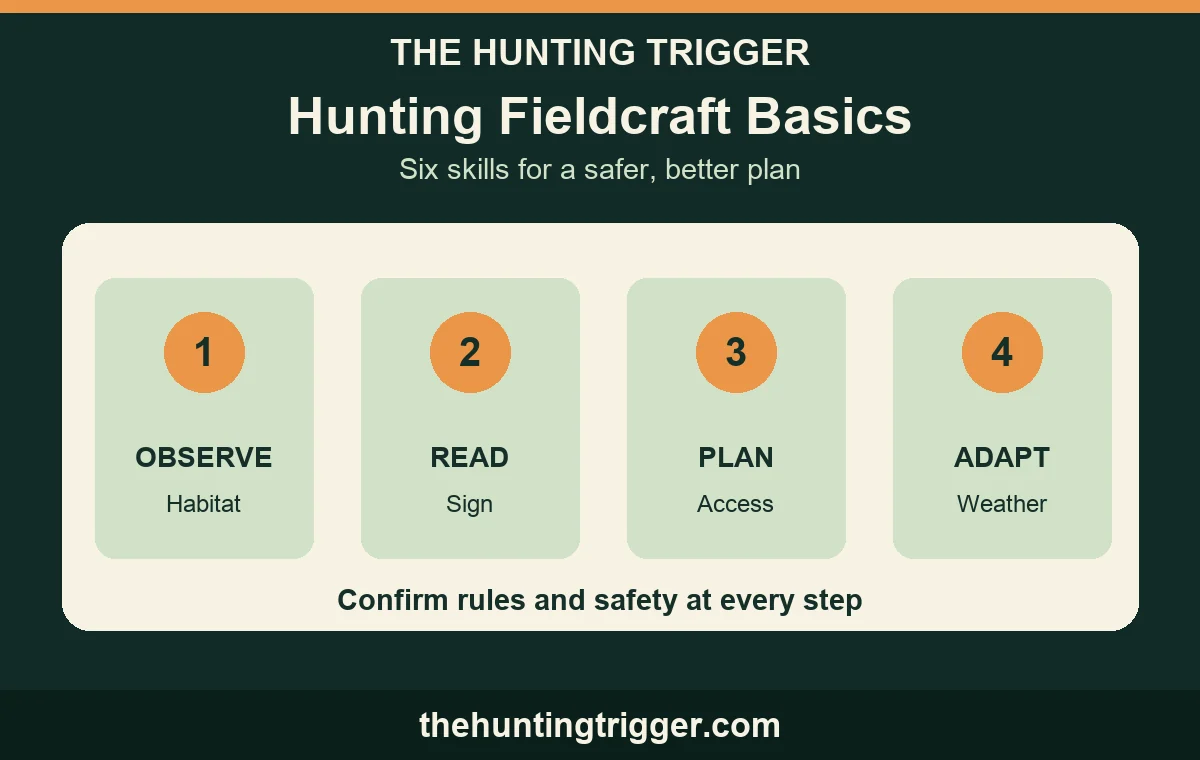
Updated September 25, 2026. Hunting fieldcraft is the practical skill of observing an area, interpreting wildlife and habitat clues, planning a lawful route, and changing the plan when conditions or safety demand it. A beginner does not need to know every track or own specialized gear. The useful starting point is to slow down, notice what the landscape shows, and verify each assumption before acting.
This is a working definition drawn from Texas Parks and Wildlife’s hunting-skills lessons, not a formal agency term. Fieldcraft supports a hunt, but it does not replace hunter education or current local rules.
| Core skill | What to ask in the field | Beginner action |
|---|---|---|
| Observe habitat | Where are food, cover, water, and travel routes? | Look first from a lawful, safe access point. |
| Interpret sign | Is this fresh evidence or an old clue? | Record location and context; avoid declaring a pattern from one sign. |
| Read terrain and wind | How might the route expose movement or scent? | Compare two possible approaches before entering. |
| Navigate and respect access | Is every part of the route open and permitted? | Check agency maps, boundaries, and local restrictions. |
| Watch weather | Could conditions make the route unsafe? | Check the forecast and know when to turn back. |
| Make safe decisions | Is the action legal, safe, and ethical? | Positively identify wildlife and what lies beyond it. |
1. Observe before moving
Fieldcraft begins with a pause. From a safe place, look for transitions between cover and openings, possible feeding areas, travel corridors, and the location of other people. TPWD’s hunting strategies lesson treats terrain, weather, wind, and observation as parts of choosing a method.
Use binoculars to inspect a distant area without walking into it. The site’s hunting binoculars buying guide explains how field of view and fit affect scanning. Binoculars help identify a subject; a rifle scope should never be used to scan or identify an uncertain target, as TPWD’s ethics guidance warns.
2. Read sign without overclaiming
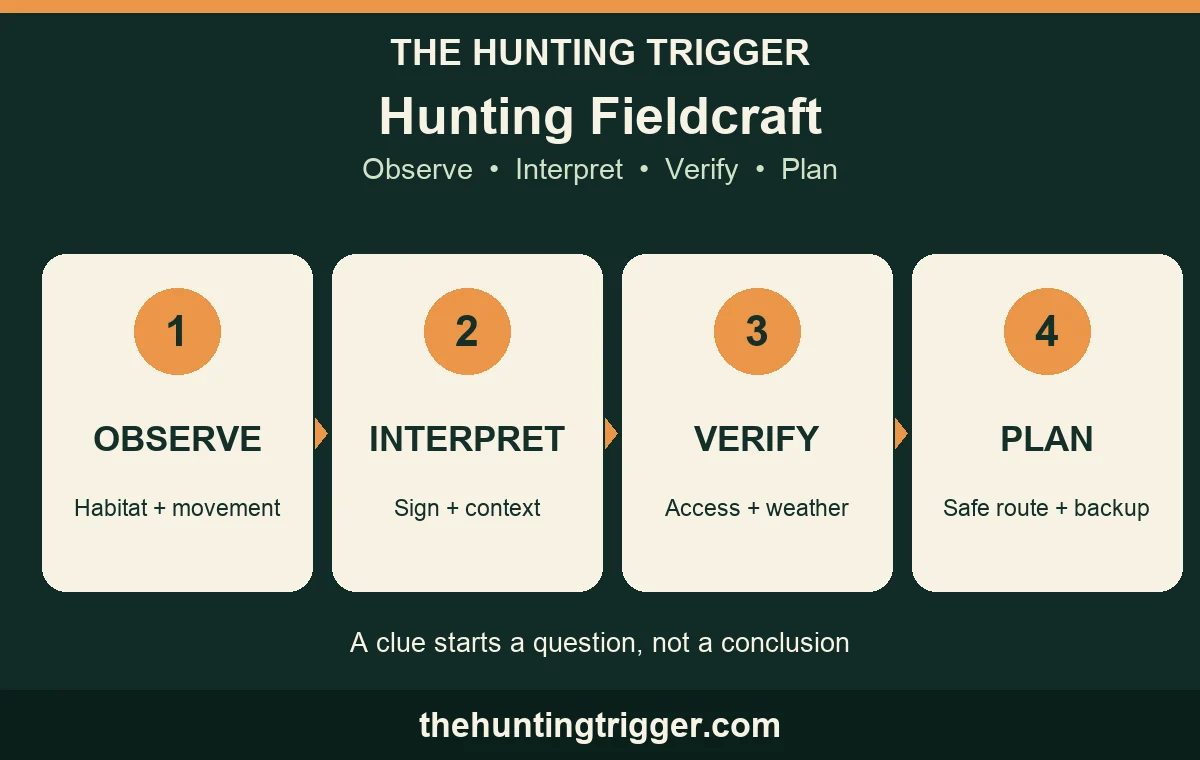
Tracks, trails, rubs, and scrapes can show that animals have used an area. They do not prove that an animal will pass during legal hunting hours. TPWD describes common game sign, while Missouri’s deer scouting guide links trails to food and cover and cautions against treating scrapes as a sure daytime location.
Write down what was actually seen: type of sign, date, location, nearby habitat, and whether weather could have changed it. On the next visit, look for repeat evidence. That simple record is more useful than a confident story built from one print in the mud.
3. Let terrain and wind shape the route
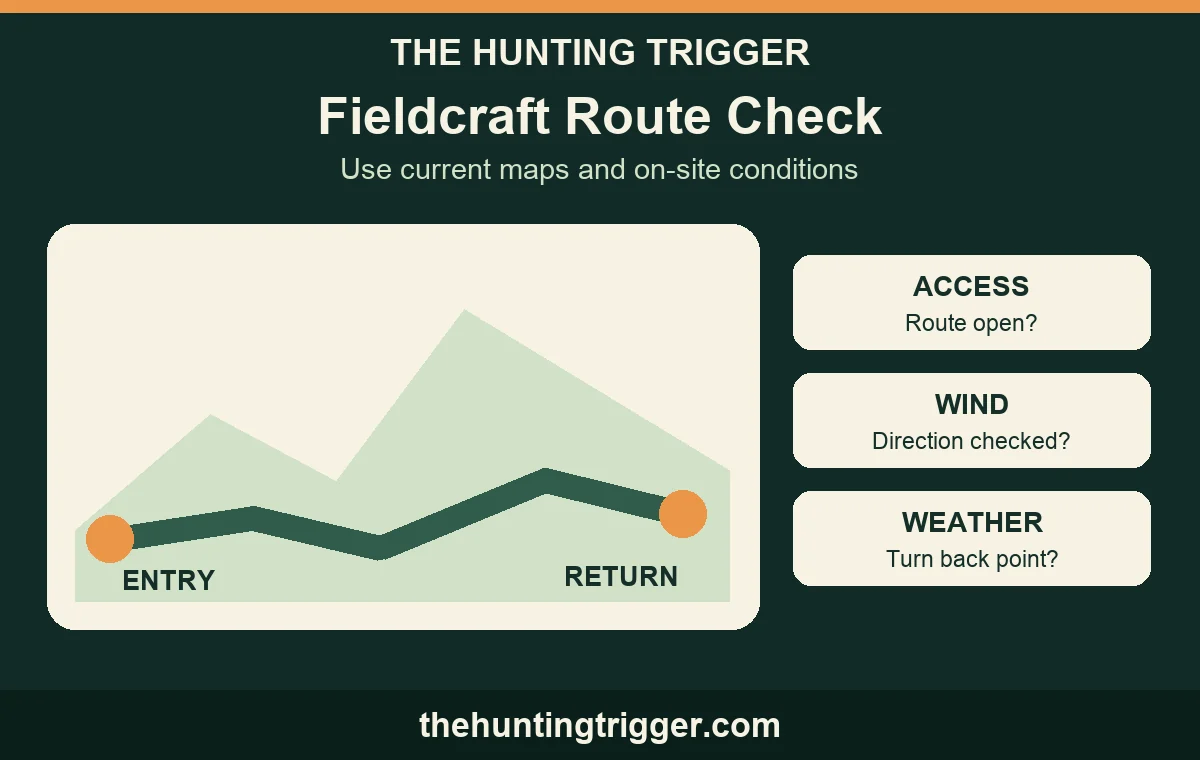
Ridges, draws, openings, and thick cover can affect both visibility and travel. Wind direction matters because human scent can reach wildlife before a person sees it; TPWD includes wind and scent in its hunting-strategy guidance. A map can suggest a route, but the actual wind and ground conditions must be checked on arrival.
Sketch a main approach and a simpler backup. Note where crossing an open area, steep ground, or an uncertain boundary would change the decision. If either route is unsafe or lacks legal access, choose another location.
4. Confirm access before the trip
The presence of public land on a map does not make every approach public. BLM’s hunting guidance says to check the local office for closures and restrictions and obtain permission before crossing private land. Its access data can help identify lawful routes, but boundaries and local conditions need current confirmation.
Check the land manager’s current map, signs at the entrance, and any area-specific permit or closure notice. The U.S. Fish and Wildlife Service’s state directory points to state agencies because licenses and hunting rules vary by state. Wildlife refuges and other managed areas may add their own requirements.
5. Treat weather and navigation as fieldcraft
A forecast, a return route, and a person who knows the plan belong in the preparation. TPWD recommends a written hunting plan with location, companions, contacts, and expected return, then leaving a copy with a responsible person. Learn to read the map and carry a reliable way to navigate if the area is unfamiliar.
Conditions can change after arrival. If a thunderstorm threatens, follow the National Weather Service’s outdoor lightning guidance and seek proper shelter. Turning back is a sound field decision, even when the scouting looked promising.
6. Keep safety and ethics in the decision loop
Good fieldcraft is not just finding animals. Before any shot, TPWD says to identify the target and what is in front of and beyond it. A sound or movement is not enough, and low light can make identification unreliable.
TPWD frames a decision with three checks: is it legal, safe, and ethical? If any answer is uncertain, stop and reassess. Check current state rules and the specific land manager’s rules before every hunt rather than relying on a general article.
A three-visit practice routine for beginners
The routine below is a way to practice the skills above without claiming a guaranteed hunting result. Confirm that walking, scouting, or hunting is allowed at the place and time chosen.
- Visit one: map and observe. Verify access, mark a return route, and identify food, cover, openings, and obvious hazards from lawful areas.
- Visit two: check the evidence. Record sign with a date and context. Compare it with the first visit and note what could have changed.
- Visit three: rehearse the decision. Check the forecast and wind, carry the route plan, and practice choosing a backup or turning around when access, weather, or visibility fails a safety check.
The practical takeaway: fieldcraft improves through careful observation and honest notes. A beginner should build a repeatable process, verify local rules, and let safety override an attractive plan.

Leave a Reply