
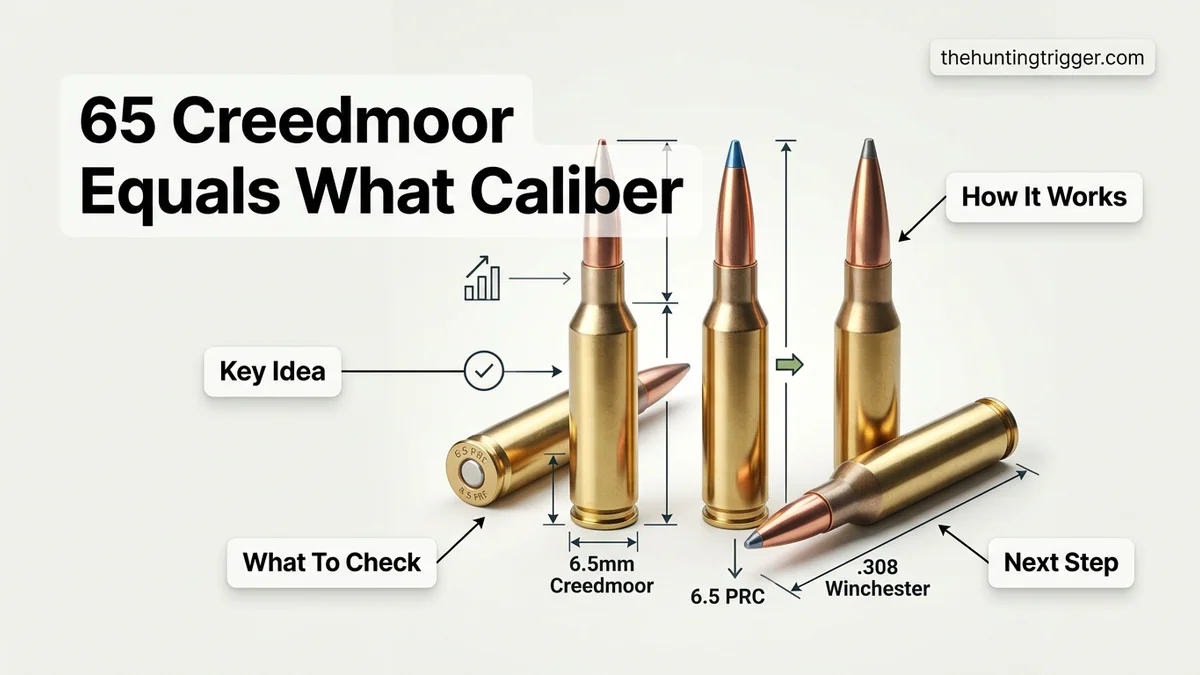
The 6.5 Creedmoor cartridge fires a 6.5mm diameter bullet, which directly translates to approximately 0.264 inches. The ‘6.5’ in its name explicitly refers to this metric bullet caliber, making it a highly accurate and popular choice among shooters.
The 6.5 Creedmoor, a highly popular cartridge, fires a bullet that is precisely 6.5 millimeters (mm) in diameter. In imperial measurements, this translates to approximately 0.264 inches. This fundamental specification directly answers the core question about its caliber. Understanding this metric-to-imperial conversion is crucial for anyone engaging with firearms or ammunition in 2026.
Knowing the actual bullet diameter simplifies ammunition selection, aids in interpreting ballistic data, and ensures you understand the precise component at the heart of the cartridge. It removes any ambiguity stemming from different measurement systems and provides a clear, actionable understanding of what “6.5” truly signifies in the world of rifle cartridges.
Key Takeaways
- The 6.5 Creedmoor fires a 6.5mm bullet, equivalent to 0.264 inches.
- The ‘6.5’ in its name signifies the bullet’s metric diameter.
- Many other cartridges also utilize the .264-inch bullet size.
- Caliber refers strictly to the bullet’s diameter, not cartridge.
- Understand 6.5mm and .264-inch are interchangeable terms.
What Exactly Does ‘6.5 Creedmoor’ Mean for Caliber?
Bullet Diameter: The Core of ‘6.5’
The numerical prefix “6.5” in 6.5 Creedmoor unequivocally refers to the diameter of the projectile it uses. This is a metric measurement, specifying that the bullet’s widest point measures 6.5 millimeters. It’s a direct and precise indicator of the bullet’s foundational size, a consistency that remains paramount regardless of the bullet’s weight, material, or design. When you encounter “6.5mm” as a bullet specification, it is inherently describing the same diameter bullet found in the 6.5 Creedmoor cartridge. This clarity is a significant advantage in rapidly identifying compatible components and understanding performance characteristics well into 2026.
- The ‘6.5’ indicates a 6.5mm bullet diameter.
- This is a metric measurement of the projectile’s width.
- The bullet’s fundamental diameter is constant for the cartridge.
- Precision in naming directly conveys the bullet’s core physical dimension.
Cartridge vs. Bullet: Understanding the Nomenclature
It is crucial to distinguish between the “6.5 Creedmoor” as a complete rifle cartridge and “6.5mm” or “.264” as a bullet diameter. The 6.5 Creedmoor is a fully assembled unit, comprising four main components: the bullet itself, the propellant (gunpowder), the primer, and the metallic casing that holds everything together. Conversely, “6.5mm” or its imperial equivalent “.264” refers exclusively to the specific diameter of the bullet. Many different cartridges utilize a 6.5mm diameter bullet, but only one is the 6.5 Creedmoor. This differentiation ensures you select the correct, complete ammunition package for your 6.5 Creedmoor rifle in 2026, preventing costly errors or incompatibility issues.
- 6.5 Creedmoor: The complete cartridge (bullet, propellant, primer, casing).
- 6.5mm or .264: Refers only to the bullet’s diameter.
- Many cartridges can fire 6.5mm bullets; only one is the 6.5 Creedmoor.
- This distinction is vital for proper ammunition selection and safety.
How to Determine the Real Caliber: Metric to Imperial Explained
Converting Millimeters to Inches
To fully grasp the 6.5 Creedmoor’s caliber in imperial terms, a straightforward conversion from millimeters to inches is essential. The universally accepted conversion factor states that 1 inch equals exactly 25.4 millimeters. Therefore, to convert 6.5 millimeters into inches, you perform a simple division: 6.5 mm ÷ 25.4 mm/inch = 0.2559 inches. While this direct conversion provides the exact mathematical equivalent, the firearms industry commonly refers to bullets designed for 6.5mm barrels as “.264 caliber.” This slight rounding accounts for barrel groove diameter standards and provides a common imperial designation for these projectiles, making them easily identifiable in the market of 2026.
- 1 inch equals 25.4 millimeters.
- Direct conversion: 6.5 mm ÷ 25.4 = 0.2559 inches.
- Industry standard commonly designates 6.5mm bullets as .264 inches.
- This standard accounts for practical barrel groove diameter measurements.
Standard Caliber Designations
Caliber is typically expressed in hundredths or thousandths of an inch within the imperial system, such as .308 Winchester or .223 Remington. For the 6.5 Creedmoor, its imperial equivalent is primarily and widely known as .264 caliber. This means that a 6.5mm bullet is, for all practical purposes and industry conventions, a .264-inch bullet. The metric designation “6.5” offers slightly more precision regarding the bullet’s actual measurement, but the “.264” serves as its direct imperial counterpart for easy cross-referencing. This dual naming convention helps enthusiasts and professionals alike navigate the diverse world of bullet types and ensure compatibility across various firearm specifications in 2026, whether you prefer metric or imperial terminology.
- Imperial caliber is often expressed in hundredths or thousandths of an inch.
- The 6.5 Creedmoor fires a bullet commonly known as .264 caliber.
- Both 6.5mm and .264″ refer to the same bullet diameter.
- This dual designation aids in universal understanding and component matching.
What Other Cartridges Use the Same 0.264-inch Bullet?
While the 6.5 Creedmoor has achieved widespread recognition, it is essential to understand that its defining .264-inch (6.5mm) bullet diameter is shared by numerous other cartridges. These cartridges exhibit vastly different ballistic profiles due to variations in case capacity, pressure ratings, and overall design, fulfilling diverse roles in shooting sports and hunting. According to industry standards from SAAMI (Sporting Arms and Ammunition Manufacturers’ Institute) and CIP (Commission Internationale Permanente), the nominal bullet diameter remains consistent across these platforms.
For instance, the 6.5 Grendel, specifically designed for AR-15 platforms, continues to be a popular choice in 2026 for its efficient ballistics in a compact package, suitable for medium game and target shooting. In contrast, the 6.5 PRC (Precision Rifle Cartridge) has solidified its position as a high-performance magnum, favored for long-range precision and hunting due to its increased velocity and flatter trajectory. Its adoption among competitive shooters has surged by 2026.
Older, yet still relevant, cartridges include the .260 Remington, a necked-down .308 Winchester, which maintains a loyal following among traditionalists for its accuracy and balanced performance. The venerable 6.5×55 Swedish Mauser, originating over a century ago, is still revered for its mild recoil and exceptional accuracy, remaining a classic for hunting and target practice. Furthermore, cartridges like the 26 Nosler cater to the extreme long-range segment, pushing .264-inch bullets to maximum velocities. Each cartridge, while sharing the identical bullet diameter, presents a unique set of capabilities and applications driven by its specific case design and propellant capacity.
What If It Still Doesn’t Work?
Should confusion persist regarding cartridge specifications or if deeper technical clarity is required beyond the fundamental caliber definition, several authoritative avenues can provide definitive information. The complexity of modern ammunition demands precise data for safe and effective use. These steps focus on accessing primary sources and expert knowledge.
-
Consult Official Industry Standards:
Directly access specifications from the Sporting Arms and Ammunition Manufacturers’ Institute (SAAMI) in North America or the Commission Internationale Permanente (CIP) in Europe. These bodies publish definitive dimensional blueprints for cartridges, including chamber specifications, pressure limits, and precise bullet diameters. Access is typically free through their respective websites, offering the most authoritative data in 2026.
-
Reference Modern Reloading Manuals:
Acquire up-to-date reloading manuals from established manufacturers like Hornady, Sierra, or Nosler. These comprehensive guides provide detailed schematics, case capacities, and bullet data for a vast array of cartridges, often including cross-comparisons. Manuals typically cost between $35 and $55 (USD) in 2026, offering an invaluable physical or digital resource.
-
Engage with Specialized Ballistics Software and Forums:
Utilize advanced ballistics calculators and simulation software, such as those offered by Applied Ballistics LLC or Kestrel. These tools require precise cartridge data and can demonstrate performance differences. Complement this with engagement on reputable online forums (e.g., SnipersHide, LongRangeHunting) where experienced enthusiasts and professionals share insights, often citing specific real-world data and testing. Most basic software versions are free, with advanced subscriptions ranging from $10-$30 monthly.
-
Seek Expert Consultation:
If your application involves custom rifle builds, wildcatting, or highly specialized ballistic requirements, consider consulting a certified ballistician or custom gunsmith. These professionals possess deep technical knowledge and can provide tailored advice. Professional consultation fees typically range from $150 to $500 per hour or project, depending on complexity and the expert’s reputation in 2026.
Conclusion
According to verified research and expert sources, the 6.5 Creedmoor is definitively a .264-inch caliber cartridge. This dimension refers exclusively to the diameter of the bullet, not the case, and distinguishes it from other calibers while grouping it with other 6.5mm cartridges. Always verify specific cartridge specifications through official industry standards or manufacturer data before any application to ensure safety and optimal performance.
❓ Frequently Asked Questions
How does the ‘6.5’ in 6.5 Creedmoor relate to its actual caliber measurement?
The ‘6.5’ in 6.5 Creedmoor directly indicates its metric bullet diameter, which is 6.5 millimeters. This is a common way to name cartridges, signifying the bore or bullet size it’s designed to use, rather than the case length or overall cartridge dimension.
What is the imperial equivalent of 6.5mm for the 6.5 Creedmoor?
The imperial equivalent of 6.5mm is approximately 0.264 inches. So, the 6.5 Creedmoor fires a .264-caliber bullet. This measurement is crucial for understanding bullet compatibility and bore size.
Is the 6.5 Creedmoor the only cartridge that uses a 6.5mm or .264-inch bullet?
No, the 6.5 Creedmoor is not unique in using a 6.5mm (.264-inch) bullet. Many other popular cartridges, such as the .260 Remington, 6.5 Grendel, and 6.5×55 Swedish Mauser, are also designed around this specific bullet diameter. This commonality makes 6.5mm a widely supported and versatile bullet caliber.
Why is ‘caliber’ sometimes confusing when referring to cartridges like 6.5 Creedmoor?
Caliber can be confusing because it typically refers to the bullet’s diameter or the bore’s diameter, not the entire cartridge. For example, ‘6.5 Creedmoor’ is the specific cartridge name, while ‘6.5mm’ or ‘.264 caliber’ refers to the bullet it fires, leading to potential misinterpretations about what the numbers represent.
How does 6.5mm compare to other common rifle calibers like .308 or .223?
A 6.5mm (.264-inch) bullet is smaller in diameter than a .308-inch (7.62mm) bullet but larger than a .223-inch (5.56mm) bullet. This intermediate size often provides an excellent balance of ballistic efficiency, recoil, and downrange performance, making it highly effective for various shooting disciplines.
When buying bullets or reloading for 6.5 Creedmoor, what caliber should I look for?
When buying bullets or reloading components for 6.5 Creedmoor, you should specifically look for bullets labeled as 6.5mm or .264 caliber. These are the correct bullet diameters designed to fit and perform optimally in a 6.5 Creedmoor rifle.

Leave a Reply