
Updated September 25, 2026. For most handheld hunting, start by comparing 8×42 and 10×42 binoculars. Choose 8×42 when a wide, steady view matters most in cover. Choose 10×42 when more detail across open ground matters more.
Fit, usable field of view, and image clarity can outweigh either number.
This guide compares the same basic specifications, then gives a field-ready fit check. It does not rank products or claim hands-on testing.
| Hunting situation | Start with | Main trade-off |
|---|---|---|
| Thick cover and quick scanning | 8×42 | Less apparent detail at long distance |
| Mixed terrain with handheld glassing | Compare 8×42 and 10×42 | Personal steadiness and field of view decide |
| Open country and distant observation | 10×42 | Narrower view and more visible hand movement |
| Extended high-power glassing | Tripod-supported binoculars | Extra weight and setup time |
These are starting points, not universal prescriptions. Lower power favors wider views in cover, while higher power helps distant observation.
What do 8×42 and 10×42 mean?
The first number is magnification; the second is objective lens diameter in millimeters. Thus, 8×42 magnifies eight times and has a 42 mm objective lens.
The numbers do not guarantee a clear image. Lens design, coatings, contrast, eye position, and how steadily a hunter holds the binocular also matter.
Is 8×42 or 10×42 better for hunting?
An 8×42 usually gives a wider, steadier handheld view. A 10×42 makes distant details appear larger, but hand movement is more visible. Vortex describes 10×42 as a flexible middle ground.
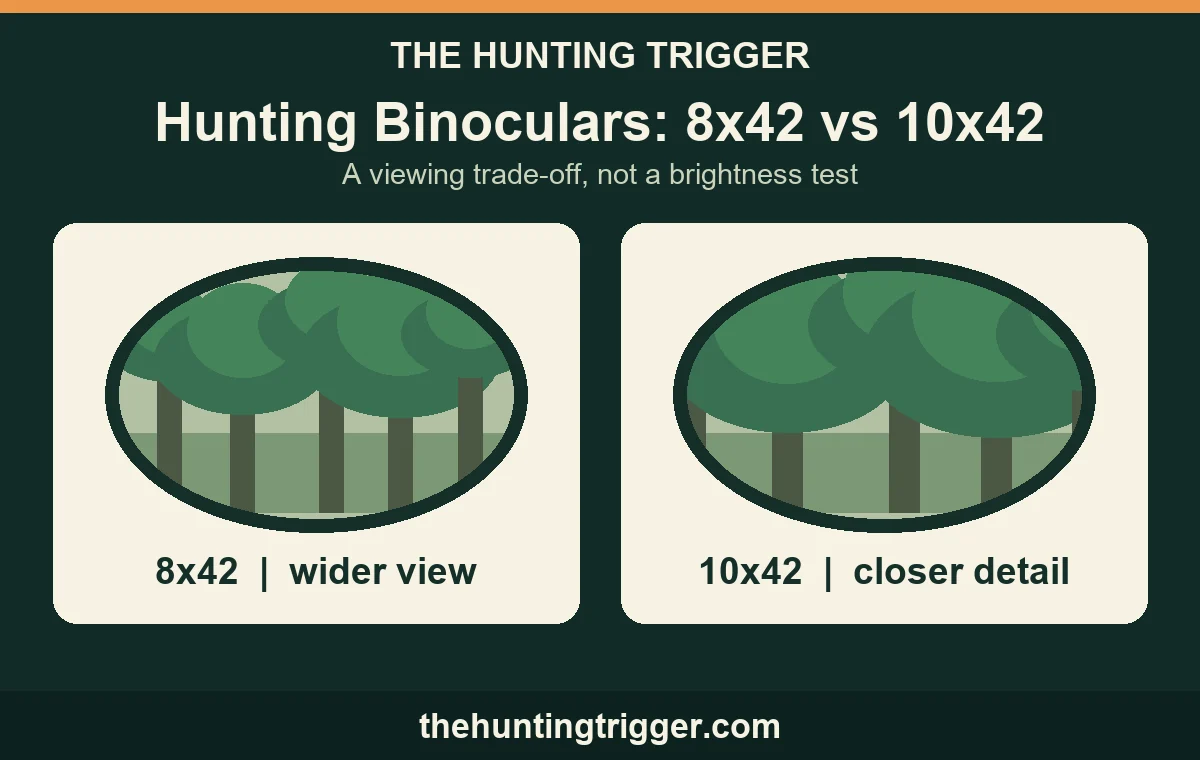
The comparison only holds when the actual models are checked. For example, Nikon’s published PROSTAFF P7 specifications list 377 feet at 1,000 yards for the 8×42 and 367 feet for the 10×42. Another model pair may differ.
The best choice is the view the hunter can keep steady while finding and identifying wildlife. Testing both sizes outdoors is more useful than selecting by magnification alone.
How should field of view be compared?
Compare the linear field of view at the same distance, usually feet at 1,000 yards. A listed 330 feet means the visible scene spans 330 feet at that distance.
A wider view helps a hunter scan brush edges or follow moving wildlife without repeatedly repositioning the binocular. Field of view is a model-specific specification, so compare actual listings rather than assuming every 8x model is alike.
Also check the close-focus distance if the binocular will serve for nearby wildlife or nature observation. Hunting use may prioritize distant clarity, but close focus can still affect everyday value.
What matters for dawn and dusk viewing?
Objective size and exit pupil help explain low-light potential, but they do not measure image quality alone. Exit pupil is objective diameter divided by magnification.
An 8×42 has a calculated exit pupil of about 5.25 mm; a 10×42 has 4.2 mm. Nikon gives the same rounded figures, 5.3 mm and 4.2 mm, for its PROSTAFF P7 pair. These are geometry, not measured brightness rankings.
Simple twilight formulas leave out transmission, contrast, and image quality. Compare real views in dim but lawful conditions when possible. The binocular cannot extend legal shooting hours or replace reliable target identification.
How should binoculars fit a hunter’s eyes?
Good fit means one comfortable circular image, a sharp view for each eye, and the full field of view with or without glasses. Adjust the hinge and eyecups before judging optical quality.
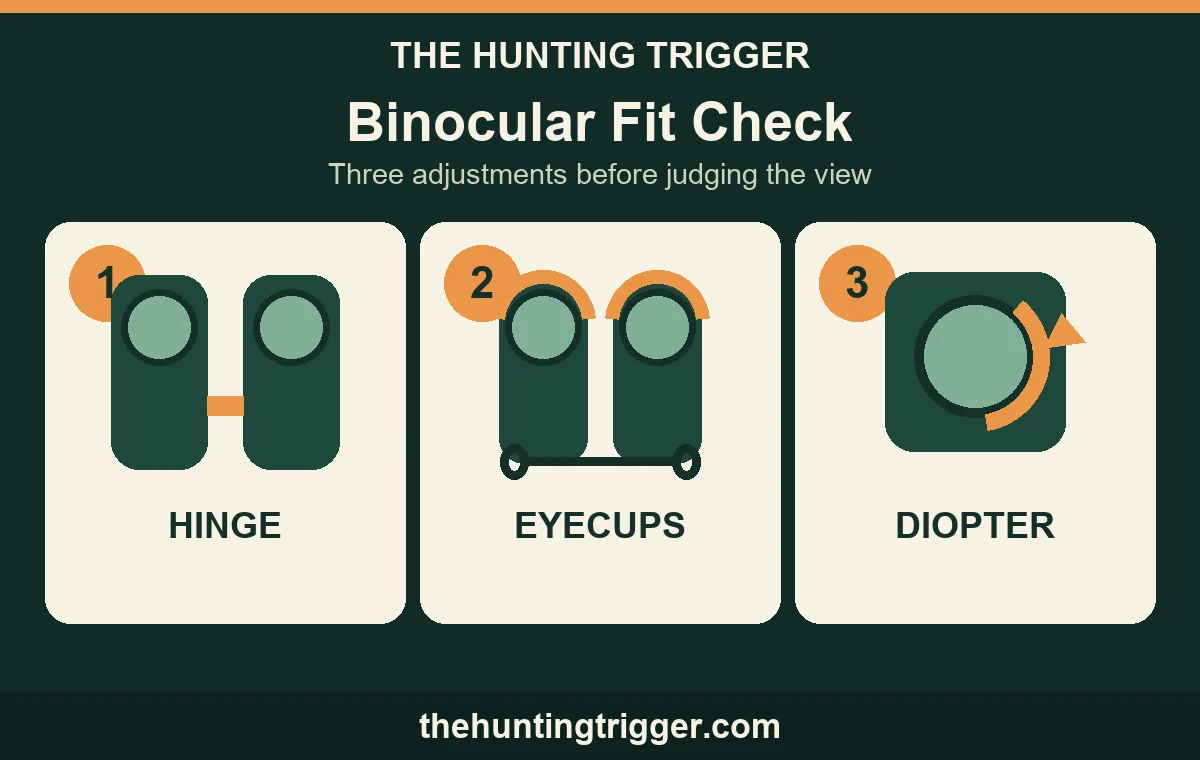
Follow this short check:
- Move the hinge until the two views merge into one circle. Check the model’s listed interpupillary-distance range if the hinge never fits comfortably.
- With glasses, start with eyecups down. Without glasses, extend them until the full view appears without dark edges.
- Cover the right objective and focus the left view with the center wheel. Cover the left objective and adjust the right-side diopter.
- Open both eyes and use the center wheel for later distance changes.
Nikon’s setup sequence places eyecups first, then the diopter and center focus. Eye relief is a listed specification, but the usable fit should be checked with the hunter’s actual glasses.
Which weather and carry features matter?
For wet or changing conditions, check the exact model’s waterproof and fogproof claim. Also inspect lens caps, grip, focus-wheel access with gloves, carry weight, and how the binocular sits in a harness.
Do not treat “waterproof” as permission to submerge any model. Nikon’s published PROSTAFF P7 claim specifies a limited water exposure and says its binoculars are not designed for underwater use.
A lighter binocular can be easier to carry, while a larger objective can add bulk.
What should a hunter check before buying?
Start with terrain and how long the binocular will be handheld. Then compare published specifications and perform a real fit test if possible.
- Compare 8×42 and 10×42 in the same lighting and at the same target.
- Read field of view in feet at 1,000 yards, not just magnification.
- Test the full view while wearing the hunter’s usual glasses.
- Check the hinge, eyecups, diopter, and focus wheel for comfortable use.
- Verify the exact model’s weather claim, weight, and included carry system.
- Avoid treating an exit-pupil calculation as a complete low-light score.
The practical choice: buy the binocular that lets the hunter find, hold, and clearly inspect a subject without strain. For covered woods, begin with 8×42. For open terrain, compare 10×42 alongside it.

Leave a Reply