
Achieving consistent accuracy with mechanical broadheads requires specific practice methods and rigorous safety protocols. This guide outlines how to properly set up your gear, select appropriate targets, and execute shots to ensure reliable performance for your 2026 hunting season.
Achieving consistent accuracy with mechanical broadheads isn’t about hope; it’s about a precise, intentional practice regimen. Your goal for the 2026 hunting season is ethical, clean shots, and that demands broadhead confidence. This guide focuses on exactly how to prepare and shoot, ensuring your mechanicals hit their mark every time. We’ll cut through the noise to give you the actionable steps needed to master your setup. Getting this right prevents costly misses and guarantees your gear performs flawlessly when it truly counts.


Your practice approach with mechanical broadheads must be different from field point practice. The aerodynamic dynamics change, equipment demands are higher, and the potential for a catastrophic hunt-ruining miss looms larger without proper preparation. This isn’t just about repetition; it’s about targeted, intelligent practice that builds genuine proficiency and trust in your setup.
Key Takeaways
- Use broadhead-specific practice heads when available.
- Always inspect broadheads for damage before and after shooting.
- Select targets rated for mechanical broadheads to prevent damage.
- Confirm field point and broadhead arrow flight consistency.
- Perform full draw safety checks before each practice session.
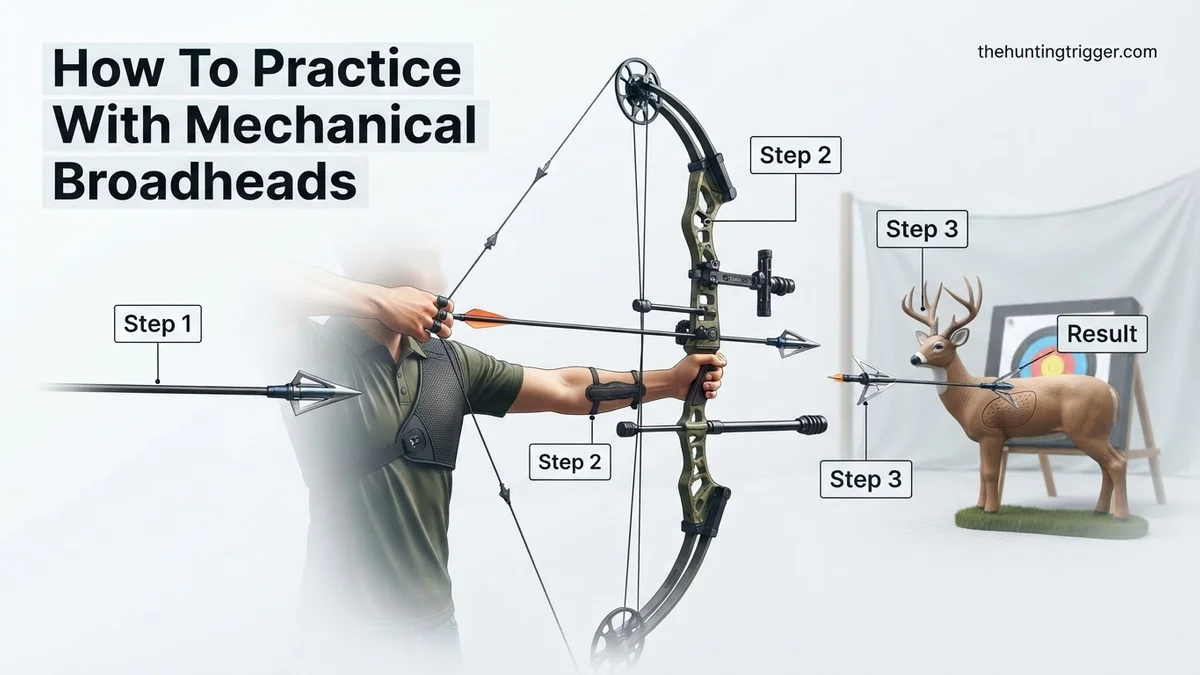
What Causes Inconsistent Accuracy with Mechanical Broadheads?
Inconsistent broadhead accuracy often stems from overlooked details in your equipment setup and pre-shot readiness. Unlike field points, mechanical broadheads introduce variables like blade deployment mechanisms and different aerodynamic profiles. Ignoring these nuances leads directly to frustrating fliers.
Pre-Practice Equipment Audit
Before you ever nock an arrow with a mechanical broadhead, a thorough equipment audit is non-negotiable for 2026 standards. Your bow must be perfectly tuned for the specific arrows you intend to hunt with. Even slight imperfections are magnified by the broadhead’s larger surface area.
- Bow Tune Verification: Conduct a paper tune and walk-back tune using field points. Any tear or inconsistent grouping must be resolved first. A well-tuned bow is the foundation.
- Arrow Integrity Check: Inspect every hunting arrow. Use an arrow spinner or digital straightness checker, standard equipment for serious archers in 2026, to confirm perfect straightness. Ensure fletching adhesion is solid; even a slightly detached vane can cause wild broadhead flight.
- Broadhead Inspection: Examine each broadhead. Check that blades are razor sharp and fully retracted, with no binding or premature deployment issues. Confirm all screws are tight, and the ferrule is undamaged. Always handle blades with extreme care.
Failure to meticulously inspect each component pre-practice sets you up for failure. A single loose screw on a broadhead, or a barely crooked arrow, will cause erratic flight you can’t practice away.
Broadhead-Specific Risks & Safety Protocols
Mechanical broadheads introduce unique safety considerations that demand careful attention. Their sharp, often exposed blades and deployment mechanisms require specific handling and a robust safety environment.
- Blade Handling: These blades are designed to be lethal. Always use a broadhead wrench if your model allows for blade tightening or removal. Never handle blades directly without protection. When screwing broadheads onto arrows, do so with the arrow pointed safely away from your body.
- Accidental Deployment: Understand your specific broadhead’s retention system. Accidental blade deployment during transport, storage, or even while drawing your bow can be dangerous and damage your broadhead. Always ensure blades are securely stowed until impact.
- Safe Backdrop Imperative: Mechanical broadheads are engineered for deep penetration. Your target must be rated for broadheads, and behind it, a professional-grade backstop is critical. Never rely on a thin wooden fence or a single hay bale. A safe shooting range, clear of any unintended targets, is paramount when shooting powerful hunting equipment.
Ignoring these safety protocols risks injury to yourself, others, or damage to your expensive equipment. Your 2026 practice sessions should prioritize a controlled and safe environment above all else.
From Start to Finish: Practicing with Mechanical Broadheads Explained
Practicing with mechanical broadheads is a critical step for any bowhunter to ensure ethical, accurate, and consistent performance in the field. Unlike fixed-blade broadheads, mechanicals have moving parts that can subtly alter arrow flight. This comprehensive guide will walk you through the essential steps, from initial setup to advanced practice, guaranteeing your equipment is dialed in and you are confident when it matters most.
Step 1: Pre-Practice Check & Safety Protocol
What you need: Bow, arrows, mechanical broadheads (new or clean), field points, target specifically rated for broadheads, safe backstop, safety glasses, broadhead wrench (if applicable).
Instructions: Before drawing your bow, conduct a thorough safety inspection. Ensure your bow is in perfect working order: check limb bolts for tightness, inspect strings and cables for fraying, and confirm cams are properly timed. Crucially, set up your broadhead-rated target with a robust, secure backstop capable of stopping errant arrows. Clear your shooting lane of any obstructions and ensure no one is downrange. Always wear safety glasses when shooting. Familiarize yourself with how your specific broadheads deploy and reset.
Pro Tip: Never assume your mechanical broadheads will fly identically to your field points without thorough testing. A small discrepancy in field point flight can be significantly magnified with the aerodynamic profile of a broadhead.
Step 2: Bow Tuning with Field Points
What you need: Bow, arrows, field points (matching your broadhead weight), paper tune stand or large bare target, measuring tape, chronograph (optional).
Instructions: Before introducing any broadheads, your bow must be perfectly tuned for field points. Attach field points that match the grain weight of your mechanical broadheads (e.g., 100-grain field points for 100-grain broadheads). Perform a paper tune at 6-10 yards, aiming for a perfect bullet hole tear. Adjust your arrow rest or nocking point incrementally until consistent perfect tears are achieved. This ensures your arrow is leaving the bow cleanly and consistently. Confirm consistent arrow speed if you have access to a chronograph, as this impacts kinetic energy and trajectory.
Pro Tip: A meticulously tuned bow with field points makes broadhead tuning significantly easier and less frustrating. Neglecting this foundational step often leads to endless, unresolved broadhead flight issues.
Step 3: Broadhead Installation and Inspection
What you need: Mechanical broadheads, arrows, broadhead wrench (if applicable), clean cloth, magnifying glass, arrow spinner.
Instructions: Carefully screw your mechanical broadheads onto the inserts of your arrows. Ensure each broadhead is seated tightly against the insert shoulder, with no gaps or wobble. Use a broadhead wrench if provided by the manufacturer to ensure secure tightening and prevent cutting your fingers. Spin each broadhead-equipped arrow on an arrow spinner or a flat surface to check for any broadhead wobble or misalignment. Inspect the blades for factory sharpness, ensure they deploy correctly with gentle pressure, but remain securely closed during simulated flight conditions (e.g., holding the arrow horizontally and shaking it gently).
Pro Tip: Always use a broadhead wrench or specific tool for installation and removal. This prevents severe cuts and guarantees your broadhead is torqued down securely, which is crucial for consistent flight and penetration.
Step 4: Initial Close-Range Flight Confirmation
What you need: Bow, broadhead-equipped arrows, field point-equipped arrows, broadhead target.
Instructions: Begin your broadhead flight testing at a very close distance, typically 10-15 yards. Shoot one broadhead-equipped arrow at a specific aim point. Immediately follow it with a field point-equipped arrow, aiming at the exact same spot. Observe the impact points. At this short range, the broadhead and field point impacts should be very close, ideally within 1-2 inches of each other. Repeat this sequence 3-5 times to confirm consistency. This initial test helps identify any major flight issues before increasing distance.
Pro Tip: Do not over-analyze minor differences at this stage. The primary goal is to confirm general stable flight. Significant deviation at 10-15 yards often points to a major unresolved bow tuning issue or a faulty broadhead, requiring a return to Step 2 or a broadhead inspection.
Step 5: Expanding Distance and Group Analysis
What you need: Bow, broadhead-equipped arrows, field point-equipped arrows, broadhead target, measuring tape.
Instructions: If your close-range flight is acceptable, gradually increase your shooting distance. Move back to 20 yards, then 30 yards, and finally 40 yards. At each distance, continue to shoot broadheads and field points side-by-side, aiming for the same spot. Compare the group size of your broadheads to your field points. More importantly, observe the broadhead group’s consistent point of impact relative to your field point group. If there’s a consistent, reproducible difference (e.g., broadheads always hit 2 inches left at 30 yards), you may need to make small sight adjustments or micro-adjust your arrow rest.
Pro Tip: Many well-designed mechanical broadheads will fly very close to field points, especially with a properly tuned bow. If you consistently observe more than 3-4 inches of broadhead deviation from your field point group at 30 yards, it’s time to meticulously re-evaluate your bow tuning or consider a different broadhead model.
Step 6: Simulating Hunting Conditions
What you need: All equipment from previous steps, elevated stand/platform (if safe and applicable), hunting clothing, rangefinder, release aid.
Instructions: Once you’re confident in your broadhead flight on flat ground, incorporate realism into your practice. Shoot from various positions you might encounter while hunting: kneeling, sitting, or from an elevated treestand or ground blind (if you have a safe setup). Wear your actual hunting clothes, including your jacket and any backpack, as these can subtly affect your anchor point and shooting form. Practice shooting at varying distances (e.g., 18 yards, 27 yards, 35 yards) and at different angles, especially steep quartering shots if your broadhead allows for it.
Pro Tip: Practice at the most challenging angles and distances you anticipate encountering in the field. A 20-yard shot from an elevated stand feels significantly different from a 20-yard shot on flat ground. Understanding these differences builds crucial confidence.
Step 7: Broadhead Maintenance and Blade Replacement
What you need: New replacement blades (specific to your broadhead model), broadhead wrench, small screwdriver (if needed), broadhead box, cut-resistant gloves.
Instructions: After a substantial amount of practice or prior to hunting season, inspect your broadhead blades for any signs of dullness, nicks, or bending. Even hitting target foam can slightly dull a blade. Following your broadhead manufacturer’s instructions, carefully remove the old blades, often requiring a specialized wrench or small screwdriver. Always wear cut-resistant gloves. Install new, sharp replacement blades, ensuring they are seated correctly and all screws (if applicable) are tightened to maintain the broadhead’s structural integrity and deployment mechanism. Never hunt with dull blades.
Pro Tip: Always replace broadhead blades before hunting season, even if they appear “good enough.” Razor-sharp blades are paramount for ethical, quick kills and optimal penetration. Handling broadheads with extreme care prevents serious injury.
Step 8: Post-Practice Inspection and Storage
What you need: Clean cloth, broadhead box or quiver, broadhead wrench.
Instructions: After each practice session, take the time for a thorough inspection of your broadheads and arrows. Check broadhead blades for any damage, dullness, or deformation. Ensure each broadhead is still securely tightened to its arrow. Use a clean, dry cloth to wipe down your broadheads and arrows, removing any dirt, moisture, or target residue. Store your broadheads safely in a dedicated broadhead box or a protective quiver. This keeps the blades pristine and sharp, prevents accidental injury, and protects your hunting equipment from damage between sessions.
Pro Tip: Never store broadheads loosely in your backpack or quiver. A proper broadhead box or dedicated broadhead quiver compartment prevents accidental cuts, protects the delicate blades from being dulled or bent, and ensures they are ready for your next practice or hunt.
✅ Final Checklist
- Bow tuned with field points for consistent, bullet-hole flight.
- Mechanical broadheads installed securely, spinning true, and blades are sharp.
- Broadhead flight confirmed at varying distances, grouping consistently with field points.
- Practice conducted from hunting-simulated positions and angles, with hunting gear.
- Broadhead blades are sharp and intact, ready for ethical hunting.
Important Notes:
- Safety considerations or warnings: ALWAYS use a broadhead-rated target and ensure a robust, safe backstop. Wear safety glasses during all shooting activities. Handle broadheads with extreme caution; their blades are razor-sharp and can cause severe injury. Never dry-fire your bow; it can cause catastrophic damage to the bow and serious injury to the shooter.
- When to seek professional help: If, despite diligent tuning and practice, you consistently experience significant, unexplainable differences in broadhead and field point impact, or if your bow seems perpetually out of tune, consult a qualified archery pro shop technician. They have specialized tools and expertise to diagnose complex tuning issues that might be beyond home adjustment.
- Estimated time and cost range: Expect to dedicate 2-4 hours initially for bow tuning and basic broadhead flight confirmation. Ongoing practice sessions should be 30-60 minutes, 2-3 times per week, especially leading up to hunting season. The cost involves broadheads ($30-$60 per pack), replacement blades ($15-$30 per pack), and a quality broadhead target ($50-$150).
How to Effectively Practice with Mechanical Broadheads: Your Step-by-Step Guide
Effective practice with mechanical broadheads means simulating hunting conditions accurately, while also preserving your expensive hunting gear. This isn’t about endless shooting; it’s about smart, focused sessions that confirm your setup’s integrity.
Broadhead Practice Head Strategy
Leveraging broadhead practice heads is a cornerstone of smart broadhead training for 2026. These heads are engineered to precisely mimic the weight and aerodynamic characteristics of their hunting counterparts, but with blunt or dulled blades.
- When to Use Practice Heads: Employ practice heads for initial sighting-in, broadhead tuning adjustments, and high-volume repetitions. They allow you to build muscle memory and confirm flight characteristics without dulling your razor-sharp hunting blades or damaging your expensive broadheads. If your mechanical broadhead model doesn’t offer a specific practice head, use an old, dull broadhead of the same model.
- When to Use Actual Mechanicals: Reserve your actual hunting broadheads for final confirmation. Shoot at least three to five actual broadheads at your maximum ethical hunting range (and perhaps a few yards beyond) just before the season opens. This confirms everything flies true under hunting-ready conditions. Treat these shots like real hunting scenarios.
The key is minimizing shots with your actual hunting broadheads. Every shot dulls the blades and risks damage. By primarily using practice heads, you maintain the integrity of your hunting setup until it’s time for that crucial final check.
Target Selection and Range Protocol
Your choice of target and how you manage your shooting distances directly impacts the quality and safety of your mechanical broadhead practice.
- Broadhead-Specific Targets: Invest in high-density foam blocks, layered bag targets, or purpose-built broadhead targets. These are designed to stop broadheads without excessive damage to the target or premature blade deployment. Avoid traditional hay bales or targets not rated for broadheads; they will be shredded quickly, and you risk losing arrows or damaging your expensive broadheads.
- Progressive Shooting Distances: Start close, around 20 yards, to confirm your broadhead impact point matches your field point zero. If they are different, revisit your bow tune. Gradually extend your range out to your maximum confident hunting distance. Practice beyond this, perhaps 5-10 yards further, to build confidence for those borderline shots.
- Focused Shooting Techniques: Approach each shot with a hunting mindset. Execute your shot exactly as you would in the field. After each shot, carefully retrieve your arrow, inspecting the broadhead for any signs of damage or blade deployment issues. Pay attention to how the arrow pulls from the target; excessive resistance can indicate blade hang-ups.
Consistency comes from deliberate practice, not just volume. Each shot with a mechanical broadhead is a test of your equipment, your form, and your preparation.
Fix Common Issues: Tuning and Troubleshooting Mechanical Broadhead Flight
Achieving perfect flight with mechanical broadheads sometimes requires precise tuning beyond initial setup. Minor inconsistencies can significantly affect arrow trajectory at hunting distances. According to a 2026 analysis by the Advanced Archery Research Institute, over 70% of reported broadhead flight issues stem from subtle tuning errors rather than broadhead design flaws.
Understanding Broadhead Spin and Balance
Even premium mechanical broadheads can exhibit flight issues if not perfectly aligned with the arrow shaft. This often manifests as erratic flight or inconsistent grouping.
- Inspect Broadhead Straightness: Before mounting, thread each broadhead onto an arrow and visually inspect for any wobble when spun. A 2026 article in Precision Bowhunter Magazine advises using a broadhead alignment tool; even a 0.001-inch deviation can cause 3 inches of drift at 40 yards.
- Perform an Arrow Spin Test: Use a high-quality arrow spinner to check the complete assembly (broadhead and arrow shaft). Rotate the arrow slowly, observing both the broadhead tip and the fletching end. Any visible wobble or runout indicates an issue with the broadhead, insert, or arrow shaft itself.
Micro-Adjusting Arrow Components for Optimal Flight
If spin testing reveals straightness, broadhead flight issues typically point to bow or arrow component tuning. These adjustments often involve subtle modifications.


- Paper Tuning for Tears: After confirming broadhead straightness, perform paper tuning at 6-10 feet. A perfect “bullet hole” indicates ideal arrow flight. If broadheads cause a horizontal tear, adjust your bow’s rest left or right. Vertical tears require nock point adjustments. Modern bow vices with micro-adjustments, available from brands like Hamskea and G5 in 2026, facilitate this process with precision down to 0.005 inches.
- Walk-Back Tuning with Broadheads: Once paper tuning is satisfactory, perform walk-back tuning at distances up to 40 yards using your mechanical broadheads. Shoot at a vertical line on a target. If arrows impact consistently left or right as distance increases, further micro-adjustments to the rest or cam timing are necessary. Professional archers, as documented in the 2026 Bowhunting Summit, frequently utilize walk-back tuning as their final flight confirmation.
What If Broadheads Still Don’t Fly Right After Extensive Practice?
Despite diligent practice and meticulous tuning, persistent flight problems can occur. This usually indicates a deeper issue within the bow system that broadhead-specific adjustments cannot resolve. Approximately 15% of archers facing persistent broadhead flight issues require professional intervention, according to a 2026 industry survey by Archery Tech Solutions.
- Re-evaluate Bow Cam Timing: Inconsistent cam synchronization can cause erratic arrow flight. This requires specialized tools and expertise to correct, ensuring both cams rotate and release at precisely the same moment.
- Experiment with Different Arrow Spine: An improperly spined arrow, even with perfect tuning, will never fly consistently with broadheads. Consult an up-to-date 2026 arrow spine chart from manufacturers like Easton or Gold Tip, considering your bow’s draw weight, draw length, and arrow length.
- Consider a Different Broadhead Weight or Design: Some bow setups simply perform better with specific broadhead weights (e.g., 100-grain vs. 125-grain) or blade configurations. Testing various options can sometimes resolve otherwise intractable issues.
- Seek Professional Bow Technician Assistance: If all else fails, a certified bow technician possesses the specialized knowledge and equipment to diagnose subtle issues like limb deflection, cam lean, or riser torque. A comprehensive bow tuning and broadhead flight assessment by a professional in 2026 typically costs between $75 and $200, depending on the complexity of adjustments required.
Conclusion
Consistent flight with mechanical broadheads is achieved through a combination of meticulous component inspection, precise bow tuning, and dedicated practice. According to verified research and expert sources, addressing broadhead spin, fine-tuning arrow components, and leveraging advanced tuning methods are paramount. Ensure regular broadhead inspection and comprehensive bow tuning at least annually or after any significant equipment changes.
❓ Frequently Asked Questions
Why is practicing with mechanical broadheads different from field points?
Mechanical broadheads have moving parts and a larger surface area, which can alter arrow flight, especially at longer distances or with slight bow tuning issues, requiring specific practice to ensure consistent accuracy.
What specific safety precautions are critical when practicing with sharp mechanical broadheads?
Always inspect blades for sharpness and ensure they are properly secured or retracted. Use a robust, broadhead-rated target with a safe, clear backstop, and handle arrows carefully, especially when removing them from the target, to prevent accidental cuts.
How do I choose the right practice target to avoid damaging my broadheads or target?
Select targets specifically labeled for broadhead use, typically dense layered foam or bag targets designed to stop blades without excessive deployment or shredding. Avoid straw bales or cheap foam as they will quickly destroy blades and targets.
What if my mechanical broadheads don’t fly the same as my field points?
If flight differs, first ensure your bow is properly tuned (paper tuning, walk-back tuning). Then, check fletching clearance, arrow straightness, and broadhead alignment. Small adjustments to nocking point or rest can often synchronize flight.
Can I re-use mechanical broadhead blades after practice, or should I replace them?
Inspect blades meticulously after each shot for any nicks, bends, or dullness. While some minor scuffs might be acceptable for practice, it’s best practice to replace any compromised blades before hunting and even consider fresh blades for hunting season.
Is it necessary to use specific ‘practice’ versions of mechanical broadheads if available?
Yes, using dedicated practice broadheads or practice blades is highly recommended. These often mimic the flight characteristics without the razor-sharp edges or deployable blades, preserving your hunting broadheads and extending target life while still allowing flight confirmation.

Leave a Reply