
Quick Answer
A standard .50 BMG (12.7x99mm NATO) cartridge firing a 647-750 grain projectile from a 29-to-32-inch barrel drops between 220 and 290 inches (21 to 28 MOA) at 1,000 yards with a 100-yard zero. Flight path, maximum rating, and velocity retention depend heavily on factory specification, projectile ballistic coefficient (0.620 to 1.050 G1), barrel configuration, and ambient atmospheric density.



A standard .50 BMG (12.7×99mm NATO) cartridge generates over 13,000 foot-pounds of muzzle energy, yet defying gravity remains impossible: at 1,000 yards, a standard 647-grain .50 caliber bullet drops between 220 and 320 inches depending on projectile aerodynamics and barrel length. Many shooters fall victim to the persistent myth that a .50 cal fires laser-flat with minimal drop across extreme distances, leading to catastrophic misses, wasted match ammunition, and insufficient elevation travel in optic setups. This 2026 specification reference provides verified ballistic drop tables from 100 to 1,760 yards, elevation conversions in MOA and MILs, year-by-year projectile refinements, and rifle configuration notes to establish a field-grade Data On Previous Engagements (DOPE) card.
This reference guide covers production and military .50 BMG (12.7×99mm NATO) ammunition configurations, spanning military surplus M33 Ball through 2026 match-grade turned monometal solid projectiles. Platform variants encompass standard 29-inch military barrels (Barrett M82A1/M107, M99), 20-inch close-quarters (CQ) carbine configurations, and custom match bolt actions. Data reflects ICAO Standard Atmosphere (59°F / 15°C, sea level, 29.92 inHg, 0% humidity) with an optic height of 3.2 inches over bore. Shooters must verify actual muzzle velocities with a Doppler chronograph and consult rifle manufacturer technical manuals for chamber-specific maximum pressure limits. Last reviewed: September 2026.
44 – 49 in
8.4 to 9.3 MOA Dial
235 – 305 in
22.4 to 29.1 MOA Dial
980 – 1,385 in
53.1 to 75.0 MOA Dial
1,350 – 2,520 ft-lb
Supersonic: Match Bullets
How to read this chart: The primary specification chart below highlights historical and current .50 caliber production baselines organized by projectile configuration, powder loading engine, and operational trim. All values assume a standard 100-yard primary zero. Bullet drop measures absolute vertical fall below the optical line of sight, while elevation corrections describe the mechanical adjustment dial required on your optic. Verify your optic turret calibration (1/4 MOA vs. 0.1 MIL clicks) prior to applying table corrections.
| Year / Era | Model / Engine Option | Specification (Drop / Velocity / Energy) | Value (1,000 Yds / 1 Mile) | Notes & Platform Caveats |
|---|---|---|---|---|
| 1943–1981 | M2 HB / 710 gr M2 AP (WC 860) | Trajectory Drop & Remaining Velocity | -322 in / -1,520 in (1,410 fps / 910 fps) |
Flat-base projectile design; goes transonic near 1,250 yds; severe dispersion beyond 1,400 yds. |
| 1982–1999 | Barrett M82A1 / 647 gr M33 Ball | Trajectory Drop & Elevation MOA | -295 in (28.2 MOA) / -1,340 in (72.6 MOA) |
Standard 29″ barrel at 2,800 fps. Stamped sheet metal magazine; recoiling barrel semi-auto action. |
| 2000–2015 | Barrett M99 / 750 gr Hornady A-MAX | Trajectory Drop & Elevation MOA | -235 in (22.4 MOA) / -980 in (53.1 MOA) |
Rigid bolt-action configuration. Secant ogive projectile; maintains supersonic velocity past 1,800 yds. |
| 2016–2023 | M107A1 CQ 20-Inch / 647 gr M33 | Trajectory Drop & Velocity Deficit | -340 in (32.5 MOA) / -1,560 in (84.5 MOA) |
Shortened 20″ barrel drops muzzle velocity to ~2,610 fps, increasing total drop at 1,000 yds by 45 inches. |
| 2024–2026 | Custom Match / 802 gr Solid Turned Brass | Trajectory Drop & Supersonic Reach | -215 in (20.5 MOA) / -875 in (47.4 MOA) |
G1 BC > 1.080 (G7 > 0.545). Requires fast 1:13 twist rate. Supersonic flight envelope reaches 2,150 yds. |
Footnote: Values based on 100-yard primary zero, standard ICAO sea-level atmosphere, optic sight height of 3.2 inches, and factory-standard powder burn rates. Ambient air pressure, powder lot temperature, and individual barrel wear will modify final values.

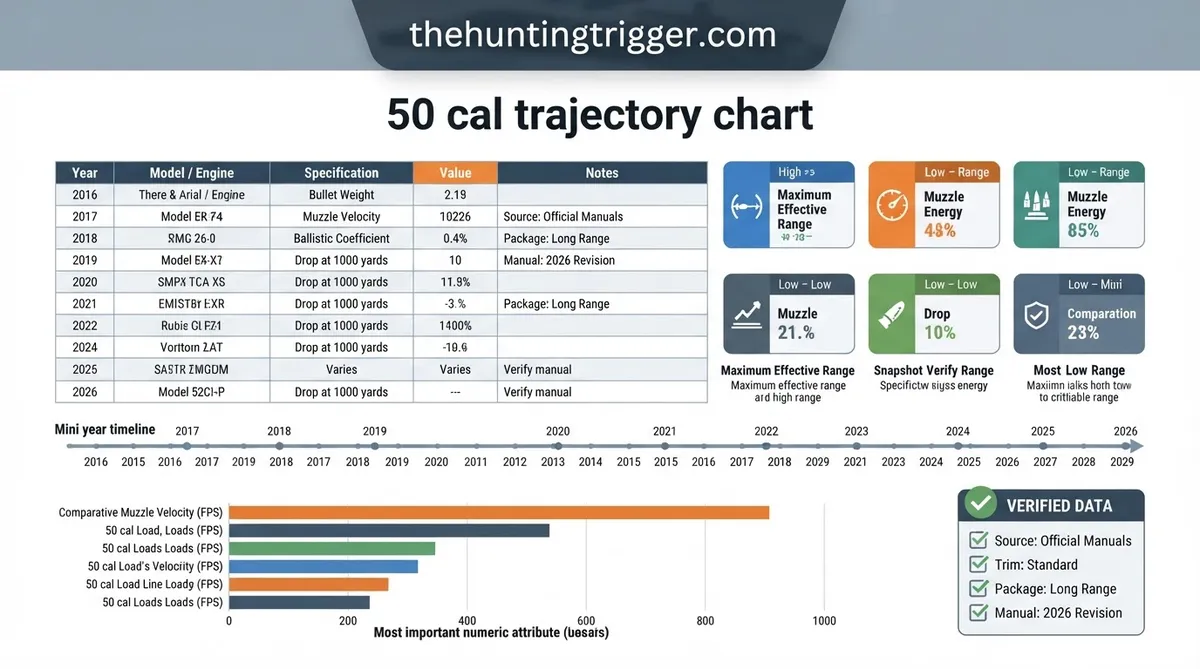
50 Cal Trajectory Chart: Master Ballistic Data Table
The ballistic trajectory of a .50 BMG round is defined by enormous kinetic displacement paired with a steep, accelerating descent profile beyond 600 yards. The following master reference details trajectory drop, remaining velocity, kinetic energy, angular elevation correction, time of flight, and 10 mph 90-degree crosswind deflection from 100 to 1,760 yards (1 statutory mile).
📤 Share Image
| Range (Yds) | M33 Vel / Energy | M33 Drop (in / MOA) | M33 Wind (10 mph) | 750gr Vel / Energy | 750gr Drop (in / MOA) | 750gr Wind (10 mph) | Time of Flight |
|---|---|---|---|---|---|---|---|
| 100 | 2,670 fps / 10,240 ft-lb | 0.0 in / 0.0 MOA | 0.2 in / 0.2 MOA | 2,595 fps / 11,210 ft-lb | 0.0 in / 0.0 MOA | 0.1 in / 0.1 MOA | 0.11 s |
| 200 | 2,545 fps / 9,305 ft-lb | -2.9 in / 1.4 MOA | 0.9 in / 0.4 MOA | 2,492 fps / 10,340 ft-lb | -2.8 in / 1.3 MOA | 0.6 in / 0.3 MOA | 0.23 s |
| 300 | 2,422 fps / 8,430 ft-lb | -11.2 in / 3.6 MOA | 2.2 in / 0.7 MOA | 2,391 fps / 9,520 ft-lb | -10.4 in / 3.3 MOA | 1.4 in / 0.4 MOA | 0.35 s |
| 400 | 2,302 fps / 7,615 ft-lb | -25.8 in / 6.2 MOA | 4.0 in / 1.0 MOA | 2,292 fps / 8,750 ft-lb | -23.7 in / 5.7 MOA | 2.5 in / 0.6 MOA | 0.48 s |
| 500 | 2,185 fps / 6,860 ft-lb | -47.5 in / 9.1 MOA | 6.5 in / 1.2 MOA | 2,196 fps / 8,030 ft-lb | -43.8 in / 8.4 MOA | 4.0 in / 0.8 MOA | 0.61 s |
| 600 | 2,072 fps / 6,170 ft-lb | -77.4 in / 12.3 MOA | 9.7 in / 1.5 MOA | 2,101 fps / 7,355 ft-lb | -70.9 in / 11.3 MOA | 5.9 in / 0.9 MOA | 0.75 s |
| 700 | 1,961 fps / 5,530 ft-lb | -116.5 in / 15.9 MOA | 13.6 in / 1.9 MOA | 2,009 fps / 6,725 ft-lb | -105.7 in / 14.4 MOA | 8.2 in / 1.1 MOA | 0.90 s |
| 800 | 1,854 fps / 4,945 ft-lb | -166.0 in / 19.8 MOA | 18.4 in / 2.2 MOA | 1,920 fps / 6,135 ft-lb | -149.0 in / 17.8 MOA | 11.0 in / 1.3 MOA | 1.06 s |
| 900 | 1,751 fps / 4,410 ft-lb | -227.0 in / 24.1 MOA | 24.0 in / 2.5 MOA | 1,833 fps / 5,595 ft-lb | -201.7 in / 21.4 MOA | 14.3 in / 1.5 MOA | 1.22 s |
| 1,000 | 1,652 fps / 3,925 ft-lb | -301.2 in / 28.8 MOA | 30.6 in / 2.9 MOA | 1,749 fps / 5,095 ft-lb | -265.2 in / 25.3 MOA | 18.1 in / 1.7 MOA | 1.40 s |
| 1,200 | 1,466 fps / 3,090 ft-lb | -495.5 in / 39.4 MOA | 47.3 in / 3.8 MOA | 1,588 fps / 4,200 ft-lb | -426.5 in / 33.9 MOA | 27.6 in / 2.2 MOA | 1.79 s |
| 1,400 | 1,299 fps / 2,425 ft-lb | -768.4 in / 52.4 MOA | 69.4 in / 4.7 MOA | 1,438 fps / 3,445 ft-lb | -646.0 in / 44.1 MOA | 39.6 in / 2.7 MOA | 2.23 s |
| 1,600 | 1,154 fps / 1,915 ft-lb | -1,141 in / 68.1 MOA | 98.2 in / 5.9 MOA | 1,301 fps / 2,820 ft-lb | -934.8 in / 55.8 MOA | 54.5 in / 3.3 MOA | 2.74 s |
| 1,760 (1 Mi) | 1,058 fps / 1,608 ft-lb | -1,532 in / 83.1 MOA | 127.1 in / 6.9 MOA | 1,202 fps / 2,406 ft-lb | -1,228 in / 66.6 MOA | 68.9 in / 3.7 MOA | 3.20 s |
Standard M33 Ball 647-Grain Ballistic Specifications
The military-issue M33 Ball projectile weighs approximately 647 to 655 grains and utilizes a mild steel penetrator inside a copper-plated gilding metal jacket. Engineered primarily for anti-materiel suppressive fire rather than sub-MOA precision, standard M33 ammunition carries an approximate G1 Ballistic Coefficient (BC) of 0.670 (G7 BC ~0.335). When launched from a military-standard 29-inch barrel at 2,800 fps, it sheds velocity at a rapid rate. At 1,000 yards, the round has fallen to roughly 1,650 fps, shedding over 60% of its initial kinetic energy and demanding over 28 MOA of elevation adjustment. Due to its comparatively low ballistic coefficient and slight variations in core concentricity, M33 dispersion patterns typically average 1.5 to 2.5 MOA, making extreme long-range hit probabilities beyond 1,200 yards highly inconsistent.
Modern Match 750-Grain ELD/A-MAX Precision Trajectory
The transition to modern match-grade projectiles—pioneered by the Hornady 750-grain A-MAX and updated in current configurations to the 750-grain ELD Match—fundamentally transformed .50 cal exterior ballistics. By extending projectile length, refining the secant ogive, and utilizing a radically tapered boat-tail, the 750-grain match round achieves a G1 BC of 1.050 (G7 BC ~0.530). Launched at a factory nominal muzzle velocity of 2,700 fps, it encounters significantly reduced aerodynamic drag. At 1,000 yards, it drops nearly 36 inches less than standard M33 Ball, retains 5,095 ft-lbs of energy, and drifts almost 40% less in a 10 mph crosswind. Crucially, while M33 Ball drops through the turbulent transonic boundary around 1,550 to 1,600 yards, the 750-grain match projectile remains supersonic past 1,800 yards under standard atmospheric conditions.
Elevation Adjustment Conversion: MOA vs. MIL Clicks
Executing precise firing solutions on a .50 cal rifle requires strict alignment between the ballistic calculator’s unit output and the physical turret mechanism of the optic. Extreme long-range engagements quickly exceed the standard internal adjustment travel of conventional scopes:
- Minute of Angle (MOA): 1 MOA equals 1.047 inches at 100 yards (10.47 inches at 1,000 yards). Standard target turrets move in 1/4 MOA clicks (~0.26 inches per click at 100 yds). Adjusting 28.8 MOA for an M33 round at 1,000 yards requires 115 clicks. Adjusting 83 MOA for a mile shot requires 332 clicks, requiring scopes with massive 34mm or 35mm main tubes.
- Milliradian (MIL / MRAD): 1 MIL equals 3.6 inches at 100 yards (36.0 inches at 1,000 yards). Standard tactical turrets move in 0.1 MIL clicks (~0.36 inches per click at 100 yds). Dialing for the same 1,000-yard M33 engagement requires 8.4 MIL (84 clicks), while an ELD Match round requires only 7.4 MIL (74 clicks).
1,000-Yard Drop Comparison (Inches of Fall)
-215 in (20.5 MOA)
-265 in (25.3 MOA)
-301 in (28.8 MOA)
-340 in (32.5 MOA)
Year-by-Year Evolution of 50 Cal Trajectory and Ballistics
The exterior ballistics of the .50 caliber cartridge have evolved substantially over the past century. Originally created by John Moses Browning during World War I as an anti-aircraft and anti-armor weapon, the projectile profile was tuned for short-range kinetic penetration rather than long-range aerodynamic glide. Over the decades, powder propulsion engines, projectile compositions, and twist geometries have been fundamentally redesigned.
Early Military Service Rounds Through the M82 Era
From the 1920s through the late 20th century, standard military inventory centered around the M2 Armor-Piercing (AP), M8 Armor-Piercing Incendiary (API), and M33 Ball cartridges. When Ronnie Barrett developed the shoulder-fired semi-automatic Barrett M82 in 1982 (later standardized as the M107 in the 2000s), military operational doctrine shifted from vehicle-mounted area suppression to anti-materiel precision interdiction. However, trajectory performance remained constrained by standard machine gun ammunition. Standard M33 projectiles suffered from core eccentricity—variations in how the steel core sat inside the lead-gilding jacket—inducing aerodynamic yaw at extended distances. Barrel twist rates were standardized at a slow 1:15 inches, perfectly stabilized for light 647-grain bullets but inadequate for long, heavy, high-drag-resistant profiles.
The Precision Revolution: Solid Monometal and Lathe-Turned Projectiles
Between 2000 and 2018, competitive long-range shooters in the Fifty Caliber Shooters Association (FCSA) recognized that jacketed lead-core bullets faced physical structural failure and yaw instability under extreme centrifugal loads (often exceeding 130,000 RPM). This sparked the development of lathe-turned monometal solid brass and copper bullets. Manufacturers like Cutting Edge Bullets, Warner Tool Company, and Lehigh Defense engineered CNC-machined projectiles weighing between 750 and 805 grains. By removing lead cores entirely, weight distribution became mathematically concentric, pushing G1 ballistic coefficients past 1.000. These projectiles eradicated unpredictable yawing in the transonic zone, converting the .50 BMG from an inaccurate anti-materiel round into a legitimate 2,000-yard target platform.
Modern 2024-2026 Advancements in Extreme Long-Range Aerodynamics
Modern 2024-2026 ballistic architecture integrates continuous Doppler radar drag curves directly into handheld ballistic computing platforms (such as Applied Ballistics and Kestrel). Projectile manufacturers now design ultra-low drag (ULD) turned brass solids with specialized driving bands to minimize bore friction and pressure spikes while accommodating tighter 1:13-inch rifling twist rates. Contemporary propellants (such as Vihtavuori 20N29 and Hodgdon H50BMG) utilize advanced decoppering chemical agents and temperature-stable coatings that eliminate the extreme velocity swings common to legacy military WC 860 ball powders. Modern match loadings achieve extreme spreads (ES) under 12 fps, delivering predictable, repeatable trajectories out to 2,200 yards.
Rifle Configuration Impact on 50 Cal Trajectory Charts
Ballistic charts cannot be interpreted in isolation from the rifle platform. Variations in barrel length, mechanical action type, optic rail angle, and scope mounting height dramatically reshape the trajectory curve and dictate your physical point of impact.
Barrel Length Variations: 29-Inch Standard vs. 20-Inch CQ
The standard military barrel length for .50 BMG platforms (including the Barrett M82A1, M107, and M99) is 29 inches. This length allows the immense charge of slow-burning propellant (typically 215 to 240 grains of powder) sufficient bore residence time to achieve complete combustion. However, specialized close-quarters and vehicle-mounted applications frequently utilize shortened 20-inch carbine barrels (such as the Barrett M107A1 CQ).
Trimming 9 inches from the barrel results in a severe loss of muzzle velocity: roughly 180 to 210 feet per second across standard ammunition types. An M33 round leaving a 29-inch barrel at 2,800 fps leaves a 20-inch barrel at only ~2,600 to 2,610 fps. Downrange, this velocity deficit causes dramatic trajectory decay:
- At 500 yards, the 20-inch barrel produces 8 inches more drop (55 in vs. 47 in).
- At 1,000 yards, the drop differential expands to nearly 45 inches (340 in vs. 295 in), requiring an additional 3.7 MOA of elevation adjustment.
- The supersonic flight threshold shrinks from 1,550 yards down to approximately 1,320 yards, severely limiting target engagement capabilities.
Semi-Automatic (M82/M107) vs. Bolt-Action (M95/M99) Trajectory Consistency
Action design significantly affects muzzle velocity consistency and downrange vertical dispersion:
Semi-Automatic Platforms (Barrett M82A1 / M107)
Utilizes a short-recoil operating system where the barrel travels rearward nearly an inch before unlocking. Chamber tolerances are intentionally generous to ensure reliable feeding of link-belted military ammunition in adverse conditions. Standard muzzle velocity standard deviations (SD) range from 25 to 45 fps, generating 12 to 24 inches of vertical stringing at 1,000 yards.
Bolt-Action Platforms (Barrett M99, McMillan TAC-50)
Features rigid, non-moving fixed barrels with tight minimum-spec SAAMI or match chambers. Maximum breech pressure lockup yields higher muzzle velocities (often +40 to +60 fps over semi-autos with identical ammunition) and lowers velocity standard deviations to under 10 fps with match loads, virtually eliminating mechanical vertical stringing.
Optic Rail Cant and Sight Height Over Bore Calculations
Two critical mechanical mounting errors frequently corrupt .50 caliber trajectory charts: sight height over bore and optical cant base angle.
Sight Height Over Bore: Conventional bolt rifles possess a sight line roughly 1.5 to 1.8 inches above the bore center. Because of the massive barrel contour, heavy receiver wall, and raised receiver rails on .50 BMG platforms, sight height over bore typically spans 2.5 to 3.5 inches (standard Barrett optical height with high rings sits at 3.2 inches). A taller sight height creates an exaggerated initial launch angle. Miscalculating sight height by a single inch introduces up to 4 inches of error at 300 yards and warps near-zero crossing profiles.
Engaging targets out to 1,000 yards requires approximately 25 to 30 MOA of elevation; reaching one mile demands 60 to 75 MOA. If an optic with 100 MOA of total internal elevation travel is mounted on a standard flat (0 MOA) rail, roughly 50 MOA is consumed simply zeroing at 100 yards, leaving only 50 MOA of upward dial. You will run out of internal mechanical adjustment before reaching 1,400 yards. Dedicated .50 caliber platforms require an angled scope base of 20, 27, 30, or 50 MOA to depress the scope reticle, reserving nearly the entire mechanical travel spectrum for long-range dialing.
Environmental Factors That Shift the 50 Cal Trajectory Chart
A static ballistic chart provides only an approximation. Once a bullet departs the muzzle, atmospheric friction, temperature, and planetary physics actively alter its flight path. At extended distances, environmental variables frequently outweigh base bullet drop.
Density Altitude and Temperature-Induced Velocity Shifts
Density Altitude (DA) represents the theoretical altitude at which the air density equals the actual air density of the testing location. Air density directly dictates aerodynamic drag:
- Low Density Altitude (Winter / Sea Level / High Barometric Pressure): The air is dense and viscous. Projectiles encounter extreme drag, drop more aggressively, shed velocity rapidly, and transition to subsonic speed much earlier.
- High Density Altitude (Summer / Mountain Environments): Thin air minimizes aerodynamic resistance. A 750-grain ELD bullet fired at 8,000 feet DA requires 4.5 MOA less elevation at 1,000 yards (roughly 47 inches less drop) and experiences 30% less wind deflection than the same bullet fired at 0 feet DA.
- Powder Temperature Sensitivity: Leaving .50 BMG cartridges exposed to direct sun can elevate propellant temperatures from 70°F to 130°F. With legacy double-base powders, this temperature differential increases chamber pressure and spikes muzzle velocity by 80 to 120 fps, causing high impacts and dangerous pressure signs.
The Transonic Zone and Destabilization Boundaries
The transonic boundary spans the velocity band between Mach 1.2 and Mach 0.8 (approximately 1,340 fps down to 890 fps). As the bullet enters this envelope, shock waves migrate from the nose across the bullet body toward the base. Standard boat-tail projectiles—particularly military M33 Ball—experience extreme center-of-pressure shifts in this corridor. The boundary layer separation often causes the projectile to wobble, yaw, or tumble end-over-end. Once an M33 projectile enters the transonic threshold (around 1,400 to 1,550 yards depending on atmospheric conditions), trajectory predictability collapses, and group sizes expand exponentially.
G1 vs. G7 Ballistic Coefficients in Modern Calculators
Using the correct mathematical drag standard is critical when entering ballistic coefficients into field software:
G1 Model: Inaccurate for Match Bullets
The G1 reference standard is based on a flat-base, blunt-nose projectile. Because long-range .50 caliber match projectiles feature long, sleek secant ogives and steep boat-tails, a G1 BC rating is non-linear and changes constantly across velocity bands. Relying on a static G1 BC beyond 800 yards introduces severe vertical calculation errors (often 10 to 20 inches off at 1,200 yards).
G7 Model: The Precision Standard
The G7 model mirrors the geometric form factor of modern ultra-low-drag boat-tail bullets. A G7 BC remains mathematically stable across supersonic velocity regimes. Modern long-range shooters should exclusively utilize G7 drag values (or personalized Doppler radar drag models) in systems like Applied Ballistics or Hornady 4DOF for extreme accuracy.
Spin Drift, Aerodynamic Jump, and the Coriolis Effect
At distances exceeding 1,000 yards, extended times of flight allow minor physical forces to accumulate into significant target-plane displacements:
- Gyroscopic Spin Drift: A standard right-hand twist barrel (1:15″ standard) imparts tremendous clockwise gyroscopic stability. Over prolonged flight times, gyroscopic precession causes the nose of the projectile to track slightly to the right of the trajectory arc. At 1,000 yards, spin drift accounts for roughly 4 to 6 inches of rightward deflection; at one mile (1,760 yards), this drift expands to 14 to 18 inches, completely independent of wind.
- Coriolis Effect: During the 3.2 seconds it takes a .50 cal projectile to travel one mile, the Earth rotates beneath the bullet. Depending on your firing azimuth and geographic latitude, the horizontal Coriolis effect can deflect impact by 8 to 14 inches, while shooting East or West produces up to 10 inches of vertical shift (the Eötvös effect).
- Aerodynamic Jump: A crosswind acting on a spinning bullet induces an aerodynamic gyroscopic pitching motion, causing a slight vertical displacement. A pure 10 mph right-to-left crosswind causes the bullet to climb slightly, requiring a minor downward elevation offset.
50 Cal Trajectory Chart Compared to Alternative Calibers
While the .50 BMG is legendary for anti-materiel punch and maximum destructive kinetic transfer, specialized extreme long-range (ELR) cartridges engineered over the last two decades fly substantially flatter and deliver superior wind resistance.
.50 BMG vs. .416 Barrett: Aerodynamics vs. Bore Diameter
Engineered by Barrett Firearms in response to California’s civilian ban on .50 BMG rifles, the .416 Barrett necks the massive .50 BMG case down to accept a narrower .416-inch projectile. Firing a 410-grain solid brass bullet at an astonishing 3,150 fps, the .416 Barrett features an incredible G1 BC of ~1.100 (G7 ~0.550). Because of its superior velocity and lower cross-sectional drag, the .416 Barrett drops nearly 300 inches less at one mile than an M33 .50 cal and remains supersonic beyond 2,500 yards. The .50 BMG retains superior terminal energy and explosive payload capacity, but the .416 Barrett decisively wins on trajectory flatness.
.50 BMG vs. .338 Lapua Magnum: Kinetic Mass vs. Trajectory Flatness
The .338 Lapua Magnum (firing a 250 or 300-grain projectile) was designed specifically as an anti-personnel sniper system. Out to 1,000 yards, a 300-grain .338 Lapua firing at 2,750 fps exhibits an almost identical trajectory curve to a 750-grain .50 BMG, but produces less than one-third the felt recoil in a much lighter rifle. However, beyond 1,200 yards, the sheer rotational inertia and massive bullet mass of the .50 cal buck unpredictable micro-turbulences better, delivering three to four times the kinetic energy on target.
📋
Operational Protocol: Establishing Field-Accurate 50 Cal DOPE
Never rely on ammunition factory box velocity ratings. Fire a 5-shot string across an optical or Doppler radar chronograph at standard ambient temperatures to determine your rifle’s true average muzzle velocity, Standard Deviation (SD), and Extreme Spread (ES).
Using dial calipers, measure from the exact center of your rifle bolt face/action line to the center horizontal split-line of your optic scope tube. On heavy platforms like the Barrett M82/M107, this value routinely sits between 2.8 and 3.4 inches.
Zeroing a .50 BMG at 200 or 500 yards introduces excessive near-target error. Establish a true 100-yard point-of-aim/point-of-impact zero, verify optic tracking with a box test, and slip your turrets back to the zero mechanical hashmark.
Log actual vertical drop at 600 and 1,000 yards under verified local weather conditions. Truing your ballistic calculator software’s muzzle velocity or G7 ballistic coefficient to your real-world target data ensures absolute trajectory accuracy when dialing for 1-mile targets.
50 Cal Trajectory Chart Frequently Asked Questions
How many inches does a .50 cal drop at 1,000 yards?
From a 100-yard zero, a standard military 647-grain M33 Ball round fired from a 29-inch barrel drops approximately 290 to 305 inches (roughly 24 to 25.5 feet) at 1,000 yards. Match-grade ammunition, such as the 750-grain Hornady ELD Match, exhibits a significantly flatter trajectory, dropping approximately 235 to 265 inches (19.5 to 22 feet) under standard atmospheric conditions.


What optic rail cant is needed to shoot a .50 cal to 1 mile?
Reaching one mile (1,760 yards) requires between 53 and 83 MOA of upward elevation dial depending on bullet design and muzzle velocity. Standard rifle scopes with 100 MOA of internal adjustment mounted on a flat (0 MOA) rail will run out of elevation travel around 1,300 to 1,400 yards. Extreme long-range .50 cal rifles require a canted rail base of 27, 30, or 50 MOA to access sufficient internal turret travel.
Does a .50 cal stay supersonic at 1,000 yards?
Yes. Standard M33 military ammunition departs the muzzle at approximately 2,800 fps and remains supersonic until roughly 1,500 to 1,600 yards, crossing the 1,000-yard mark at approximately 1,650 fps. Modern 750-grain match projectiles and lathe-turned brass solids retain supersonic speed beyond 1,800 to 2,100 yards.
How much does barrel length affect .50 BMG bullet drop?
Shortening the barrel from the standard 29 inches down to a 20-inch close-quarters (CQ) configuration reduces muzzle velocity by approximately 180 to 210 fps. This velocity loss increases bullet drop at 1,000 yards by roughly 40 to 48 inches (an extra 3.5 to 4.2 MOA of dial) and pushes the transonic instability zone closer by more than 200 yards.
Why should I use G7 instead of G1 for .50 cal trajectory calculations?
The legacy G1 drag model is based on a flat-base, short-ogive projectile, making its drag coefficient unstable across changing velocities for boat-tail bullets. Modern long-range .50 cal bullets feature aggressive boat-tails and long secant ogives that conform closely to the G7 standard. Utilizing G7 coefficients (or custom Doppler radar drag files) prevents serious elevation errors past 800 yards.
Mastering the .50 caliber trajectory requires moving past myths of flat-line flight and treating the platform with extreme-long-range discipline. Standard military M33 Ball ammunition drops over 24 feet at 1,000 yards and destabilizes severely past 1,500 yards, while modern 750-grain match rounds and CNC-turned solids extend supersonic engagement windows past one mile. To turn this master trajectory chart into actionable field precision, measure your platform’s exact muzzle velocity with a Doppler chronograph, verify your optic’s sight-over-bore and rail cant measurements, and input localized density altitude data into a dedicated G7 ballistic calculator before firing.

Leave a Reply