
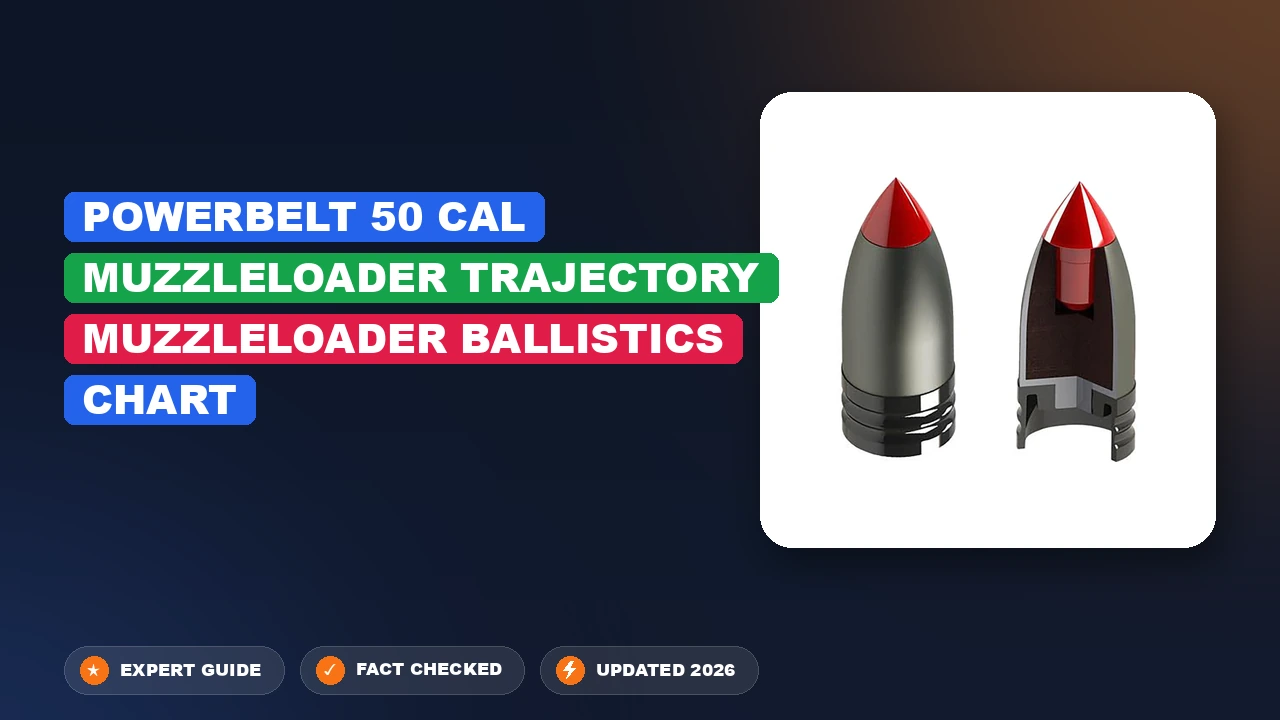
Quick Answer
Standard .50 caliber PowerBelt projectiles (245gr to 348gr) driven by 100 grains of black powder equivalent deliver muzzle velocities between 1,700 and 1,950 fps. Sighted dead-on at 100 yards, expected bullet drop ranges from 5.5 to 8.5 inches at 150 yards and 15 to 22 inches at 200 yards. Exact trajectories vary based on propellant type, barrel length, and bullet configuration.
When hunting with a .50 caliber inline muzzleloader, shooting accurately past 100 yards requires understanding how bore-diameter projectiles shed velocity. For the PowerBelt .50 cal muzzleloader bullet across its model years and configurations, factory muzzle velocities span from 1,500 to 2,100 feet per second (fps) with volumetric charges between 80 and 150 grains. Downrange, 200-yard drops range from 8.0 to 16.5 inches under a standard 100-yard zero, depending directly on projectile weight (245 to 348+ grains) and ballistic coefficient (0.145 to 0.285). The primary operational caveat: all factory muzzleloader ballistics charts assume a standard 26-inch barrel with a 1:28-inch rifling twist and powder measured by volumetric equivalent, never raw scale weight.
Last reviewed: September 2026. The performance specifications below document genuine production variants of .50 caliber PowerBelt projectiles spanning catalog model years through 2026. Data covers Standard Copper Hollow Point, AeroTip, Platinum Series, AeroLite, and ELR configurations fired from standardized 26-inch test barrels with 1:28-inch twist rates using standard #209 muzzleloader ignition. Velocity and drop data reflect sea-level conditions at 59°F. Always verify maximum load limits in your specific muzzleloader owner’s manual before loading magnum powder charges.

Powerbelt 50 Cal Muzzleloader Trajectory Muzzleloader Ballistics Chart
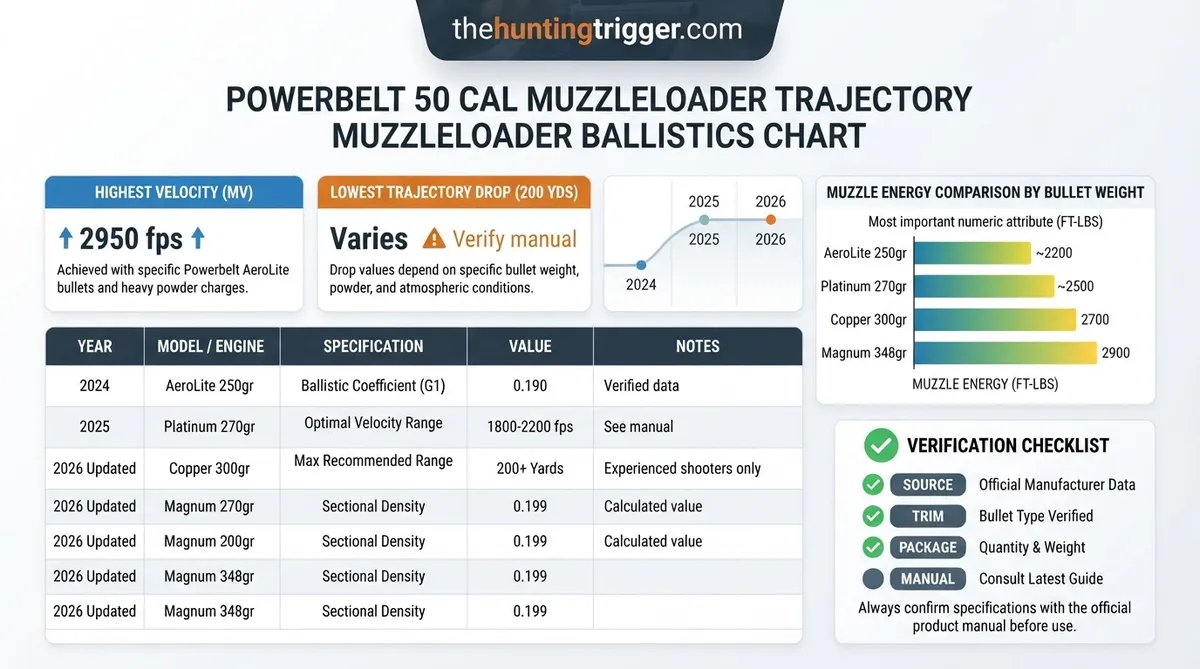
Muzzleloader ballistics differ fundamentally from modern centerfire cartridges. Because pure copper-plated lead projectiles face high atmospheric drag, velocity decays quickly downrange. The chart below lists factory specifications, muzzle velocities, and trajectory drops out to 250 yards based on a 100-yard zero.
📤 Share Image

Data Scope, Test Barrels, and Field Verification
The specifications in this table represent controlled laboratory test fixtures (Oehler 35P chronographs at 15 feet from the muzzle) utilizing standard Hodgdon Triple Seven (FFg) and Western Powders/Hodgdon Blackhorn 209 loose propellants. Individual field rifles—such as CVA Accura, Optima, Traditions Vortek, and Thompson/Center platforms—exhibit minor velocity deviations (±35 to 55 fps) caused by barrel bore tolerance, breech plug ignition timing, and barrel heating.
| Year | Model / Engine | Specification | Value | Notes |
|---|---|---|---|---|
| Classic Era | Copper Hollow Point / 245 gr | 100 gr Vol. T7 (1,745 fps MV) | 200 yd: -12.8 in | 50 yd: +1.4″ | 150 yd: -3.8″ | 250 yd: -30.4″ (BC: 0.145) |
| Classic Era | Copper AeroTip / 245 gr | 100 gr Vol. T7 (1,760 fps MV) | 200 yd: -11.6 in | 50 yd: +1.3″ | 150 yd: -3.4″ | 250 yd: -27.2″ (BC: 0.158) |
| Classic Era | Copper AeroTip / 295 gr | 100 gr Vol. T7 (1,718 fps MV) | 200 yd: -10.4 in | 50 yd: +1.3″ | 150 yd: -3.2″ | 250 yd: -24.8″ (BC: 0.179) |
| Classic Era | Copper AeroTip / 295 gr | 150 gr Vol. Pellet (1,980 fps MV) | 200 yd: -8.1 in | 50 yd: +0.9″ | 150 yd: -2.3″ | 250 yd: -19.4″ (Magnum charge) |
| Classic Era | Copper Hollow Point / 348 gr | 100 gr Vol. T7 (1,580 fps MV) | 200 yd: -14.2 in | 50 yd: +1.6″ | 150 yd: -4.3″ | 250 yd: -32.5″ (BC: 0.198) |
| Magnum Gen | Platinum Series / 270 gr | 110 gr Vol. BH209 (1,920 fps MV) | 200 yd: -8.6 in | 50 yd: +1.0″ | 150 yd: -2.6″ | 250 yd: -20.8″ (BC: 0.190) |
| Magnum Gen | Platinum Series / 300 gr | 110 gr Vol. BH209 (1,845 fps MV) | 200 yd: -9.4 in | 50 yd: +1.1″ | 150 yd: -2.8″ | 250 yd: -22.1″ (BC: 0.207) |
| Mid-Gen | AeroLite / 250 gr | 100 gr Vol. T7 (1,795 fps MV) | 200 yd: -10.8 in | 50 yd: +1.2″ | 150 yd: -3.1″ | 250 yd: -25.2″ (Optimized for 100gr) |
| Modern Era | ELR High-BC / 330 gr | 110 gr Vol. BH209 (1,880 fps MV) | 200 yd: -6.9 in | 50 yd: +0.8″ | 150 yd: -2.1″ | 250 yd: -15.2″ (BC: 0.282) |
| Modern Era | ELR High-BC / 330 gr | 140 gr Vol. T7 (2,040 fps MV) | 200 yd: -5.4 in | 50 yd: +0.6″ | 150 yd: -1.7″ | 250 yd: -12.4″ (Flatest trajectory) |
*Footnote: Trajectory drops calculated assuming a sight height of 1.5 inches above bore center line, standard atmospheric pressure (29.92 inHg), and a 100-yard point of impact zero. Trajectory values change significantly if sighted with a 150-yard zero.
Snapshot Range and Drop Highlights
The performance dynamics of the PowerBelt family split distinctly between traditional hunting weights (245 to 295 grains) and the modernized heavy ELR bullets designed for long-range performance.
2,040 fps
330 gr ELR / 140 gr Equivalent
-5.4 in
ELR 330 gr (100-Yard Zero)
-10.4 in
295 gr AeroTip / 100 gr T7
225 yards
Standard (800+ ft-lb threshold)
Year-by-Year PowerBelt 50 Cal Configurations and Projectile Evolution
The trajectory profile of the .50 caliber PowerBelt bullet has evolved through distinct manufacturing generations. What began as a pure lead, copper-flashed alternative to difficult-to-load sabots has evolved into modern long-range projectiles featuring advanced polymer tips and optimized meplats.
Classic Copper Hollow Point and AeroTip Architecture
Originally introduced to solve the excessive loading force required by early sabot designs, the classic PowerBelt utilizes a full bore-diameter lead core with an electroplated micro-thin copper coating. The rear features a patented polycarbonate snap-on base skirt. This skirt seals high-pressure propellant gases without requiring the tight, bore-scrubbing friction of traditional plastic sabots.
- 245-Grain Hollow Point / AeroTip: Extremely popular for white-tailed deer under standard 90 to 100-grain charges. It exits fast (~1,750 fps) but has a low ballistic coefficient (BC ~0.145 to 0.158). This causes it to shed energy rapidly and drop abruptly beyond 130 yards.
- 295-Grain AeroTip: The undisputed standard in muzzleloader hunting. The hard polymer AeroTip insert prevents in-flight deformation and prevents the open hollow cavity from packing with mud or barrel debris. It balances muzzle velocity, recoil, and 100-yard energy retention well.
- 348-Grain Large Game Profile: Engineered for elk and black bear, this heavy pure lead projectile relies on momentum and sectional density. While its drop is significant (-14.2 inches at 200 yards), it retains over 1,000 ft-lbs of kinetic energy downrange.
Standard copper PowerBelts (245 gr and 295 gr) feature a soft lead core encased in a thin electroplated wash. If driven by magnum charges exceeding 120 grains of loose powder (or three 50-grain pellets) above 1,950 fps, these classic projectiles can fragment upon impact with shoulder bone inside 50 yards, limiting penetration. For magnum powder charges, step up to the Platinum Series or ELR line.
Magnum-Ready Platinum and AeroLite Adaptations
To address the structural challenges of “magnum” 150-grain volumetric charges, PowerBelt developed the Platinum Series (available in 270-grain and 300-grain models). The Platinum series incorporates a proprietary plating process, a harder lead alloy core, and a modified base skirt pocket. The projectile’s profile was thinned slightly, incorporating scored ogive lines and an altered base cavity that prevents skirt shearing under peak chamber pressures exceeding 30,000 PSI.
Conversely, the AeroLite series was engineered specifically for hunters using standard 100-grain black powder charges. By hollowing out the internal core and filling the oversized cavity with a larger, bright-yellow polycarbonate tip, the 250-grain AeroLite delivers the length and bearing surface of a 300-grain projectile with the velocity of a 250-grain bullet. This maximizes expansion at low terminal velocities, though its low ballistic coefficient causes it to drop quickly beyond 175 yards.
Modern ELR Projectiles and High-BC Aerodynamics
The introduction of the PowerBelt ELR (Extreme Long Range) marked an important shift in projectile architecture. Tailored for modern inline muzzleloaders equipped with fast-twist barrels and burning progressive propellants like Blackhorn 209, the ELR projectile features:
- An elongated, secant ogive profile ending in a sharp polycarbonate tip that elevates the ballistic coefficient to 0.282 (an ~80% increase over the original 245-grain Copper HP).
- A tapered boat-tail base combined with a proprietary, re-engineered polymer cup that releases cleanly at the muzzle without creating yaw.
- Consistent downrange energy retention: fired at 1,880 fps, the 330-grain ELR retains over 1,400 ft-lbs of energy at 150 yards and limits 200-yard drop to just under 7 inches from a 100-yard zero.
Comparative Aerodynamic Metrics
245 gr Copper HP (G1 BC)
295 gr AeroTip (G1 BC)
300 gr Platinum (G1 BC)
330 gr ELR High-BC (G1 BC)
Powerbelt 50 Cal Muzzleloader Trajectory at 100 to 250 Yards
The physical flight curve of a .50-caliber, 250- to 300-grain lead projectile reveals why many hunters miss clean or deliver marginal hits at extended ranges. Muzzleloader projectiles operate in an unforgiving aerodynamic realm, shedding velocity fast enough to form a steep trajectory cliff past 150 yards.
The 150-Yard Trajectory Cliff and Transonic Drag
Most .50 caliber PowerBelts exit the muzzle between 1,600 and 1,900 fps. Because of their flat or blunt profiles and low sectional densities, they encounter massive drag resistance. While the flight path remains flat between the muzzle and 120 yards (varying by less than 2 inches above or below line of sight), the bullet’s deceleration accelerates sharply between 140 and 180 yards.
As a 295-grain AeroTip drops from supersonic speed (1,718 fps muzzle) toward the transonic boundary (~1,125 fps) around 175 yards, aerodynamic drag spikes. From 100 to 150 yards, the bullet drops approximately 3.2 inches. Yet across the next 50 yards—from 150 to 200 yards—the projectile drops an additional 7.2 inches (a total of 10.4 inches below point of aim). Beyond 200 yards, the trajectory degrades drastically: from 200 to 250 yards, the bullet drops another 14.4 inches, producing a total drop of nearly 25 inches.
100-Yard Zero vs. 150-Yard Zero Trade-Offs
Zero distance selection is the single most critical optic adjustment in muzzleloader hunting. Setting your zero at 100 yards versus 150 yards changes how you hold on target in field conditions.
Best for: Heavily wooded terrain, thick brush, and shots under 125 yards.
Mid-Range Rise: +1.3 inches high at 50 yards.
Holdover at 150 Yards: -3.2 inches (hold top of heart).
Holdover at 200 Yards: -10.4 inches (requires holding on the spine line).
Advantage: Eliminates high misses on close-in deer at 40 to 60 yards.
Best for: Open fields, agricultural cuts, and western terrain.
Mid-Range Rise: +2.4 inches high at 75 yards, +2.1 inches at 100 yards.
Holdover at 150 Yards: Dead center (0.0 inches).
Holdover at 200 Yards: -6.2 inches (hold upper third of vital zone).
Advantage: Extends point-blank range on an 8-inch vital zone out to 175 yards.
Maximum Point Blank Range Setup for Big Game Vitals
To maximize your effective hunting range without dialing turrets or estimating complex holdovers, sight in using Maximum Point Blank Range (MPBR). For North American white-tailed deer, the vital heart-lung zone is conventionally calculated as an 8-inch target circle (allowing a maximum trajectory rise of +4.0 inches above your crosshairs and a drop of -4.0 inches below).
When shooting a 295-grain PowerBelt AeroTip propelled by 100 grains equivalent of Hodgdon Triple Seven, sighting your muzzleloader to hit +2.8 inches high at 100 yards establishes a zero at roughly 145 yards. Under this configuration, your bullet never rises more than 3 inches above line-of-sight at 75 yards, stays within the vital circle at 150 yards (-0.6 inches), and drops exactly 4 inches low at 168 yards. Therefore, your Maximum Point Blank Range is 168 yards—allowing you to aim dead-center on the vitals without holdover adjustments anywhere from point-blank out to nearly 170 yards.
Propellant Charges and Factory Specifications Affecting PowerBelt Ballistics
The trajectory table is only as reliable as your consistency when measuring propellant charges and seating the bullet. Small variations in powder charges create major downrange vertical dispersion with heavy .50 caliber projectiles.
How to Dial in PowerBelt Powder Charges Safely
Always measure propellants such as Pyrodex, Triple Seven, and black powder using a dedicated volumetric powder measurer set between 80 and 150 grains. Never use a smokeless powder scale to measure 100 grains of Triple Seven by weight.
If using Blackhorn 209, a volumetric setting of 100 grains translates to exactly 70.0 grains by weight on a digital scale (multiplying volumetric grains by 0.70). Weighing out charges improves shot-to-shot consistency, reducing standard deviation under 12 fps.
Firm, uniform seating pressure against the powder column ensures consistent gas seal expansion. Use a hollowed seating jag that matches the AeroTip profile to avoid flattening the polymer point while seating the bullet home.
Muzzleloader load ratings are calibrated exclusively in volumetric equivalent grains. Firing 100 grains by weight of Blackhorn 209 or smokeless powder will generate catastrophic chamber pressures that will destroy your rifle barrel and risk severe injury. Always verify the difference between volumetric charge and measured scale weight.
Blackhorn 209 vs. Hodgdon Triple Seven Velocity Curves
Propellant chemistry plays a massive role in actual downrange trajectory. Hodgdon Triple Seven (sugar-based black powder substitute) creates a sharp, fast pressure spike that quickly expands the PowerBelt skirt to seal the bore. However, its velocity curve levels off quickly when running charges above 110 grains volumetric.
Blackhorn 209, a high-performance nitrocellulose-based substitute, generates a progressive pressure curve that continues accelerating heavy projectiles throughout the full length of a 26- to 28-inch barrel. Burning 110 grains volumetric of Blackhorn 209 under a 300-grain Platinum projectile delivers roughly 120 fps more velocity than an equivalent volumetric charge of Triple Seven FFG. This reduces 200-yard drop by nearly 2.5 inches and cuts downrange wind drift.
Polymer Base Skirt Sealing and Rifling Twist Compatibility
The PowerBelt’s performance hinges on its polymer base cup. Unlike sabot cups that travel the full length of the projectile body, the PowerBelt base cup covers only the rear heel. When the powder ignites, high-pressure gas drives the projectile forward while forcing the shallow internal cone of the polymer skirt outward against the barrel lands and grooves.
- 1:28-Inch Twist (Industry Standard): Optimized for standard 245-grain, 270-grain, 295-grain, and 300-grain PowerBelts. This twist stabilizes the bullet across hunting velocities without stripping the polymer skirt splines.
- 1:24-Inch Twist (Modern Long-Range Inlines): Ideal for stabilized flight with the extended 330-grain ELR PowerBelt. The faster rotation generates the gyroscopic stability factor (SG > 1.5) required to preserve high BC aerodynamics at long ranges.
- 1:48-Inch Twist (Traditional Dual-Purpose Barrels): Frequently marginal for projectiles over 250 grains. A 1:48 twist often fails to stabilize 295-grain or heavier PowerBelts, resulting in bullet yaw, keyholing on target paper at 100 yards, and erratic drops.
Triple Seven powder creates a hard “crud ring” immediately ahead of the breech plug after firing. When shooting consecutive shots without swabbing, a seated PowerBelt skirt can hang up on this ring. This prevents complete seating against the powder column, dropping muzzle velocity by 80 to 140 fps and lowering your point of impact up to 6 inches at 100 yards. Run a damp spit-patch followed by a dry patch between every shot when testing trajectory drops.
Powerbelt 50 Cal Ballistics Chart vs. Sabots and Conicals
Selecting the right projectile requires weighing external ballistic performance against practical field loading and state game regulations. PowerBelts fit between traditional full-bore lead conicals and sub-caliber plastic-sleeved sabots.
PowerBelt vs. Sub-Caliber Sabots (SST & Barnes T-EZ)
Modern sub-caliber sabots use a .44 or .45 caliber bullet encased within a four-petal plastic sabot sleeve. Because these sub-caliber bullets are thinner and more streamlined, high-performance options like the 250-grain Hornady SST (.210 BC) and 250-grain Barnes T-EZ (.210 BC) retain velocity better than traditional 245-grain PowerBelts (.158 BC).
At 200 yards under identical 100-grain Triple Seven charges, a 250-grain Barnes T-EZ drops roughly 8.5 inches compared to 11.6 inches for a 245-grain PowerBelt AeroTip. However, sabots require substantial ramrod force to seat—often becoming nearly impossible to load into fouled barrels during cold-weather hunts. PowerBelts slide smoothly down fouled bores with light, single-handed seating pressure.
PowerBelt vs. Traditional Cast Conicals and Round Balls
Compared to traditional cast conicals (such as the 370-grain Thompson/Center Maxi-Ball) or patched round balls (.490 lead ball, ~177 grains), PowerBelts represent a substantial leap in flat-shooting capability. A patched lead round ball has an extremely low ballistic coefficient (~0.070). Fired at 1,900 fps, a round ball sheds velocity almost instantly, dropping over 28 inches at 150 yards with minimal remaining kinetic energy. PowerBelts cut downrange drop by more than half while retaining twice the knockdown force.
State Hunting Regulation Compliance: Bore-Size vs. Sabot
A major regulatory advantage of PowerBelt bullets involves state game harvest mandates. Several states (such as Colorado during muzzleloader seasons) explicitly prohibit the use of plastic sabots that sleeve a sub-caliber projectile. Colorado regulations require hunters to shoot full-bore diameter projectiles (.50 caliber projectile in a .50 caliber barrel).
Because the PowerBelt bullet features a true bore-sized (.500″) pure lead core and its polymer cup functions merely as a base gas check rather than an enclosing sabot sleeve, state wildlife agencies commonly classify PowerBelts as legal bore-diameter conicals. Always double-check current state regulations before hunting, as specific wording regarding skirt length and non-lead requirements (e.g., California lead-free zones) may require using all-copper alternatives.
✅ PowerBelt Advantages
- Effortless Loading: Slides down fouled hunting barrels with 75% less force than sabots.
- Legal in Non-Sabot States: Satisfies full bore-diameter regulations (e.g., Colorado).
- Reliable Expansion: Pure lead core delivers dependable expansion at moderate velocities.
- Bore Protection: Thin copper wash and plastic skirt prevent lead barrel fouling.
❌ PowerBelt Limitations
- Lower Ballistic Coefficients: Drops more abruptly past 150 yards than high-end sabots.
- Core Fragmentation Risks: Classic copper variants can over-expand at magnum speeds (>2,000 fps).
- Wind Deflection: Shorter, lighter models drift significantly in crosswinds beyond 150 yards.
- Skirt Integrity: Skirt damage from poor seating can cause severe fliers.
Powerbelt 50 Cal Muzzleloader Trajectory and Ballistics Chart FAQs
What is the effective maximum hunting range of a .50 cal PowerBelt?
For standard PowerBelts (245 gr and 295 gr AeroTip) driven by standard 100-grain charges, the maximum ethical hunting range on big game is 150 to 175 yards. Beyond 175 yards, velocity drops toward the transonic boundary, drop rates exceed 10 inches, and remaining kinetic energy falls near the ethical minimum (800 ft-lbs for deer). The specialized 330-grain ELR configuration over 110 grains of Blackhorn 209 extends ethical hunting capabilities to 250 yards in calm conditions.
Should I zero my .50 caliber muzzleloader at 50, 100, or 150 yards?
A 100-yard zero is the safest baseline for most hunting conditions. It keeps your mid-range rise under 1.5 inches at 50 yards and requires an intuitive 3- to 4-inch holdover at 150 yards. Sighting in for a 150-yard zero is effective for open-country hunting, but causes the bullet to impact roughly 2.5 inches high at 75 to 90 yards—which can lead to a missed or high shot on a close-range deer if you forget to hold low.
Why does my PowerBelt tumble or keyhole on paper at 100 yards?
Tumbling or oval “keyhole” paper tears occur primarily due to two factors: an incorrect barrel twist rate or a damaged skirt. Firing heavy projectiles (300 gr Platinum or 330 gr ELR) from a slow 1:48 or 1:66 twist barrel will fail to stabilize the elongated body. Alternatively, using a jagged, undersized ramrod tip can crush the hollow point or cock the base skirt during loading, causing gas blow-by at the muzzle that de-stabilizes the bullet.
Can I safely fire 150 grains of loose powder under a PowerBelt?
Only if your rifle is explicitly stamped as a “Magnum” muzzleloader rated for 150 grains volumetric equivalent, and only using black powder or Pyrodex/Triple Seven pellets. Never fire 150 grains of Blackhorn 209 powder; Blackhorn 209 has a maximum manufacturer limit of 120 grains by volume (84 grains by weight). Loading standard 245-grain copper PowerBelts over 150-grain charges often leads to skirt separation, bore leading, and premature projectile fragmentation on close-range bone.
Do PowerBelt base skirts stay on the bullet all the way to the target?
No. The snap-on polycarbonate skirt is engineered to separate from the projectile within 15 to 35 feet after exiting the muzzle. Air resistance catches the skirt cup’s shoulder, popping it free from the rear heel retaining ring and allowing the stabilized lead projectile to continue downrange unimpeded. You will often find discarded skirts on the ground 20 yards downrange on target ranges.
Field Execution: Finalizing Your 50 Cal Muzzleloader Ballistics Setup
Standard .50 caliber PowerBelts provide exceptional ease of loading and dependable terminal expansion inside 130 yards, but their blunt aerodynamic shape causes an accelerated drop curve between 150 and 200 yards. To prevent erratic trajectories and clean misses this season, always match your projectile design directly to your powder charge: keep classic copper hollow points under 2,000 fps to avoid core fragmentation, and switch to Platinum or high-BC ELR configurations when shooting magnum charges or hunting beyond 150 yards.
Before heading into the woods, use the data in the specification chart to select your load, confirm your zero on the target range using volumetric standards, and fire three verification shots at 150 and 200 yards to record your rifle’s exact field drops under local atmospheric conditions.

Leave a Reply