If you have ever wondered whether you can use a rifle scope on a crossbow, you are not alone. Many hunters and shooting enthusiasts consider this idea, especially when they already own a good rifle scope. Crossbows and rifles share some similarities in aiming and shooting, but they also have important differences.
Choosing the right scope for your crossbow can affect your accuracy, safety, and overall experience. Let’s explore everything you need to know about mounting a rifle scope on a crossbow, from technical compatibility to real-world performance.
Table of Contents
Understanding The Basics: Crossbows Vs. Rifles
At first glance, rifle scopes and crossbow scopes look almost the same. Both are optical devices used to help you see and aim at your target more clearly. However, the way rifles and crossbows shoot projectiles is quite different.
A rifle fires a bullet at a very high speed—often over 2,000 feet per second (fps). A crossbow launches an arrow (or bolt) much slower, usually between 250 and 450 fps. This big difference in speed changes how the projectile drops as it travels to the target.
Rifles are usually zeroed (calibrated) for much longer distances, sometimes up to 300 yards or more. Crossbows are used at much closer ranges, often between 20 and 60 yards. This affects how scopes are made and what markings (reticles) they use.
Can You Mount A Rifle Scope On A Crossbow?
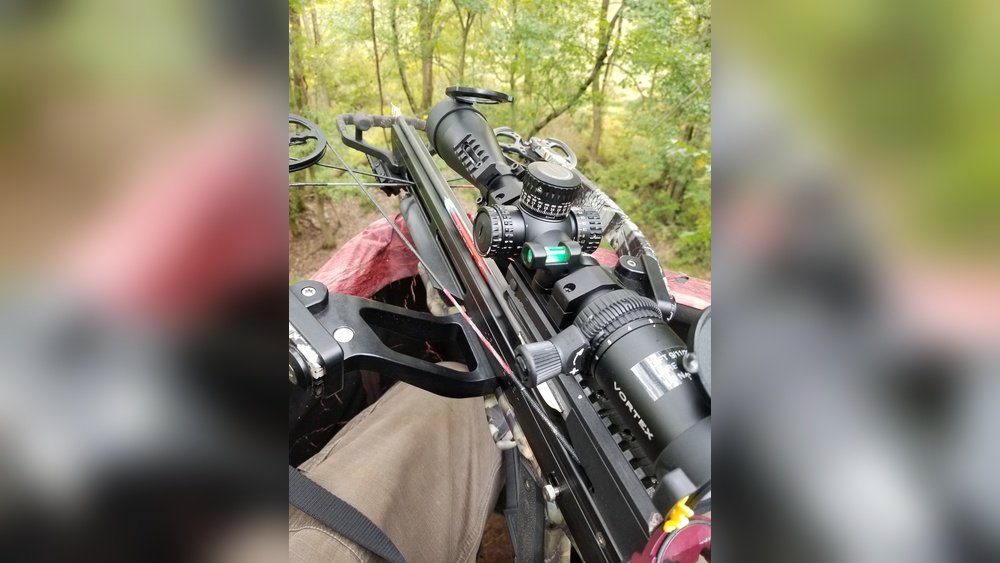
The short answer is yes, you can physically mount a rifle scope on many modern crossbows, as long as the mounting systems match. Most crossbows today use Picatinny or Weaver rails, which are also common on rifles. If your crossbow has one of these rails, you can attach most rifle scopes to it.
But mounting is just the start. You need to consider whether the scope will actually work well for crossbow shooting. Here’s where things get more complex.

Key Differences Between Rifle Scopes And Crossbow Scopes
Ballistic Compensation
Perhaps the most important difference is ballistic compensation. Rifle scopes are calibrated for bullets with high speeds and flat trajectories. Their reticles (the lines or dots inside the scope) are marked for bullet drop at long distances.
Crossbow scopes, on the other hand, are designed for arrows, which drop much more quickly over short distances. Most modern crossbow scopes have multiple aiming points (like dots or lines) specifically set for 20, 30, 40, and even 50 yards, where arrow drop is significant.
Parallax Settings
Parallax is the way the reticle and the target line up at different ranges. Rifle scopes often have their parallax fixed at 100 yards or more. Crossbow scopes set parallax at much shorter ranges, usually 50 yards or less. Using a rifle scope with the wrong parallax can make aiming less precise at crossbow distances.
Magnification Levels
Rifle scopes often have higher magnification (like 3-9x or even 4-12x), which is helpful for long-range shooting. For crossbows, high magnification isn’t necessary and can even make aiming harder because the field of view becomes very narrow at close distances.
Durability And Recoil
Crossbows produce a different kind of recoil or shock when fired. While rifles create a sharp backward kick, crossbows generate a vibration and a forward jolt. Not all rifle scopes are built to handle this kind of movement, so internal parts may wear out faster.
Technical Compatibility: What To Check Before Mounting
Before you try to install a rifle scope on your crossbow, check these critical details:
- Mounting Rail Type: Is your crossbow rail Picatinny or Weaver? Does the scope’s base fit?
- Eye Relief: Rifle scopes often have longer eye relief (distance from your eye to the scope). Crossbows are usually shot with your face closer, so make sure you can see clearly through the scope.
- Field of View: At close range, you want a wider field of view. Test this before hunting or target shooting.
- Durability: Can the scope’s internals handle the unique crossbow recoil? Check manufacturer recommendations.

How Rifle Scopes Perform On Crossbows: Real-world Experience
Many shooters have tried using rifle scopes on crossbows, with mixed results. Here’s what typically happens:
- Short-Range Accuracy: At 20-30 yards, a rifle scope can work if you adjust your aim for arrow drop. However, you must often “hold over” the target, since the reticle isn’t marked for arrow trajectories.
- Long-Range Issues: As distance increases, the lack of proper ballistic markings makes accurate shooting much harder. You may miss low unless you manually compensate.
- Magnification Trouble: High magnification can make it hard to find and track your target at typical crossbow ranges.
- Durability Concerns: Some rifle scopes lose zero (don’t hold their aim) after repeated crossbow shots.
Here’s a quick comparison of key features:
| Feature | Rifle Scope | Crossbow Scope |
|---|---|---|
| Ballistic Calibration | Bullets (flat trajectory) | Arrows (steep drop) |
| Parallax Setting | 100+ yards | 20–50 yards |
| Magnification | 3-9x or higher | 1.5-5x (usually lower) |
| Reticle Type | Simple crosshair or BDC for bullets | Multiple aim points for arrow drop |
| Recoil Resistance | Backwards (gunpowder recoil) | Forward & vibration (string release) |
When Might A Rifle Scope Work On A Crossbow?
There are certain situations when using a rifle scope on a crossbow is possible:
- Target Practice: If you are shooting at a fixed distance, you can adjust the scope to hit the bullseye at that range. This works best for casual shooting, not hunting.
- Short-Term Solution: If you already have a rifle scope and want to try your crossbow before buying a dedicated scope, it’s an option.
- Budget Constraints: For those who do not want to invest in a new scope right away, a rifle scope can provide a temporary aiming solution.
But for most hunting and serious target use, a crossbow-specific scope will perform better.
Best night vision scopes for hunting
Problems You Might Face
Many beginners overlook problems when using a rifle scope on a crossbow:
- Inaccurate Range Markings: Rifle scopes usually lack the multi-dot or line reticles needed for fast, accurate crossbow shooting at different distances.
- Difficult Adjustments: You may have to guess or estimate holdover at ranges other than your “zeroed” distance.
- Parallax Errors: At short range, parallax issues can make the target appear off-center.
- Reduced Durability: Some scopes lose their zero or even break after repeated crossbow shots.
How to get a sharp image in your rifle scope
How To Make A Rifle Scope Work On A Crossbow
If you decide to try a rifle scope on your crossbow, follow these practical steps:
- Check Mount Compatibility: Make sure the bases fit securely. Loose mounts will ruin your accuracy.
- Zero the Scope: Set your scope so the arrow hits the target at your most common shooting distance (often 20 or 30 yards).
- Test for Durability: Fire several shots and check if the scope holds its zero.
- Use Low Magnification: Start with 3x or less to keep a good field of view.
- Mark Your Own Holdovers: Use stickers or colored markers to create your own reference points on the reticle for common crossbow distances.
Here’s a quick guide to common scope mounting rail types:
| Rail Type | Description | Common On |
|---|---|---|
| Picatinny | Wide, with consistent spacing | Modern rifles, crossbows |
| Weaver | Narrower slots, less universal | Older rifles, some crossbows |
| Dovetail | Thin, rail-like groove | Some airguns, budget crossbows |
Is It Worth Using A Rifle Scope On A Crossbow?
For most users, the answer is no if you want the best results. While you can make a rifle scope work, you will not get the accuracy, speed, or confidence that a crossbow scope gives. Crossbow scopes are affordable and designed for the unique needs of crossbow shooters.
However, if you are experimenting, on a budget, or just practicing at a fixed range, a rifle scope can work until you are ready to upgrade.
What Makes A Good Crossbow Scope?
If you want to upgrade from a rifle scope, here’s what to look for in a crossbow scope:
- Multiple Aim Points: Look for scopes with 3-5 dots or lines for different distances.
- Short Parallax Distance: Scopes set for 20-50 yards will be more accurate.
- Low to Medium Magnification: 1.5x to 4x is ideal for crossbow ranges.
- Durable Construction: Built to handle crossbow vibration and shock.
- Illuminated Reticle: Helpful for low-light hunting situations.
Here’s a side-by-side look at scope features to consider:
| Feature | Important for Crossbows? |
|---|---|
| Multi-Distance Reticle | Essential |
| High Magnification | Not needed |
| Short Parallax | Very helpful |
| Shockproof Design | Yes |
| Lightweight | Preferred |
Two Surprising Insights Most Beginners Miss
- Reticle Calibration Matters More Than You Think: Many new crossbow shooters do not realize how quickly arrows drop compared to bullets. Having the right reticle for your arrow speed and weight is key to hitting targets consistently.
- Scope Durability Isn’t Just About Strength: Crossbow recoil is different from rifles, with more vibration and forward movement. Some high-end rifle scopes can still fail on a crossbow, while even budget crossbow scopes often last longer.
Final Thoughts
Mounting a rifle scope on a crossbow is possible, but it’s often not the best choice for accuracy or reliability. For casual use and practice, it can work with the right adjustments. However, a true crossbow scope is designed for the unique needs of crossbow shooting—shorter ranges, faster arrow drop, and different recoil. If you want the best results, especially for hunting or competition, investing in a crossbow-specific scope will make a big difference. For more on the physics of projectile drop and scope types.
What does AO stand for on a scope
Frequently Asked Questions
Can You Use Any Rifle Scope On A Crossbow?
You can use many rifle scopes on a crossbow if the mounting rail fits, but it is not always practical. Rifle scopes are not designed for the short range and quick arrow drop of crossbows, so aiming can be less accurate.
What Problems Might I Face Using A Rifle Scope On A Crossbow?
Common problems include incorrect range markings, parallax errors, high magnification making aiming harder, and durability issues because rifle scopes are not always built for crossbow recoil.
Is A Crossbow Scope Really Necessary?
A crossbow scope is not absolutely required, but it is highly recommended for hunting and serious target shooting. Crossbow scopes are made for the unique needs of crossbows, making aiming faster and more accurate.
Can I Damage My Rifle Scope By Using It On A Crossbow?
Yes, it is possible. Crossbow recoil is different from rifle recoil, with more forward motion and vibration. Some rifle scopes can lose their zero or even break if not designed for this kind of shock.
What Is The Main Difference Between A Crossbow Scope And A Rifle Scope?
The main difference is ballistic calibration. Crossbow scopes have reticles for quick arrow drop over short distances, while rifle scopes are set up for flat-shooting bullets at much longer ranges. Parallax and magnification are also set differently.

Leave a Reply