Bore sighting a scope with a laser is one of the best ways to save time, money, and frustration at the shooting range. When you align your rifle’s sights with the barrel before firing a single shot, you get on paper faster, avoid wasting ammunition, and make fine adjustments much easier.
While the process sounds technical, it’s quite simple when you follow clear steps. This guide will explain everything you need to know about how to bore sight a scope with a laser, why it matters, common mistakes, and expert tips for better accuracy.
Table of Contents
What Is Laser Bore Sighting?
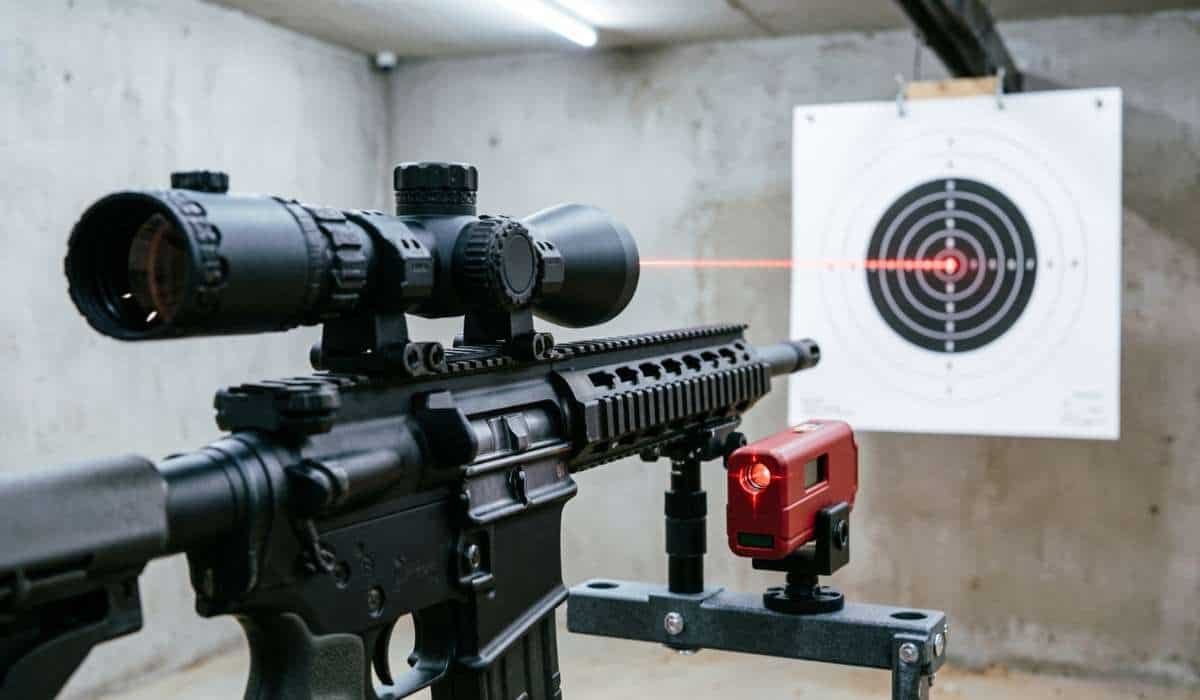
Laser bore sighting uses a laser device to project a visible dot along the rifle’s bore axis. This dot shows exactly where the barrel is pointed. By adjusting your scope’s reticle to match the laser, you make sure the rifle is nearly zeroed before you fire any rounds.
This method is much faster and more precise than traditional methods like “eyeballing” through the barrel.
There are two main types of laser bore sighters:
- Chamber-inserted: Shaped like a cartridge, placed in the chamber.
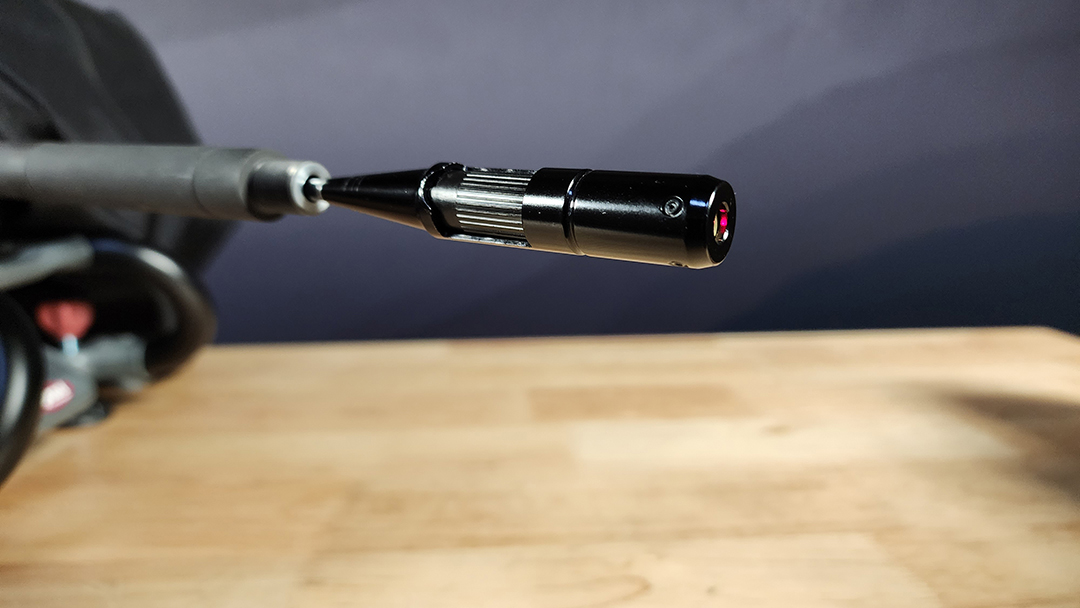
- Muzzle-inserted: Inserted into the barrel’s muzzle, often using a set of adapters.
Both types work well, but there are some differences in accuracy and ease of use, which we’ll compare later.
Why Bore Sighting With A Laser Matters
Every rifle is unique. Even small differences in scope mounts, rings, or barrel alignment can throw off your zero. If your scope is not roughly aligned, you might not even hit the target at 25 yards. This is why bore sighting is essential, especially if you have:
- Mounted a new scope
- Changed mounts or rings
- Switched barrels or actions
- Bought a new rifle
Laser bore sighting is especially helpful for beginners. It gives you a visible reference point, which is much less confusing than trying to “guess” at the range.

Tools And Items You Need
Before you start, gather these items:
- Laser bore sighter (chamber or muzzle type)
- Batteries for the laser
- Your rifle (unloaded, bolt open)
- The scope you want to zero
- A stable gun rest or sandbags
- A paper target or a large blank surface at 25 yards
- Screwdriver or tool for scope adjustments
- Good lighting (indoors or outdoors)
- Safety glasses
It’s also smart to keep a notebook or phone handy for recording adjustments or notes.
Safety First
Before any work on your firearm, always:
- Double-check that the rifle is unloaded. Remove the magazine and open the action.
- Point the muzzle in a safe direction at all times.
- Wear eye protection.
- Never insert a live round during this process.
Many accidents happen because of simple mistakes. Taking one extra minute to check can prevent serious injury.
Step-by-step: How To Bore Sight A Scope With A Laser
1. Set Up Your Workspace
Find a well-lit area with enough room to set a target 25 yards away. Indoors is fine if you have a long hallway or garage. Make sure you have a stable shooting bipod, bench or table.
2. Secure The Rifle
Place the rifle on a gun rest, shooting bags, or a sturdy surface. Stability is key. Even a small movement can affect alignment.
3. Install The Laser Bore Sighter
- For chamber-inserted models, choose the correct caliber laser, insert it into the chamber, and close the action (without force).
- For muzzle-inserted models, pick the right adapter, insert the laser into the barrel, and tighten gently.
Make sure the laser is projecting a clear dot on the target area 25 yards away. Replace batteries if the dot is dim.
4. Turn On The Laser
Switch on the laser bore sighter. You should see a bright red or green dot on your target. If not, check alignment and battery.
5. Align The Scope
Look through your scope without touching the rifle. Use the scope’s windage (left/right) and elevation (up/down) turrets to move the reticle until it sits exactly over the laser dot.
This part takes patience. Make small adjustments and recheck after each turn. Remember, some scopes “click” with each adjustment, while others are smooth.
6. Double-check Alignment
After you match the reticle to the laser dot, look away and check again. Sometimes your eye can trick you if you stare too long. If everything lines up, you are ready for live-fire zeroing.
7. Remove The Laser Device
Turn off the laser and carefully remove it from the barrel or chamber. Never leave the device in while firing.
8. Final Zero At The Range
Take your rifle to the range. Start at 25 yards, fire a 3-shot group, and adjust your scope as needed. Most rifles will be within a few inches of center. Move out to 100 yards for final zeroing.
Chamber Vs. Muzzle Laser Bore Sighters: Which Is Better?
Both types of laser bore sighters have strengths and weaknesses. Here’s a quick comparison to help you choose:
| Feature | Chamber-Inserted | Muzzle-Inserted |
|---|---|---|
| Accuracy | Very high, aligns with chamber | Good, but depends on muzzle fit |
| Ease of Use | Simple, fits like a cartridge | Needs adapters for barrel size |
| Versatility | One caliber only | Works with many calibers |
| Cost | Usually more expensive | More affordable |
Practical tip: If you own several rifles in different calibers, a muzzle-inserted laser is more versatile. For the best precision on one rifle, a chamber model is ideal.
Common Mistakes To Avoid
Even experienced shooters make errors while bore sighting. Watch for these:
- Not securing the rifle firmly. Movement causes misalignment.
- Forgetting to remove the bore sighter before firing. This can damage the gun and the device.
- Skipping live-fire zeroing. Laser bore sighting gets you close, but not perfect.
- Using a poor-quality laser sighter. Cheap models may not project straight.
- Failing to check scope mount tightness. Loose screws ruin accuracy.
Non-obvious insight: Some shooters try to bore sight at 100 yards. This is often too far for the laser dot to be visible, especially in daylight. Stick to 25 yards for best results.
How Accurate Is Laser Bore Sighting?
Laser bore sighting will get you “on paper” at 25 yards, usually within 2-4 inches of center. It is not a replacement for live-fire zeroing. Many factors, such as barrel harmonics and bullet type, affect the final point of impact.
Here’s an idea of what to expect:
| Step | Expected Accuracy |
|---|---|
| After laser bore sighting | Within 2-4” at 25 yards |
| After first 3 shots (with scope adjusted) | Within 1” of center at 25 yards |
| Final zero at 100 yards | On target, with minor tweaks |
Laser bore sighting saves you up to 10 rounds of ammo per rifle setup, which can be a big cost and time saver.

Practical Tips For Better Results
- Use a large, plain target at 25 yards. Even a cardboard box with a taped bullseye works.
- Do bore sighting indoors with dimmed lights if possible. The laser is easier to see.
- Record your turret adjustments. This helps track changes and diagnose issues later.
- If your scope has parallax adjustment, set it to 25 yards during bore sighting.
- Clean your barrel before starting. Dirt can block the laser or affect its path.
- If you struggle to see the laser dot, try a green laser bore sighter, which is brighter than red.
Expert tip: After bore sighting, check your scope’s eye relief and reticle focus. These small comfort tweaks pay off during actual shooting.
Troubleshooting: When Things Don’t Line Up
Sometimes, the reticle won’t match the laser dot, even with full turret adjustment. This can happen if:
- The scope rings are too high or low.
- The mount is not level.
- The scope is not centered in its adjustment range.
In these cases, you may need to:
- Shim the scope mount (very thin material under the rings).
- Loosen and reposition the scope.
- Check for bent or damaged parts.
If you still can’t align, consult a gunsmith. For more on scope mounting best practices, see this Riflescope guide.
Frequently Asked Questions
What Distance Should I Use For Laser Bore Sighting?
Start at 25 yards. This distance is ideal because the laser dot is bright and easy to see, and most rifles will be close to zero at this range. After bore sighting, move to your preferred shooting distance for fine-tuning.
Can I Skip Live-fire Zeroing After Using A Laser Bore Sighter?
No. Laser bore sighting gets you close, but live ammo is needed for final adjustments. Factors like bullet weight, barrel vibration, and environmental conditions affect the real point of impact.
Will A Laser Bore Sighter Work In Daylight?
Laser dots are hard to see in bright sunlight, especially beyond 25 yards. Use the laser indoors or in shade for best results, or choose a green laser model, which is brighter than red.
Is A Chamber Or Muzzle Laser Bore Sighter Better?
For single-caliber precision, a chamber-inserted model is best. If you want versatility for multiple calibers, a muzzle-inserted sighter is more flexible and cost-effective.
How Often Should I Bore Sight My Scope?
Bore sight your scope any time you mount a new optic, change mounts/rings, or notice your zero is off. It’s also smart to check after rough handling or long-term storage.
Lastly
Zeroing your rifle doesn’t have to be a guessing game. Laser bore sighting is a simple, affordable way to get on paper fast and start shooting with confidence. Just remember: bore sighting is the first step—always finish with live-fire adjustments for true accuracy. With the right tools and careful setup, you’ll spend less time adjusting and more time hitting your target.

Leave a Reply